 A Nation Must Think Before it Acts
China’s Political Warfare: Challenges to Taiwan and the United States in Latin America
A Nation Must Think Before it Acts
China’s Political Warfare: Challenges to Taiwan and the United States in Latin America

A nation must think before it acts.
China’s Political Warfare: Challenges to Taiwan and the United States in Latin America
Throughout Latin America, China is engaging in a unique form of political warfare—employing, per FPRI’s definition, “elements of national power including cyber, economic, financial, informational, paramilitary, and political statecraft tools short of declared war… to achieve political goals.” While building soft power through economic exchanges, Beijing has also advanced political goals in the region through overt and covert activities. These goals can be generally classified into isolating Taiwan diplomatically and challenging US interests in the Western Hemisphere.
From the US-Mexico border to the Strait of Magellan, the United States has long been the most influential external actor in Latin America. With irregular migration flows, organized crime networks, and critical supply chains crossing borders within a shared hemisphere, it remains critical for the United States to ensure security and prosperity throughout the Americas. For this reason, the second Trump administration has prioritized the Western Hemisphere in both the new National Security Strategy and National Defense Strategy.
Recently, however, China has emerged to challenge US primacy, becoming an economic and geopolitical force that neither the United States nor Latin American governments can ignore. In a region struggling to overcome poverty and underdevelopment, few Latin American political leaders have proved willing to resist Beijing’s offerings, even when facing Washington’s opposition.
But there is another, overlooked side of China’s engagement with Latin America that explains Washington’s concerns with its activity in the region. While showing notable developmental generosity, China has also exacerbated transnational crises threatening the region. Beijing has for decades pressured governments to sever diplomatic relations with Taiwan. While the United States and Latin American democracies have pressured autocracies to democratize, China has provided diplomatic cover and financial insulation to repressive regimes pushing millions to emigrate. Furthermore, China has contributed to organized criminal enterprises, especially illegal fishing and fentanyl trafficking. Directly concerning the United States, China has developed military-to-military ties across the region and built state-linked infrastructure at strategic chokepoints, including espionage facilities in Cuba within 100 miles from US territory.
This panoply of strategic threats to US national security within its own hemisphere necessitates sophisticated, multifaceted policy that recognizes Latin American nations’ inevitable economic pull towards China but halts Beijing’s political activities that undermine hemispheric stability and security.
Coercing Taiwan in Latin America
China’s engagement with Latin America is inherently political. As the cornerstone of Chinese foreign policy, Beijing’s One China Principle has forced every country to hold diplomatic relations with China or Taiwan, but not both. While Cuba, Mexico, and most South American nations opened relations with China during the Cold War, Paraguay as well as many Central American and Caribbean countries continued recognizing Taiwan through the 2000s. Those countries have faced intense pressure from China to renounce relations with the island, which Beijing claims is an inalienable part of Chinese territory. In 1996, China vetoed a UN Security Council resolution authorizing peacekeepers in post-conflict Guatemala because the country recognized Taiwan diplomatically. Between 2007 and 2023, Beijing persuaded political leaders in Costa Rica, Panama, El Salvador, the Dominican Republic, Nicaragua, and Honduras to sever ties with Taiwan and establish relations with China—offering stadiums, glass-and-steel buildings, and flashy infrastructure projects in return.
Towards Taiwan’s remaining allies—down to just 7 in the Americas and 12 worldwide—China continues applying economic and political pressure. In 2024, Beijing rejected a Guatemalan agricultural shipment after its president held a virtual meeting with Taiwan’s president. In December that year, Beijing sent an envoy to lobby Paraguayan lawmakers for recognizing China over Taiwan, and Paraguay’s government promptly expelled the Chinese official for interfering in internal affairs. Honduras’ new president has pledged to re-establish relations with Taiwan, surely motivating the Chinese government to attempt to prevent such a move at all costs.
Beijing’s aggressive diplomacy against Taipei in Latin America is not limited to the countries still recognizing Taiwan. When Guyana announced it would establish a Taiwanese trade office, China’s ambassador there met with the Guyanese foreign minister the same day, who promptly cancelled the office. China’s foreign ministry praised Guyana for having “corrected its mistake in a timely manner.” Similarly last November, Colombian legislators visited Taiwan to deepen cultural and commercial ties, and China’s ambassador in Colombia immediately met with Colombia’s foreign minister, who issued a statement denying the possibility of a Colombian trade office in Taipei. In Panama, China’s ambassador was even more aggressive, sending threatening WhatsApp messages to Taipei-bound Panamanian lawmakers and urging them to cancel the upcoming trip. These messages failed to prevent the visit but clarified China’s zero-tolerance policy towards Taiwanese-Latin American diplomacy. As China’s new Policy Paper on Latin America and the Caribbean prioritizes Taiwan’s diplomatic isolation, Beijing is poised to continue its offensive against Taipei in the Americas while heightening military aggression in the Taiwan Strait.
Support to Dictatorships, Contributions to Crime, and Threats to US National Security
China’s political warfare does not only target Taiwan in Latin America. An authoritarian state with a poor human rights record, China has made no distinction between democracies and dictatorships in the Americas. China has embraced repressive regimes in Cuba, Nicaragua, and Venezuela (until Nicolás Maduro’s capture), helping them circumvent US sanctions and diplomatic pressure to democratize. Reciprocating Beijing’s generosity, Nicaragua expelled Taiwan from a multilateral organization in 2023. Venezuela and Cuba’s regimes have also enthusiastically endorsed China’s claims on Taiwan. While Maduro’s recent extradition challenges the future of authoritarianism in Venezuela, Nicaragua, and Cuba, China’s engagement with these regimes has undoubtedly gained it international supporters while weakening rule of law in South America, Central America, and the Caribbean.
Beyond government ties, China has created what experts call a global “Silk Road of crime” that extends deep into the Americas. On Latin American seas, Chinese fishing fleets have been a prime contributor to illegal, unreported, and unregulated (IUU) fishing. Part of Beijing’s state-subsidized Maritime Militia, these boats have arrived in the hundreds near Ecuador, Peru, Chile, Argentina, Uruguay, and Brazil—depleting local fisheries and violating exclusive economic zones. In 2021, Ecuador petitioned China’s government to stop these activities, and issued a public statement with Peru, Colombia, and Chile that condemned the “presence of a great foreign fleet” plundering “our jurisdictional waters.” China’s foreign ministry claims a “zero tolerance” policy, yet these maritime incursions continue. Most critical to US citizen security, China has provided 78 percent of equipment and 84 percent of precursor chemicals to produce fentanyl, which Mexican gangs traffic into US territory and has killed hundreds of thousands of Americans since 2018. In April 2023, Mexico’s president asked Xi Jinping to halt the transport of these materials, but China’s foreign ministry denied responsibility and blamed the United States. China’s denial amounts to complicity in organized crime—Latin America’s greatest source of citizen insecurity today.
China has also deepened military engagement in Latin America. In 2020, five times more Latin American and Caribbean students were enrolled in Chinese military academies than US ones. Major People’s Liberation Army (PLA) commanders have visited Latin American countries, including Maj. Gen. Song Yanchao in Nicaragua in 2023 and the Vice Chair of China’s Central Military Commission in Cuba the following year. Last September’s 12th annual Xiangshan Defense Forum in Beijing hosted over 1,800 participants from over 100 countries, including 18 Latin American nations, where China’s Minister of Defense endorsed building “closer and more resilient” ties with Latin America. These exchanges are poised to continue, with China’s December 2025 policy paper on Latin America and the Caribbean (LAC) pledging to “actively carry out military exchanges and cooperation with LAC countries.”
On December 19, the PLA conducted a wargame simulating simultaneous combat operations in the Taiwan Strait, Sea of Okhotsk, and Caribbean Sea. Broadcasted on Chinese television, the simulation showed blue (Western) forces facing Red (Chinese) units off Mexican and Cuban shores, demonstrating the PLA’s preparation for combat operations in the Western Hemisphere.
Alongside strengthened military capabilities, China has built cyber capabilities in the region. Under its Global Security Initiative, China has constructed more than 35 “Safe City” police centers containing surveillance cameras with facial recognition technology. Huawei—the Chinese Communist Party-tied tech giant banned in the United States since 2022—is a prime source of 5G and other telecommunications equipment for Latin American citizens and governments, despite its track record of espionage usage. Against warnings from Marco Rubio, Mike Pompeo, Jake Sullivan, and many other US officials, Huawei’s revenue in the Americas grew to $4.9 billion in 2024. More acutely, China has built signal intelligence (SIGINT) facilities in Cuba—just 90 miles from a multiagency center for intelligence collection and counternarcotics operations in Key West.
Beyond digital infrastructure, China has emerged as a prime source of traditional infrastructure development in the region since launching the Belt and Road Initiative (BRI) in 2013. Experts have identified 37 port projects tied to Chinese companies across the Americas, including at strategic chokepoints near US territory. Within a state-planned economy, these firms are state-owned and, under China’s 2017 National Security Law, required to support China’s national security interests, which could mean intelligence collection and operational assistance for the PLA. The potential for this infrastructure’s use for civilian and military purposes—termed “dual-use”—greatly concerns US Southern Command, the US military’s combatant command for the region. Particularly concerning projects include a $50 million PLA-linked satellite station in Argentina, a $3.5-billion megaport majority-owned by Chinese shipping giant COSCO in Peru, and two China-connected ports at both ends of the Panama Canal. In the past year, COSCO threatened legal action against the Peruvian government for attempting to limit its ownership of the new megaport, and Beijing warned Panama of a “heavy price” after its supreme court ruled against a China-linked company’s ownership of the canal-adjacent ports. Beijing thus continues to play the “long game” in Latin America, fighting to maintain its influence at strategic locations.
Complicating Competition: China’s Economic Significance to Latin America
A constant stumbling block to US efforts to reduce China’s influence in the Western Hemisphere has been how critical China has become to Latin American economies. Between 2000 and 2020, Chinese-Latin American trade skyrocketed from $12 billion to $315 billion, driven by China’s massive demand for commodities to provide food and fuel for its 1.4 billion population. This commerce reduced poverty significantly and made China the most important trade partner of all major Latin American economies, barring Mexico and Colombia. China’s commercial presence has in many ways replaced that of the United States, which remains the largest trade partner of the region as a whole, but is now second to China in South America as a subregion.
China’s economic importance in Latin America does not only concern commerce. China has also shown generosity towards the region, growing its soft power by donating medical equipment during the COVID-19 pandemic, building Confucius Institutes to study Chinese language and culture, and offering many scholarships for Latin American students to study in China. Beijing has provided thousands of lavish, all-expenses-paid visits to China for Latin American politicians and journalists, who often later advocate for closer ties with China. The United States has tried to compete, founding the International Development Finance Corporation (DFC) in 2018 as a BRI alternative and launching Americas-aimed economic initiatives under both the Trump and Biden administrations, but these efforts have largely failed to move the needle.
Beijing’s economic promises and Washington’s geopolitical concerns have led many in the Global South, including Latin America, to complain, “What we get from China is an airport. What we get from the US is a lecture.” Not helping is America’s long history of armed and covert interventions in the region, which drive large sectors of Latin American societies to distrust US intentions as imperial self-interest and view China’s engagement as altruistic.
So how does Washington overcome this unfavorable outlook?
It is first necessary to acknowledge that America’s options are limited, and that Latin American governments will always design engagement with China as they see fit. The United States will find little to no leverage over governments that reject US strategic concerns or even antagonize the United States—as Cuba and Nicaragua have long done and Venezuela did until Maduro’s removal. On the other hand, the remainder of countries seek to maintain deep political and economic cooperation with the United States, and in the past year, a wave of right-of-center governments has spread across the region, installing governments that have viewed strong ties with Washington as a fundamental foreign policy priority. Some have even showed willingness to limit their engagement with Beijing in order to please Washington. Recognizing who the given political leaders of a country are and their respective receptiveness to US concerns regarding China will give policymakers a much more clear-eyed view on what is possible on a country-by-country basis.
It is also critical to identify and exploit comparative advantages. Despite China becoming the largest trade partner of South American countries, the United States remains the largest investor in Latin America as a whole, as well as the largest export market and a critical source of income from remittances for Mexico and Central American countries. Moreover, these proximal countries face shared challenges in migration, transnational crime, and natural disasters that necessitate intraregional cooperation, giving them many reasons to seek positive relations with Washington. This leverage can be exploited to set redlines on engagement with China, such as encouraging countries to limit engagement with Beijing in non-economic and strategic sectors.
Finally, the United States must develop contingency planning to insulate itself from the most pressing threats. Considering the proximity of Chinese dual-use infrastructure and SIGINT facilities to US territory, Washington must develop defense planning and secure its infrastructure to these threats. Cyber infrastructure needs to be safeguarded from attacks, including automated hacking using artificial intelligence—especially at strategic locations like interagency centers and military bases. US Southern Command must continue and expand bilateral and multilateral exchanges and exercises with partner nations to guarantee interoperability in the event of a China-connected security crisis. Such exercises to ensure the Panama Canal’s security are of utmost importance, as the interoceanic waterway would prove critical in a kinetic conflict requiring rapid deployment of US naval assets to the Indo-Pacific.
Examining the diversity and extent of Chinese actions in Latin America reveals a double political warfare campaign, aimed at ending Taiwan’s international presence and challenging US strategic interests. China continues a diplomatic offensive against Taiwan’s international engagement, applying diplomatic and economic pressure against Latin American governments that approach the island even for purely commercial purposes. While the United States has attempted to weaken and democratize authoritarian regimes in Cuba, Venezuela, and Nicaragua, China has strengthened them with diplomatic and economic support. These regimes, in turn, have supported Beijing’s international ambitions while opposing Washington’s foreign policy. Chinese subsidies to illegal fishing and fentanyl trafficking directly contribute to transnational crime in the Americas, creating a host of problems for the United States and its neighbors throughout the hemisphere. Chinese military activities in the region—spanning diplomatic exchanges, war games, and cyber facilities—all demonstrate a growing challenge to US national security near its shores. As the United States and China engage in great-power competition globally and approach the verge of kinetic conflict, countering China’s political warfare by reducing the strategic threats of Beijing’s engagement with Latin America remains a critical task of policymakers in Washington.
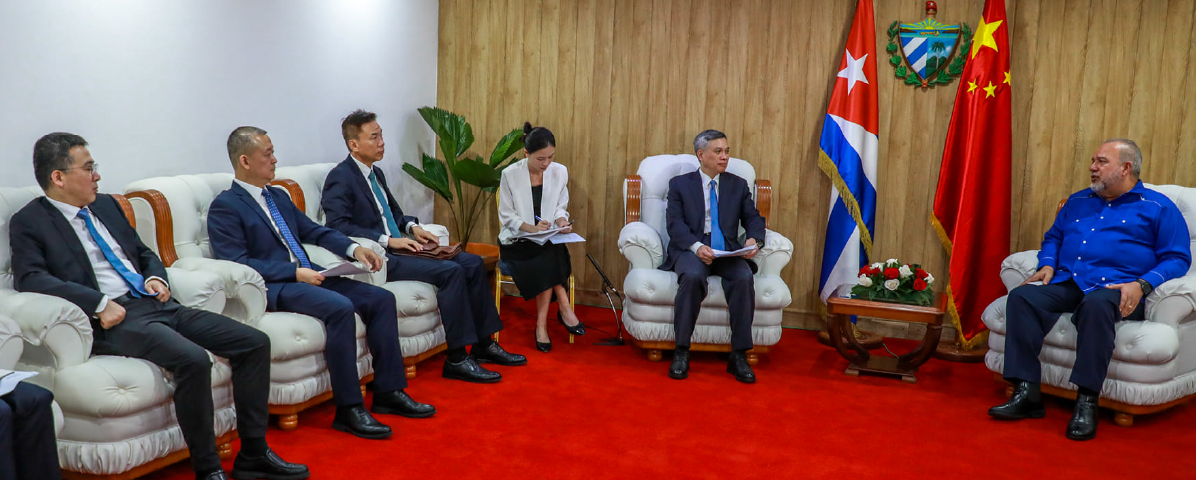
Image: Facebook | Gobierno de Cuba