 A Nation Must Think Before it Acts
The Mine Gap: America Forgot How to Sweep the Sea
A Nation Must Think Before it Acts
The Mine Gap: America Forgot How to Sweep the Sea

A nation must think before it acts.

The Mine Gap: America Forgot How to Sweep the Sea
On the morning of April 14, 1988, the USS Samuel B. Roberts, an Oliver Hazard Perry-class frigate cruising through the Persian Gulf, struck a mine. The explosion tore a hole 15 feet wide in her hull, flooded her engine room, and nearly broke her keel in two. Ten sailors were injured. By some miracle, none were killed. The ship had hit an Iranian M-08 contact mine, a weapon whose design dated all the way back to World War I. America’s response was Operation Praying Mantis, the largest surface naval engagement since World War II. It destroyed or disabled half the operational Iranian Navy in a single day. It was, militarily, a success. But it did not solve the mine problem. Nearly four decades later, the US Navy is confronting that same problem again—with far fewer tools than it once possessed to solve it.
The naval mine is perhaps the most cost-effective weapon in modern arsenals. Sophisticated modern mines can be manufactured for tens of thousands of dollars, or an older design can be dusted off from a stockpile. Whichever type of naval mine you choose, it can be dropped into place from a submarine, a helicopter, or something as small and simple as a speedboat. As well as the potential to destroy warships and commercial vessels, the economic and strategic costs that mines impose by closing shipping lanes are orders of magnitude greater than any cost in producing and deploying them.
Iran understands this calculation very well and has reportedly begun laying mines in the Strait of Hormuz, the narrow chokepoint between Oman and Iran through which roughly one-fifth of all crude oil passes on its way to global markets. The mining is not yet extensive, with only a few dozen mines believed to have been laid so far. But despite American and Israeli efforts, Iran retains almost all of its small boats and its stockpile of naval mines is estimated to number somewhere between 2000 and 6000—a significant proportion of them produced domestically, with others sourced from China and Russia.
US Central Command has responded by striking Iranian minelayers and mine storage facilities, destroying 16 vessels in an initial wave of strikes. President Donald Trump has warned of consequences “at a level never before seen” if mines are not removed. But destroying some of the platforms that lay mines is not the same as clearing mines already in the water. And clearing mines—the painstaking, dangerous, technically demanding process of finding and neutralizing them—is precisely where the US Navy finds itself caught acutely, embarrassingly short.
Thirty Years of Quiet Retreat
The story of how America arrived at this moment is one of institutional neglect, misplaced procurement ambition, and a strategic culture that consistently treated mine warfare as unglamorous, low-priority, and someone else’s problem.
At the height of the Cold War, the US Navy maintained a substantial and capable mine countermeasures (MCM) force. The lessons of World War II, Korea, and Vietnam had not been forgotten. Specialized ships, dedicated MCM helicopters, and trained mine warfare communities existed precisely because the US Navy understood that the ability to keep sea lanes open was fundamental to every other mission it might be asked to perform.
The post-Cold War peace dividend dismantled much of that. Through the 1990s and into the 2000s, the US Navy steadily drew down its dedicated MCM force. The logic was superficially reasonable: The Soviet threat had receded, defense budgets were under pressure, and mine warfare lacked the political constituency that sustains big and flashy capabilities like aircraft carriers and submarines. The Avenger-class MCM ships survived, but only barely. By the time of Operations Desert Shield and Desert Storm, the US Navy’s MCM readiness was already drawing concern. The investment did not follow.
The critical institutional blow came in 2006, when the US Navy dismantled MineWarCom, the Mine Warfare Command that had served as the dedicated advocate, organizer, and operational hub for the mine warfare community. Its responsibilities were distributed across multiple other commands, none of which had mine warfare as a primary mission. In the language of military bureaucratic jargon, mine warfare was “integrated” into the broader surface warfare enterprise. In practice, it was marginalized. The small, specialist community lost its flag-level advocate, its budget champion, and its organizational identity. What had been a dedicated fighting enterprise became a portfolio line in other people’s presentations.
The LCS Gamble That Failed
The US Navy’s plan for replacing its ageing Avenger-class ships was the Littoral Combat Ship (LCS)—a fast, modular, multi-mission vessel that would, in theory, carry a swappable MCM “mission package” to any theater as required. The execution of that concept has been a decade-long catalogue of failure.
The LCS MCM mission module arrived late, over budget, and operationally problematic. The unmanned surface vessels that form the heart of the package have suffered repeated reliability failures in testing. In one incident during operations out of Bahrain, a tow bracket on an unmanned vessel snapped during an MCM exercise, leaving the vehicle drifting and requiring recovery by a separate ship. The sensors have proven ineffective in turbid or shallow waters—precisely the conditions found in the Persian Gulf. Pre-mission preparation for a single MCM sortie requires up to six hours of calibration and maintenance.
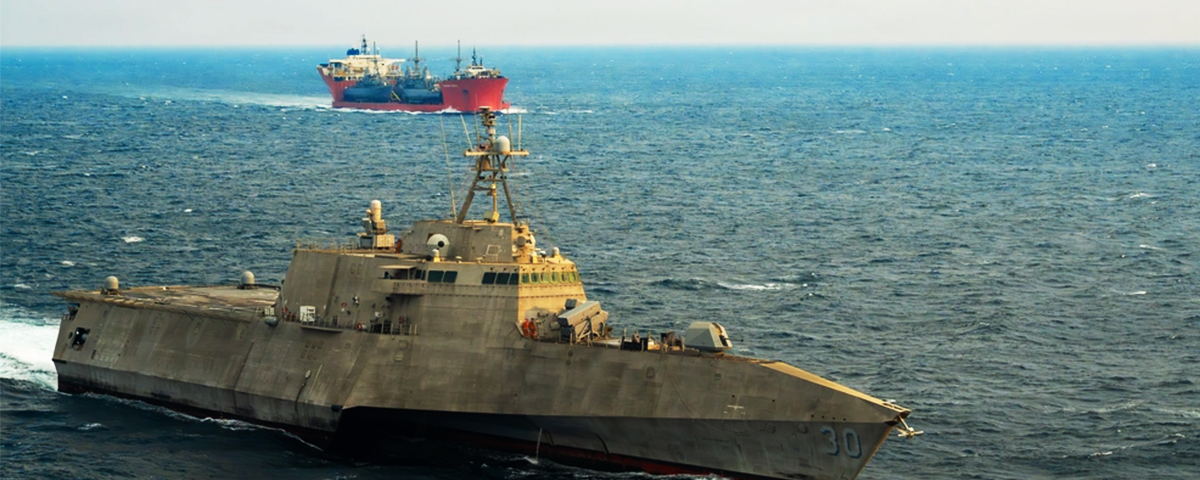
The last four Avenger-class MCM ships in the Middle East—USS Devastator, USS Dextrous, USS Gladiator, and USS Sentry—were decommissioned in Bahrain in September 2025, and ironically arrived in Philadelphia for scrapping the day before reporting surfaced about Iranian minelaying in the Strait of Hormuz. Their replacements, three Independence-class LCS vessels fitted with the MCM package, are now the entirety of the US Navy’s dedicated MCM presence in the Fifth Fleet area of operations. Two of those have now apparently been sent to Malaysia. The remaining four Avengers are committed to the Pacific theater. There is no reserve.
Borrowing from Allies
That the United States has not confronted this capability gap more visibly is, in large part, because it has been able to rely on NATO allies to carry much of the MCM burden—particularly in European waters, where the legacy of two world wars left the seabed littered with ordnance that still requires clearance today.
NATO’s Standing Mine Countermeasures Group 1 has operated continuously since its establishment in 1973, providing a multinational MCM immediate reaction force under Allied Maritime Command. The group is commanded on a rotating basis by allied nations and, although the United States participates, it draws its ships principally from European allies. Belgium and the Netherlands, in particular, have maintained MCM capabilities out of all proportion to their overall fleet size, reflecting their geography and their history. Their joint rMCM program, which delivered its first next-generation mine warfare toolbox to the Belgian Navy in Zeebrugge just this month, represents the most advanced operational MCM capability currently entering NATO service anywhere.
The Franco-British Maritime Mine Countermeasures Programme (MMCP), meanwhile, produced and deployed unmanned surface vessel hunting systems within three years of its launch—a pace of development that the LCS MCM program has entirely failed to match over a timeframe more than three times as long. The US Naval Surface and Mine Warfare Development Center has been sending its mine warfare tactics instructors to be trained at the Naval Academy in Ostend, co-located with the NATO Naval Mine Warfare Centre of Excellence. America’s most capable mine warfare training now happens in Belgium, supported by a program it did not build.
The world’s most powerful navy has thus become a student of capabilities that smaller, less well-resourced allied navies have maintained through the kind of discipline, institutional memory, and strategic seriousness that the US Navy progressively abandoned. The United States, with a defense budget billions of dollars larger than any of these nations, is borrowing expertise in Belgium.
The Hormuz Problem
Iran’s mine-laying capability does not depend exclusively on its numbered fleet, which US and Israeli strikes have largely destroyed. Mines can be deployed from small craft, from midget submarines, and from the rocky coastline provides Iran with miles of cover from which to operate. Even a relatively small number of confirmed mines in the Strait of Hormuz is sufficient to close it to commercial traffic for as long as clearing operations are underway. Insurance underwriters had already scrapped cover for vessels in the Persian Gulf before mine reports emerged. Oil prices have swung by ten dollars a barrel on single intelligence reports. The economic weapon is already working.
The uncomfortable reality is that clearing those mines—even the few dozen currently believed to have been laid—requires precisely the dedicated, patient, methodical MCM capability that the US Navy has spent three decades running down. The LCS mission packages in Bahrain are the available instrument, but only one vessel remains there. The operational limitations are well-documented. The allied navies that might supplement them are not coming to help, despite Trump’s increasingly desperate calls for assistance.
What the Strait of Hormuz crisis has done is convert a long-running analytical concern into an operational emergency. The question of whether the US Navy’s MCM capability is adequate can no longer be deferred. It is being answered in real time, in water that carries a fifth of the world’s oil supply, by an adversary that has thought carefully about how to use a century-old weapon to neutralize the most expensive navy in the world.
The USS Samuel B. Roberts hit her mine in 1988. The United States spent the years since forgetting the lesson. The Strait of Hormuz is teaching it again.
Image: In January 2026, merchant vessel Seaway Hawk sails in the Arabian Gulf while transporting decommissioned US Navy Avenger-class Mine Countermeasures Ships, USS Devastator, USS Dextrous, USS Gladiator, and USS Sentry, escorted by the US Navy Independence-variant littoral combat ship USS Canberra (LCS 30). (US Naval Forces Central Command / US 5th Fleet)