 A Nation Must Think Before it Acts
How War with Iran Undermines Deterrence in the Indo-Pacific
A Nation Must Think Before it Acts
How War with Iran Undermines Deterrence in the Indo-Pacific

A nation must think before it acts.
How War with Iran Undermines Deterrence in the Indo-Pacific
Some argue that the goals of the attacks on Iran are ambitious: to eliminate the Iranian threat, delegate Middle Eastern security to regional partners, and redirect strategic bandwidth to the Indo-Pacific. At the same time, the demonstration of sheer US military power could deter Beijing from taking action regarding its own ambitions for Taiwan. In short, the ultimate goal of the Iran attacks could be seen as part of a broader grand strategy so that the United States can ultimately focus on the Indo-Pacific and the China threat.
Indo-Pacific Focus as Endgame?
If the objective was to free up capacity for the Indo-Pacific by entrusting Middle Eastern security to regional partners, the diplomatic architecture designed for precisely that purpose already existed. The Abraham Accords aimed to normalize relations between Israel and key Arab states and build a regional security framework that could function with diminished American involvement. While the 2023 Israel-Hamas war disrupted further diplomatic normalization, the security cooperation dimension of the accords remained broadly intact. The Iran campaign, paradoxically, has placed even that surviving architecture in jeopardy.
A deeper structural problem, however, undermines the post-Iran optimism. The principal variable binding Israel and Saudi Arabia together is the shared perception of an Iranian threat. No persuasive case has been made that this alignment would survive the removal of that precise threat. Removing a common enemy does not automatically produce durable peace; it can just as easily unleash suppressed rivalries. The expectation that Israel, Saudi Arabia, the United Arab Emirates, and other regional actors would seamlessly assume collective responsibility for Middle Eastern security without American underwriting requires a theory of regional cooperation that has no empirical precedent in the Middle East.
Iran had accumulated substantial quantities of near-weapons-grade uranium but had not entered the final weaponization stage. In fact, Director of National Intelligence Tulsi Gabbard stated before the Senate Intelligence Committee that Iran had shown no effort to reconstitute its enrichment capabilities since Operation Midnight Hammer the previous year. This is a qualitatively different situation from the 1994 North Korean Yongbyon crisis, where Pyongyang was actively producing fissile material and had very likely already secured weapons-grade plutonium.
Another angle to the refocus on the Indo-Pacific argument is that a weakened Iran would disrupt China’s energy supply, given that Iran exports 90 percent of its oil to China.
Yet China is 85 percent energy self-sufficient. Coal remains its primary energy source at approximately 58% of total consumption, and renewable energy installed capacity exceeded thermal capacity for the first time in 2024. Crude oil accounts for less than 20 percent of China’s total energy consumption, meaning that all oil shipments through the Strait of Hormuz represent only about 6.6 percent of China’s overall energy picture (Nomura), of which Iranian crude constitutes a fraction. Beijing has also built substantial insulation against precisely this scenario: as of early March, China held approximately 1.39 billion barrels of oil in strategic reserves, enough to cover 120 days of net crude imports. China’s transportation transformation — EVs, LNG trucking, and high-speed rail expansion — has collectively avoided more than 1.2 million barrels per day of implied oil demand since 2019, and that figure continues to grow.
China can replace lost Iranian volumes by increasing imports from Saudi Arabia, Russia, Brazil, and other suppliers, though at a higher cost that would squeeze margins for independent refineries in Shandong province that relied on discounted Iranian crude. The disruption is economically inconvenient for Beijing, but it is not strategically crippling.
Yet energy security is not what has defined US strategy toward Iran. One expectation from the Trump administration could be to neutralize the Middle Eastern threat before pivoting to Asia. But such a coercive reset was never part of the stated Asia-first playbook, and whether it is achievable remains deeply uncertain. The Iran campaign is a departure from, not an expression of, the strategic framework its architects publicly endorsed.
China’s Gambit
If the United States is successful in defeating a major Middle Eastern power, the question is whether Beijing will think twice before testing Washington over Taiwan. This argument, which assumes that engagement in one theater deters adversaries from acting in another, is a modern iteration of Cold War domino theory. This argument rests on the Domino Theory logic of “reputation for resolve”—the claim that demonstrated willingness to fight in one context credibly signals willingness to fight in others. Yet the evidence suggests that adversaries often assess current capabilities and interests, not past behavior in unrelated theaters. Indeed, Epic Fury’s impact to date should not be underestimated: precision strikes against more than 2,000 targets within 100 hours, the intelligence penetration required to eliminate senior Iranian leadership, and the evident integration of artificial intelligence (AI) into targeting, battle damage assessment, and the compression of kill chains. These are capabilities that any potential adversary would study with intense interest. Beijing and Pyongyang will not be indifferent to what they have observed. The speed and precision of the opening salvos represent a qualitative leap in operational tempo that the People’s Liberation Army’s own planners must now account for.
But this form of deterrence, rooted in demonstrated physical capability rather than political signaling, raises an uncomfortable question: was a large-scale war the only available method to communicate it? Operational capabilities can be showcased through exercises, selective demonstrations, and controlled technological disclosure without expending actual inventory. The United States has historically employed such methods effectively. The problem with demonstrating capability through sustained combat operations is that it simultaneously depletes the material base that makes such capability possible. The AI-enabled targeting systems are impressive, but the Tomahawks, SM-3s, and terminal high-altitude area defense (THAAD) interceptors they direct toward their targets are finite and slow to replace. The campaign that showcased American operational brilliance is also consuming the resources required to replicate that performance against a far more capable adversary.
Iran has actively exploited the cost asymmetry. As of early March, Tehran had launched roughly 585 ballistic missiles and 1,522 drones, exceeding the total volume of the entire Midnight Hammer campaign. The logic is straightforward: cheap drones exhaust expensive interceptors, followed by ballistic missile salvos. A PAC-3 missile segment enhancer interceptor costs approximately $3.9 million; an Iranian Fateh-313 costs less than $500,000.
An ecosystem of 51 prime defense contractors during the Cold War has consolidated into five. The defense workforce has shrunk to roughly a third of its 1985 level of 3.2 million. For some critical systems, supply chains have narrowed to a single vendor: the Stinger missile, used to intercept drones, has only one manufacturer. The Trump administration has proposed raising the fiscal year 2027 defense budget to $1.5 trillion, a 66 percent increase over the prior year. But funding alone cannot overcome the absence of production capacity and skilled labor. Money does not build missiles; factories and workers do.
Those are real risks facing the world’s most populous and economically dynamic region. Bear in mind, too, that Taiwan faces approximately $20 billion in undelivered American weapons orders, including delayed F-16V fighters and national advanced surface-to-air missile air defense systems critical for countering Chinese airpower. Japan confronts roughly one trillion yen in outstanding US defense equipment deliveries. Multiple Patriot batteries have been redeployed from allied nations to the Middle East, along with THAAD interceptors and launchers. The simultaneous removal of both mid-altitude and high-altitude missile defense systems from the Western Pacific weakens the layered defense architecture in a region where North Korean and Chinese missile threats are intensifying, not receding.
For key US allies, including South Korea and Japan, the focus is on the pragmatic presence of the United States that goes beyond rhetoric. The relevant metric is not the political symbolism of American resolve in the Persian Gulf; it is the number of interceptors available to defend their airspace. It is no coincidence that Japanese Prime Minister Takaichi Sanae subtly noted that “the security environment in the Indo-Pacific, as well as the Middle East, is extremely grave” in her meeting with President Trump on March 19.
What Lies Ahead
There is a plausible long-term scenario in which depletion forces the very military-industrial mobilization that Asia-first strategists have long advocated but never achieved through peacetime policy alone. But such mobilization takes years. Scaling THAAD production will not yield meaningful inventory until 2027 or 2028 at the latest.
The United States may now be accepting severe near-term risk in the Indo-Pacific in exchange for a potential long-term payoff: the elimination of the Iranian threat, a forced rearmament cycle, and the eventual consolidation of strategic focus on China.
Whether this gamble succeeds depends on the duration of the campaign, the administration’s ability to resist mission creep, the speed of defense industrial mobilization, and, most critically, whether Beijing judges the current window of American overextension as a moment of opportunity.
What reassures allies and deters adversaries is not the spectacle of distant bombardment. It is the tangible presence of military capability where it is needed most. The challenge for the United States is ensuring that the physical means of deterrence remain credible in the Indo-Pacific while they are being expended at an alarming rate thousands of miles away.
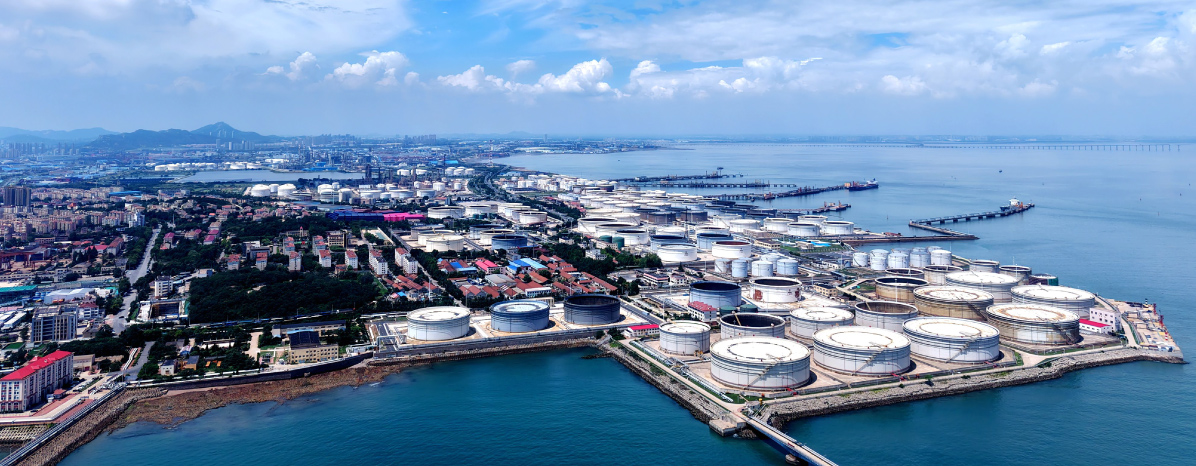
Image: A group of oil tanks stores imported crude oil at Qingdao Port Crude Oil Terminal in Qingdao City, Shandong Province, China, on August 10, 2025. (Photo by Costfoto/NurPhoto)