 A Nation Must Think Before it Acts
House of GUGI: A Historical Imagery Analysis of Olenya Guba
A Nation Must Think Before it Acts
House of GUGI: A Historical Imagery Analysis of Olenya Guba

A nation must think before it acts.

House of GUGI: A Historical Imagery Analysis of Olenya Guba
Introduction
In April, the UK Minister of Defence, John Healey, gave a speech calling out Russian military activities near sensitive underwater cables and pipelines in and around British waters. He said that, in partnership with Norway and other allies, British forces tracked an Akula-class attack submarine, two special mission submarines, and the research/spy ship Yantar operating near critical undersea infrastructure. Reporting suggests UK forces believe the Akula was acting as a distraction for the special mission submarines, which were “conducting nefarious activity over critical undersea infrastructure elsewhere.” Last week, some additional details about the “nefarious” Russian activity emerged. Reuters reported the United States had assisted in driving off the Russian special mission submarines, which were conducting a clandestine operation involving a “secret weapon designed to disable critical undersea cables without leaving any fingerprints.” While additional details on the nature of the weapon have not been forthcoming, it’s worth looking at the organization behind the operation in more detail.
The special mission submarines and Yantar belong to the Main Directorate for Deep Sea-Research (Glavnoye Upravlenie Glubokovodnikh Issledovanii), more commonly known by their Russian-language acronym GUGI. As implied by the name, GUGI is involved in deep-sea research activities such as oceanographic mapping, undersea salvage, submarine rescue operations, and various seabed warfare activities. Founded in the early 1960s, GUGI now has a fleet of surface vessels for “research” purposes and a number of special mission submarines capable of diving to extreme depths. Other special mission submarines include “mothership” subs, which ferry the smaller vessels between their base and the operations area. This small element of the Russian sub-surface force has drawn lots of attention in recent years. Incidents of seabed warfare such as undersea cable sabotage and mapping undersea infrastructure have become regular parts of the hybrid conflict between Russia and NATO since the full-scale invasion of Ukraine. Relatively little is known about GUGI compared to the rest of the Russian submarine fleet. However, it is well known that GUGI, like much of the submarine force, operates out of the Kola Peninsula.
Unlike the rest of the Russian North Fleet submarines, which generally sail from Gadzhiyevo and Polyarny, GUGI submarines mainly call Olenya Guba home. An analysis of available historical overhead imagery of Olenya Guba suggests some interesting details about the trajectory of GUGI, demonstrating the increased importance of seabed warfare for the Russians since the mid-1980s. Ultimately, the images make clear that at some point near the end of the Cold War the facilities at Olenya Guba were turned over to GUGI and seabed warfare became a focus for the Russian Navy in the high north.
I surveyed available digitized, declassified aerial reconnaissance photos of Olenya Guba until the end of declassification in the late 1980s (many of these images have not been digitized yet, so if anyone is interested in funding a digitization effort, let me know). After the period of declassification, I used images from the French Centre Nationale d’Études Spatiales, specifically SPOT, to fill the gap until modern commercial satellite imagery became available.
The appearance of several structures closely associated with GUGI special mission submarines in the early 1990s presents the earliest hard evidence of GUGI activity at Olenya Guba. That activity has continued through the present, when GUGI vessels are engaged in hybrid warfare activities against NATO on the seabed. The continuing nature of GUGI activity at Olenya Guba after the collapse of the Soviet Union and through the financial constraints of the 1990s and 2000s suggests the enduring importance the Russian military has attributed to seabed warfare.
Olenya Guba and the First Cold War
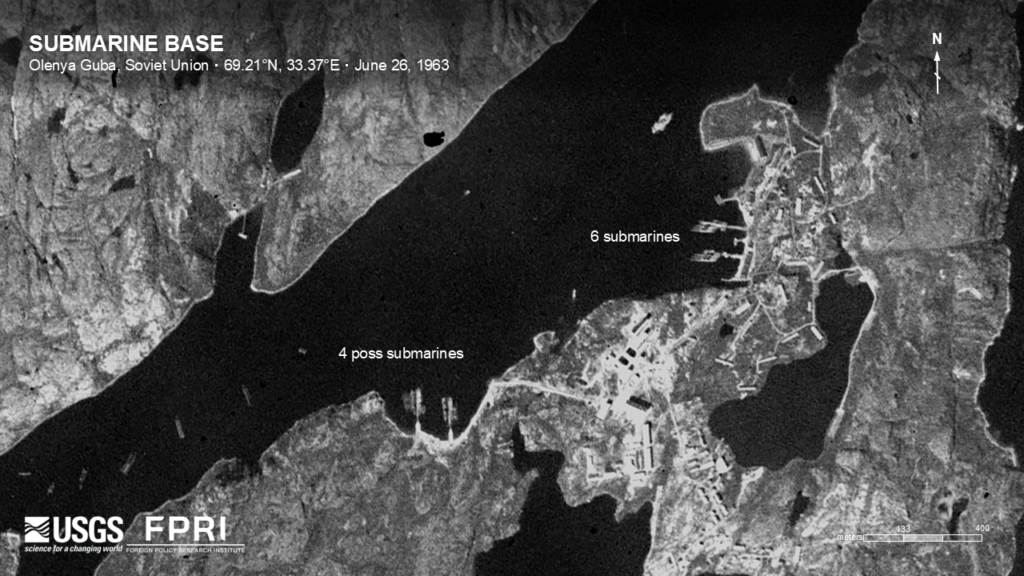
In the early 1960s, overhead reconnaissance photographs captured by the US intelligence community provided insight into the state of Soviet subsurface forces on the Kola Peninsula. A Corona satellite likely took this image, given the resolution of the image and the prohibition on aerial overflight of the Soviet Union after the U-2 shootdown in 1960. Memos from the National Photographic Interpretation Center (NPIC) identified that six submarines and four “possible submarines” were visible at Olenya Guba in the summer of 1963. The poor resolution of the satellite imagery, while state of the art at the time, made it difficult to discern what the naval vessels were. However, it was clear from the imagery that Olenya Guba was some sort of submarine base.
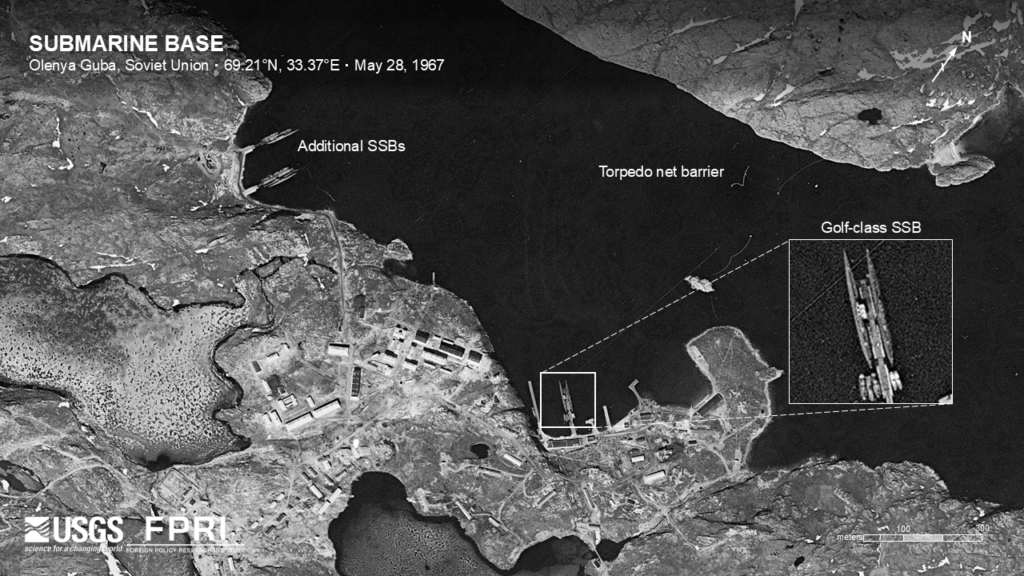
By the late 1960s, the satellite imagery, and consequently the purpose of the submarine base at Olenya Guba, was much clearer. A number of Golf- or Hotel-class ballistic missile submarines (SSB) can be seen at the piers, with their distinctive, large sails that housed the missile compartments.
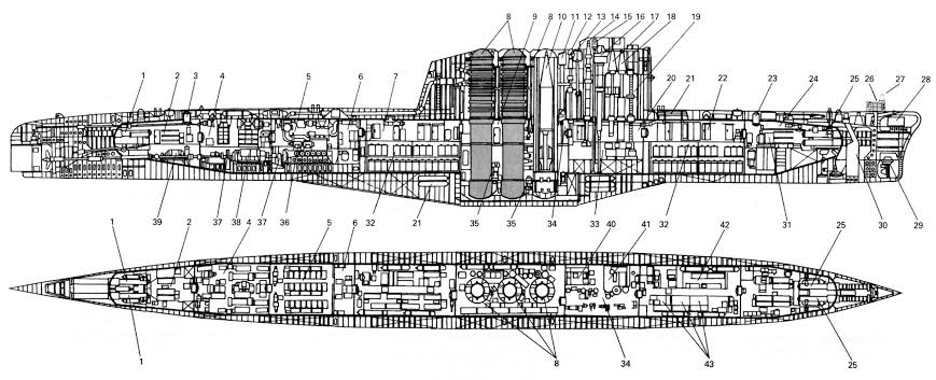
A diagram displaying the Golf-class SSB with its missile tubes housed in the sail
One of the Golfs even has the lid on its missile compartment open, perhaps for maintenance or loading/unloading operations. This assessment is corroborated by another NPIC report of a KH-4 mission running from mid-June to early July 1967. The satellite image above may even have been captured by that mission. If that was the case, given the resolution of the image it must have been a KH-4A or KH-4B that had improved on the roughly 7.5m resolution of the older Corona’s, as seen in the image from 1963. Analysis of photographs collected during that mission reports that several “G-SSB” and some unidentified surface vessels were seen at Olenya Guba. It also notes there was no new construction, changes in facilities, or unreported features. That seems to be the case for the infrastructure visible in the 1963 and 1967 images, where very little has changed and the naval facilities had not been expanded.
By the end of the 1960s, Olenya Guba was a ballistic missile submarine base. However, it was not the most modern facility. The Soviets had started launching the first Yankee-class nuclear-powered ballistic missile submarines (SSBN) in 1966, which were based at Sayda Guba, also known as Gadzhiyevo. Given the rapid modernization of the Soviet submarine fleet and the lack of concomitant change at Olenya Guba, the inlet might have become something of a backwater for the Soviet subsurface forces by the end of the 1960s.
Olenya Guba and the Second Cold War
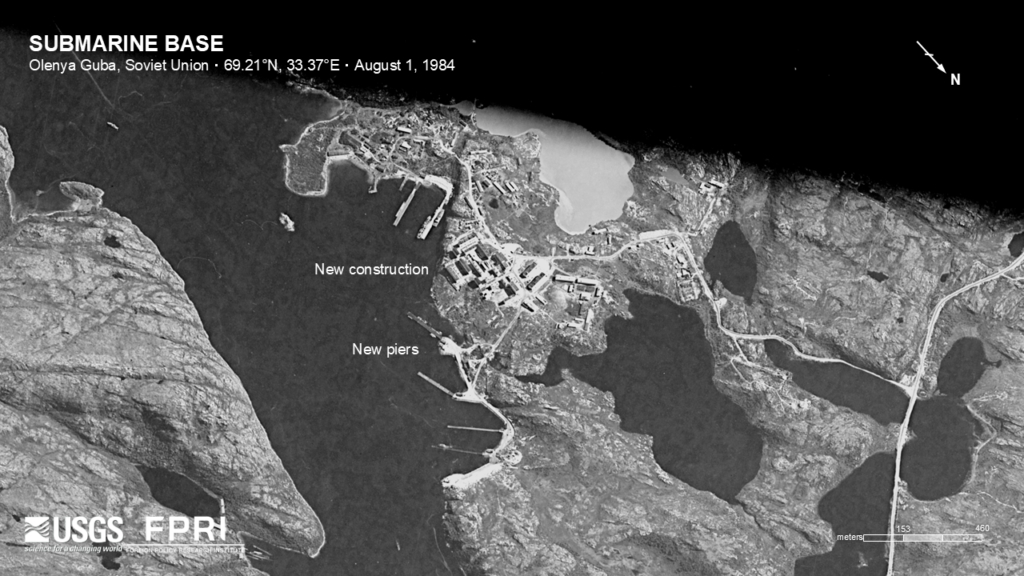
No digitized declassified imagery is available from the 1970s. The next available image is from the summer of 1984, leaving a 17-year gap. New infrastructure had been built in the intervening years. Additional piers were added to increase operational capacity, and supplemental administrative or housing was constructed to support it. However, there is little visible activity. Only two surface vessels are visible in the bay, no submarines. As the SSBs were phased out of the Soviet force and the Soviet navy came to rely on SSBNs, the base may have slipped into irrelevance. The lack of submarines might indicate the purpose of the site had shifted over the course of the period of détente, but it’s equally possible the photo was simply taken at an inopportune moment, when all the underwater vessels were underway.
While no mission report was found in the CIA FOIA archive for this image, the Annual Index of Photo Exploitation Products for 1984 identified that a submarine base and a submarine repair base were located at Olenya Guba at the time. This suggests the inlets primary mission of supporting Soviet subsurface forces was unchanged. Based on the Cold War and contemporary overhead imagery, it seems likely the repair base is in the back of the inlet, while the site we have focused on is the operational base.
GUGI and the End of the Cold War
While the 1970s and early 1980s were a period of stagnation, the base at Olenya Guba appears to have gained a new role with the end of the Cold War.
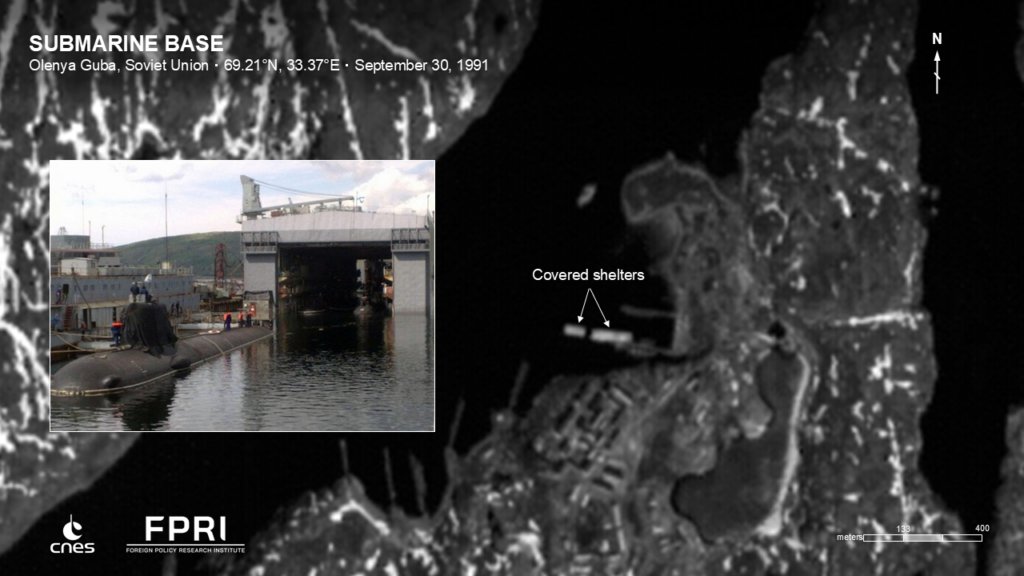
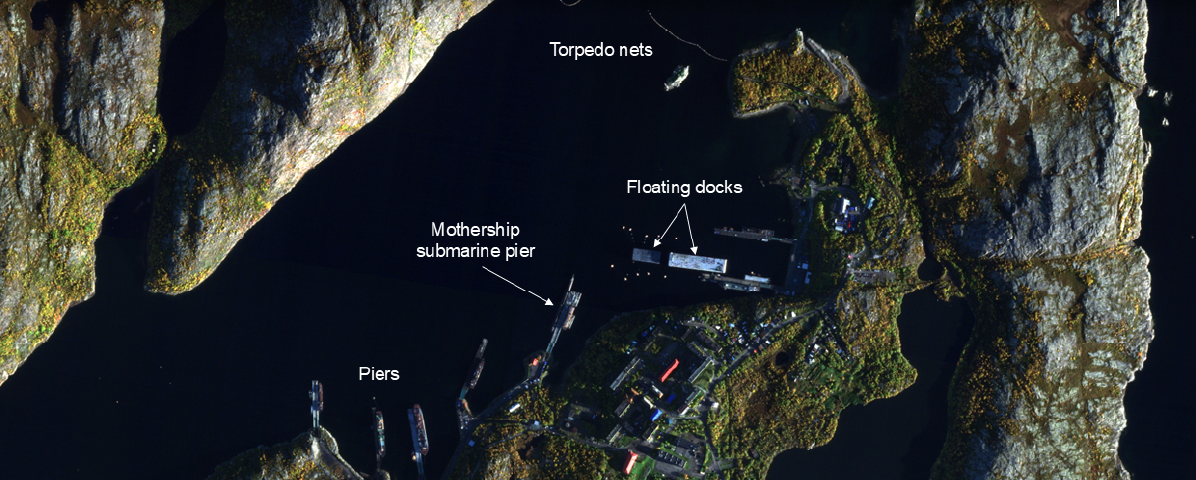
A SPOT image from 1991 showed the Russians had built two new large floating structures at Olenya Guba. These structures are covered shelters to conceal the deep-diving special mission submarines used by GUGI for seabed warfare and other activities from overhead reconnaissance. A ground-truth image shows one of the floating docks along with a GUGI vessel, one of the Project 1910 Uniform-class deep-diving submarines. The image can be geolocated to Olenya Guba.
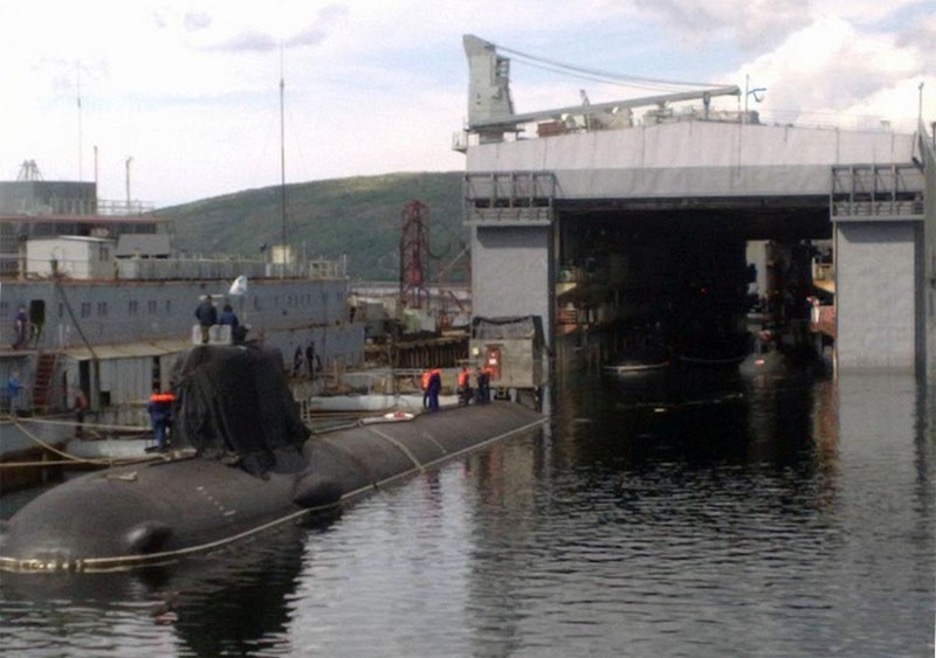
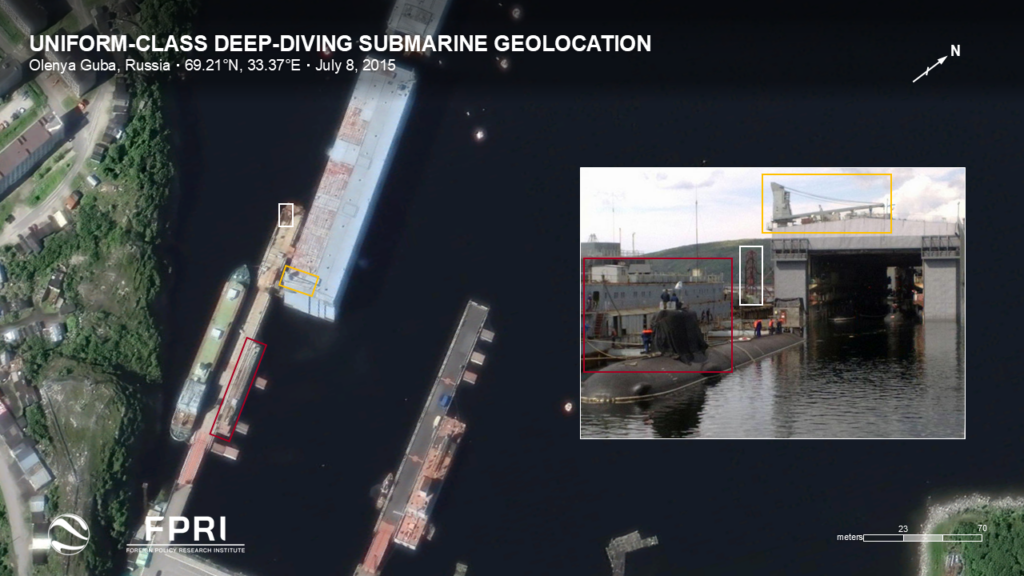
The appearance of these shelters sometime before September 1991 is the clearest indication in available overhead imagery that GUGI was operating from Olenya Guba by the end of the Cold War. While GUGI may have operated out of Olenya Guba before the covered floating dock appeared, the association of GUGI with those shelters and the identification of GUGI vessels in and around the shelters suggests that they were built with GUGI operations in mind. Such shelters are not often seen at Soviet and Russian SSBN bases and the Russians typically leave their SSBNs exposed to overhead reconnaissance today.
The construction and maintenance of the facilities at Olenya Guba during the period of intense economic crisis in Russia after the collapse of the Soviet Union suggests the importance assigned by the Russians to the seabed warfare assets housed at the site. Had GUGI assets been less significant for the Soviet, and then Russian, Navy, one could easily have seen the new facilities at Olenya Guba being torn down, shuttered, or falling into a state of disrepair in the late 1990s and early 2000s. Instead, the new and enduring infrastructure built there around the end of the Cold War indicates that by the early 1990s GUGI had moved significant operations to Olenya Guba, where it still operates from today.
Olenya Guba Today
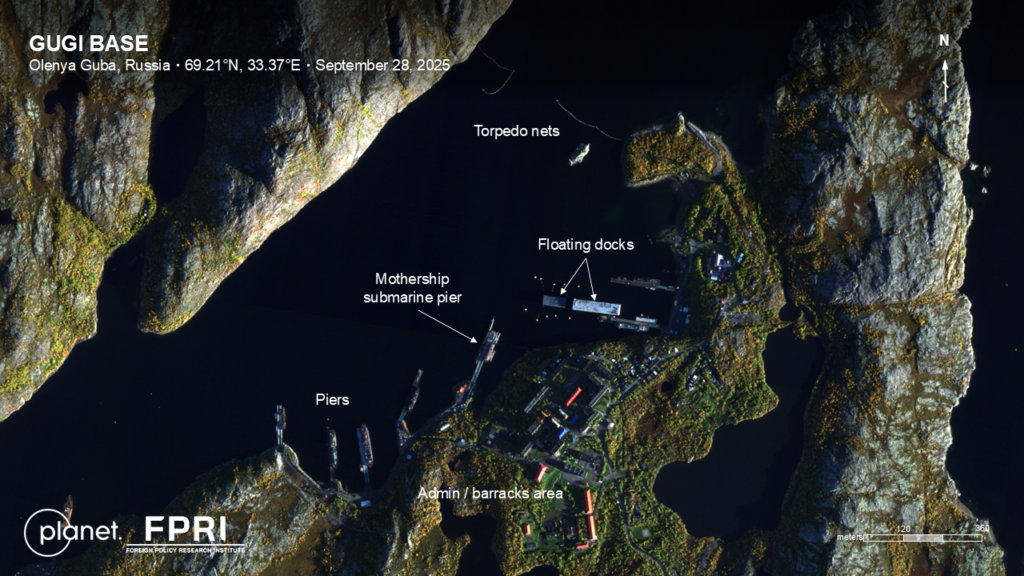
Since the end of the Cold War and the addition of the covered floating docks, very little else has changed at Olenya Guba. There is continuing GUGI-related activity there, and infrastructure has been maintained, but no significant expansions or changes in the facilities have occurred. In the 2010s and early 2020s, a number of buildings in the administrative and housing area were reroofed, underscoring that the site remains occupied and operational, but nothing to indicate the mission the facility supports has changed meaningfully.
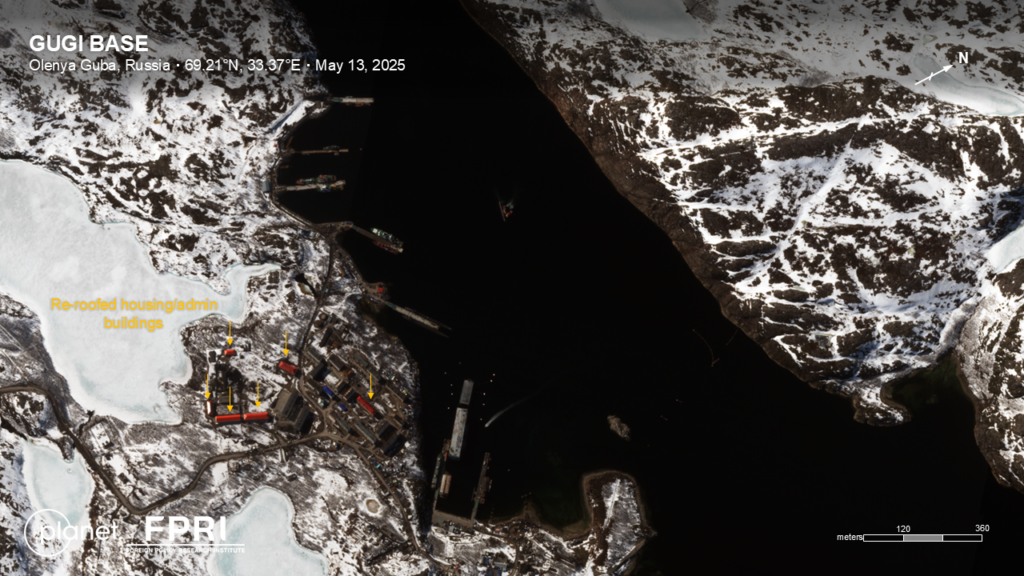
However, while the infrastructure at Olenya Guba has stagnated, the capabilities seen there have grown. The spy ship Yantar is often seen there, along with many of the GUGI mothership submarines like the Project 09787 Delta-IV stretch (Podmoskovye) used for transporting the organization’s deeper divers like the Losharik. Suspected of being able to operate at depths of 1000 meters or greater, Losharik is the newest and most advanced Russian seabed warfare vessel and would likely play an important role in targeting critical undersea infrastructure in a conflict between Russia and NATO.
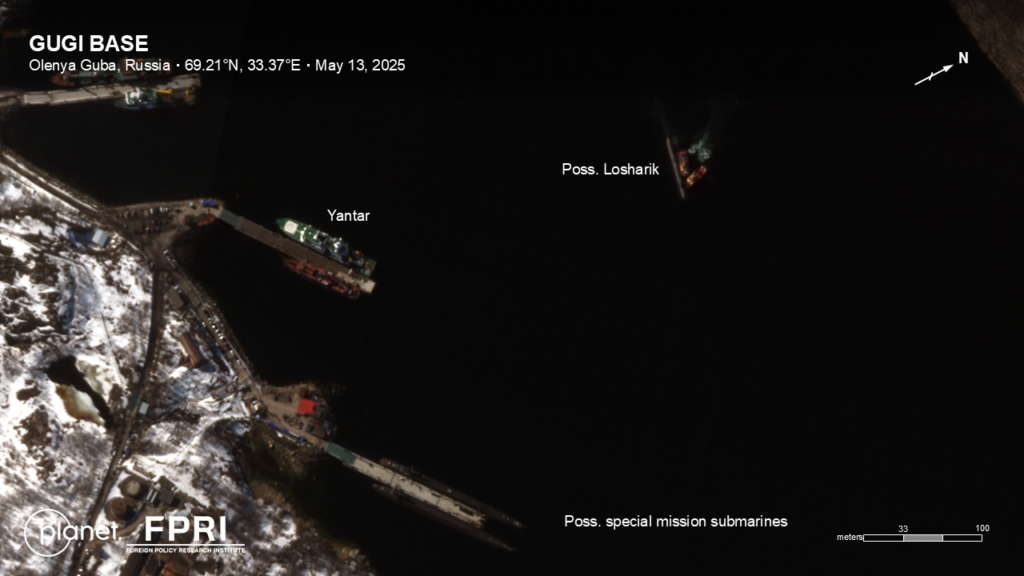
On occasion, those secretive submarines are visible in overhead imagery. An image captured by our friends at Planet Labs last year caught what appears to be two tugboats maneuvering Losharik towards the covered docks. Losharik is reported to be around 70 meters long, the same length as the submarine seen in the Planet image. As Losharik is often not visible in satellite imagery or Olenya Guba, it is safe to assume it is typically housed under the awning of the special covered docks, safe from prying electronic eyes.
Conclusion
Olenya Guba has long been tied to submarine activities. However, sometime during the latter stages of the Cold War, a change in the mission the facility supports occurred. Based on the available imagery, Olenya Guba has been at the heart of Soviet and Russian seabed warfare for at least the past 35 years. Distinctive infrastructure and new capabilities indicate that GUGI has called Olenya Guba home since the early 1990s. As demonstrated by the confrontation this April, undersea competition between Russia and NATO in the Arctic is intensifying, and new Russian weapons are being brought to bear. Given novel Russian tools such as the secret, fingerprint-less cable interference device identified by Reuters, keeping tabs on the organization which employs such weapons and the infrastructure which enables their operations will only become more important. Understanding the long-running nature of GUGI activity at Olenya Guba helps underscore the importance of seabed warfare capabilities and cable interference to the Russian military.