 A Nation Must Think Before it Acts
The War of Endurance: Russia, Ukraine, and the Struggle Behind the Front Lines
A Nation Must Think Before it Acts
The War of Endurance: Russia, Ukraine, and the Struggle Behind the Front Lines

A nation must think before it acts.

The War of Endurance: Russia, Ukraine, and the Struggle Behind the Front Lines
Bottom Line
-
The Russo-Ukrainian War has evolved into a total war, with both sides employing political, economic, and military means to erode the other’s will to fight. Because of the military stalemate in southeastern Ukraine since late 2023, both sides view forcing societies, rather than militaries, to surrender as a possible path to victory.
-
The difference in approaches is that Ukraine focuses on Russian livelihoods by striking war-related economic infrastructure while Russia targets Ukrainian lives, attacking urban areas and civilian infrastructure. Ukraine aims to collapse Russia’s economy, thus eroding support for the war and President Putin. Russia’s goal, by contrast, is to terrorize Ukraine’s population into surrender by striking cities unrelentingly, killing random civilians and making urban areas unlivable, particularly during the winter.
-
Both Russia and Ukraine have political, economic, and military vulnerabilities that the other can target in the pursuit of these goals. The outcome of the war may be determined by how effectively each side exploits the other’s weaknesses while shielding their own. Tactics, weapons, logistics, and other facets of war may factor less in the end than the ability of each society to simply endure.
Introduction
The Russo-Ukrainian War, if dated to Russia’s illegal annexation of Crimea, is the longest running conflict in Europe since the French Revolutionary and Napoleonic Wars (1792-1815). It may come to resemble not just these wars in duration and social destruction, but the Thirty Years War (1618-1648) as well.
One hundred days after Russia’s second invasion of Ukraine on February 24, 2022, this author concluded that, “Russia and Ukraine are locked in a war of attrition, with respective war aims requiring a complete victory for one party and defeat for the other.” Nothing since then has changed that assessment. In wars of attrition, when military operations reach a deadlock, the conflict will move into other areas to try to break it. Therefore, in the past year, this war has evolved from a clash of armies across a broad battlefield into a conflict aimed against Russian and Ukrainian societies with kinetic operations targeting each other’s economies. There are no longer rear lines in this war, as the will and perseverance of each society is now a military objective. For Russia, this also means targeting civilians directly, which is a war crime.
While Ukrainian President Volodymyr Zelensky has signaled a willingness to accept a ceasefire, without relinquishing territory, Russian President Vladimir Putin continues to insist upon maximalist war aims, which would effectively reduce Kyiv to a vassal of Moscow. Many analysts have argued that Putin believes either that Russia is winning this war or, just as importantly, believes that he cannot remain in power without achieving victory. If so, Russia will continue to prosecute this war as long as Putin remains alive and Russians are willing to follow him. On the other side, most Ukrainians recognize the costs of vassalization and are unwilling to pay them, with a recent poll indicating that 61 percent of the population is willing to fight indefinitely. The combination of Ukrainian resistance and battlefield stasis have pointed the war to its current direction, a total war involving the societies of both nations. Moscow and Kyiv acknowledge that ending the war will require either the army, economy, or societal will of their enemy to collapse, rendering them unable to continue.
Both sides now target each other’s societies to achieve this end. The difference is that Ukraine focuses on Russian livelihoods by striking economic targets, while Russia targets Ukrainian lives by attacking urban areas and, at times, even individual civilians as though the war has become a human safari. This deep battle of ballistic missiles, cruise missiles, and drones against cities and economic targets is waged literally over the flight paths of a parallel fusillade of drones, artillery, and tactical rockets along the front lines. These parallel air wars represent a new phase of the war. Despite the conventional wisdom that the Russo-Ukrainian War proves the ascendency of defense over offense, in the air domain shows a different picture of the offensive cheap, easy-to-produce munitions overwhelming the defense of expensive and difficult-to-produce interceptors.
During the winter of 2025-2026, Ukrainian society survived its own Valley Forge of a Russian campaign against its energy infrastructure. It will face a similar “blitz” again this winter. Ukraine has retaliated by attacking Russia’s refineries and retail distribution infrastructure, along with other targets, and time will tell if it repays Moscow in kind by targeting Russia’s equally vulnerable energy infrastructure this winter.
Based on this new reality, what should observers understand about how each side’s ability to absorb these attacks and maintain their war effort? Specifically, what are the weak points found in each society that will come under stress in the next year? This article will examine the political, economic, and military situations of both warring parties, aiming to provide the reader with an understanding of the circumstances now shaping the war and the future of the conflict.
Ukraine
Political. As the summer of 2026 ends, Ukraine is buffeted by political storms over the way the war is being waged and government corruption. There is growing sentiment that, despite martial law, elections need to be held again to address these issues and reaffirm the government’s democratic legitimacy. President Zelensky’s July firing of Defense Minister Mykhaylo Fedorov was a political disaster. Fedorov was respected for taking a new approach to the war, increasing reliance on technology relative to troops, in contrast to the Soviet-style leadership of Army Chief of Staff General Oleksandr Syrskiy. Even Zelensky’s subsequent firing of Syrskiy did not quell the outrage that resulted from Fedorov’s dismissal. Adding to the brouhaha over how the war is being run and who should run it, are regular exposés of Ukrainian government corruption, often entangling figures close to Zelensky.
This has led to calls, most recently by Fedorov, for wartime elections, although Ukraine’s constitution forbids them while martial law is in effect. Those against holding elections point to the constitutional prohibition, the difficulty of holding elections while Russia occupies part of the country, and the opportunity elections would give Moscow to covertly subvert the process, or disrupt it through kinetic and cyberattacks. Those in favor argue that the democratic process in Ukraine must be restarted to determine how the country should proceed with the war and any future peace. The question of elections, heated by disagreements over war and peace and anger at official corruption, will be a major political issue in Ukraine as the war continues.
Economic. Despite Russian occupation of 20 percent of its territory, the loss of additional cities and agricultural land to combat operations, constant attacks against its energy infrastructure, the emigration of 5.9 million citizens, and internal displacement of another 3.7 million, Ukraine’s economy has managed to survive. However, Ukraine’s Gross Domestic Product (GDP) is 20 percent smaller than when the war began, its inflation rate in July was 7.7 percent (as compared to 14.1 percent in July 2025), its workforce has contracted by a quarter (even as unemployment sits at 11 percent), the government has a $27 billion budget deficit, and industry has been hard hit by the war, although its defense industry, including a massive drone-industrial complex essential to the war effort, has expanded ten-fold since 2022.
Ukraine’s greatest economic challenge at the moment is the blockade of the port of Odessa. Recent Russian attacks have cut maritime traffic by 90 percent, preventing the export of major foreign currency earners — iron ore and agricultural products — risking the loss of 10 percent of Ukraine’s GDP as well as the import of raw materials for its steel industry. If the port does not reopen, Ukraine faces an unsustainable trade imbalance that will further increase inflation and its budget deficit.
Foreign assistance has been what has kept the Ukrainian economy in the war. Since 2022, the United States and Europe have provided approximately $400 billion in aid. The European Union and its member states alone have provided $226 billion in financial, military, humanitarian, and refugee assistance. In April 2026, European leaders agreed to an additional loan of $104 billion over the next two years. Ukraine has also received financial support from the International Monetary Fund (IMF) and humanitarian aid from the United Nations. Economically, Ukraine is sustained by foreign aid, which has ameliorated some of the economic realities it faces. If there is a bright spot in Ukraine’s war effort, it is that it can still receive foreign aid and foreign loans. This is something Russia, with its own economic challenges, cannot.
Military. The military situation in Ukraine is complex, with groundbreaking technological advances occurring even as the war becomes increasingly medieval in practice. Readers seeking to follow the war’s daily military aspects should consult the reporting of FPRI Senior Fellow Robert Lee. For the purpose of this overview, Ukraine’s military situation can be condensed into three core issues: Ukraine’s military has stalemated the Russian army, forcing it to suffer heavy casualties for minor tactical gains; it’s forces are hampered by personnel shortages and corruption; and the military is increasingly unable to protect Ukrainian cities due to a shortage of assets able to intercept ballistic missiles.
The ability of Ukraine’s armed forces to stalemate a Russian army over one and a half times its size is a great accomplishment. Ukraine’s use of drones and unmanned ground vehicles to compensate for its smaller size is a true revolution in military affairs. However, it must continue to hold the “fortress belt” towns: Slovyansk, Kramatorsk, Druzhkivka, and Kostyantynivka. These towns occupy slightly higher ground than the rest of the surrounding plains and their urban terrain and water obstacles provide the most defensible ground between Russian forces and their intermediate goals of the administrative borders of Donetsk Oblast and then the Dnepr River. This area is the focal point of both military and diplomatic combat. Russia demands Ukraine surrender this terrain without a fight, which indicates both its importance to Moscow’s future designs in Ukraine and the cost the Kremlin knows it will have to pay to seize it—if it can.
Ukraine’s military prowess is counterbalanced by its inability to mobilize enough troops to break the stalemate and regain the initiative. On two occasions, during their 2022 counterattacks near Kherson and its 2024 offensive into Russia’s Kursk oblast, Ukraine’s army lacked sufficient reserves to turn these initial operational successes into strategic victories. Part of this manpower shortage is due to the government’s unwillingness to mobilize men under 25 years old, due to concerns of long-term demographic consequences for the country’s future. Another factor is war weariness and the reluctance of many men to serve. Finally, there is the problem of systemic corruption in Ukraine’s mobilization system, which has been seen as both unfair and inefficient. Until Kyiv resolves these issues, Ukraine’s ability to move from defense to offense will be constrained.
Ukraine’s other military vulnerability is its limited supply of ground-to-air missiles capable of intercepting Russian (and North Korean) ballistic missiles. Russia’s barrage of missile launches coupled with Ukraine’s limited supply of Patriot interceptors has strained Kyiv’s air defenses. While Ukraine’s military can intercept most drones and cruise missiles, they managed to shoot down only half of incoming ballistic missiles. This is unlikely to change soon. Even if the United States was to suddenly change its policy on military aid to Ukraine, Patriot and THAAD missile expenditures in the 2026 war with Iran have expended American missile reserves, leaving very few available. The cruel reality is that Russia will be able to pound Ukrainian cities and its energy infrastructure for the next several years. However, as difficult as things are in Ukraine, there are problems on the “other side of the hill” as well.
Russia
Political. Russia’s autocratic political system does not require consent of the governed, just obedience. The Kremlin’s fear that that this obedience could end factors into its economic and military decision-making, balancing wartime needs with regime security. Putin must determine how to achieve an outcome that can be framed as a victory and with a price within the limits he believes Russians will accept. Those limits are far higher than most industrialized nations, but Russian history has demonstrated that they are not unreachable. These concerns have manifested in the Kremlin’s machinations to block the political activity of Yabloko, Russia’s only remaining liberal party whose platform is “Peace and Freedom,” in advance of the Duma elections on September 18-20. A Russian Supreme Court decision on August 10 forbade Yabloko from running on the nation-wide party list ballot, removing any chance of registering an anti-war protest vote. Yabloko, which garnered less than 2 percent of the vote in the last Duma election and has not received above 5 percent since 1999, registered between 10 and 20 percent support in July polls. Similar concerns led to Moscow preventing veteran liberal politician Boris Nadezhdin from running as an independent candidate and forcing him into exile. The Kremlin cannot allow Duma elections to give rise to any figure or party around whom discontent can coalesce, especially in advance of the decisions it must make regarding the economy and another possible military mobilization — decisions that might test the obedience of the Russian people.
Economic. If Russian strikes against Ukrainian society focus on the bottom two layers of Maslow’s hierarchy of needs — basic physical survival and safety — Ukrainian strikes focus on lessening the Kremlin’s financial and logistical ability to sustain the war while decreasing Russian popular support for the war effort.
Impairing Kremlin finances is a viable strategy for Ukraine, as the Russian government is already struggling to pay for the war. Since international sanctions prevent Russia’s government from raising money via foreign bond sales and loans, it depends on hydrocarbon exports and internal revenue to balance its budget nearly half of which is taken up by military spending. Despite the initial windfall from increased oil prices from the Iran war, Russia’s fossil fuel revenues have declined approximately 12 percent over the last year due to increased Western sanctions and Ukrainian attacks. Russian government debt doubled between 2024 and 2025 and has already exceeded earlier government estimates for 2026. In addition to spending almost half the budget on defense, the Kremlin will spend another 8.8 percent this year on servicing the debt. In July, Russia’s Finance Ministry, fearing it could not cover interest payments, indefinitely suspended domestic bond auctions, the primary source of government borrowing, Furthermore, even Russian government predictions indicate that the economy will stagnate in 2026, preventing the country from growing out of the deficit. Inflation provides further macroeconomic stress, which for the past five years (2021-2025) has averaged 8.68 percent. In June 2026, inflation was officially recorded at 6 percent, although one informed observer who recently visited Russia informed the author that it was at least 10 percent.
Banks, Trains, and Refineries
These problems are not insurmountable, as almost all countries run deficits and experience inflation during wartime. However, these issues may be the least of the Kremlin’s economic problems. Three other factors — the viability of Russia’s banking, railway, and oil refining systems — could further exacerbate supply shortages and macroeconomic instability.
Banks. Russia’s banking system is teetering on the edge of a crisis, driven by bad loans and decreasing liquidity. Since the early stages of the war, the Kremlin has forced banks to provide credits to the military-industrial complex, credits that may never be paid back. While this approach provides a separate path to finance the war beyond the state budget, it has also built a bad-debt timebomb into Russia’s banking system. This looming crisis is further compounded by various government programs, which encouraged farms, factories, and small businesses to borrow to increase production while promoting family home ownership to bolster the construction industry. Since 2021, Russian corporate debt has increased by 93 percent and household debt by 57 percent.
The ability of businesses and individuals to pay these debts is hamstrung by high interest rates and increased VAT taxes to fund the war. Personal bankruptcies increased by 30 percent in 2025 and have risen an additional 13.7 percent so far in 2026. Corporate bankruptcies have increased by more than 10 percent in the first half of 2026. These figures would be higher were it not for bank restructuring of over-due loans. FPRI Senior Fellow Maximillan Hess observed in the Moscow Times that the IMF considers a 10 percent non-performing loan rate a sign of “significant banking distress.” Russia’s largest bank, Sberbank, noted that “impaired loans” made up 5.5 percent of its portfolio in the second quarter of 2026 and Russia’s second largest bank, VTB, reported that 14.2 percent of its loans were “troubled.” Neither of these figures included loans that were being “restructured.”
Banking distress in Moscow is due to both bad loans and decreasing liquidity, as companies and individuals withdraw cash to move their assets beyond the government’s reach in what Fortune called a “slow motion bank run.” Declining liquidity is one reason many banks will not, or cannot, bid on government bonds, which contributed to the suspension of federal bond auctions. While Russian banks faced a similar drop of liquidity in the first year of the war, bank withdrawals in 2026 have already eclipsed the total for 2022, and some estimates suggest they could double that amount by the end of the year. The greater amount of cash on the streets outside the banking system will expand the underground economy making it even more difficult for the government to collect taxes to finance the war.
While Ukrainian drone strikes against Wildberries and Ozon warehouses (which handle goods and services equivalent to 8.5 percent of Russia’s GDP) seem to be directed against Russia’s retail economy, they actually attack Russia’s ability to finance the war and its banking system. Direct damage to Wildberries properties is estimated at over a billion U.S. dollars and the loss of sellers’ inventories (for which Wildberries will not pay compensation) amounts to several billion dollars more. The subsequent effects of these losses include lower tax revenues, increased bankruptcies, increased inflation, decreased GDP, and additional pressures on Russia’s banks. VTB holds a 5 percent stake in Wildberries and is its top creditor, while Sberbank also holds considerable Wildberries-related debt. While all three may be “too-big-to-fail” and, in the event of a major crisis, could count on a government bailout, any such bailout would just add another financial burden to the Kremlin as it tries to finance its endless war.
This is exactly what Ukraine intends. President Zelensky stated that Wildberries was a legitimate military target because it provided dual-use goods to Russia’s military. However, his advisor Mykhailo Podolyak announced that the goal of these attacks was to “negatively impact revenues to the Russian budget and create additional social pressure inside the country,” or in other words, “defiscalization.”
Trains. Russia’s railway system is vital for a country that stretches west-to-east across eleven time zones yet lacks a reliable highway system and whose major river transport routes run north to south. Russia Railways (RZhD), a state-owned monopoly, transports 87 percent of all cargo and accounts for 2.5 percent of Russia’s GDP. It faces similar challenges as the rest of the economy: mounting debt, overdue loans, decreasing capacity, and an urgent need for recapitalization and modern equipment.
RZhD currently operates at a loss. International sanctions and reduced domestic economic activity have decreased civilian traffic, which has historically generated RZhD’s profits. The only increase in cargo traffic has been military shipments, which do not generate profits. Although shipping fees have risen above the inflation rate for the past five years, it has not been enough to make RZhD solvent. As a result, its 2026 budget is 20 percent smaller than in 2025. RZhD is also impacted by Russia’s labor shortage, as approximately 200 trains are cancelled daily due to a lack of crews. Infrastructure and rolling stock maintenance are also affected and there are growing complaints of goods not arriving on time. The significance of Russia’s deteriorating railway system is detrimental to the state of the overall Russian economy, as it creates a bottleneck for economic recovery. As one analyst described, “key industries cannot export or move goods at higher volumes because rail capacity is insufficient, which in turn means the railroad earns even less revenue to expand or repair that capacity, perpetuating the bottleneck.”
Additionally, RZhD is carrying one of Russia’s largest corporate debt loads at around $51.9 billion. Like Wildberries, its main creditor is VTB. In short, RZhD is another government bailout waiting on the horizon for a government low on cash.
Refineries. Ukrainian attacks against Russian refineries began in 2022. By mid-2024, these strikes had decreased refinery output by approximately 14-15 percent. In mid-2025, a wave of attacks, enabled by drones with larger payloads and longer ranges, hit sixteen separate Russian refineries and took approximately 40 percent of Russia’s refining capacity offline. Most of the damage, however, was quickly repaired and these attacks only disrupted Russian refining output by another 3-6 percent. Currently, Ukraine is pursuing a sustained campaign against Russian refineries and oil storage facilities. By mid-summer 2026, these attacks had disabled between 20-40 percent of Russia’s refinery capacity, leading to fuel shortages in most Russian regions, although authorities went to great lengths to minimize the impact in Moscow and St. Petersburg. However, even the residents of Russia’s two largest cities have not been able to ignore the attacks, as spectacular strikes against local refineries have left smoke columns and black skies for all to observe and contemplate. Unlike in 2025, repeated attacks have made repair efforts a Sisyphean task and prevented the return to normal operations. Russian efforts to compensate for these attacks may do more long-term harm than good, as many refineries no longer produce Euro-3 grade gasoline and have reverted to producing easier to refine but high-sulfur Euro-2 grade gas. This blend has not been seen in Russian gas stations for years, and is harmful to most automobile engines made after 2015.
The impact of Ukraine’s economic warfare against Russia’s refinery system extends far beyond ruined car engines. Fuel shortages have added to inflation, disrupted public transportation and the summer harvest, and contributed to the continuing decline of GDP. Most importantly, they have brought the reality of the war home into the daily lives of Russian consumers nationwide.
The wartime challenges facing these three critical sectors of the Russian economy illustrate that growing financial and physical stress on the basic supporting structures of the Russian economy. Other sectors (construction, auto manufacturing, telecommunications, etc.) face similar problems. One sector collapsing could send others into freefall. A cascading collapse of economic sectors is exactly what the Kremlin fears, especially if there is no appreciable military success to justify past sacrifices. Military victory, a battlefield breakthrough that forces Ukraine to sue for peace, is essential for the Kremlin to end the war and prevent the possibility of a cascading economic collapse. However, implementing a military strategy that brings victory (and soon) presents risks of its own.
Military. Russia’s 2026 summer offensive has achieved little tactically and nothing strategically. This has put Putin on the horns of a dilemma: He must break Ukrainian will before economic issues reach a critical point. To do so, he has increased aerial attacks against Ukrainian cities and infrastructure and closed the port of Odessa. Other options may be mobilizing fresh troops to overwhelm Ukrainian defenses in the fortress belt or potentially reopening a new front in the northeast to threaten Kyiv and Kharkiv.
Recruits are to the Russian army what cheap bank credits are to its military-industrial complex: necessary but do not last forever. While Russian casualty rates have remained steady in 2026 at approximately 30-35,000 per month, there is mounting evidence that costly financial incentives and impressment can no longer fill the ranks of its armed forces. Even if Russia is able to recruit enough soldiers to replace its monthly losses, it is unlikely to lead to battlefield success. Since the frontlines stabilized in late 2023, Russian battlefield advances have made the Battle of the Somme seem like a sprint. The Russian army needs a way to break this stalemate, yet has demonstrated no new ideas beyond sending more men to the front to overwhelm Ukrainian defenses.
Furthermore, with the growing sophistication of drone warfare and Russian indifference to combat medical care, the ratio of killed in action (KIA) to wounded in action (WIA) is shifting starkly towards fatalities. Drones have replaced artillery as the primary source of casualties for both sides, and the increased capabilities of Ukrainian first-person-view drones make them more likely to kill than wound their targets. In April 2022, the author estimated that due to poor Russian army logistics and leadership, the KIA to WIA ratio, normally assumed in the Modern era to be 1:3 or 1:4, was actually closer to 1:2. Since then, that ratio has decreased even more and may now be 1:1 or worse. That would leave Russia with fewer wounded able to recover and return to the fight, further exacerbating its personnel problem.
President Putin may announce another mobilization after the Duma elections. If he does, it will confirm reports of declining recruitment numbers and acknowledge that Russia cannot continue this war indefinitely without allowing economic problems to grow until they threaten regime stability. If Putin signs a mobilization order, he would be “going for broke.” Russia will need to mobilize more men than ever before to absorb high attrition rates and generate enough manpower to overwhelm Ukrainian defenses. That could require a mobilization of at least 500,000 men. However, if the mobilization does not bring meaningful gains on the battlefield, then the order may backfire.
Battlefield realities in Ukraine mean most newly-mobilized men will become casualties even if their deployment brings military success. High casualties have not affected Russian society to date, in part because most Russians see these casualties as volunteers who joined more for financial than patria, or love of country, and, if killed or wounded, got what they bargained for. However, a new mobilization that throws another half a million men into the Donbas meat grinder without achieving any results may change that perception. If Putin mobilizes, the consequences will be determined based on the results, whether it will bring results he can call victory, or a gamble, which he did not survive.
Conclusion
The Russo-Ukrainian War is a total war in which political, economic, and military forms of warfare affect both Russian and Ukrainian society. Both countries have numerous weak points that such a strategy can exploit, as well as strengths that can sustain the war effort. Ukrainians know what they are fighting for and have economic strategic depth in the West, which subsidizes their economy and supports their military. The Russian people have high tolerance for suffering, which is motivated by a deeply rooted imperial passion to reclaim past grandeur that is sometimes difficult for modern Western cultures to understand.
Military success will depend on either side (tactically, technologically, or both) (re)introducing an element of maneuver onto the battlefield that achieves a political goal. For Ukraine, that means reconquering significant territory; for Russia, it means establishing a pro-Moscow government in Kyiv. At the current rates of advance, neither objective seems realistic, but success in war is neither linear nor preordained. World War One on the Western Front began as a war of maneuver, settled into a stalemate for three years, and ended as a war of maneuver. In both World War I and II, the largest battles in Europe were fought during the final stages of the war. If history is any guide, there is much more fighting to come. The strategic air war aimed at Russian and Ukrainian societies reflects an acknowledgement by both sides that a pure battlefield victory is unlikely. The strategic goal for both sides is to either create an economic collapse that prevents the other from being able to support their armed forces on the front lines or to create a social collapse that forces, even violently, a change in government, that would accept the other’s terms. If neither scenario happens, then stasis continues. If this stasis is codified by a “ceasefire,” the conflict will simply be reduced to a lesser scale similar to the eight years of fighting along the Line of Contact in Donetsk and Luhansk from 2014-2022. This outcome would solve few of Ukraine’s or Russia’s long-term economic and demographic problems.
Therefore, barring some sudden and surprising change on the battlefield, this author believes that this war will continue, with its duration determined as much by events that happen behind the front lines as by those on them. The beginning of this article referenced the length of the French Revolutionary and Napoleonic Wars between France and Great Britain. It may be useful to examine the role that economic warfare played on both sides of these wars. Doing so may reveal, as the historian Alfred Thayer Mahan noted in his book The Influence of Sea Power on the French Revolution and Empire, that Great Britain did not necessarily defeat France in that epic contest as much as it outlasted it. Endurance in this war may be the key to victory. The only question is, who can last longer?
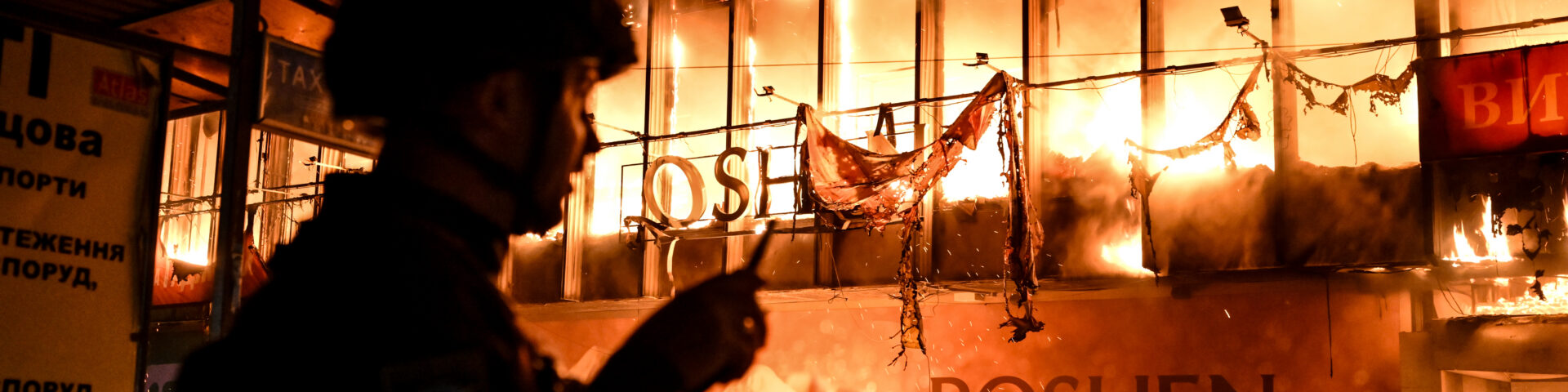
Featured image: A law enforcement officer stands in front of the burning Intrade shopping centre in Zaporizhzhia, Ukraine, on September 21, 2026. (Photo by Dmytro Smolienko/Ukrinform/NurPhoto)