 A Nation Must Think Before it Acts
An Awkward Relationship: The German Far Right and Trump

A nation must think before it acts.
An Awkward Relationship: The German Far Right and Trump
Since taking office in January 2025, US President Donald Trump has continued his attacks on Europe, started during his first term, and escalated them to a new level. At the 2025 Munich Security Conference, his vice president, JD Vance, scolded mainstream European parties for allegedly undermining freedom of speech and persecuting far-right parties. On April 2, his so-called “Liberation Day,” he imposed sweeping tariffs on European industries and even threatened to annex Greenland, a sovereign territory of Denmark, by force earlier this year. At the same time, the new American administration has been cozying up to far-right parties across Europe, endorsing candidates and even inviting party leaders to Trump’s inauguration. These incidents are part of Trump’s broader strategy to reshape Europe in an image aligned with MAGA ideology.
Yet, rather than forging closer ties between the US and Europe, this strategy has contributed to the most significant rupture in the history of the transatlantic relationship and backfired even with the far-right parties it sought to support. A particularly illustrative example is the Alternative for Germany (AfD), an influential political force in Germany and Europe that initially embraced American support but ultimately distanced itself from Washington as US policies clashed with its own foreign policy principles. Although the AfD and MAGA share ideological similarities, their visions of international order differ, particularly regarding national sovereignty, non-interference, and American hegemony. The breakdown of this relationship illustrates the limits of ideological alignment and offers important lessons for US foreign policy, both within and beyond Europe.
The Far Right on the Rise
Across Europe, populist radical right parties have gained ground, scoring record election results in recent years. In the 2024 European parliamentary elections, far-right parties gained almost a quarter of the vote, emerging as the second strongest force in the European Union after the centrist parties. Across many European countries, these parties are forecast to become the leading political force. In some countries, like Italy, the Czech Republic, and Finland, they are already in power. In Germany, Europe’s largest economy, the AfD recently scored a series of successes in local elections, falling just short of an absolute majority in the state of Saxony-Anhalt, scoring first in Mecklenburg-Western Pomerania, and scoring third place in left-leaning Berlin. The recent wins of the AfD have put enormous pressure on the governing Christian Democratic Union party, which, for the first time in post-war history, has failed to win enough seats to enter a state parliament, and whose leader, Chancellor Friedrich Merz, has an approval rating of a mere 10%.
Until now, Germany’s centrist parties have pledged to maintain a so-called “firewall,” which prevents collaboration with the far right, a commitment rooted in the country’s historic experience with far-right nationalism, which culminated in the Holocaust and the Second World War. Yet, the center-right CDU has already broken this firewall on several occasions, such as when seeking support for tougher immigration policies. As the center-right CDU and center-left Social Democratic Party of Germany struggle to retain voters, the prospect that a future coalition might include the AfD is not unlikely, even as centrist politicians continue to rule out the possibility.
Whether and when the AfD could enter power remains uncertain. What is certain, however, is that a Germany ruled by the AfD would fundamentally transform both German domestic and foreign policy, with far-reaching consequences for Europe. The party seeks to fundamentally reshape the EU by weakening its supranational institutions, transferring decision-making powers to national governments, and allowing Germany to opt out of common EU policies.
The Foreign Policy of the AfD
The AfD was founded in 2013 by a group of libertarian economists and journalists who criticized the European Union’s response to the financial crisis, particularly the bailouts of Greece and other European countries, and advocated for Germany to exit the Eurozone. Initially focused on economic issues, the party gained traction during the 2015 refugee crisis, when almost a million refugees, mostly from the Middle East, entered Germany and overwhelmed the local asylum system. In the 2017 parliamentary elections, AfD entered the Bundestag (the German federal parliament) for the first time, scoring a record 13 percent and immediately becoming the largest opposition party. Over the following years, the party grew in support and became increasingly radicalized, focusing on opposition to immigration and Islam, and advocating for Christian traditional values.
While the AfD’s foreign policy is less developed than its domestic policy, it is broadly characterized by pro-Russian and anti-American positions. Russia has long been an important economic and cultural partner for Germany. Especially in Eastern Germany, where support for the AfD is strongest, Russia is seen as a “great brother,” and many Eastern Germans look back fondly on the German Democratic Republic, the former socialist puppet government of East Germany under Soviet control. Until the full-scale invasion of Ukraine in 2022, Russia was Germany’s main supplier of energy and served as a fundamental pillar for its export-driven manufacturing economy. By contrast, the AfD views the United States with suspicion. Some of its more extremist factions even characterize Germany as still under US occupation, pointing to the roughly 35,000 American troops stationed in the country. The party’s manifesto calls for a complete withdrawal of allied troops and nuclear weapons from German territory. The AfD also rejects the US on a cultural basis, with party head in Thuringia Björn Höcke arguing that Germany has been usurped by American culture and that West Germany is full of “German-speaking Americans.”
A New American President
The return of Donald Trump to the White House in 2025 changed this calculus, as the AfD started cozying up to the new administration. AfD and MAGA share a similar ideology and values, with a worldview that sees immigration and Islam as the primary threats to Western Christian societies and embraces illiberal, authoritarian tendencies. The Trump administration has viewed European liberal governments as akin to its domestic political opponents, and as a result, has extended support to far-right leaders, including Viktor Orbán in Hungary, Marine Le Pen in France, Giorgia Meloni in Italy, and now the AfD in Germany.
US Vice President JD Vance and Secretary of State Marco Rubio both publicly endorsed the AfD ahead of Germany’s 2025 federal elections. At the Munich Security Conference in 2025, Vance shocked European allies when he argued that the biggest threat to Europe came from mainstream political parties that undermine freedom of speech by ostracizing the far-right. Rubio echoed Vance’s criticisms, calling the German government’s decision to put parts of the AfD under surveillance by the domestic security service as “tyranny in disguise.” Shortly before taking office as head of the DOGE department, tech billionaire Elon Musk publicly endorsed the AfD, claiming that “Only AfD can save Germany” and holding a live interview with AfD Chancellor candidate Alice Weidel on X ahead of federal elections.
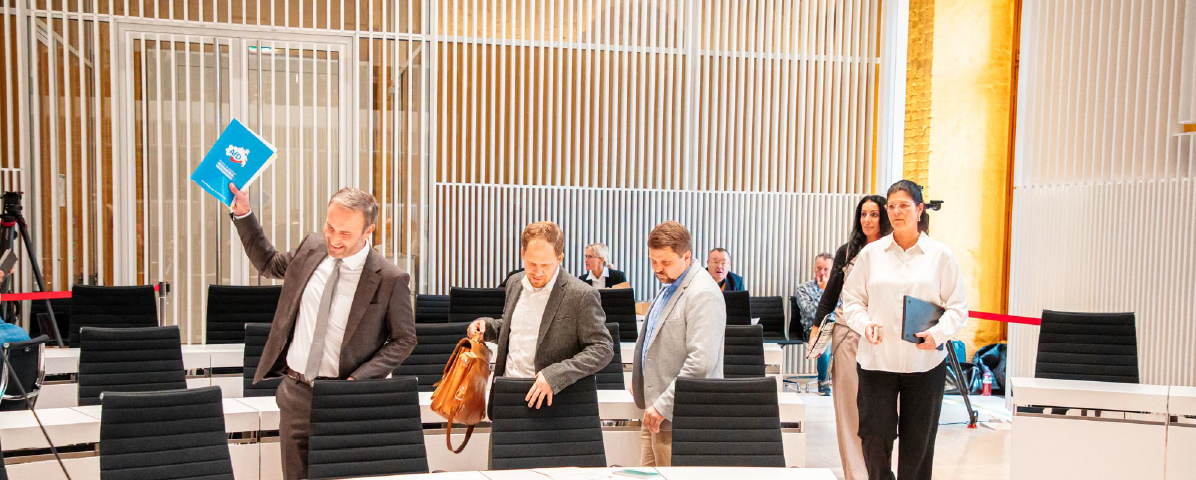
In May 2025, the German domestic intelligence service classified the AfD as “extremist,” intensifying scrutiny of the party and raising fears of a potential ban. According to statements by AfD politician Maximilian Krah, the party viewed a close relationship with the Trump administration as a means of deterring the German government from implementing a ban. Under the leadership of foreign policy spokesman Markus Frohnmaier, AfD began dispatching delegations to Washington, meeting with young MAGA-aligned politicians and members of the Trump administration. Prominent AfD politicians, including Beatrix von Storch, joined these visits to DC, while AfD co-leader Tino Chrupalla even attended Trump’s presidential inauguration in January 2025. During the Munich Security Conference, Vance met with the party’s other co-leader Alice Weidel, alongside other notable figures, such as German President Frank-Walter Steinmeier and (then) opposition leader (and current Chancellor) Friedrich Merz.
Transatlantic Rupture
This rapprochement began to unravel as the Trump administration pursued policies that clashed with the AfD’s economic interests and its vision of international order. On April 2, 2025, his so-called “Liberation Day,” Trump announced sweeping tariffs across the globe, including a 20 percent general tariff on Europe, a 25 percent tariff on trucks and automobiles, and a 50 percent tariff on steel and aluminum implemented two months later. Although Chrupalla conceded that the tariffs were “understandable,” Weidel struck a harsher tone, describing them as “poison for free trade.” Trump’s military interventions abroad, including the operation to capture Venezuelan President Maduro and the war in Iran, further strained the relationship. Chrupalla asserted that “Donald Trump started out as a peace president—he will end up as a war president,” casting the United States as an aggressor. Similarly, Weidel denounced the interventions, arguing that Trump had reneged on one of his central campaign promises.
The most significant blow to the relationship, however, took place in January 2026, when Trump threatened to annex Greenland by force. He ultimately backpedaled after being placated by NATO Secretary General Mark Rutte and the EU’s threat to retaliate with the so-called “trade bazooka,” the bloc’s powerful anti-coercion instrument. Trump’s Greenland threat caused significant backlash among the European public, with his approval rate tanking to 8 percent in Germany. More broadly, many Europeans came to view the US as a necessary partner, rather than an ally. Moreover, an increasing number of Europeans also began to view the United States as a threat and move towards favoring other strong powers, like China.
Against this backdrop, the AfD increasingly distanced itself from the American administration, amplified its criticism of the United States, and returned to its longstanding calls for closer alignment with Russia. This shift became apparent when the AfD welcomed Trump’s announcement that he would reduce the number of troops stationed in Europe, a majority of which were stationed in Germany. Chrupalla went further, calling for a complete withdrawal of NATO troops from Germany and reiterating earlier criticisms that NATO served US interests at the expense of its European members.
Lessons (To Be) Learned
The AfD’s distancing from Trump illustrates the limits of ideological alignment in international politics. Although the two movements share a nationalist and socially conservative worldview, their visions of international order are fundamentally different. The AfD’s foreign policy combines opposition to American influence with a preference for closer ties to Russia and a multipolar system in which European states retain greater autonomy. Trump’s second-term pursuit of American dominance, particularly in the Western Hemisphere, has exposed the tensions within this alignment. The result is not simply a disagreement over tariffs, military interventions, or Greenland, but a deeper conflict over the limits of great-power influence. The episode also highlights the tension between the AfD’s stated commitment to sovereignty and non-interference and its selective application of these principles when dealing with Russia. Ideological affinity can facilitate cooperation, but it cannot eliminate competing national interests or incompatible visions of international order.
For the United States, the lesson is not that Washington can simply return to the transatlantic relationship as it existed before Trump. American policies have weakened trust among European governments and publics, while the AfD’s experience demonstrates that even ideologically sympathetic partners may resist American pressure when their own interests and principles are at stake. Rebuilding a durable transatlantic relationship will therefore require more than cultivating political allies. Washington must treat European countries as partners with legitimate interests and independent agency, rather than as members of an ideological camp expected to support American decisions. This means consulting allies before taking consequential action, respecting their sovereignty, and pursuing shared objectives through cooperation rather than coercion. It also means accepting that European partners will not always agree with American policies, whether on trade, military intervention, or relations with other great powers. Such an approach would not eliminate transatlantic disagreements, but it would provide a more sustainable basis for managing them. Ultimately, the United States’ influence in Europe will depend less on whether European parties embrace MAGA ideology than on whether Washington can demonstrate that cooperation with America serves their own national interests.