 A Nation Must Think Before it Acts
In Conversation with Roderich Kiesewetter | Germany’s New Defense Strategy
A Nation Must Think Before it Acts
In Conversation with Roderich Kiesewetter | Germany’s New Defense Strategy

A nation must think before it acts.
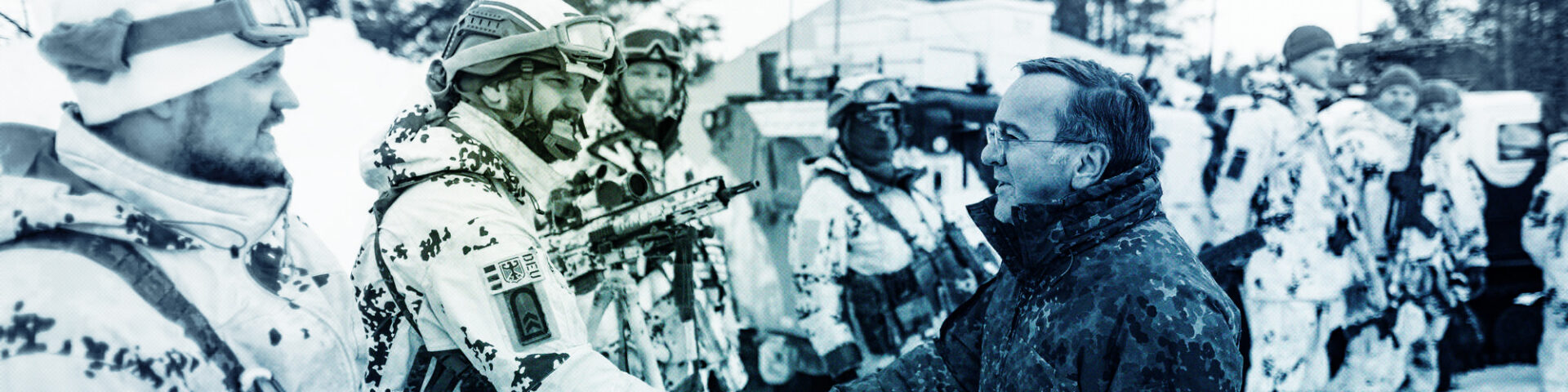
In Conversation with Roderich Kiesewetter | Germany’s New Defense Strategy
This conversation was recorded on May 13, 2026. You can listen to the full conversation here.
Aaron Stein: Hello and welcome. My name is Aaron Stein, President of the Foreign Policy Research Institute. Today I’m talking with Roderich Kiesewetter, who is a member of the German Parliament, a retired colonel, and the group coordinator of his caucus inside the Committee on Foreign Affairs. It’s really great to have you here in Philadelphia.
Roderich Kiesewetter: Thank you, Aaron. A great honor for me to be here.
AS: Well, you’re coming up because a lot’s actually happening in Germany. A lot seems to have been happening in Germany over the last couple of years. And one [thing] is this new military defense strategy that came out last week.
Now, a lot of our listeners will probably have read stories about it in the news, but for those who want to hear it exactly from you, give us your top-line assessment of what it actually says and what it means.
RK: Well, thank you very much indeed. The military strategy of Germany is embedded in the National Security Strategy.
This strategy was the first ever in the history of the Federal Republic since 1949, and it was established in 2023. This year, finally, we have this military strategy, which in the past was not called a strategy, but now it’s much more delineated and it’s much more helpful for the reform of our armed forces. First of all, the security architecture it’s leaning on is NATO first: It’s a transatlantic partnership. It’s a fair burden shifting and not this old, unfair burden sharing. We can elaborate on this a little bit later.
It is oriented toward the threats we see. There is a coalition of China, Russia, Iran, and North Korea trying to hollow out the international rules-based order. And especially China, Iran, and North Korea are supporting Russia in its war against Ukraine. So, our military strategy sets some priorities. First, to defend our country. Second, to defend NATO territory. And third, to reach out to our partners in the world who are like-minded in defending the rules-based international order. You’ll find those countries in ASEAN, countries of this organization in the Indo-Pacific, including Australia, Taiwan, and New Zealand. And we would like to invest more in a fairer transatlantic burden-sharing and burden-shifting, but let me come back to that later.
This includes also a refurbishment of our armed forces and a refurbishment of our armaments industry. The armed forces should be war-fit by the end of 2029, because Russia will, at the latest, then be able to confront us with a full-fledged war on NATO territory.
Second, we renewed our mandatory service. We are starting out on a voluntary basis, but by the end of this decade we will shift to a mandatory service for the military, but also a mandatory civilian service.
Third, regarding the armaments industry, it is very necessary to have a closer look. Our armaments industry was contained by very heavy export regulations so that our armed forces were focused on piecemeal production. Therefore, the certification of our process is a piecemeal process. Instead of a certification process including the whole production line, we look for the single bullet, we look for the single tank, for the single drone, which is really very time consuming and not up to speed and up to the necessary challenges.
So all in all, we also have the necessity to procure new elements. Due to the fact that the United States has postponed or even declined their willingness to deliver high-precision, long-distance missiles like the Tomahawk, we need to speed up our own production.
The threat is from Kaliningrad, where Russian Iskander missiles are threatening Berlin and could reach Berlin within two minutes, or other European countries and capitals. So we need a counterweight against that. Europe will be able to have these weapons by 2030, but now we have to speed up. The idea is to have high-precision long-distance missiles reaching targets east of Moscow. Why? Because we need a counterweight to the threat going out from Kaliningrad and other Russian bases. One critical factor is time. The idea to be war-fit is 2029. The idea to have the full investment in our 5 percent goal is 2035. But to completely bring into practice this new military strategy is 2039. So this is too long. We have to refocus this all together by 2029 or 2030.
AS: A very good summary of everything that is going on, particularly regarding long-range precision strike, which I’ll come back to. But one thing I really liked about the document is it has a really clear goal, which is to be the strongest conventional force in Europe. But it does try to walk this line—and I’m curious about it—which is national versus European defense. So, when you’re thinking about that, where does Germany’s border begin for the conception of this new security thinking or security strategy that’s being implemented?
RK: You hit the point. This is really the most important question because it is related to trust, reliability, and predictability. We hear from our neighbors, “What does it mean, strongest conventional army? By capabilities, by manpower, by excellent logistics or procurement processes, what does strength mean?” And we don’t have a clear answer.
When we look to other European armies of European countries like Turkey, like Poland, like the UK, or France, they have stronger armies. They have more reach, they also have the capability for a strategic projection of troops. We don’t, so we have to [initiate] this. I believe we should combine capabilities and troop strength, but it is of much more importance to have reserve capacities to refill the troops in case of war, casualties, and losses. Strength must be measured also by logistics and by equipment. Second, is it really helpful to have the strongest European army with the rules of engagement and caveats that Germany has?
Some of my colleagues and I are trying to convince our government to send clear signals that this new German army is not only part of a European defense, it must be an integrated part of the European defense of NATO, and it must be available for our partners without any restriction. Look to the brigade in Lithuania. This brigade will be completely enforced probably by 2028.
Then we have to bring into NATO three complete divisions by 2030 and another probably 10 brigades by 2035. But these troops must be available, and we should not shy away if Russia is pressing, or any other country is pressing some member states of EU or NATO to hand over territory, for example. So we must be available and reliable, and strength should not be defined by caveats and rules of engagement.
The limit or the bottom line must be the Charter of the United Nations, Article 42.7 of the EU Treaty (the Lisbon Treaty), and Article 5 of NATO. So, we must be available. Strength by denial of availability is not strength.
AS: Another thing I’m curious to hear your thoughts about is [being] the strongest army in Europe versus NATO. You talked in your first answer about NATO territories, NATO obligations, but as you know, NATO has a lot of non-European Union members.
You mentioned one, Turkey, there’s obviously the United Kingdom, and Norway as well being another one. So you have those three that are outside of Europe, but obviously are part of NATO. So, how do you think about that, I don’t want to call it a tension, but those obligations both to the North Atlantic Treaty Organization, but also to the Lisbon Treaty and your EU member colleagues?
RK: Well, let me come back to strength. Strength also means interoperability and standardization. It doesn’t help if you have an army which doesn’t fit in the decision-making processes, command and control cycles of others, or in the logistics, supply chains, and so on. So, strength means complete interoperability and complete standardization.
And you made a very clear point regarding who should be included. Until 2024, the unique selling point of the United States was predictability and reliability. And now we experience a United States where the key appearance is unpredictability. This is good for the enemy, but this might also press or even threaten partners because they don’t know whether they could rely on Article 5 completely or on the nuclear umbrella. Therefore, Europe has to reconsider that it is not the European Union and it’s not only the European NATO states.
What we need is a new understanding of Europe in two terms. One is fair burden shifting so that we are responsible for conventional defense and deterrence in Europe, including the MENA region—Middle East and Northern Africa—because the United States cannot afford to be present there and to defend the Indo-Pacific. We must be aware that this would be not a gift but a necessary shift of burden—not a gift from Europe to the United States. And it would also show the Trump administration that we have understood that we have to take over more responsibility.
And the second layer connected with that is, what is Europe? And it is not the European Union when Norway, Iceland, the UK, Turkey, and Ukraine are not members. Some of them strive for this membership. What we need is a geopolitical and geoeconomical understanding of Europe. And Europe is stronger with the UK, with Norway, with Iceland also due to the geo-gap—and Greenland, Iceland, the UK, where Russian nuclear submarines are very present.
And we need a strong eastern pillar of defense in the southeast of NATO, including Ukraine and Turkey. What if Iran goes nuclear? Turkey will become nuclear. And Turkey would no longer need the security guarantees of the United States and of NATO.
As a nuclear power, Turkey would be more independent than we might see it [now]. So we need the southeastern flank to not only be defended by Bulgaria, Romania, and Greece. We need the knowledge of Ukraine and Turkey to be included also for the sake of the Black Sea, which is tending to become a Russian territorial water, which we cannot afford at all. We have this responsibility.
So it is more not only [based] on the definition of strength and capabilities, we also have to have a look on the map and improve the geopolitical and geoeconomical stance of Europe. And then the United States will have a partner where it is worthwhile to cooperate, to make deals in the language of Trump, but also to see a common market of more than 900 million people. We could set standards. We could also defend our market economies.
AS: So you mentioned Russia, and the document is very clear in that Russia is—to use US terminology—the pacing threat for Europe. It is the baseline for the entirety of your threat assessment. And that’s different in the US. Russia is one of many threats that the US thinks about, and it’s been deprioritized a little bit in this Trump administration.
But one thing that the document tries to do is that it categorizes the threat from Russia, and I believe it starts with hybrid warfare and escalates from there. That’s a very large menu for the armed forces to consider. So maybe explain a little bit how you prioritize what the actual threat is from Russia, because in the document, it’s expansive.
RK: And it’s very important because that’s really new. Russia is conducting that war not only in this classic military arena. It’s military warfare, but as you mentioned, it’s hybrid civilian warfare and it is cognitive warfare.
The most successful effort of Russia is in this cognitive warfare. So, showing that Russia is an imperial power, has colonial rights, needs a zone of influence, looking to other countries as corrupt, being a provider of orientation, giving Germany a chance for independence with German engineers’ art and Russian resources to make us independent from the United States, from the EU, from NATO, from the Euro. This is, by the way, the idea of the alternative for Germany (AfD): to come back with this old continental German thinking.. So, we have to be aware that the armed forces are only strong in this war when we understand that we need a comprehensive whole-of-society approach. That in schools, in civilian resilience teams, in blue light organizations, in disaster relief and counter-catastrophe organizations, we know what is at stake: peace, freedom, and self-determination.
Russia is flying drones over Germany. Last year, 2,000 times. We have had about 2,000 drone overflights coming from Russian ships. The GUGI (the Russian Main Directorate for Deep-Sea Research) is now part of the Ministry of Defense of Russia. We have had arson attacks on DHL containers. We have destruction of fiber knots in our railway cooperation.
And in civilian warfare we also have to look to the war in Ukraine. Russia is not very successful militarily, but they are exhausting Ukraine. On the civilian field they are destroying Ukrainian culture, schools, hospitals, churches, electricity, power stations, waterworks, and so on.
So they try to increase mass flight from Ukraine. In cognitive warfare, they try to show that the Ukrainians have no chance, but Ukrainians fight and die for peace and self-determination. And therefore, our strategy, for the first time in our history, sees three theaters: the cognitive one, the civilian one, and the classic military one.
AS: This raises the question—because it does seem like this is a considerable change for how Germany views itself in Europe, but also the German willingness to anchor itself around a foreign adversary. Correct me if I’m wrong, I’m not from Germany, but whenever there is change, there is inevitable political debate about whether or not this is a good change. So, I’m curious for those of us who are listening who are not German, what the debate is.
And two, to steal another phrase from US politics, how are you going to pay for it, [meaning] the economics that underpin this. Historically, that’s always been a hindrance in German debate, which is how much to spend on defense, how much debt or deficit to take on. Walk us through both the economics of the plan and then the societal buy-in, for lack of a better term, for this approach.
RK: Before I come back to your excellent question, I need to say it doesn’t help to flood the zone with money, to overwhelm the armaments industry with money if you don’t change the mindset.
So, if you get more from the old, you do not orient the new, needed armed forces to what is going on on the real battlefield. And we should not fight the war of yesterday. We should look at the lessons identified and then learn what Russia, China, Iran, North Korea, and other rogue states draw from this war in Ukraine, from the war in Azerbaijan, Armenia, from the war in Libya, and Sudan as well. So, we have to install a permanent lesson-identified, lesson-learned process combined with improvement in the armed forces.
And second, it’s the first time in our armaments history that we really have enough money. We had in 2012, 2013 a budget for our armed forces of 33 billion euros. As of last year we now have 55. This year we will have 80 billion euros, and by 2029 we will have, each year, 150 billion euros for our defense. So this is nearly five times more than 15 years ago. This is really helpful.
However, you cannot flood the zone with money without controlling it and without a clear approach: lessons learned, how to bring this into the reform of the army, and not to have a very conservative approach. This is really important for the mindset.
And then third: we have the money, we have the lessons-identified process (hopefully also to be learned), and then we need to confront the people.
There was an Austrian poet, Ingeborg Bachman, and she said, “You can confront the human being with the truth.” I walked through more than 200 electoral districts—we have 299 in my country—and had events with the public, together with my colleagues, but mostly by myself, with the public. Sometimes it was 50 people, sometimes 300, and I confronted them with what is going on against Ukraine, but also against us.
And I learned people are much farther developed than the Berlin bubble and obviously the Brussels bubble. The people expect more action, more operational thinking, and more truth. If we shy away, they shy away from supporting that. So, they need to know what’s going on.
And there we have a quite good school system, but you also need to teach the unions, the churches, and also some NGOs. And we parliamentarians need to walk the countryside, the rural sides, not only the cities. I believe this must be the task of the next two, three years. And then, with this whole-of-society approach, we could speed up with Sweden and Finland, who have in every household a small brochure of “What should I do in times of war?” In Germany, you need to click through the internet and then you find, “How should I prepare for a crisis?” It’s a big difference.
AS: So, if you were to come back to Philadelphia in five years, which you’re of course more than welcome, and we were to have this conversation again, what would be, in your mind, an indicator of success?
RK: The indicator of success would be that Ukraine has an observer status in the European Parliament in five years and knows that they will be, by the mid-30s, a member of the European Union and a refurbished NATO.
AS: Well, that’s very clear and concise. Roderich, thank you for taking your time for this podcast.
RK: Thank you, Aaron.
The third season of the Ties That Bind is generously supported by the Konrad Adenauer Stiftung USA.