 A Nation Must Think Before it Acts
Is US Influence in Africa at a Crossroads?
A Nation Must Think Before it Acts
Is US Influence in Africa at a Crossroads?

A nation must think before it acts.

Is US Influence in Africa at a Crossroads?
The United States enters the second half of the 2020s facing a fundamental question in Africa: Is Washington still seen as a strategic partner of choice, or is it becoming a transactional power whose engagement is seen as narrow, punitive, and unpredictable? This is no longer a theoretical question. It is now being tested in southern Africa, West Africa, the Sahel, and in the mineral-rich heart of the African continent.
Strained US-South African relations, friction with Nigeria over claims of religious persecution, renewed efforts to regain some counterterrorism footing in the Sahel, and the controversies around third-country deportation deals and minerals diplomacy all point to a larger issue. While the United States is not pulling away from Africa altogether, it is redefining its presence in ways that could either sharpen its influence or erode it.
For decades, American influence in Africa has been based on a mix of security cooperation, development assistance, diplomatic engagement, and support for good governance and public health. Such support was never without contradictions, but it did give Washington a broader identity than that of a purely extractive or coercive actor. Currently, the pattern of US engagement looks different. It is more selective, more openly associated with immediate political priorities, and much more willing to link diplomatic engagement to issues such as migration control, ideological signaling, or commercial access to strategic minerals. On a continent where governments already have alternatives to China or Russia, such as the Gulf states, Turkey, India, and the European Union, this shift matters. African leaders are increasingly able to hedge, diversify, and resist external pressure. If the United States appears to them to be mainly interested in punitive actions, one-off deals, or symbolic confrontations, it risks losing not just goodwill but also long-term leverage.
South Africa: From Strategic Disagreement to Diplomatic Rupture
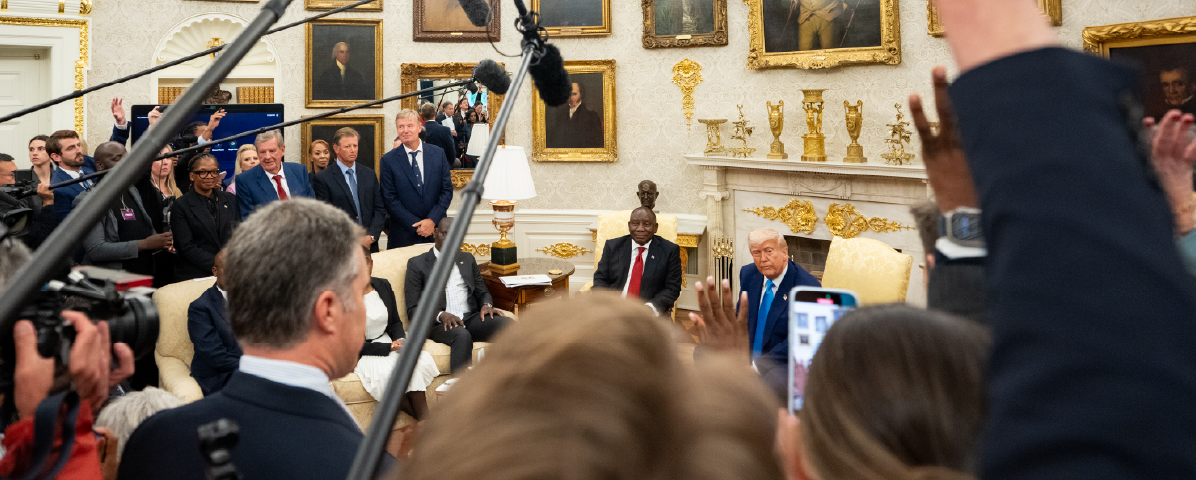
The most visible and significant deterioration has been in US relations with South Africa. President Donald Trump’s move to disinvite South Africa from the 2026 G20 Summit in Miami followed an already dramatic breakdown, in which US officials boycotted the South African-hosted Johannesburg summit. In addition, the Trump administration escalated claims that white Afrikaners were being persecuted or subjected to “genocide,” allegations that South African officials, and even groups representing Afrikaners, have strongly rejected. Despite no substantiation of the claims, the US administration prioritized refugee admissions for white South Africans even as refugee access was curtailed for many other groups. Whether these steps are viewed as moral positioning or domestic political theater, the effect is the same in Africa: The United States looks willing to rupture ties with one of the continent’s most important powers on the basis of a narrative that many Africans see as ideologically loaded and factually questionable.
Feelings like this matter because South Africa is not just another bilateral partner. It is a leading voice in the African Union, Africa’s largest economy, a member of numerous multilateral organizations, and a country whose positions often shape broader African perceptions. A rupture with Pretoria, therefore, has an impact beyond trade or bilateral diplomatic relations. It signals to other African governments that Washington might be prepared to downgrade relations with an influential African nation not over conventional disputes such as sanctions, military alignment, or treaty obligations, but over a polarizing culture war issue. Many are likely to read this less as principled diplomacy than as evidence that domestic American policies can redefine foreign policy priorities toward the continent.
This could have significant consequences. In the first place, the dispute with South Africa weakens US credibility as a defender of multilateralism at a time when African governments are skeptical of Western selectivity. Secondly, it risks pushing South Africa to deepen cooperation with other powers, including China and Russia, not necessarily out of ideological agreement but as a hedge against US hostility and unreliability. Thirdly, it might reinforce a broader continental impression that the United States is comfortable engaging African countries only when they align with US domestic priorities. Even those governments that disagree with South Africa on some issues might still resent what they see as public humiliation of an African power at the first African-hosted G20 Summit.
In diplomacy, symbolism is important, and it can be costly for the United States.
Nigeria: An Ideological Cloud Over Security Cooperation
While South Africa is an example of an increasing diplomatic rupture, Nigeria is a more complicated situation. It is an illustration of deep strategic importance combined with rising political distrust. Nigeria is central to any serious American engagement in West Africa. With over 240 million people, it is the most populous country in Africa; it is one of its largest economies; it is a major security player in the Lake Chad Basin; and it is a critical player in regional diplomacy. But US-Nigerian relations are strained because the Trump administration has redesignated it as a Country of Particular Concern, based on what the US government describes as mass-scale persecution of Christians, and the increasingly heated rhetoric from Washington that frames violence in Nigeria primarily through the lens of Christian persecution. While this framing resonates strongly with segments of the American right’s political base, in Nigeria it is viewed by many as incomplete, politicized, and dangerously provocative.
Violence in Nigeria is real and serious, and Christian communities have suffered grievously in parts of the country. But Nigerian officials credibly argue that the violence also involves jihadist insurgency, banditry, communal conflict, weak policing, and governance failures rather than a single, state-directed campaign of religious persecution. In a country whose population is almost evenly split between Christians, who live in the south, and Muslims, mostly in the north, where attacks have been concentrated, and where the religion of victims is not often reported—or relevant—it is impossible to conclusively attribute religious persecution as a motive. When Washington ignores these distinctions, it risks alienating Abuja and oversimplifying a crisis that requires careful analysis and cooperation rather than mere denunciation. Washington’s calls for aid conditionality, sanctions, visa restrictions, and pressure against sharia and blasphemy laws might appeal to some audiences in the United States, but they risk making Nigerian leaders more defensive and less willing to coordinate closely with the United States on security matters.
Neither side, though, can afford a complete breakdown of the relationship. The United States needs Nigeria’s cooperation on intelligence, regional stabilization, energy, maritime security in the Gulf of Guinea, and counterterrorism activities in the Lake Chad corridor. Nigeria, on the other hand, benefits greatly from US training, intelligence, diplomatic support, and economic ties. For this reason, outright rupture of the relationship is not the main risk. What is more probable is a more corrosive relationship, one that remains functionally intact, but that is less trusting, less open, and more transactional. If the United States is seen as lecturing Nigeria from a narrow ideological frame while simultaneously asking for deeper security cooperation, its leverage will be weaker. Abuja might continue to work with the United States where interests overlap, but it might also diversify its partnership and resist American pressure more openly and directly.
The Sahel: Counterterrorism Cooperation Returns, But With Tighter Constraints
The Sahel is another stress test of US influence in Africa. After the loss of key access points, particularly in Niger, where Washington had a drone base, the United States has been looking for ways to reestablish a viable counterterrorism posture, not just in West Africa, but in the broader Sahel.
The current Trump administration appears to be renewing its focus on the Sahel, as it seeks to renew ties with the Alliance of Sahel States (AES), Mali, Niger, and Burkina Faso, with delegations to the capitals of the three countries discussing US military support in exchange for access to their natural resources. Washington would consider providing weapons, equipment, and potentially personnel to aid local forces fighting extremists. In return, the United States would get priority access to uranium, gold, and other critical minerals. This approach emphasizes intelligence sharing, training, and advisory missions, rather than large-scale deployments of US military forces. While this is, on the surface, a pragmatic-sounding adjustment to current political realities, the AES, which was formed in 2023, already has strong ties to Russia, including the presence of military advisors, training support, and supply of arms, and since 2025 AES foreign ministers have concluded agreements with Russia on security, energy, and higher education. This limits America’s freedom of action in the region.
Some progress has been made on moving this new agenda forward, with an intelligence cooperation agreement with Mali near completion and the removal of sanctions on some senior Malian defense personnel, but despite the potential of getting Washington back in the good graces of Sahelian countries, these changes in US policy are unlikely to offset Russian or Chinese influence in the region. Unfettered US access to the Sahel will be difficult because the environment has changed in three significant ways. First, access to the region is now contested. Governments that have survived coups or insurgencies are more suspicious of Western intentions and more willing to use anti-Western rhetoric to bolster regime legitimacy. Second, the external competition is greater. Russia offers assistance with fewer political conditions attached, while China and the Gulf states expand their economic influence through infrastructure construction, mining, and commercial deals. Even Turkey and Europe are ahead of the United States in terms of trade with the Sahel. Third, the populations of the Sahel are disillusioned with security agreements that promised stability but failed to deliver, and US competitors, Russia in particular, have used this in their propaganda campaigns. In this context, even a small US footprint can be portrayed as neo-imperialism rather than a mutually beneficial partnership.
This presents the United States with a serious strategic dilemma. If Washington’s focus is narrowly on counterterrorism, it might regain some operational advantage but lose credibility with countries on the continent on governance and democratic norms. If, on the other hand, it insists too heavily on constitutional order and political reform, it might find itself excluded from the security spaces it considers vital.
A logical hybrid strategy, which the current administration shows no sign of pursuing, would be to intensify work with cooperative countries like Nigeria, other coastal West African partners, and perhaps even northern anchor states outside the coup belt, while monitoring Sahelian threats from the periphery. While this is the most practical and realistic option, it’s not the same as influence. It’s damage limitation, which African leaders will recognize. On the Sahel, the United States seems to be in a damned if you do, damned if you don’t situation. The question then becomes, does it focus on short-term gains, or swallow the pain and focus on long-term credibility in the rest of the continent? We can only wait and see.
Assistance, Minerals, and Deportation Deals: The Cost of Transactionalism
A recent issue that highlights the current administration’s approach to Africa is the growing overlap among strategic minerals diplomacy, aid leverage, and domestic immigration enforcement.
The Democratic Republic of Congo (DRC) has drawn a lot of attention because of US efforts to secure access to the critical minerals in its conflict-ridden eastern region, and because it has become part of a network of African countries accepting third-country deportees from the United States. There are reports of similar agreements with countries such as Rwanda, Eswatini, and Sierra Leone. Critics of the deportation agreements, such as Human Rights Watch (HRW), argue that these opaque deals violate human rights law and are “part of a policy that is designed to instrumentalize human suffering as a deterrent to migration.” The governments implementing such deals risk violating international law. Human Rights Watch claims to have seen a copy of the agreement with Rwanda that includes an inducement of approximately $7.5 million in US financial support in exchange for Rwanda’s acceptance of third-country deportees. The agreement with Eswatini, according to HRW. Offers $5.1 million to build Eswatini’s border and migration management capacity in exchange for the country accepting up to 160 deportees from the United States. These agreements effectively turn African governments into subcontractors for US immigration control operations, and, even where they are accepted willingly, the public optics can be damaging in the long term.
Though not as serious in human rights terms as the deportation deals, the reported use by Washington of assistance funding as leverage to secure access to critical minerals is just as controversial.
In November 2025, according to a report in Al Jazeera, the United States approached Zimbabwe with an offer of $300 million in funding in exchange for sensitive health data, which Harare rejected, and around the same time, Washington announced $1 billion in health funding for Zambia, which Lusaka said was problematic because the United States sought access to the country’s minerals. In the minerals deal with the DRC, as mentioned above, the situation is even shakier due to the DRC’s security situation and the weakness of the DRC government. The deal could possibly entail the commitment of US security resources, including ‘boots on the ground’ in one of the least stable countries in the world.
Diversifying and securing US mineral supply chains is essential for economic and national security. It is also important to support African nations’ efforts to exploit mineral wealth for sustainable growth and to reduce extremist violence. But African audiences are unlikely to appreciate the nuances of these policy issues. If a country appears to be receiving security support or mineral investments at the same time it agrees to accept deportees who are not nationals of the country, or there is a sudden influx of American mining companies where there were none before, many will conclude that Washington is monetizing vulnerability. That impression is intensified by Washington’s perceived shift away from traditional development assistance and toward dealmaking framed explicitly around US gain. From the American perspective, this might be candid realism. But, from African perspectives, it looks like coercive diplomacy dressed up as partnership. The difference is not semantic. It goes directly to whether the United States is seen as a trusted and reliable actor or a neo-colonial exploiter to be used when unavoidable.
That doesn’t mean that the United States should not be interested in African critical minerals. Quite the contrary. Competition over cobalt, lithium, copper, tantalum, and rare earth supply chains will be central to global industrial policy and security for a long time to come, and the United States has compelling reasons to avoid overdependence on Chinese-dominated systems. But there is a difference between building mutually beneficial mineral partnerships and appearing to tie security guarantees, diplomatic mediation, or migration deals to access to extract these minerals. If Africans believe that every American initiative ultimately serves a narrow resource agenda, Washington’s strategic reach might become shallower even in areas where its commercial footprint is large. Influence is not measured by contracts signed; it’s measured by whether partners believe the relationship has mutual value.
What Does All This Mean for US Influence in Africa in the Future?
In the coming years, US influence in Africa is likely to fluctuate rather than simply grow stronger or weaker. The United States will remain consequential because it offers many African states access to finance, technology, military training, intelligence, higher education, health partnerships, and diplomatic clout. In times of crisis, the United States can still make an enormous difference. But influence will increasingly depend on whether African governments see US engagement as broad-based and dependable, or as selective and punitive. The current trend points toward selective influence: stronger in nations or sectors where American interests are immediate, weaker in the broader contest for legitimacy and long-term political trust.
This loss of legitimacy and trust matters because the United States no longer operates in an arena where African governments have few alternatives, and where it provided a clear alternative to extractive countries like China and Russia. China is still deeply entrenched in infrastructure, trade, and mining. Russia continues to exploit security vacuums and elite insecurity, particularly in fragile states. The countries of the Persian Gulf are expanding investment, logistics, and political influence, and Turkey and India are also broadening their footprints. In such a competitive environment, an American strategy centered on coercive pressure, punishment, or one-sided dealmaking is unlikely to generate durable alignments. Some African governments might still accept American offers, but they will do so for short-term tactical reasons rather than long-term loyalty. They are likely to shop around, compare offers, and push back when US demands seem politically costly at home.
There is, therefore, considerable reputational risk for Washington. If the United States is seen as championing refugee protection for white Afrikaners while restricting other refugee channels, invoking religious freedom in Nigeria in ways that are viewed as partisan, seeking renewed counterterrorism access without broader political vision, and using aid to achieve mineral access or support for America’s deportation problems, a coherent image begins to emerge. It is an image of a powerful country that is interested in Africa less as a community of sovereign partners than as a set of problems to manage and assets to acquire. That image might be inaccurate and unfair in some respects, but perceptions often matter more than official intent. And in international affairs, reputational damage accumulates quietly before it becomes strategically obvious.
The decline in US influence is not inevitable, at least not permanent. The United States could still preserve, and in some areas even rebuild or increase its influence if it recalibrates its approach to Africa in three ways. First, it would need to treat major African states such as South Africa and Nigeria as strategic interlocutors, even when there are sharp disagreements, instead of turning disputes into public tests of ideological loyalty. Second, it needs to embed security cooperation within a broader framework that includes trade, governance support, education, and health, so that military engagement doesn’t become the only face of US official policy. Third, it would need to ensure that mineral partnerships and migration agreements are transparent, legally defensible, clearly reciprocal, and they are not linked to humanitarian programs. In short, Washington must show that it is not merely transacting with Africa but is investing in relationships.
The disputes now unfolding in Africa are not isolated controversies. Taken together, they reveal a broader transition in US policy from a relatively broad, if at times imperfect, model of engagement to a narrower, more transactional one. The clash with South Africa shows just how quickly political symbolism can wreak havoc with strategic relationships. The strain with Nigeria shows the danger of reducing complex insecurity to a single ideological narrative. The push to regain a foothold in the Sahel for counterterrorism operations shows that military relevance can survive even as political influence fades. And the convergence of minerals diplomacy, aid pressure, and deportation deals shows how easily hard-nosed realism can become reputational self-harm.
The United States is unlikely to pull back completely from Africa in the coming years, if for no other reason than the need to address the counterterrorism issue. But it risks becoming less admired, less trusted, and less able to shape outcomes beyond narrow areas of immediate interest. For some in Washington, that might be acceptable if concrete short-term gains in security, mineral access, and migration control are achieved. But great power influence is not sustained by transactions alone. It depends on credibility, predictability, and partners’ belief that the relationship serves more than one side’s short-term aims. If the United States wants lasting influence in Africa, it will have to prove that it still sees African states not just as instruments of policy or powerless pawns in great-power competition, but as consequential partners in shaping and preserving the international order.
Image credit: President Donald Trump hosts a bilateral meeting with President of South Africa Cyril Ramaphosa, Wednesday, May 21, 2025. (White House/Flickr)