 A Nation Must Think Before it Acts
Just How Much is Too Much? The Defense Spending Dilemma
A Nation Must Think Before it Acts
Just How Much is Too Much? The Defense Spending Dilemma

A nation must think before it acts.

Just How Much is Too Much? The Defense Spending Dilemma
The president asked Congress to approve a Pentagon funding request of $1.5 trillion for next year’s defense budget. This represents a record-shattering budget increase of roughly 50 percent over last year’s baseline budget. The Pentagon’s proposed request is larger than the Reagan-era increase over his entire first term, and four times larger than the increase (12 percent) that Donald Trump successively fought for in 2018. This brief article evaluates this proposal in light of the rapidly shifting environment facing US policymakers, including the US fiscal situation.
There are certainly arguments for enhancing America’s defenses for tomorrow’s battles, but there is also lots of red ink on the national balance sheet. We face a convergence of two challenges: our security and our long-term fiscal stability and prosperity.
The Yale historian John Lewis Gaddis called grand strategy a process by which “potentially unlimited aspirations are reconciled with finite means.” The brief closes with a compromise option to reconcile our aims and commitments with finite resources.
The Case for Higher Defense Spending
The case for enhancing the security of the United States is based on a deteriorating security picture. “America’s military is shrinking, aging, and overcommitted, leaving it dangerously unprepared for modern warfare,” Mackenzie Eaglen writes in Affording Defense. She adds, “This imbalance between expanding global commitments and a diminishing force structure has resulted in strategic insolvency.” This evaluation of our defense preparedness is not hyperbolic. The strategic environment includes both rising challengers, increased collusion among the authoritarian states, and a changing character of warfare that we are not ready for.
The Pacing Threat is Outpacing the Pentagon
China, the acclaimed pacing competitor, is investing significantly in its military power. Precluding a fait accompli against Taiwan is likely to be a critical contingency that the Pentagon will focus on. The solution to Taiwan’s defense is fairly well understood if Taiwan would accelerate the needed reforms. The United States will also need to adapt as war games addressing the Taiwan Strait revealed that the United States would likely run out of critical precision munitions in short order.
Collaborating Threats
The first of these is the autocratic “Axis of Upheaval.” Their collaboration “marks a fundamental shift” since US adversaries are “willing to come to the direct military aid of one another.” This shift could upend how Washington thinks about its defense plans and what planners call the simultaneity problem. Overall, the purported axis is not yet a collective threat, as the autocracies are acting bilaterally, largely in support of Russia. But we have seen indications in Ukraine and Iran that the “axis” is acting collaboratively in a manner inimical to Western interests and could evolve into a more insidious collective threat.
Naval Capacity Shortfalls
Shipbuilding is another major shortfall. Security analysts decry the “generational neglect of the inseparable relationship between economics and seapower.” The Chinese navy has passed the American fleet in total numbers and its shipbuilding capacity is several orders of magnitude greater than the United States: It expanded from 271 to 328 ships in the period from 2012 to 2024. The US Navy’s fleet grew slightly during the same timeframe, from 284 to 289. The US Navy fields larger ships with greater capacity, including more missiles, but Beijing’s fleet is closing the gap and has surpassed the United States in some areas. Trump has recognized this issue and issued an Executive Order titled “Restoring Americas Maritime Dominance” to begin the long road of recovering our shipbuilding and repair capacity to offset China’s assertive growth.
The Navy’s leadership admits that its current force structure is not sufficient in size or design to deliver the combat power to prevail in high-end maritime conflict. In response, working with the White House and Office of Management and Budget, it has developed a Golden Fleet initiative to address this challenge. The fleet design creates a balanced, high-low mix of platforms, combining high-end combatants with scalable, lower-cost systems and unmanned capabilities.
The most controversial element in the Golden Fleet is a proposed 36,000-ton battleship. The battleship’s primary role is to deliver high-volume, long-range offensive fires and serve as a survivable command-and-control platform. Procurement of the initial ship will begin in 2028 at an estimated cost of $17B with projected delivery in the early 2030s. The battleship has drawn criticism for its conceptual use, size, and cost. “It is simultaneously a strike platform, a command ship, a strategic delivery vehicle, and an air defense asset,” Emma Salisbury points out. She notes that “ships designed to do everything are likely to do nothing on schedule and nothing within budget.”
An Aging Air Force
The US Air Force is equally challenged. The former Secretary of the Air Force noted that “China’s massive investment in air-, land-, and sea-launched medium-range systems and systems … have already put traditional Air Force systems and operating concepts at risk .” Air Force platforms are aging significantly and have been reduced in numbers. The average fighter plane is over 30 years old. The need to address protracted wars, magazine depth for munitions, and airfield protection is apparent.
Homeland Defense
Astute defense analysts recognize that the continental United States is not a sanctuary in future conflicts. Missile defenses are seen as a necessary part of this principal mission. Building an American “Iron Dome” system has gained the president’s support. He signed an Executive Order for “a next-generation missile defense shield for the United States against ballistic, hypersonic, advanced cruise missiles, and other next-generation aerial attacks.” The president has asked for $18 billion in his new budget for this initiative, which is a down payment on a much larger investment over time. Yet, numerous experts wonder if a comprehensive missile defense of the United States could be cost effective. It may confer no strategic benefits and risk adversary responses or an accelerated arms race.
Strategic Deterrent
An aging nuclear enterprise is another consideration. The Congressional Budget Office estimates that US plans for nuclear forces and their modernization will cost $946B over the 2025–2034 period, roughly $95 billion a year. That total includes costs for the operation of America’s nuclear forces and $309 billion to modernize nuclear delivery systems and weapons. The US Air Force Sentinel Intercontinental Ballistic Missile program is delayed, with costs up over 81 percent. The Navy has experienced delays in its ballistic missile submarine program, the Columbia class, estimated to cost $126 billion for 12 boats.
This will be a crucial investment decision as much of the strategic deterrent force was built in the last century. The bomber force was built in the 1960s, the US intercontinental ballistic missiles constructed in the 1970s, and the “boomer” ballistic missile submarines were finished in the 1990s. This is not a mission on which to take undue risk with aging systems.
Space Warfare
Related to strategic deterrence is the status of space as an increasingly critical domain. In the past space was an important enabler for conventional combat operations. Now it is part of a crowded battlespace. A former Secretary of the US Air Force, Frank Kendall, noted that “space isn’t just a warfighting domain, it is the warfighting domain.” The Commander of the Space Force described the space domain as “more contested than at any other time in history.” Scholars conclude that “the role of space in military affairs is returning to center stage after a three-decade hiatus.” The American intelligence community assessed that China will probably achieve world-class status in all but a few space areas by 2030. The same threat assessment by the Director of National Intelligence concluded: “Competitor threats to US space architectures are growing in scale and complexity as nations prioritize the development of extensive counterspace capabilities to contest US space dominance.”
All told there are numerous requirements to satisfy in the Pentagon’s budget. This does not begin to address the need to invest in our inadequate defense industrial base that was once “The American Edge” or shore up depleted munitions inventories for more protracted scenarios.
The Case Against Increasing the Pentagon Budget
The basic problem with satisfying the Pentagon’s request is that the US government already spends seven dollars for every five dollars it brings in as revenue. Deficit spending would be fine in wartime or in an economic crisis, but we have made it an addiction. This soaks up potential investment capital and reduces our ability to address the next emergency.
A quick overview of our past and projected spending (based on current law) shows that we have made deficits a serious problem, and do not seem to be able to limit our spending or generate more revenue to close the gap. Figure 1 from the Congressional Budget Office’s 2025 outlook displays past, present, and current national revenues and outlays. We are continuously planning to outspend our incoming revenue. This pattern is not sustainable.
Figure 1. US Federal Outlays and Revenues as Percentage of Gross Domestic Product
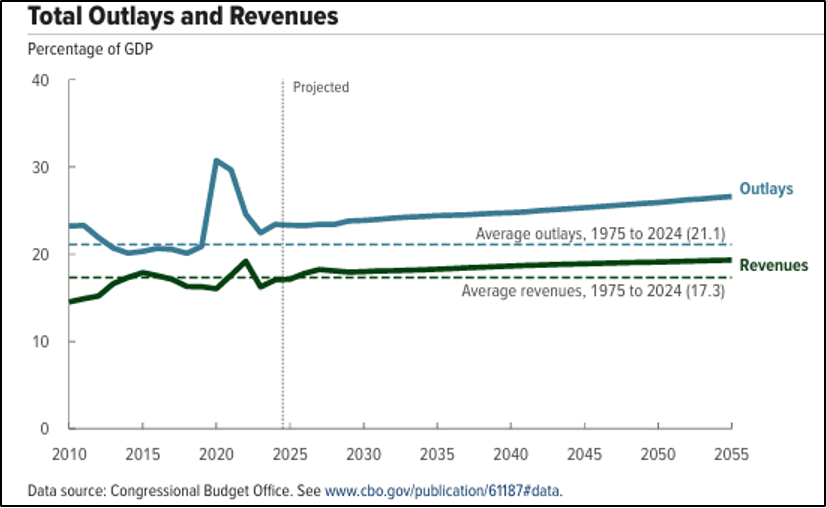
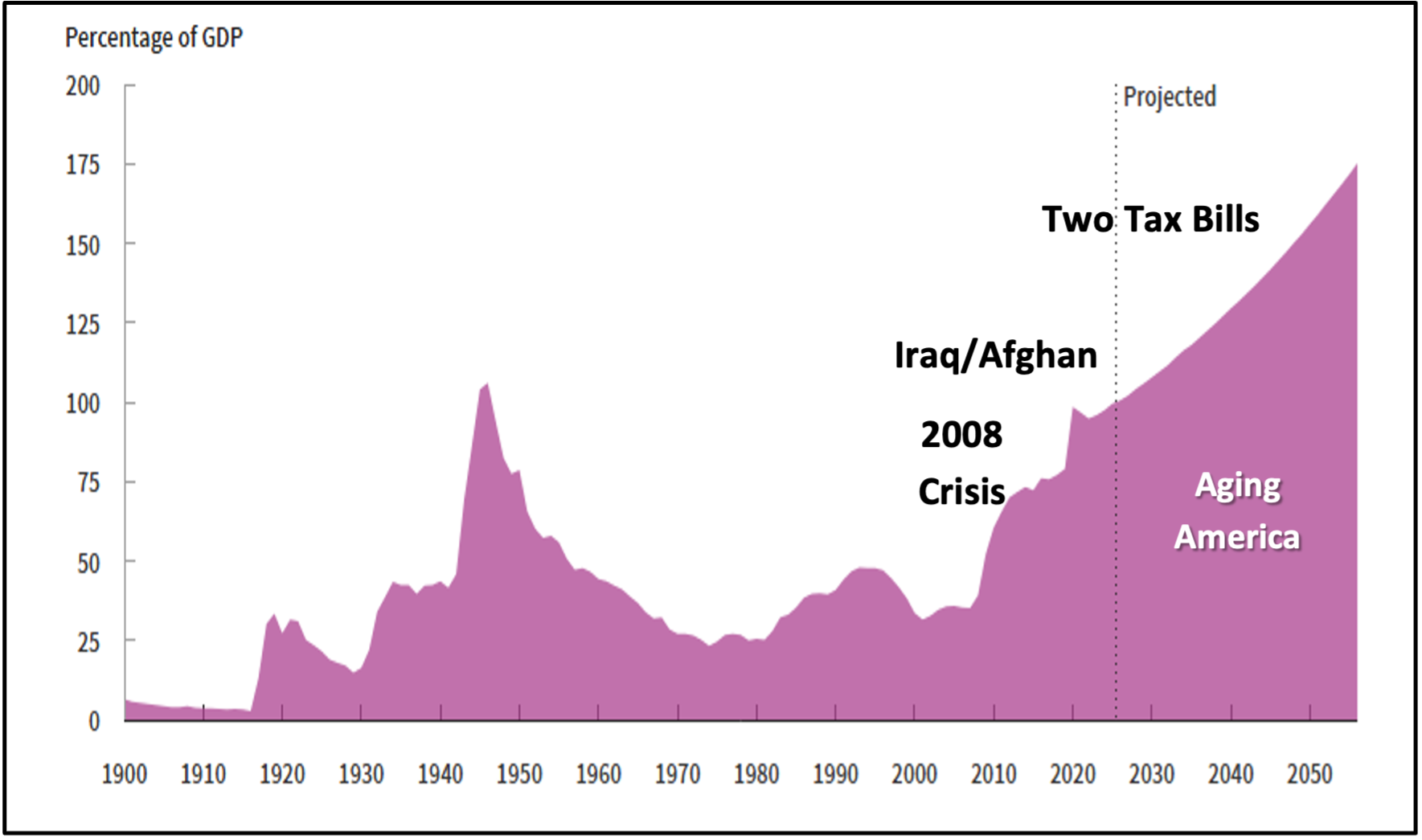
Figure 2 offers a depiction of federal debt held by the public from the Congressional Budget Office. This year’s deficit is projected to be $1.85 trillion. A few events from the recent past that generated some of that debt have been added to the graphic. Our government took extraordinary actions to cushion the social and economic impacts of the 2008 financial crisis and the COVID pandemic. We also borrowed to finance operations in Afghanistan and Iraq. Our demographic future and associated social and healthcare costs influence the projection as America ages.
Figure 2. Federal Debt, 1900-2056
Some of my professional colleagues have noted that the United States has provided for its defense at higher rates during the Cold War. They contend that this history supports the ability of the US government to once again reach these levels of defense spending. As Todd Harrison, the “go to” budget expert at the American Enterprise Institute put it, “The United States could spend a much greater share of its budget on defense, as it has in the past. The nation spends a smaller share on defense because other forms of spending have taken priority. This is a policy choice, but it is not a fiscal constraint.” He is correct: We have spent a greater share of the federal budget in the past and it is a policy choice.
However, that is only part of the historical context. Significant discontinuities exist including the diminished political consensus that underwrote the Cold War. The biggest discontinuity between now and the Cold War is the debt, or more accurately, the interest payments on that debt. The Congressional Budget Office estimates the interest cost on our expanding debt is $1.039 trillion in Fiscal Year 2026. In fact, interest payments are the fastest growing component of the federal budget. So yes, we have paid more for defense in the past but never when this deeply in debt and never when interest payments exceeded annual security budgets.
Resolving Our Strategic Insolvency
American policymakers and strategists face a dilemma. We continue to face a dynamic security environment including an intensifying strategic competition with a peer state. At the same time, elements of our defense establishment are eroding due to age or technological obsolescence. Simultaneously, we have dug a hole in our national wallet by the promiscuous use of the national credit card. We have reached a tipping point where our annual debt burden is actually higher than our annual defense budget. By this fall, we will be $40 trillion in debt and well on the way to $50 trillion by 2032.
As the security scholar Susan Bryant noted in her anthology on resourcing our security, “Strategically, the American government’s current alignment of ends to means—of revenue generation to government spending—is incoherent and is running a high risk of failure if significant reform is not immediately undertaken.”
So how do we do resolve this dilemma and bring our commitments and our capabilities into better alignment as trenchant observers like Walter Lippman recommended long ago? My proposal is for a five-year legislated defense appropriation that ramps spending in $100B increments (see Table 1). This provides a predictable basis for both the management of the Pentagon’s investments and congressional oversight. The Pentagon can effectively manage the proposed increase in a responsible manner in a responsible manner with this profile. If this proposal were enacted, the US government would get to the same level Trump asked for but over a longer time period with predictable programmed growth.
Table 1. Proposed US Defense Spending Profile

To ensure strategic discipline, Congress should carefully scrutinize the full cost of the Golden Dome program. It may be technologically feasible but is it the priority problem? How well does this program secure the nation from more likely cruise missiles or drone attacks on critical infrastructure? Additionally, Congress should also closely examine the operational necessity of a 36,000-ton battleship. Could modern cruisers of 18–20,000 tons serve as a better platform for volume fires and advanced weapons?
Given the fiscal picture, an important consideration for an increased Pentagon budget should be that it must be paid for, either by tradeoffs within existing government programs or increased revenues. Increases to corporate tax rates, closing loopholes, reducing healthcare outlays, and paring back tax cuts are possible solutions to increase revenue. We may have to consider all of them. If we are serious about our security situation, we should pay for it, not simply put it on the country’s credit card for the next generation to pay for. We have dug deep holes in our security and national treasury. It is time to stop digging and make the clear choices and resulting sacrifices that are needed. It is time to build the “peace through strength” that the 2025 National Security Strategy calls for and close the gap between our desired ends and the means to secure them. In short, we need to regain our strategic solvency.
Featured image by Kevin Doyle/Unsplash