 A Nation Must Think Before it Acts
A Crown Jewel in Peril: Russia’s Arctic Aggression Masks Nuclear Vulnerability
A Nation Must Think Before it Acts
A Crown Jewel in Peril: Russia’s Arctic Aggression Masks Nuclear Vulnerability

A nation must think before it acts.

A Crown Jewel in Peril: Russia’s Arctic Aggression Masks Nuclear Vulnerability
Russia sees opportunity in the Arctic. For centuries, ever-present sea ice has made the region hostile to trade or military exploitation. But as the ice melts, that reality is changing. Russia plans to capitalize on the economic benefit of arctic trade, is increasing its military presence in the region, and is leveraging its dominance to conduct disruptive gray zone activity against US allies. But the retreat of arctic ice may not work entirely in Russia’s favor. As the ice melts, Russian nuclear weapons are becoming more vulnerable. Allies must thread the needle between appropriately exploiting this vulnerability, and avoiding Russian overreaction.
Russia’s Arctic Interests
A significant portion of Russia’s Arctic power projection is based on its dominance of regional trade. Russia is expanding the Northern Sea Route (NSR), a long-established shipping route between Russia and Asia, into a broader trade network known as the Trans-Arctic Transport Corridor. Russia maintains tight control over the area by requiring that international vessels obtain both Russian permission and icebreaker escort from its fleet to transit the route.
This behavior is part of a broader pattern of Russian lawfare in the region, leveraging contested legal claims to restrict allied freedom of movement in the Arctic. After Russia passed a law in late 2022 regulating the navigation of warships in the NSR, allied-aligned analysts have debated whether to conduct a freedom of navigation operation there, However, the risks have ultimately outweighed the benefits and Russia maintains de facto dominance over the route.
This dominance is reinforced by a strengthening military posture. Russia has revitalized its Arctic military forces for over a decade by rebuilding Soviet-era bases and modernizing air defense capabilities. In its 2023 foreign policy concept, Russia listed the Arctic as a priority region, second only to its near abroad in Eastern Europe. However, Russia’s foreign policy and military expansion seems to increasingly serve its trade decisions, rather than the other way around. Cargo volumes in the NSR have fallen over the past two years, reaching a new low of 37 million metric tons last year and bucking Putin’s 2018 ambitions of traffic reaching 80 million by 2024. The NSR’s relative economic weakness indicates the true purpose of Russian regional dominance: power projection.
Russia’s lawfare and military expansion facilitates military control, which in turn shields Russia’s gray zone warfare activities. Russia’s “shadow fleet” of vessels, sailing under flags of convenience, has been increasingly implicated in the destruction of undersea infrastructure, as well as its broader sanction-evasion efforts. Russia’s control over the surrounding waters facilitates these activities, allowing the shadow fleet to move with impunity across increasingly broad swathes of Arctic waters.
A Crown Jewel in Peril
While the Arctic is presently a region of Russian strength, it also houses one of Russia’s most precious, and historically most vulnerable, assets: its nuclear-armed ballistic missile submarines, or SSBNs. According to US intelligence estimates, two-thirds of Russia’s sea-based nuclear forces are based on the Kola Peninsula – the region of Russian near-Arctic territory closest to the Norwegian border. The peninsula is highly militarized, and sits at the core of Russia’s Arctic power projection. It is home to the headquarters of Russia’s Northern Fleet at Severomorsk and a submarine base at Gadzhyievo, which hosts both Cold War Delta-IV and modern Borei-class ballistic missile submarines.
Russia’s crown jewel of nuclear deterrence did not come to reside in its freezing home by happenstance. During the earliest days of the Cold War, the Soviets had not yet developed intercontinental-range missiles to mount on their submarines. To carry out a nuclear strike against the United States—or to patrol in a region from which they could do so—their SSBNs had to navigate close to the US’s Atlantic and Pacific coastlines. But these locations close to US coastlines were within range of a large network of US passive acoustic sonar sensors called SONOS, which could detect and track Soviet submarines, thereby minimizing the submarines’ value as a deterrent force.
Soviet espionage eventually identified this vulnerability, and the USSR quickly moved to better secure their naval nuclear deterrent. Instead of transiting subs through risky, distant waters, they developed longer-range sea-launched missiles capable of hitting the United States from the Barents Sea and nearby Arctic waters closer to home. To further secure these local submarine patrol areas, the Soviets constructed “bastions,”or zones of layered defenses where SSBNs could safely reside, surrounded by networks of sensors, mines, escorting attack submarines, and other naval assets.
But the layered bastion defense was not the only thing protecting Soviet submarines. The surrounding Arctic ice served, in effect, as a security blanket for vulnerable SSBNs.
SSBNs are pursued by mixed forces of planes, helicopters, and ships, equipped with various sensors designed to detect submarines in their underwater hiding places. Additionally, submarines can be followed, or “tailed,” by other submarines. All of these methods of submarine detection are further complicated by the presence of surface sea ice. Large ships struggle to navigate zones with heavy sea ice and the sensor arrays they tow for submarine detection can be disrupted by unpredictable ice floes. Some anti-submarine planes and helicopters can detect submarines through the ice by identifying the magnetic field disruption caused by their hulls, but their munitions are unable to punch through thick “pack ice,” especially when traveling at the low altitudes required for submarine tracking. Finally, the sound wave detection methods used to tail submarines underwater are made unreliable as they pass into the sonically active marginal ice zone, where ice breakup causes significant acoustic anomalies.
Altogether, the under-ice environment is much safer for submarines than the open ocean, especially when actively evading an opposing anti-submarine warfare (ASW) force. The decline in Arctic ice could remove one of the layers of protection Russia relies on to secure its SSBN fleet, reintroducing an early Cold War vulnerability in a modern context.
Measuring the Danger
Geospatial analysis reveals just how bad this challenge is for Russia. The following figure shows how long Russian submarines would need to traverse to safer under-ice waters, assuming that they could travel in a straight line at maximum speed, a scenario which is unlikely in practice.

Graphic courtesy of Carl Parkin based on data from the National Snow and Ice Data Center (NSIDC)
The figure demonstrates that these transit times are growing longer across all seasons, especially in late summer, when record lows of around 20 hours from the 1980s are blown out of the water by 35+ hour transit times in recent years. Additionally, the upper curve of the graph observed during summer months is stretching horizontally. This indicates that the length of “ice summers,” when traversal times are at their highest, is getting longer, meaning there are more days each year where Russian submarines are further from the protection of ice.
But traversal time isn’t the only variable that should concern Russia—the following figure shows that as the ice melts, it is receding further into the waters of its adversaries. While the 1980s saw sea ice regularly reaching through the gap between the archipelagoes of Svalbard (demilitarized, and controlled by Norway) and Franz-Joseph Land (Russian-owned), the ice is now hiding itself behind Svalbard and moving closer to the coast of allied-controlled Greenland, where US bases create far more dangerous waters for a Russian SSBN.

Graphic courtesy of Carl Parkin based on data from the National Snow and Ice Data Center (NSIDC)
Allied Opportunities
These estimates deserve a caveat: other variables may improve submarine survivability in the Arctic region. A recent study found that changing water temperatures in the Arctic are affecting how sound propagates, perhaps providing a hider’s advantage to SSBNs. The Arctic soundscape is also changing as a whole, with ice breakup and increasing commercial activity creating more ambient noise in the region, which helps mask the sounds of nuclear submarines.
Nevertheless, the changing extent of Arctic sea ice will affect the vulnerability of Russian SSBNs in the future, and alter the overall dynamics of naval warfare in the Arctic. In the mid-1980s, in response to the Soviet bastion strategy, the Allies implemented a new Maritime Strategy designed to be implemented in the event of war. The centerpiece of this plan was a naval surge into the Barents Sea, enabling an aggressive campaign to hunt down Soviet SSBNs. This strategy was criticized at the time for its feasibility in the Arctic’s harsh, icy conditions. As the environment changes, it may become more feasible.
NATO is already rising to meet the Russian threat in the Arctic, in part due to pressure from the Trump administration. In December 2025, NATO reorganized its Joint Forces Command, Norfolk, to include Denmark, Sweden, and Finland, “reinforc[ing its] posture in the High North” and creating a new “strategic bridge between North America and Europe” according to US Air Force General Alexus G. Grynkewich, Supreme Allied Commander Europe. In February of 2026, the Alliance launched the Arctic Sentry vigilance activity, after US President Donald Trump and NATO Secretary-General Mark Rutte agreed that “NATO should collectively take more responsibility for the defense of the region.” Arctic Sentry will intensify NATO’s force presence in the Arctic: the United Kingdom will double its troops in the Norwegian arctic to two-thousand over the next three years, and Sweden will lead a new four-thousand strong land force based in Finland. The operation will also involve integrated sensing and the construction of new infrastructure in NATO’s Arctic nations.
The Alliance is also pursuing high profile anti-submarine warfare modernization and expansion efforts. Germany has ordered eight P-8 Poseidon aircraft, massive derivatives of the Boeing 737 equipped with sensors designed to track submarines, and Norway has purchased at least five British Type 26 frigates, another anti-sub platform. To traverse through the ice that still remains in the contested Arctic, the US has signed a pact with Canada and Finland to construct a new fleet of allied icebreaker ships to challenge Russia’s long-held icebreaker dominance.
Altogether, NATO seems well-poised to exploit the emerging vulnerability of Russian submarines in the coming years. It has reason to do so: Russia’s submarine-based harassment is increasing. The UK Ministry of Defense recorded a 30 percent increase in Russian submarines entering British waters in the past two years, and the UK deployed forces in April to deter a covert Russian operation to sabotage its undersea cables. Russian subs may be less likely to engage in escalatory, gray zone activity if they are more aggressively tracked, tailed, and held at risk. While shifting from chasing off attack submarines to chasing down SSBNs may seem like a radical escalation, it is not without precedent given the extreme vulnerability of the Russian submarine force prior to its transition to bastion basing, and the explicit plan to destroy SSBNs laid out in the Maritime Strategy.
While Russia increased the rate and scope of its naval exercises across territorial and allied-aligned waters indiscriminately up until 2022, it now seems to have refocused to a more defensive, preparatory posture in the Barents Sea. This shift could indicate that Russia has recognized the emerging vulnerability to its submarine bastions, and is looking to secure its SSBN force regardless of the state of the Arctic ice. In doing so, Russia has revealed a soft spot. NATO has the opportunity to probe this vulnerability in an attempt to curtail Russian gray-zone activity.
However, regardless of its Cold War precedent, NATO should be cautious when employing this strategy. The Alliance must be explicit that its tracking and tailing of SSBNs is a reaction to Russian submarines’ gray zone activity, intended to re-establish a red line rather than conduct a counterforce first strike. Military innovations that threaten the efficacy of Russia’s nuclear forces have shaken Russia in the past, provoking it to resurrect and complete escalatory Cold War-era weapons proposals, such as the nuclear-powered cruise missile. Inciting further overreactions should be avoided by the Alliance if possible. Furthermore, in a worst case scenario, tracking SSBNs could lead to use-it-or-lose-it pressures in an emerging conflict. NATO should consider the balance of risks and benefits in its approach when attempting to deter future Russian aggression.
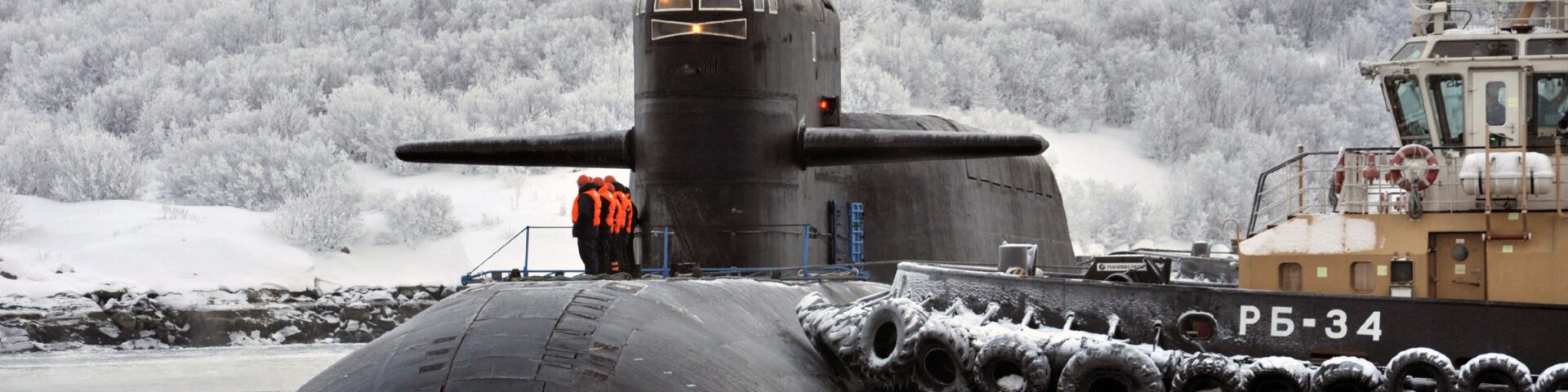
Featured image: The crew of K-51 Verkhoturie nuclear submarine based in in Gadzhiyevo base of the Northern Fleet of Russia, February 2023. PhotoXpress/ZUMAPRESS.com via REUTERS