 A Nation Must Think Before it Acts
How France’s Fall Signals China’s Rise in the Sahel
A Nation Must Think Before it Acts
How France’s Fall Signals China’s Rise in the Sahel

A nation must think before it acts.
How France’s Fall Signals China’s Rise in the Sahel
In a disturbing, though predictable, move, Burkina Faso severed diplomatic relations with France on June 26, 2026, accusing its former colonial ruler of pursuing “neo-colonial ambitions,” and maintaining “subversive networks,” and even supporting terrorist groups against the Burkinabè state. Paris described the decision as “hostile and unfounded.” Ouagadougou, however, called it long overdue, citing France’s alleged interference in Burkina Faso’s internal affairs along with the absence of trust, mutual respect, and respect for sovereignty that serve as the basis of normal diplomatic relations. The inevitability of this severing of the last institutional thread was predictable, as French troops were expelled from Burkina Faso in 2023, followed by French diplomats in 2024.
The diplomatic rupture is accompanied by a broader regional realignment. In June 2026, Burkina Faso, along with with Mali and Niger, formally withdrew from the Economic Community of West African States (ECOWAS), arguing that the regional bloc had increasingly come to serve the interests of France and other Western partners at the expense of their own national interests and sovereignty. Viewed alongside their decision to also withdraw from the Rome Statute, these moves signal a broader effort by these states to de-Westernize the normative architecture of the post-Cold War international order.
These decisions also reinforced these three states’ commitment to consolidating the Alliance of Sahel States (AES), whose rotating presidency is held by Burkina Faso’s Captain Ibrahim Traoré in 2026. The AES was established through the Liptako-Gourma Charter, signed on September 16, 2023, creating a confederation that spans approximately 2.8 million square kilometers and is home to nearly 75 million people. Although initially conceived as a mutual defense and collective security pact, the alliance has since evolved into a broader political, security, and economic framework.
The diplomatic rupture should therefore be understood as a part of a broader geopolitical realignment rather than simply another de-Westernization surge in the coup-détente dominated politics of the Sahel region in response to Western calls for democratization. Two factors help explain this shift.
The Region’s History Makes What Is All Too Predictable
First, the ongoing push for de-Westernization in Sahelian states such as Burkina Faso is deeply rooted in the region’s colonial history and enjoys significant, materially grounded popular support. Captain Ibrahim Traoré, Burkina Faso’s military ruler and interim president, has consciously and effectively utilized this sentiment by invoking the anti-imperialist legacy and iconography of Thomas Sankara, the country’s revered revolutionary and president, who was assassinated in 1987. Regarded as the “Father of the Burkinabè Revolution,” Sankara is often described as “Africa’s Che Guevara.”
Traoré has transformed Sankara’s legacy into a powerful instrument of political mobilization. His message has been further amplified across Africa and its diaspora through a dense digital ecosystem of sympathetic—and, at times, coordinated and inauthentic—media networks supported by non-Western partners.
Unlike earlier forms of rhetorical Third-Worldism—a movement advocating for solidarity and unity of developing, decolonized nations in Africa, Asia, and Latin America against both Western capitalist influence and Soviet-style communism, prioritizing economic self-sufficiency and anti-imperialism during the Cold War period—or dependency-driven critiques of the West, the current sovereignty narrative in Burkina Faso seeks to translate de-Westernization into tangible economic and political outcomes.
The question of whether the de-Westernization narrative is successful or not does not matter as long as it is presented as delivering real nationalistic gains. For example, the nationalization of gold reserves, a billion-dollar agro-pastoral program, is yielding huge benefits. As a result, rice imports were suspended following record domestic cereal production, and a massive push of infrastructural development, including the construction of roads, dams, and food processing plants, are presented as evidence that self-reliance can be achieved without IMF-backed structural adjustment conditionalities in exchange for emergency financial assistance, such as fiscal austerity, privatization, and market deregulation.
However, much Western analysis continues to interpret the Sahel’s realignment through the lens of how authoritarian regimes in these states work towards junta survival and military rule. But in doing so, this analysis ignores the domestic demand for beneficiation, sovereignty, and development that also drives these shifts. Meanwhile, the West’s repeated use of economic sanctions and diplomatic isolation risks strengthening the very anti-Western sentiment it seeks to counter.
China Seizes the Opportunity
The second factor has a wider geopolitical significance. As the Sahel in general, and Burkina Faso in particular, have become the laboratory of Africa’s de-Westernization movement, China has seized the opportunity to embed itself deep into the region’s political, economic and security structures, using the moment to expand its sphere of influence and strategic depth. Burkina Faso, a landlocked and war-torn state, is central to Beijing’s strategic ambition in the region. Sitting at the center of West Africa, Burkina Faso connects the Sahara to the Gulf of Guinea’s hinterland. As such, nearly every commercial network and trade route from the ports of Abidjan, Lomé, and Cotonou to the Sahelian interior runs through Burkina Faso or its AES partners, making the confederation a strategically important hub.
Moreover, Burkina Faso is also Africa’s fourth-largest producer of gold, recording a record 94 tons in 2025. Recent finds of lithium, rare-earth elements, and cobalt reserves have further positioned the country at the center of the global critical mineral landscape, which is of interest to the US, China, and other powers. At the same time, Burkina Faso has also emerged as the epicentre of jihadist violence in the Sahel. The Jama’at Nusrat al-Islam wal-Muslimin, for example, is estimated to contest control over nearly 60 percent of the country’s territory through a sustained violent insurgency, making the country one of Africa’s most fragile and conflict-prone states. This deteriorating security landscape contributed to Burkina Faso being ranked as the world’s second-most terrorism-affected country in 2025. For Traoré, this is his single biggest challenge. As such, whoever helps him fight Ouagadougou’s battles gains strategic leverage over the entire Sahelian heartland—and over the logistics corridors that link it to the Atlantic seaboard. As such, China has gone all out in providing the financial, military, diplomatic, logistical, and technological support that has sustained Burkina Faso’s efforts to combat jihadist groups.
The Traoré government, however, has not simply exchanged one external patron for another. Rather, Burkina Faso is pursuing a strategy of polyalignment, simultaneously cultivating functionally differentiated partnerships with multiple non-Western powers simultaneously in order to maximize strategic autonomy. Each partner serves distinct strategic needs. Russia, for example, provides the political and security pillar through the foundational bilateral agreement signed between the two countries in Moscow in February 2026. The agreement envisages the deployment of Africa Corps personnel for regime protection, cooperation on Rosatom’s proposed civil nuclear program, and networked support to the information ecosystem that reinforces the Traoré government’s narrative of sovereignty and de-Westernization. In addition, Turkey has emerged as a crucial defense and critical infrastructure partner, supplying Traoré with armed drones while expanding its role in the country’s energy sector. One example is the Turkish-built 119 MW power plant, financed by the Africa Finance Corporation, which is expected to become Burkina Faso’s largest electricity facility when it becomes functional in 2027. Investments from the Gulf states, meanwhile, fill important financing gaps across various sectors.
Nonetheless, Russia’s economic constraints and the ongoing Russia-Ukraine conflict have posed severe structural limitations on Moscow’s ability to maintain long-term support. According to SIPRI, Russian arms exports declined by roughly 64 percent between 2015–19 and 2020–24, highlighting Russia’s diminishing capacity to sustain long-term economic and security partnerships abroad. Although Russia can reinforce the politics of geopolitical realignment, it lacks the economic depth to finance Burkina Faso’s developmental and defense ambitions. Against this backdrop, China assumes far greater significance than any other country engaging with Burkina Faso. Beijing can serve as the one-stop solution, capable of combining capital for long-term financing at scale, infrastructure, industrial capacity, defense equipment, and information ecosystem. These comprehensive offerings have positioned China as the material center of gravity in Burkina Faso’s evolving network of external partnerships.
China has moved swiftly moved to fill the vacuum that the West never managed to fill. Since restoring diplomatic relations with China in 2018 after severing ties with Taipei, Burkina Faso has witnessed a deep and rapid strengthening of its strategic partnership with Beijing. The relationship has built momentum following a recent multi-phase defense agreement with the PRC-owned arms conglomerate NORINCO in 2024, aimed at boosting the Traoré government’s defense capacity. Since then, Ouagadougou has received successive deliveries of Chinese defense equipment, including VP11 and CS/VP14 mine-resistant armoured vehicles, VN22B fire-support platforms, PLL-05 self-propelled gun-mortars, SR5 multiple rocket launchers, and other advanced military platforms. This technology has provided Burkina Faso’s forces with long-range strike capabilities, significantly enhancing its firepower and mobility for the first time against JNIM. More importantly, these defense systems were delivered in months rather than years and are reportedly financed through flexible arrangements that are backed by future gold exports, without the political and structural economic conditionalities that usually accompany Western security assistance.
Arms Transfers Database for Burkina Faso
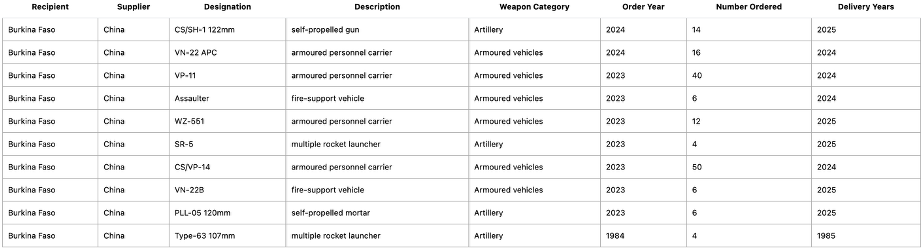
Source: SIPRI
It is therefore unsurprising that China now accounts for roughly 26 percent of West African arms imports and has displaced Russia as sub-Saharan Africa’s largest weapons supplier. However, the partnership extends well beyond weapons. Beijing has also become a major development partner, funding energy projects, critical infrastructure, and digital connectivity, in addition to the extraction and processing of critical minerals, a sector in which China holds a global monopoly. Technology transfer (which France never provided over six decades), satellite communications systems, the Smart Burkina urban policing and security program, Chinese state-owned enterprise Yunhong’s involvement in rare-earth exploration, and the appointment of Chinese businessman Li Yubao, who acquired Burkinabè citizenship, as a special adviser to the president, indicates the growing institutionalization of the relationship between Ouagadougou and Beijing. The relationship provides both capacity and capability rather than a purely transactional exchange. For instance, Beijing has provided more than US$30 million in grant aid to Burkina Faso and brought the country within the implementation framework of the 2024–27 Forum on China–Africa Cooperation (FOCAC) Action Plan. This framework has paved the way for deeper institutionalized cooperation in security, infrastructure, and development, reflecting Beijing’s strategic ambition to position Burkina Faso as a model of its integrated security-development approach in the Sahel.
To view China’s Sahel engagement as merely continental or country-centric is to overlook its most consequential dimension: Beijing’s geo-economic strategy. For Beijing, strategically located, landlocked, resource-rich states in the Sahel region are not ends in themselves but cartographic means in order to gain strategic access to the Atlantic coast. China’s template is now becoming predictable and clearly visible. In the Indian Ocean, China translated more than two decades of ports, pipelines, and undersea cables projects investment in Djibouti into a naval base and logistics nodes to facilitate the People’s Liberation Army Navy’s (PLAN) “far seas defense” doctrine. As such, the strategic and tactical depth that China has gained in the western Indian Ocean region is now being replicated, more quietly and with less international scrutiny, on West Africa’s Atlantic-facing seaboard. The substantive evidence is quite visible, as the Chinese-built Niger-Benin pipeline, a 2,000-kilometer pipeline built at a cost of roughly US$6 billion and one of the longest on the continent, does not just terminate in the Sahel; rather, it terminates at the Atlantic export terminal of Sèmè-Kraké.
Furthermore, China’s state-owned defense giant NORINCO’s newest African primary support and service office is located in Dakar, Senegal, an important Atlantic connectivity hub, and is strategically positioned to service and cater for the arms supply ecosystem of all three AES militaries through personnel training, maintenance, and logistical support in the heart of West Africa. Beyond defense and security cooperation, Chinese-financed strategic port infrastructure now stretches from the re-expanded Friendship Port in Nouakchott, Mauritania, through the Gulf of Guinea, which US strategic planners have identified as consistent with Beijing’s strategy to establish a permanent naval facility on the eastern flank of the Atlantic. In January 2026, the first- ever BRICS-plus naval exercise was conducted off South Africa’s Western Cape in Atlantic waters involving Chinese, Russian, and Iranian warships. These developments suggest that China’s deeper engagement in the Sahelian interior is part of a larger strategy to weave a strategic corridor from the hinterland to the Atlantic coast, connecting gradually—corridor by corridor and contract by contract—to an emerging Atlantic maritime network that could provide PLAN strategic and tactical depth in “far off seas.”
The strategic implications are difficult to ignore. Since the Second World War, the Atlantic has largely remained the strategic heartland of Western (primarily US) maritime power—a maritime space where NATO and the US have enjoyed overwhelming naval dominance. An expanding Chinese strategic presence along Africa’s Atlantic rim—supported mostly by strategic Chinese investments in commercial ports with potential dual-use functions, integrated defense logistics, digital and satellite infrastructure, and access to the resource-rich Sahel—would provide Beijing with strategic options comparable to those created through its investment in Djibouti and Gwadar in the Indian Ocean. Such a network will give PLAN the capacity to sustain a long-term presence along critical sea lines of communication, broaden the geographical scope of strategic competition beyond the Indo-Pacific, and incrementally overturn the balance of power. In this respect, Burkina Faso is a critical frontier when viewed through Alfred Thayer Mahan’s famous observation that, “sea power begins ashore.” Burkina Faso, a landlocked country, may never host a Chinese naval base, but it provides Beijing with inroads that gradually shape and anchor strategic geography for greater maritime influence in the Atlantic.
However, China’s Sahel strategy also faces significant constraints. In Niger, for instance, Beijing has faced severe headwinds when Niger expelled Chinese oil executives and unilaterally revised the contractual terms governing Chinese National Petroleum Company’s operations. Its investment in the Niger–Benin oil pipeline has also come under severe strain due to repeated attacks by the Front patriotique de libération, an anti-junta rebel group. In Mali, the government has recently summoned the Chinese ambassador over deep concerns relating to illicit artisanal and illegal mining, a sector which has come under attack from JNIM. Across Africa, particularly among military regimes, governments have increasingly applied their resource nationalism clause in equal measure to Beijing as to Paris. Moreover, Chinese-supplied military platforms have not fundamentally altered the security balance, as JNIM still continues to expand its operational reach despite successive arms acquisitions by Sahel military governments. As such, China’s expanding footprint in this part of Africa is often described by strategists as built on politically fragile and highly contested ground.
Nonetheless, the broader direction of China’s expansion is becoming increasingly clear. The West has relied heavily on sanctions, the suspensions of diplomatic ties, and political and economic conditionality, a strategy that has, in many respects, done more harm than anticipated by further accelerating the very geopolitical realignment it sought to prevent. Consequently, non-Western democracies and responsible middle and emerging powers have become increasingly relevant to this evolving geopolitical landscape. However, they will need to compete on the scale and speed of delivery, infrastructure, finance, technology transfer, and credible partnerships, rather than relying primarily on normative messaging. In this context, India and other Global South middle powers have the opportunity to provide Ouagadougou with additional strategic options to de-risk and diversify without prescribing whom it should choose. Through demand-driven development finance partnership, capacity building and capability enhancement, technology transfer, resource beneficiation, and digital public infrastructure offered as sovereign public goods, they can strengthen Burkina Faso’s genuine strategic autonomy while ensuring that every external partner, including China, operates within a competitive environment rather than assuming the role of another neo-colonial actor. Ultimately, the defining moment in Africa’s quest for de-Westernization in an emerging multipolar order will hinge largely on whether the process produces genuine strategic autonomy and multilateral alignment rather than merely reproducing another cycle of dependency.
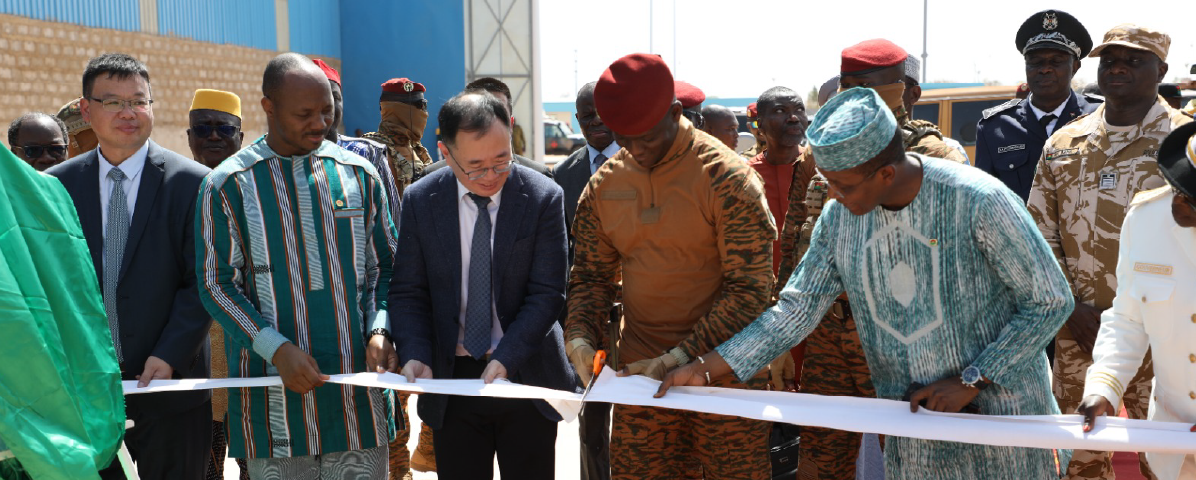
Featured Image: Captain Ibrahim Traoré inaugurated the Chinese-backed Sino-Burkina Ciments SA (CISINOB) industrial company at a 2025 ceremony in Burkina Faso. (Source: commerce.gov.bf)