 A Nation Must Think Before it Acts
In The Latest Russia-Belarus Non-Strategic Nuclear Exercise, Putin and Lukashenka Show Teeth
A Nation Must Think Before it Acts
In The Latest Russia-Belarus Non-Strategic Nuclear Exercise, Putin and Lukashenka Show Teeth

A nation must think before it acts.

In The Latest Russia-Belarus Non-Strategic Nuclear Exercise, Putin and Lukashenka Show Teeth
In mid-May, Belarus and Russia announced that they would conduct military exercises involving the delivery of nuclear weapons to units in the field. Over the next three days, imagery emerged of Russian and Belarusian forces practicing for the employment of nuclear weapons, including mock deliveries of nuclear warheads to Belarusian missile units.
The exercises were trumpeted by both Russian and Belarusian political leadership as an important step in achieving both Russian and Belarusian security against foreign threats. President Vladimir Putin said this exercise was the first joint training of the Russian and Belarusian armies on the management of strategic and tactical nuclear forces since Russia and Belarus announced their nuclear-sharing arrangement—perhaps the most significant change in Russia’s nuclear posture since its full-scale invasion of Ukraine.
This new nuclear relationship between Russia and Belarus has produced intense skepticism from some analysts, who view the deployment of nuclear weapons to Belarus as primarily a political effort that lacks military utility. This was perhaps evidenced by past joint exercises that appeared to be primarily intended to train the Belarusian military on basic nuclear operations. There was great skepticism that the level of cooperation went further than this into large-scale joint planning. However, recent Russian and Belarusian exercises have revealed a level of deeper theoretical integration between Russian and Belarusian nuclear and conventional units than many anticipated. Although the deployment of Russian nuclear weapons in Belarus still has ways to go, the exercise demonstrates an intent by both parties to systemize the link between Belarusian forces and Russia‘s strategic posture.
An Enhanced Threat Environment
On May 21, Putin stated that joint training on the management of strategic and tactical nuclear forces had been conducted due to an increased threat environment near Russia’s western border. Deputy Foreign Minister Sergey Ryabkov went a bit farther in a recent interview, commenting that the risk of a confrontation between NATO and Russia was growing, and blamed rhetoric from European capitals about an imminent war with Russia.
Top officials of both the Belarusian and Russian defense ministries have repeated these remarks in one way or another over the past five years. It would be easy to dismiss them, as many have, as simple propaganda. But the anxiety is real, especially as the United States and its European allies appear to have emerging disagreements on the direction of military policy. These remarks by Russian politicians reflect longstanding anxieties about Russia’s conventional inferiority vis-à-vis NATO.
Recall, for example, that the scenario for Zapad-21, one of the largest military exercises conducted by Russia and Belarus, was that an alliance of Western states (named in the exercise as Neris, Pomoria, and the Polar Republic) focused its force on Belarus after having failed to destabilize it via non-military means. This scenario was a clear reference to Russian and Belarusian concern about deterring Poland and other NATO states along the border specifically, given Poland’s ongoing military buildup. Minsk also noticeably drew attention to Poland’s decision to increase the core size of its military during the run-up to the 2025 iteration of Zapad exercise, although what was shown of the exercise turned out to be rather tame.
The accession of Finland and Sweden to the alliance has generated additional concern by high-ranking figures in the Russian military. In one article in Military Thought, the premier journal of the Russian General Staff, the head of the GRU, Adm. Igor Kostyukov, expressed that Finland would be the ideal location to deploy US strike assets to strike critical objects in the northern and western part of Russia.[1] This threat perception is likely to be enhanced with the recent Finnish revision of its laws to allow the transport and possession of nuclear weapons.
Moscow also believes that tensions between Russia and NATO over NATO’s support for Ukraine could lead NATO to impose a land and sea blockade on Kaliningrad, its vulnerable exclave. This threat perception was heightened by Lithuania’s sanction enforcement in 2022, in which Vilnius prohibited the transit of Russian goods that were subject to EU sanctions through its territory claiming it was obligated to enforce a European Commission decision. This issue was eventually resolved when Lithuania lifted rail restrictions after the EU clarified the scope of the transit ban. However, some Russian military analysts from the Russian Academy of Military Science saw it as a rehearsal for a blockade of Kaliningrad for a future contingency according to a recent publication in Vestnik Akademii Voenykh Nauk, a periodical that features both military and civilian perspectives and is like the US Joint Forces Quarterly.[2]
Seeking a Joint Nuclear and Conventional Deterrent
These concerns appear to be driving efforts by both Russia and Belarus to achieve a high level of interoperability at both the conventional and nuclear levels to deter and defeat conventional and nuclear attacks of various scales. This is reflected in the nature of the exercises themselves. According to the Russian Ministry of Defense, the exercise involved more than 64,000 troops, 7,800 units of military hardware including over 200 missile launchers, over 140 aircraft, 73 surface ships, and 13 submarines, including 8 strategic missile submarines. According to Pavel Podvig, the scale suggests that these numbers also represent the non-strategic part of the exercise and Belarusian participation.
Operational footage released during the exercise appeared to demonstrate these combat readiness efforts in practice. Chief of the General Staff Valery Gerasimov characterized the joint Russian-Belarusian training as a snap drill and highlighted that a delivery and transfer of nuclear munitions to Belarusian and Russian troops to use in combat had been carried out from May 19 to May 20. This included videos of a Russian nuclear weapons convoyinking up with a Belarusian Iskander missile unit in the field and transferring a (likely dummy) warhead to the missile body. According to the Belarusian Ministry of Defense, Iskander-M combat crews conducted preparations to receive special munitions for the tactical missile system and load them onto launch and transport-loading vehicles. After the munitions were loaded, the launchers and transport-loading vehicles covertly relocated to a new operational area and simulated a launch upon arriving.
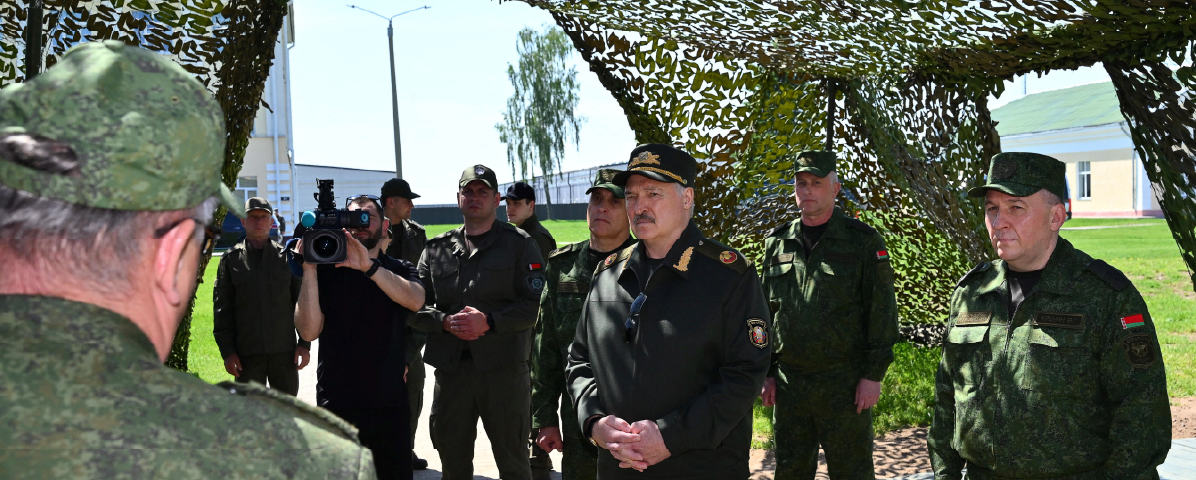
These exercises were consistent with the remarks of Lt. Gen. Igor Kolesnikov, commander of Russia’s 12 Main Directorate in charge of nuclear weapons stewardship, which stated that the 12th GUMO would be responsible for maintaining custody of Russian nuclear weapons at all points until they are ordered released to Belarusian field units in a crisis. In short, the Belarusian Iskander unit appears to have been the star of the exercises, with Lukashenka inspecting the unit’s headquarters in Asipovichi in person and receiving a painting of an Iskander.
Although less shown and discussed in Russian and Belarusian media, the Belarusian air component, consisting of Su-25 Frogfoot close air support aircraft capable of carrying nuclear gravity bombs, was also apparently exercised. The air leg of Belarus’s nuclear forces is by far the most baffling component of the entire nuclear relationship between Russia and Belarus, as the Su-25 is a suboptimal nuclear weapons carrier due to its slow speed, low survivability, and low operating altitude.
What is especially notable about this round of exercises was the degree to which Russian strategic forces were coordinated with Belarusian exercises. For instance, while Belarusian units conducted a launch of a ballistic missile from the Iskander-M system from Kapustin Yar, Russian strategic forces, including a Yars ICBM launcher and TU-95 aircraft, conducted exercises and practice launches.
Gerasimov’s own characterization of the exercise reinforced this interpretation. He seemed to play up the exercise highlighting that “at the first stage of the exercise From May 19 to May 20, a surprise check of nuclear forces was carried out. Troops and the forces were put on alert, full delivery was carried out and the issuance of nuclear weapons to Russian and Belarusian units combat use of nuclear weapons.” Gerasimov’s own remarks suggest that the exercise went farther than what was shown in the footage for both Russian and Belarusian crews, but most visual evidence suggests that mock warheads were used, although there is always the possibility that it was not shown due to operational sensitivity.
Questions surrounding the conduct of the exercise are not the only source of ambiguity. Other observers have also pointed out other incongruencies between Belarus and Russia regarding these set of exercises. For instance, the Belarusian announcement was released a day early. Taken together, this suggests the Russian-Belarusian nuclear-sharing arrangement continues to exhibit signs of an evolving system whose operational planning remain in flux.
Russian-Belarusian Concepts of Operations
To meet perceived threats, Moscow and Minsk are striving to maintain their forces in constant combat readiness and shape adversary decision-making. One of the standout moments of the exercise was the participation of a Belarusian combat crew that launched an Iskander missile at the Russian military training area of Kapustin Yar as part of the joint nuclear forces exercise. This may indicate that Belarusian forces are increasingly being incorporated into a broader set of conventional-nuclear integration measures than was evident in previous exercises.
The emphasis on readiness and survivability is consistent with Kolesnikov and retired Maj. Gen. V. V. Kruglov’s published writings.[3] In the pages of a 2024 issue of Military Thought they claimed that the United States and NATO are preparing to unleash nuclear war against Moscow and Minsk. Russia must respond to this threat through a variety of means, including ensuring the combat readiness of Russian and Belarusian nuclear forces. They advocate for improving tactical methods of maneuvering units in the field to escape and defend from adversary strikes to ensure the survivability of nuclear forces under intense enemy fire.
In addition to tactical innovations, Russian military thinking about coercive signaling is evolving. Since Russia launched its full-scale invasion of Ukraine, other Russian military thinkers have stressed the importance of credible demonstrations, including the showcasing of military systems and their capabilities. These musings are a product of a discussion that aims to grapple with the role of nuclear weapons in a Russian strategy to counter US and European horizontal escalation in Ukraine.
Konrad Muzyka argues that perhaps the most striking part of the exercise is not necessarily the direct participation of missile or strike-capable units themselves, but more so, the expanding focus on a framework surrounding these elements including air defense, command-and-control continuity, technical support, dispersal procedures, reserve-security functions, and operational survivability. Establishing a more organized battle rhythm of exercises is a critical component of the vision espoused by the very man responsible for operationalizing the nuclear-sharing arrangement, Kolesnikov. It also aligns with a vision to ensure operational readiness for a speedy deployment of capability during the initial period of war to safeguard Russia’s retaliatory capability.
Putin highlighted that this was the first exercise of its kind given the degree of high-level integration. He called the exercise the first joint training of the armies of Russia and Belarus in the management of strategic and tactical nuclear forces. Belarusian President Aleksandr Lukashenka agreed, highlighting that the general staffs and defense ministers of both nations had already been conducting exercises on a quarterly basis involving many of its individual elements and components. Putin also announced that Russia and Belarus will hold another Union Shield exercise in 2027, which are not associated with a nuclear component in contrast to the Zapad exercise set. Taken together, these developments suggest that the exercise was not simply an ad hoc addition to the Russian-Belarusian nuclear-sharing arrangement, but also part of a broader effort to systematize readiness and integrate conventional-nuclear related procedures into routine military activities.
Such efforts align with the concept of strategic deterrence in Russian military thinking. According to Anya Fink, Russian military analysts view strategic deterrence as a defensive strategy designed to prevent war and contain escalation if war breaks out. Although strategic nuclear forces play a central role in this strategy, conventional capabilities and the integration of nuclear and non-nuclear domains remain important components as well.
The Oreshnik intermediate-range ballistic missile, which is intended to be deployed in the future in Belarus—which was not featured in the exercise, nor did it seem active during the exercise according to satellite imagery we examined at the time—also appears to fit inside Russia’s strategic non-nuclear tool kit. In a recent issue of Military Thought, Sergei Karakayev, the commander of Russia’s Strategic Missile Force, wrote that the deployment of a brigade with the Oreshnik system “underscores the Russian Federation’s focus on preventing military conflicts primarily through reliance on strategic conventional weapons. In this case, the existing strategic non-nuclear deterrent potential can serve as a reliable tool for solving de-escalation tasks of regional and global deterrence without escalating the conflict to the point of nuclear weapons use.”[4] This statement further highlights the importance of Belarus as an extension of Moscow’s goal to integrate conventional and nuclear capabilities through an additional capability.
Conclusion
While Moscow’s military remains bogged down in Ukraine, recent exercises reveal a glimpse of how the General Staff visualizes the role and the use of Belarus in a future contingency. For now, Moscow and Minsk are putting pieces on the board as they gradually operationalize their nuclear-sharing arrangement.
More importantly, we continue to observe aspects of key concepts in Russian military thinking in the operationalization of the nuclear-sharing arrangement. At the same time, we have also seen that Moscow and Minsk can send incoherent and contradictory signals both between themselves and to the West. These signals are not a bug but a feature of an arrangement that is yet to mature. As Moscow reflects on how to bolster its coercive reputation as it wages war on Ukraine, it is important for NATO members to recognize that they are observing a process of experimentation and that not all the pieces will necessarily line up.
[1] I.O. Kostyukov, “NATO’s Military Activities as The Main Source of Military Threat to Russia,” Military Thought, no. 5 (2024).
[2] S.A. MODESTOV, L.P. KOROLEVA, and A.I. BRAGNIK, “Strategic Deterrence in a Hybrid Confrontation (СТРАТЕГИЧЕСКОЕ СДЕРЖИВАНИЕ В ГИБРИДНОМ ПРОТИВОБОРСТВЕ),” Vestnik Akademii Voenikh Nauk 94, no. 1 (2026).
[3] I.A. Kolesnikov and and V.V. Kruglov, “On New Military Dangers and Threats to Russia,” Military Thought, no. 6 (2024).
[4] Sergei Karakayev, “Analysis of The Experience of Military Conflicts and Its Impact on The Directions of The Construction and Development for the Strategic Missile Forces (Анализ опыта современных военных конфликтов и его влияние на направления строительства и развития РВСН),” Military Thought, no. 4 (2026).
Featured image credit: Belarusian President Alexander Lukashenko visits a missile brigade of the Armed Forces during joint Russian-Belarusian nuclear exercises, in the Asipovichy district, Mogilev region, Belarus, May 21, 2026. President of the Republic of Belarus/Handout via REUTERS