 A Nation Must Think Before it Acts
Taking LEO Off the Board: Russian Thinking About Anti-Satellite Warfare
A Nation Must Think Before it Acts
Taking LEO Off the Board: Russian Thinking About Anti-Satellite Warfare

A nation must think before it acts.

Taking LEO Off the Board: Russian Thinking About Anti-Satellite Warfare
 Executive Summary
The Soviet Union and Russia have invested in anti-satellite weapons to ensure that their nuclear deterrent remains credible. For both the Soviet Union and Russia, the destruction of American satellites was (and is) viewed as part of the country’s broader nuclear war plan and part of the opening salvo in a nuclear conflict with the United States. During Soviet times, these investments were aimed at developing conventional anti-satellite weapons to hold risk the relatively small number of US early warning satellites. The Soviets paired these weapons with a large nuclear force, along with novel delivery system – Fractional Orbital Bombardment – to ensure that its deterrent could strike US targets in ways that could evade nascent missile defense.
The return of US missile defenses has spurred considerable Russian investments in similar novel delivery systems, designed to evade any current or future investment in missile defense. The US investment in Golden Dome has also catalyzed investment by Russia in nuclear-armed options to hold at risk large satellite constellations, including those operated by private space operators, which military thinkers assume will be leveraged by the Department of Defense during any conflict for targeting and reconnaissance. The result is a serious investment and thinking about “taking low-earth-orbit” off the board in a nuclear conflict and the development and testing of nuclear armed satellites and upgraded orbital bombardment capabilities.
Historical Counter-Space Foundations: The Soviet Union historically developed diverse anti-satellite (ASAT) capabilities—including the ground-controlled Istrebitel Sputnik interceptor, the highly maneuverable Naryad system, and the Skif/Polyus orbital laser platform—to neutralize US strategic advantages and protect its nuclear deterrent
Resurrection of Orbital Bombardment: To bypass northern-oriented American early-warning radars, the Soviets deployed a Fractional Orbital Bombardment System (FOBS) in 1967 that traveled a southern path over Antarctica; Russian President Vladimir Putin has resurrected this exact approach to evade modern missile defense tracking through the development and May 2026 testing of the RS-28 (SS-X-29/SS-X-30, Satan II) Sarmat ICBM.
Commercial Networks as Primary Targets: Evolving Russian military thinking explicitly designates Western commercial satellite networks like Starlink, Maxar, and Planet’s Dove constellations as legitimate targets for military destruction due to their active role in providing battlefield intelligence. Russian analysts are highly alarmed by commercial Synthetic Aperture Radar (SAR) technology, which penetrates cloud cover and directly dismantles Russia’s traditional reliance on tactical camouflage and military deception (maskirovka).
Taking LEO Off the Board”: Spurred by an influx of spending for the upcoming Golden Dome space-based interceptor architecture, Russian planners are increasingly incentivized to further bypass traditional treaty norms and leverage co-orbital nuclear weapons to achieve a catastrophic mass-kill of low-earth orbit tracking networks and space-based defenses.
Introduction
The Soviet Union pioneered early space flight. These early space flight designers took extreme risks, built impressive rockets, and awed the world with the aggressive launch of the world’s first satellite and human into orbit. The Cold War pushed both Moscow and Washington to develop new weapons to overcome defenses, or to try and carve out an advantage during a potential conflict in Europe. The space race defined the early Cold War, ending in 1969 when the first American astronaut set foot on the moon.
The quest to leverage space for warfighting has continued. The United States has a clear advantage in this area, leveraging satellites for global communications and for remote observation of foreign countries. The American dependence on space-based assets has prompted serious investments in weapons to destroy them in orbit. The Soviet Union launched programs to build a large, land-based ballistic missile force before the 1970s, when it is generally determined that Moscow assumed nuclear parity with the United States. The Soviet Union prioritized offense during the first two decades of the Cold War, relegating ballistic missile defense (BMD) to theoretical studies and basic concepts in the national laboratories and ministries.
The Soviet prioritization made sense. However, once the two sides reached nuclear parity, Soviet leaders made an effort to ensure the survivability of their deterrent, concluding logically that any American advancement in defenses would be directly threatening to mutual deterrence. The Soviet Union also had the same technological factors that pulled its leadership to authorize spending on experiments on increasing missile accuracy. The miniaturization of electronics and the integration of more capable chips into guidance allowed for the upgrading of platforms to improve guidance and accuracy. The result was the increased capability for missiles to target other missiles, creating a technological pathway to study and develop capable missile defenses and conventionally armed anti-satellite weapons.
Soviet and Russian thinking about space as a military domain is a reflection of how the country organizes its armed forces and how military elites think about warfighting. In the United States, space has clearly emerged as a separate domain, to be protected because it enables American offensive operations globally. The Soviet investment was anchored around having anti-satellite missiles, capable of destroying small numbers of high-value American assets in space. The thinking was basically to disrupt American command and control to upend conventional and nuclear warfighting elements of the American military. This strategy was dependent, in part, on the fact that during the Cold War the number of American satellites was quite small—and the cost of launching and building those systems was far less than the investments needed to hold them at risk.
The change to Soviet thinking in the 1980s was spurred, in large part, by the promise of Ronald Reagan’s Strategic Defense Initiative (SDI). The goal of SDI was ambitious and hinged on the launch of space-based missile defense, designed to provide global protection from missile launch. The space-based layer was eventually dubbed “Brilliant Pebbles” and designed around the idea that these interceptors would be housed in ever-present satellites, deployed in high enough numbers to shoot down during the initial boost-phase of a Soviet nuclear-armed missile. The promise of the Brilliant Pebbles concept alarmed Soviet planners, who assumed the worst—that the system would work. The result was an expansion of ongoing work on both ballistic missile interceptors and anti-satellite weapons and, eventually, the investments now being made in nuclear-armed satellites in orbit. The intention is to overcome American missile defenses in three interlinked ways: creating delivery vehicles to evade ground and space-based missile interceptors; investing in more nuclear weapons, including exotic systems to destroy large satellite constellations; and retaining legacy anti-satellite (ASAT) and BMD programs to hold at risk both US and European missiles, along with a smaller number of orbiting assets.
This paper will examine Soviet and now Russian thinking about war in space, the investments made to hold at risk US assets in orbit, and how US private sector advancements are pushing the Russians to consider deploying nuclear weapons in space. The topic is challenging because Moscow is not forthcoming about its ambitions or plans, but what follows is a historical summary of their orbital and ground-based anti-satellite programs, investments in missile defense evading platforms, and what is publicly known about their nascent efforts to develop a nuclear armed high-earth-orbit satellite.
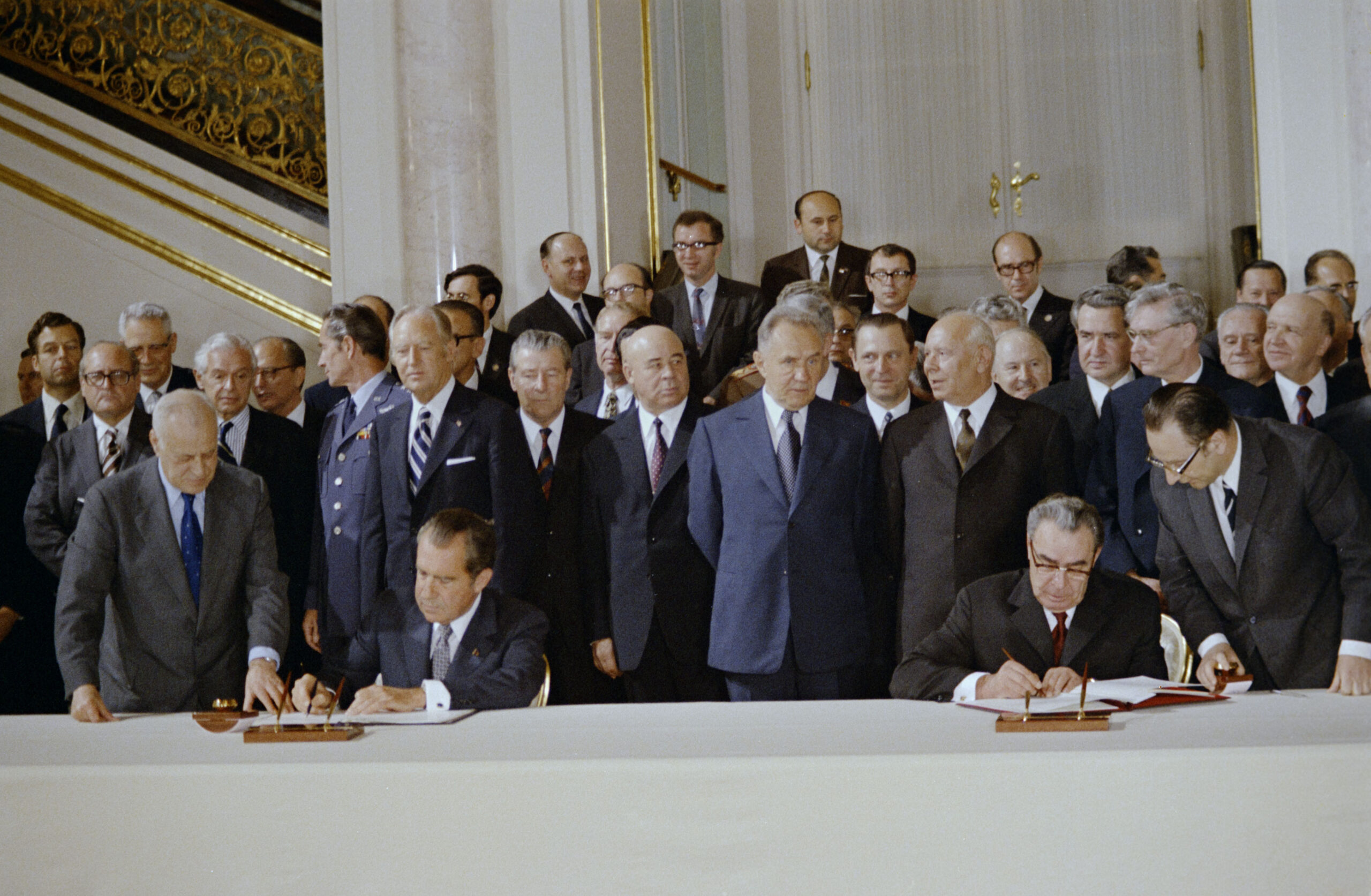
May 26, 1972. President Nixon and General Secretary Brezhnev signing the (SALT 1) ABM Treaty. (Nixon Presidential Library)
History of Soviet ABM Programs
The Soviet Union’s investments in counter-space were designed, at the macro level, to hold at risk a small number of US satellites, which Moscow thought would need to be attacked before or during major combat operations. The entirety of the Soviet effort was broadly in line with their space program, which had numerous overlapping design bureaus working on space projects, along with a public facing civilian space program.
From the outset of the Soviet space program, Moscow studied and invested in technology to enable combat in orbit. As William Odom notes, the Soviet Union was hesitant to engage in a BMD arms race while simultaneously building a massive intercontinental ballistic missile (ICBM) force. This hesitance helps explain Soviet enthusiasm for the Anti-Ballistic Missile (ABM) Treaty, which placed limits on the number and locations of interceptors in both countries.[1]
Moscow’s hesitance, however, did not prevent researchers from planning and proposing new defensive systems, and work proceeded at varying levels throughout the 1960s and 1970s. The two main programs of note were for earth-observation satellites, or RORSATS, and then the Istrebitel Sputnik (IS) program, which oversaw work on the Soviet Union’s ASAT and BMD programs. Russian concepts for combat space systems date to very early in the space race and continue to appear in current satellite operations. In addition to IS and Naryad’s roots at the Chelomei design bureau, OKB-41 (now known as the Kometa Corporation) considered a variety of possibilities in its technical proposals.
The programs were also consolidated in the 1980s and gathered under two larger umbrella programs. The D-20 program, under the Ministry of Radio Industry, primarily contained ground-based BMD projects. This fit with the ministry’s traditional roles in missile defense, early warning, and command and control. The SK-1000 program, under the Ministry for General Machine Building, focused on space-based BMD and both ground- and space-based ASAT projects. An additional program, Kontseptsiya-R, held the Ministry of Radio Industry’s ASAT projects.
The IS program began in 1961 and the development of the interceptor was delayed and then tested in the early 1960s. The system was not ground-based. Instead, it was an actual satellite in orbit. The system included a ground-based radar, control station, rocket, and satellite. The ground-based radar determined the orbital parameters of the target satellite and passed the data to the command station, which calculated the launch trajectory for the rocket. After separating from the rocket, the attacking IS satellite approached the target, first via pre-programmed and commanded maneuvers, and then by tracking the target satellite with the IS satellite’s built-in radar. The program began in 1961 with the last test carried out in 1982. It was operational between 1978 and 1993, with the final version, the IS-MU, entering into service in 1991.[2]
This program was later subordinated under the aforementioned SK-1000 program in the mid-1980s; a response by Premier Mikhail Gorbachev to the SDI effort in the United States. The SK-1000 program ultimately included the IS program, a rival project dubbed Naryad, Kaskad, and Kamin.
The Naryad project was a co-orbital Soviet system, designed to carry warheads to destroy satellites in orbit. Naryad incorporated a newly designed propulsion module and had very large propellant reserves. It was, therefore, capable of very substantial changes to the craft’s orbit. The basic idea was to use the satellite’s maneuverability to get close to satellites in orbit, either to rendezvous with them or to then use on-board radar to guide missiles towards their targets. Naryad was thus a multi-use system—compared to IS, which destroyed itself near the target.[3]
The Kaskad program included an optionally crewed space plane concept. Optionally crewed orbital platform armed with ASAT and ABM missiles. RSC Energia made preliminary designs for both missile-armed (Kaskad) and laser-armed (Skif) platforms; KBTochmash (the Nudelman design bureau) was responsible for the missile armament. The missile armament was expected to weigh less than the laser complex, so it was expected that the missile platforms would carry more propellant (and thus have greater capacity to maneuver). Additionally, it was proposed to refuel the stations using Buran-type spacecraft. The laser platform was intended to attack targets in low earth orbit, while the missile platform attacked targets in medium and geostationary orbit.
While little is known about the ASAT missiles for Kaskad, a mockup of the ABM shown in an Energia publication looks very, very similar to early Brilliant Pebbles concepts. Several Progress spacecraft were modified to serve as test platforms for the system, with launch into orbit planned for 1986-88. The spacecraft were never launched and were later converted back for normal use.[4]
The Soviets also pursued a second, laser-focused program: Skif/Polyus. Both Skif and Kaskad were intended to share propulsion and other components. The lead developer, Astrofizika, was unable to create a laser of the desired power (one megawatt) that would fit within the weight and size constraints of the Energiya-designed platform and Proton launch vehicle. Work on Skif fell behind Kaskad until 1983, when the US Strategic Defense Initiative injected new energy into Soviet ABM and ASAT programs. In response, the Soviets sought an interim solution, which used an existing laser to create a test platform. The orbital test platform, Skif-D (also known as Polyus) used two turbogenerators of unknown type, each producing 1.2 megawatts. The laser was to be similar to that used on the A-60 Dreyf, a one-megawatt CO2 laser. The motion control system was exceptionally complicated, using the carbon dioxide exhaust from the laser and compensating for vibrations and forces caused by the turbogenerators. There were additional proposals in 1986 to create a new variant, the 17F19S Skif-Stilet, using the laser from the ground-based 1K11 Stilet.[5]
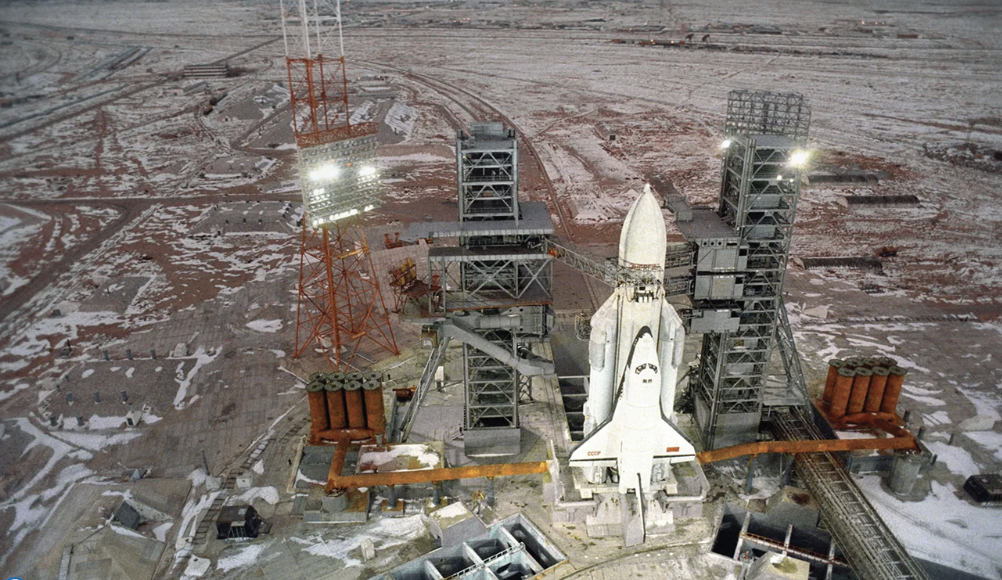
The Soviet space shuttle Buran, paired with an Energia booster rocket, before its launch from the Baikonur Cosmodrome, Kazakhstan, November 1988. Sovfoto/Universal Images Group/REX/Shutterstock.com/Encyclopædia Britannica
The test platform was scheduled for launch on the first Energia rocket in 1986 (later slipping to 1987). Designers were given very little time (less than one year) to prepare the test article for launch. The test platform only required a one-week operational life, so the turbogenerators were replaced with batteries. The propulsion system from an unused, early-1970s 11F72 service module (part of the canceled Almaz space station project) was grafted onto the test platform to boost it into orbit. On launch, the test platform needed to separate from Energia, rotate 180 degrees, and fire its engine to enter orbit. While tests at Baikonur revealed a variety of fixable problems with the laser, targeting, and power systems, there was no equipment on-site to test the propulsion module. At the same time, Gorbachev was agitated by the program’s existence, and all testing of the laser and targeting systems was forbidden. When Polyus finally launched on May 15, 1987, the craft separated from Energia, rotated 360 degrees, and fired its engines in the exact opposite of the direction required. The craft burned up during reentry over the Pacific Ocean.[6]
The Kamin concept envisioned orbital mines. The program was not expected to produce a draft proposal until 1989, and flight tests were not expected until 1992. The mines would be pre-deployed in orbit with lifetimes of six to eight months. They were to have some maneuvering capability and would be command-detonated from a ground station.[7]
In summary, the OKB-41 Design Bureau examined:
- A system using an interceptor satellite with homing guidance and a conventional warhead;
- A system in which a preliminary inspection of the satellite target was carried out before attack;
- A system that takes into account the maneuvering of the satellite target and the detonation of a mine on a signal from the Earth;
- A system ensuring the capture of a dangerous target satellite and the possibility of its return to earth;
- A system that ensures the destruction of a satellite target by a laser beam or a beam of accelerated particles from devices installed on a spacecraft.
These concepts would appear in many Soviet ASAT projects, including those in which OKB-41 was not involved. More recently, the stalking of classified US government satellites by Russian satellites Kosmos-2542 and Kosmos-2558 in 2020 and 2022 also reflects one of these ideas.
The Soviet military also had an air-launched anti-satellite program, dubbed Kontakt. The project relied on the Mig-31 and the 79M6 missile. Two prototype aircraft were made; MiG-31D test flights started in 1987. Test flights concluded in the early 1990s, though some work continued until 1995. Missile prototypes, or at least mock-ups, existed, though it is unclear if there were any test launches. The program was housed within Kontseptsiya-R. The missile relied on the 45Zh6 observation complex for targeting, combined with a new command transmission system (46I6).
These programs all suffered at the end of the Cold War and either were cancelled outright or withered away due to lack of funding. The programs were, in certain cases, duplicative and ran afoul in the 1980s of Gorbachev’s outreach to the West. However, the SDI program did spur attention and funding for many of these programs, a harbinger of how Russia will react to the planned Golden Dome architecture.
The Soviet history with ASATs, therefore, is a lesson for how throughout the Cold War planners explored ways to hold at risk US satellites with a variety of weapons. Russia paired these investments with other means to ensure that US missile defense could not challenge Moscow’s second-strike capability. These dual themes have returned in recent years, with Russia investing in both orbital weapons, novel delivery systems, and ASATs to overcome weaknesses identified during the Ukraine war.
Fractional Orbital Bombardment: Evading Missile Defenses
The history of the Soviet Union’s investment orbital bombardment is instructive. The system was designed and deployed to overcome Safeguard, the American missile defense system that was designed in the 1960s to protect US missile sites. The Soviet interest in orbital bombardment stemmed from the capability to attack the United States from different azimuths, thereby helping to evade early warning and missile defense radars and interceptors. The Safeguard system was eventually limited by the terms of the ABM Treaty. However, Washington made a strategic choice to overlook the Soviet deployment of orbital bombardment systems. The Soviet system was simply too inaccurate to truly threaten the US deterrent.
The choice was made to prioritize the Outer Space Treaty (OST) and the Soviet pledge to prevent the militarization of space. The two parties signed the OST in 1966. Almost immediately, however, Russia violated the spirit of the agreement with the development of a Fractional Orbital Bombardment System (FOBS). Article IV of the agreement clearly states that state parties “undertake not to place in orbit around the earth any object carrying nuclear weapons.”[8]
At the dawn of the missile age, Soviet planners viewed orbital weapons as potentially superior to missile-launched warheads. Military planners correctly argued that an orbital weapon would have an unlimited flight range, be able to strike targets simultaneously from two different directions, have unpredictable trajectories, and have faster flight times to targets. These advantages would obviate any advantage a defender could gain from missile defense, thereby ensuring the credibility of a retaliatory nuclear strike.[9]
In the early days of the Cold War, both the United States and the Soviet Union explored orbital bombardment concepts. The idea is that you can place something in orbit and, after a fraction of an orbit or a total orbit around the earth, it can then be de-orbited to strike targets on the ground.
Orbit is a state of being. An object placed in orbit is moving fast enough that it continues to fall over the horizon faster than it does back to earth. To come back to earth, an object in space must slow down. This is how a FOBS would work: An object is inserted into orbit and then fires a small rocket to slow down and fall to its target. One advantage of such a system is that you do not have to fire a missile on a ballistic arc, therefore decreasing early warning time for the defending state. The other advantage is that an attacking state could insert an object into orbit over Antarctica (flying south) and have the object “take the long way around” the earth. This object then would avoid US early warning radar and missile defense tracking, which remain pointed at the North Pole (the shortest distance between the United States and Russia and China).
In retrospect, Moscow’s interest in the ABM Treaty makes more sense. The Soviet Union agreed to place reciprocal limits on missile defense deployment. It did so knowing that it had other tools to hedge against any qualitative advancement in US missile defense interceptors and that it could still hold at risk US targets with nuclear weapons deployed in exotic ways. It also had a series of programs to deploy novel anti-satellite and missile defenses in space, as discussed in the previous section.
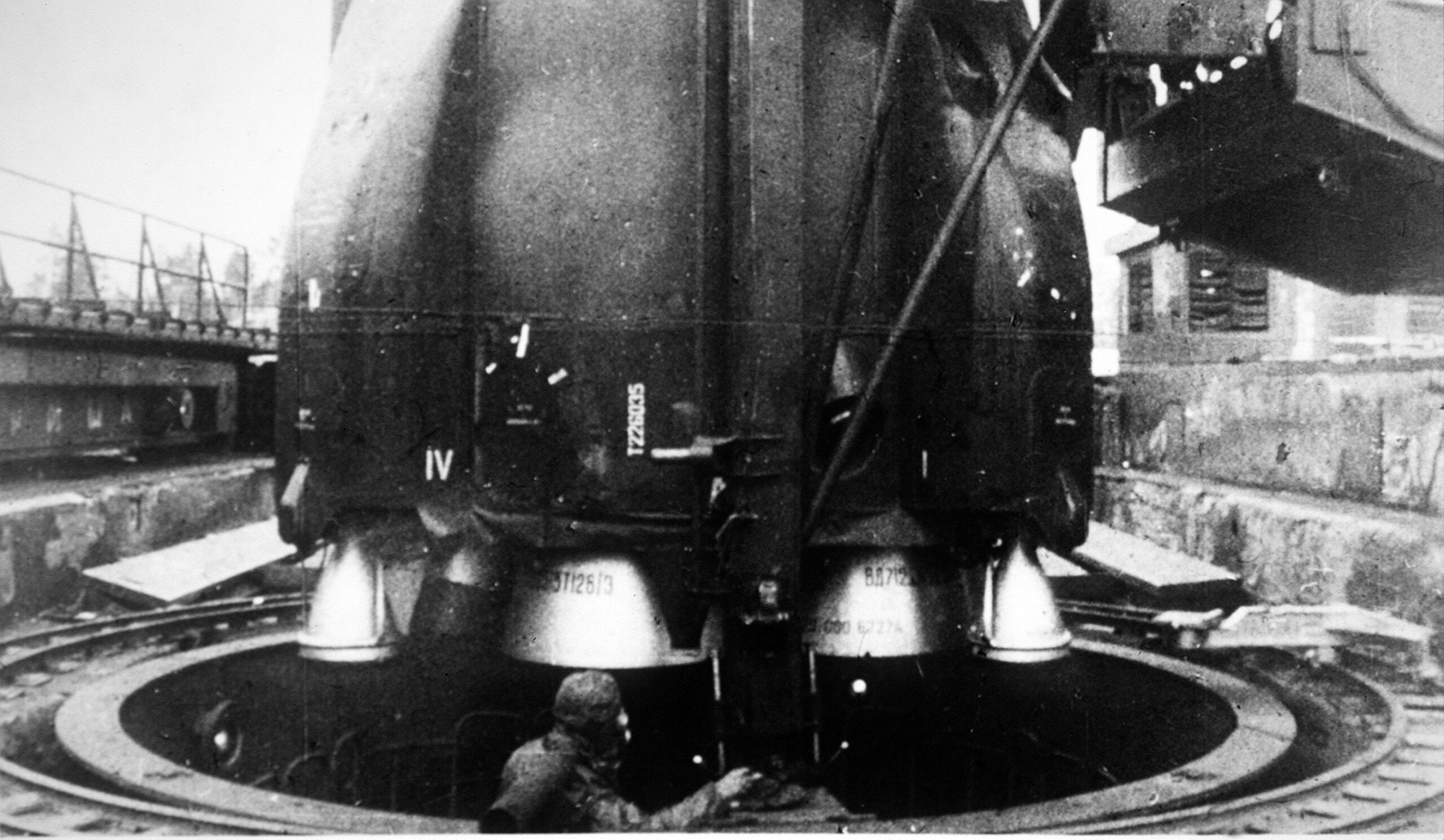
The rocket nozzles for the R-36 ( SS-9 Scarp), a deriviate of which, the R-36-O (Capital O for “Orbital”), first launched in 1965. After the twentieth R-36-O launch in 1968, the Soviet Union declared its FOBS program operational. The SS-9 was eventually replaced by the SS-18 Satan (R-36M). (Wikimedia Commons)
The Soviet Union tested and deployed this FOBS in 1967, just months after the leadership in Moscow signed the Outer Space Treaty. The United States chose to accept the Soviet legalese explaining away the violation: The weapon did a fractional orbit but the treaty ostensibly only covered a full orbit, thereby giving some wiggle room to President Lyndon Johnson to ignore the violation.[10] The Soviet FOBS system remained operational for close to two decades, before being dismantled in 1983. The Soviet FOBS system was once viewed as an anachronism of history. However, the appeal of using orbital mechanics to attack targets from unpredictable azimuths is once again an appealing concept for adversary nations. The Chinese government, for example, tested an orbital bombardment system in 2020. They did so with decades of technological progress and appear on the precipice of developing an accurate orbital bombardment system to hold US targets at risk.
Russian President Vladimir Putin has also resurrected the concept with the development and testing of Sarmat (RS-28). The missile has had a troubled history, but its intended purpose is to travel the long way around the earth and give Russian planners an orbital bombardment system. The Russian emphasis on survivability of its nuclear forces is based, in large part, on continued fears about US missile defense.[11] The end of the ABM Treaty and, now, NEW Start has had two immediate effects: The United States no longer faces constraints on the buildup of missile defenses, and any limits on interfering with satellites to monitor nuclear forces are no longer in effect.
The Russian concern about missile defenses is certain to increase further, following President Donald Trump’s push to test and deploy space-based interceptors in the near future. The Soviet FOBS system was intended to overcome the most basic of US missile defenses. The Russian approach, now, is to diversify its delivery vehicles. This includes the standard configuration of ground- and sea-launched missiles. However, these delivery vehicles are now being augmented with more novel weapons, including an unmanned underwater torpedo (Status-6) and a nuclear-powered cruise missile. Sarmat would be yet another system, all working together to overcome any potential advantage to the Russian deterrent with further investments in missile defense.
The result is yet more warning indicators for the future of the OST. Moscow is seriously looking at how space should be incorporated into its war fighting concepts. The current thinking is informed, deeply, by the rise of US commercial actors that now dominate the market. Russian strategists are thinking through how to hold at risk private constellations, which they view as enablers of US and allied combat operations—including in Ukraine.
Russian Thoughts on Space as a Domain
For this paper, the author examined articles in Military Thought, a journal affiliated with the Russian Ministry of Defense. The articles reviewed can be generally separated into broad categories: structure and organization of space forces (including debates on space as a separate theater of military operations); tactics and realities of war in space; development of space capabilities; and reports on foreign systems and concepts, and historical articles.
The Russian military is clearly examining how to limit—and perhaps render unusable—government and commercial space assets. The Russian writers in the journal, unsurprisingly, frame Russia’s treatment of space as a theater for military operations as a reaction to the American decision to establish the Space Force. Regardless of the veracity of this claim, there is a serious discussion about how the Russian armed forces should develop military communication satellites and weapons to shoot down, or disable, increasingly large satellite constellations. The writings include significant discussion about the trends in Ukraine and the role that commercial satellites are playing in the war.
Authors such as Nikulin Shcherbakov and Ravina Sidorin et al[12] examine the military use of Western commercial satellite networks like Starlink, specifically debating their legitimacy as military targets. These analyses are supported by A. A. Toporkov et al, who track global launch trends and focus on other commercial satellite constellations, such as Planet’s Dove constellation.[13] For remote sensing, V. P. Likhachev et al focus on the rise of small Synthetic Aperture Radar (SAR) satellites like ICEYE and Capella. Russian military analysts are especially concerned with SAR technology because its ability to penetrate cloud cover and certain materials directly undermines Russia’s traditional use of camouflage and maskirovka (military deception).[14]
At a higher strategic level, Russian scholars evaluate emerging technologies that threaten the nation’s long-term deterrent capabilities. V. V. Sukhorutchenko and S. V. Kreidin analyze the geopolitical implications of the US ABM program, highlighting the specific dangers of boost-phase intercepts and exploring methods to counter space-based interceptors.[15] These articles were written before the Trump administration’s Golden Dome concept, but given the similarities in Golden Done to Brilliant Pebbles, it is almost certain that Russian thinkers believed that the decrease in launch cost and large constellations could make space-based missile defense more feasible.
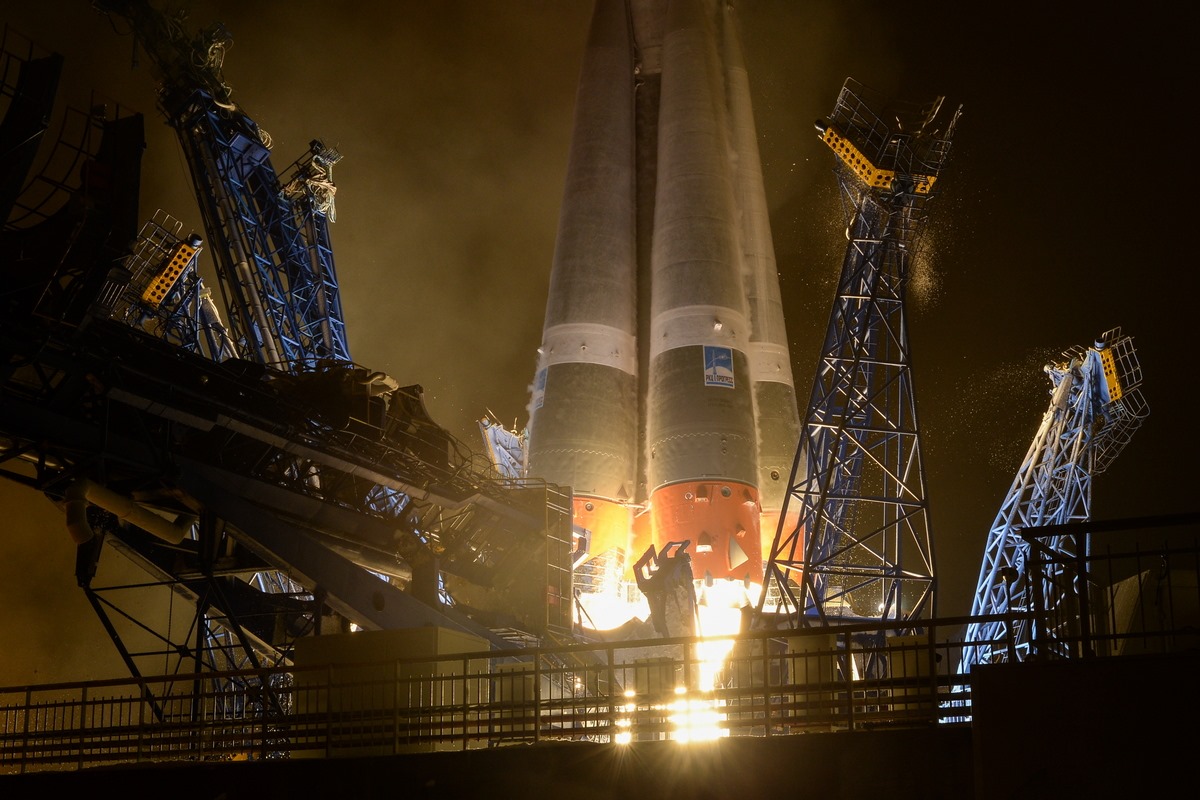
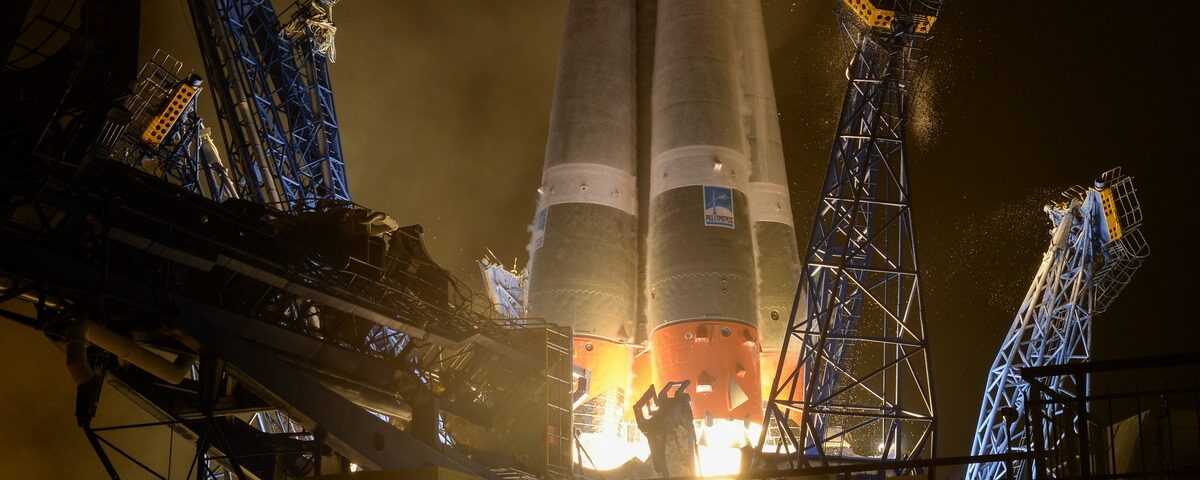
Archangelsk, Russia.- Photos taken on December 3, 2020 show the Soyuz-2.1b medium-class launcher, which took off from the Plesetsk space base, Arkhangelsk province, Russia. (Roscosmos courtesy / Latin America News Agency via Reuters Connect)
Complementing this, R. O. Nogin discusses the development of hypersonic weapons and prompt strike capabilities by the United States and NATO.[16] Collectively, these studies emphasize the risks that foreign advancements in guided missiles and high-speed delivery systems pose to the RVSN (Russia’s Strategic Missile Forces), viewing them as direct challenges to Russia’s established security framework.
In reviewing Russian thinking, the most useful is probably S. A. Kovalev et al. The authors argued that the emergence of space combat necessitates the creation of tactics for military space forces.[17] These tactics must account for the space environment – space operations require precision beyond that possible by human pilots. Space combat will require highly automated—perhaps even fully automatic—spacecraft with the capability for human intervention.[18] Nonetheless, the tactics of space combat will build on existing fundamental principles.[19]
The traditional tactics of modern combined arms warfare (maneuver, strike, and fire) find application in space in modified form. Maneuver in space exists in two forms – technical maneuver (for placing the satellite in its initial orbit and maintaining its orbit) and combat (maneuvers in combat situations to position the satellite for strike and fire operations or evade enemy attack).[20] Most satellites, however, have very little maneuvering capability; significant orbital adjustments require large quantities of propellant. A highly maneuverable combat spacecraft would require far larger propellant reserves than normal and would thus be very expensive to launch.[21]
Kovalev and his co-authors understand space strike to be combat operations in the space theater of operations to destroy enemy space force assets (either on earth or in space) by means of one’s own space forces located either on the earth or in space (strikes being categorizable as “ground-to-space, space-to-space, space-to-ground, or a combination”).[22] Fire (in the sense of artillery fires) are not applicable as such in space, but can in the space context be considered the application of electronic or opto-electronic systems to disable enemy assets.[23]
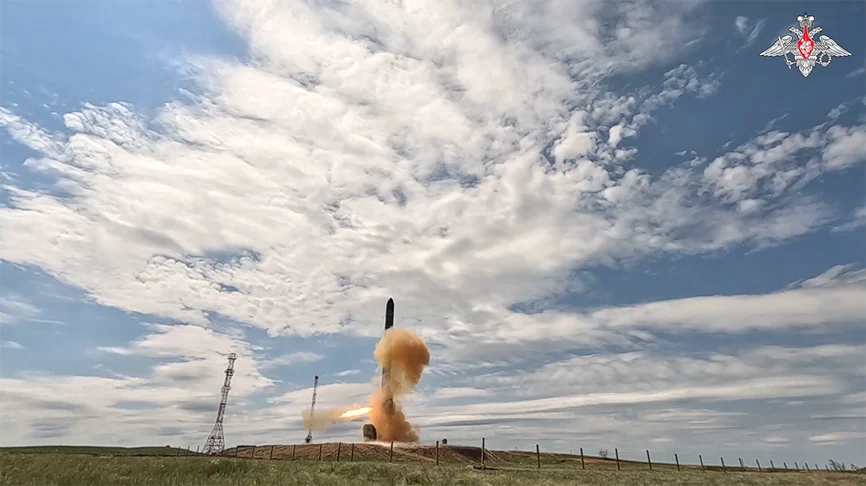
Russia announced a second successful test launch of the RS-28 Sarmat (SS-X-29/SS-X-30, Satan II) intercontinental ballistic missile (ICBM) on 12 May 2026. To help counter US ballistic missile defenses, this super-heavy ICBM is capable of Fractional Orbital Bombardment and carrying multiple re-entry vehicles, including Avangard (Vanguard) hypersonic glide vehicles. (Russian Ministry of Defense)
This thinking almost certainly influenced the Russian decision to test a nuclear armed satellite in orbit. Russian strategist I. S. Toporkov in his article on lessons learned the Ukrainian conflict argues that the US provision of Starlink and remote sensing data is part of efforts to inflict a strategic defeat on Russia.[24] The discussion about Starlink is worth summarizing in full because it underscores how Russian thinkers are thinking through how best to counter large satellite constellations and helps explain interest in co-orbital nuclear weapons.
The authors contend that Western commercial satellite constellations—specifically those operated by SpaceX, Maxar, and Capella Space—function as resilient, dual-use systems under the direct oversight of the Department of Defense. These networks are designed to provide critical battlefield intelligence and command support, with a structure robust enough to be rapidly restored following partial failures. Given that both military commanders and private industry leaders have acknowledged these systems’ roles in supporting the Ukrainian regime, the authors argue that this infrastructure should be treated as a primary target for military destruction.
To counter these capabilities, the authors propose a range of systemic measures centered on directed energy and physical force. One primary method involves “blinding” or permanently disabling the optical-electronic sensors of spacecraft using laser systems, such as the air-based Sokol-Eshelon or the ground-based Peresvet. Furthermore, they suggest that the physical destruction of satellites, ground control centers, and support infrastructure via high-precision weaponry is a necessary consideration for neutralizing the effectiveness of foreign space groups.
Electronic warfare and signal disruption provide additional avenues for suppression, ranging from atmospheric interference to orbital countermeasures. The authors suggest creating “shielding clouds” of passive interference at altitudes of 5,000 to 8,000 meters to sever the link between ground terminals and satellites, a method noted for its economic feasibility despite its temporary nature. A more advanced proposal involves launching domestic electronic warfare satellites into the same orbits as Starlink “strings.” This would theoretically allow a single Russian asset to disrupt an entire constellation while maintaining the integrity of Russia’s own satellite communications.
Ultimately, the authors view the military application of commercial satellite systems as a cornerstone of the United States’ strategy for information dominance and “network-centric” warfare. They conclude that because modern commercial networks are inherently universal and adaptable for military use, any foreign national or international satellite system should be viewed as a potential target. These proposed countermeasures are framed as essential steps to degrade the troop and weapon control capabilities that these space-based assets provide to Russian adversaries.
The testing of Cosmos-2558 would give Russian planners options in excess of what is widely being discussed. It is not the only tool Moscow is exploring. There are a myriad of co-orbital programs Moscow is experimenting with, including conventionally armed ASATs. Cosmos-2558 was placed at the edge of low-earth orbit in an unusual orbit. The satellite appears to have failed, but may have been intended to test electronics in a high-radiation environment. A nuclear weapon in orbit would require being left there for long periods of time, so there is value in testing how such a system would react to prolonged periods at the edge of the Van Allen radiation belt.
The satellite appears to have failed, but the need for large target kill remains a salient topic for Russian military planners. The nuclear option is one tool in what appears to be a broad-based program to develop multiple options to hold at risk American satellites. The mix of conventional, ground based, and on-orbit options would appear to give Russian planners options for both limited and mass-kill attacks. The issue has grown more acute as Russian strategists grapple with the role space has played in the war in Ukraine and how US commercial advantages are complicating Russian targeting.
As a result, there are ample reasons for Moscow to lean more heavily into space-based nuclear weapons. For much of the Ukrainian war, the concern has been about Starlink and that need to hold at risk commercial satellites that provide military services. After the election of President Trump, the threat of space-based missile defenses has returned for Russian planners. The Soviet FOBs program was a reaction to Safeguard, a nascent and small missile defense system built and then deactivated to implement the ABM Treaty. The Reagan administration’s investment in SDI spurred Russian investments in anti-satellite weapons, but the program’s delays—and the Soviet Union’s eventual collapse—halted Soviet progress.
However, with the influx in defense spending to support the Golden Dome project, Russia strategists are certain to both leverage Soviet-era studies about SDI and updated thinking about Starlink to counter US missile defense. The outcome may further incentivize Cosmos-2558 type experiments, deployed alongside its novel delivery stems, along with the RS-28 orbital bombardment system.
Conclusions
The future is certain to feature a more militarized space domain. Russian thinking and investments, however, suggest a novel change to how the Soviet Union thought about holding at risk US space assets. Russian investments suggest that, under certain conditions, leadership could choose to simply “take LEO off the board.” Specifically, it could leverage a nuclear weapon to mass kill commercial satellites, including US space-based missile defense. The act would also harm Russian satellites. However, given the rapid expansion of targets, the redundancies the US is now building, and the decreasing cost of launch, Russian strategists are thinking about how to negate these advantages. The urgency is certain to continue, as the United States continues to explore and invest in space-based missile defense.
The main conclusion is that norms that underpin the OST are eroding—and rapidly. The incentives to exploit space for all forms of military operations. Russia is investing in systems to negate those advantages, expanding on concepts and ideas from the Soviet era. The major difference, now, is the scope of the challenge Russian planners are now faced with. The United States is proposing a radical expansion of asset in LEO, both through commercial actors and the deployment of Golden Dome. The result is, in many ways, predictable. Russia is turning to nuclear weapons to hold these larger constellations at risk. It is doing so with on-orbit nuclear weapons, along with a return to orbital bombardment, paired with earth-based delivery vehicles to negate US sensor and shooter advantages.
[1] William E. Odom, The Collapse of the Soviet Military (Yale University Press, 1998).
[2] Viktor Misnik, ed., «Комета» – 35 лет [“Kometa” – 35 years] (Oruzhiye i Tekhnologii, 2008), 51.
[3] Anatoly Zak, “Naryad anti-satellite system (14F11),” RussianSpaceWeb.com, November 15, 2021, http://www.russianspaceweb.com/naryad.html.
[4] Y. P. Semenov, ed., Ракетно-космическая корпорация Энергия имени С.П. Королева [S. P. Korolev Rocket and Space Corporation Energia], volume 1 (Energia, 1996), 419-420.
[5] Konstantin Lantratov, “«Звездные войны», которых не было” [The star wars that weren’t], Buran, January 2005, http://www.buran.ru/htm/str163.htm.
[6] Konstantin Lantratov, “The star wars that weren’t.”
[7] Pavel Podvig, “Did Star Wars Help End the Cold War?,” Science and Global Security, Vol. 25, No. 3 (2017), 10.
[8] “Treaty on Principles Governing the Activities of States in the Exploration and Use of Outer Space, including the Moon and Other Celestial Bodies,” United Nations, October 1967, https://www.unoosa.org/oosa/en/ourwork/spacelaw/treaties/introouterspacetreaty.html.
[9] Asif Siddiqi, “The Soviet Fractional Orbiting Bombardment System (FOBS): A Short Technical History,” Quest: The History of Spaceflight Quarterly, no. 4 (Spring 2000), 22-32.
[10] “Russia Building Space A-Missile, McNamara says,” November 1967, CIA Reading Room, https://www.cia.gov/readingroom/docs/CIA-RDP70B00338R000300110028-3.pdf.
[11] Hans M. Kristensen et al., “Russian Nuclear Weapons, 2026,” Bulletin of the Atomic Scientists 82, no. 3 (2026), 221–54, https://thebulletin.org/premium/2026-05/russian-nuclear-weapons-2026/.
[12] Nikulin Scherbakov, “Views of the Leadership of the U.S. Armed Forces and Their Allies on the Problems of Information and Space Support for Strategic Operations,” Military Thought, October 2023; Ravina Sidorin and D. S. Kuznetsov, “The Role of US Space Group in Information Support of Ukrainian Armed Forces: Lessons and Conclusions,” Military Thought, October 2023.
[13] A. A. Toporkov, A. A. Romanov, D. V. Dianov, and S. V. Cherkas, “Space Launches in 2020-2021: Global Trends and Achievements in Space Exploration,” Military Thought, January 2023.
[14] V. P. Likhachev, A. V. Unokvsky and S. V. Fursov, “The State and Prospects of Using Small-size Space Vehicles of Service Radar Reconnaissance in US Space Forces,” Military Thought, October 2022.
[15] V. V. Sukhorutchenko and S. V. Kreiden, “Nuclear Deterrence under Conditions of Expanding US Global System of Missile Defense,” Military Thought, May 2022.
[16] R. O. Nogin, “About Threats to Objects of Strategic Missile Forces from Strikes by Means of Aerospace Attack,” Military Thought, May 2022.
[17] S. A. Kovalev, S. A. Sotnik, and D. S. Sotnik, “Armed Struggle in Space: Continuity and Differences of Tactical Principles,” Military Thought, March 2023-4, 45.
[18] S. A. Kovalev, S. A. Sotnik, and D. S. Sotnik, “Armed Struggle in Space,” 46-47. This reflects Soviet and Russian space capsule design. For example, the Soyuz capsule is designed to automatically dock with the International Space Station without any crew input. Manual docking controls are only provided as a backup. This is fundamentally different from US Cold War crewed spacecraft, which always used crew inputs to control different aspects of flight. The Apollo spacecraft could have been largely automated, with primary spacecraft control on the ground. That it wasn’t is a reflection of NASA culture: see, for example, David Mindell, Digital Apollo: Human and Machine in Spaceflight (MIT Press, 2008). The Russians view cosmonauts as passengers in spacecraft, and it thus follows that they would expect combat spacecraft to be uncrewed.
[19] S. A. Kovalev, S. A. Sotnik, and D. S. Sotnik, “Armed Struggle in Space,” 48.
[20] S. A. Kovalev, S. A. Sotnik, and D. S. Sotnik, “Armed Struggle in Space,” 48.
[21] S. A. Kovalev, S. A. Sotnik, and D. S. Sotnik, “Armed Struggle in Space,” 50.
[22] S. A. Kovalev, S. A. Sotnik, and D. S. Sotnik, “Armed Struggle in Space,” 50-51.
[23] S. A. Kovalev, S. A. Sotnik, and D. S. Sotnik, “Armed Struggle in Space,” 51.
[24] I. S. Toporkov, A. A. Romanov, D. V. Dianov, and S. V. Cherkas, “The Role of US Space Group in Information Support of Ukrainian Armed Forces: Lessons and Conclusions,” Military Thought, July 2023, 142.