 A Nation Must Think Before it Acts
Better Late Than Never, US and Allies Race toward Ukrainian Counter-Shahed Tech
A Nation Must Think Before it Acts
Better Late Than Never, US and Allies Race toward Ukrainian Counter-Shahed Tech

A nation must think before it acts.

Better Late Than Never, US and Allies Race toward Ukrainian Counter-Shahed Tech
The idea that an Iranian Shahed drone could strike the US Navy’s nerve center in Bahrain during daylight hours, despite decades of preparedness for such an event, seems absurd to most military planners. However, this is exactly what occurred in the early stages of the ongoing conflict with Iran.
Consequently, the United States and its Gulf allies are racing to bring in Ukrainian defenses and expertise to strengthen their own defense systems. While Shahed drones are routinely neutralized on a large scale in Ukraine through effective interception techniques that are relatively inexpensive, the US and its Gulf allies have been slow to adopt Ukrainian innovation and experiences. Reporting from the war with Iran is filled with video footage of Shaheds breaking through Gulf defenses, something that is relatively rare in Ukraine despite the scale of Russian attacks.
According to Ukrainian President Volodymyr Zelenskyy, Russia launched over 14,670 guided aerial bombs, 738 missiles, and nearly 19,000 attack drones during the winter months of 2025–2026. Most of these drones were Russian-produced, Iranian-designed Shahed systems extensively used against Ukrainian cities and energy facilities. In the final week of winter alone, Russia launched over 1,720 attack drones, dropped nearly 1,300 guided aerial bombs, and fired over 100 missiles at Ukraine, according to Zelenskyy’s statement on March 1.
In Ukraine, Shahed drones are typically regarded as a low-threat platform. They are well understood and easily defeated. Many are intercepted at night using truck-mounted machine guns and various other cost-effective techniques, from aircraft equipped with machine guns and miniguns to small arms and a growing arsenal of homegrown interceptor drones. Electronic warfare also plays a critical role, although its effectiveness is diminishing.
Despite multiple waves of attacks—averaging hundreds of drones per night—less than 10 percent of the Shaheds manage to hit their targets. Their slow speed and large surface area allow Ukrainian defenders to track their movements via social media platforms like Telegram. According to Ukrainian defense sources, domestically produced interceptor drones now account for nearly one-third of the Russian aerial threats successfully neutralized, a capability needed immediately in the ongoing conflict with Iran.
Among Ukraine’s most effective interceptors are the General Cherry Bullet, Sting, and Octopus. Together, these interceptor drones—from low-cost FPV models like Sting to more autonomous systems like Octopus—are transforming how Ukraine defends its airspace against large volumes of Russian UAV attacks. Their speed, affordability, modularity, and operational flexibility have enabled Ukraine to rapidly and sustainably enhance its air defense, filling gaps that traditional missile systems alone cannot address. Each of these platforms has achieved well over a thousand kills despite their relatively recent introduction to the battlefield.
General Cherry (also transliterated as General Chereshnya) is a volunteer-driven technology company/startup in Ukraine dedicated to producing low-cost UAVs, including interceptor drones designed to counter Russian combat drones such as the Shahed family. Typical General Cherry kinetic interceptors, with explosive payloads, can reach high speeds (around 300 km/h) and are optimized for rapid engagement. They are easy to use, inexpensive, and are guided to their targets by FPV goggles or a ground control station.
The Sting is one of Ukraine’s most widely recognized interceptor drones, developed by the Wild Hornets group—a distinct volunteer team that is functionally allied with Ukraine’s drone ecosystem. This FPV loitering munition/interceptor drone is designed to hunt and destroy enemy UAVs. Capable of high flight speeds, it can intercept and overtake many Russian targets, including the Shahed. It reportedly can achieve speeds of several hundred kilometers per hour and carries an onboard explosive warhead to destroy its target.
The Octopus interceptor represents a more specialized, next-generation UAV developed in Ukraine in cooperation with Western partners, particularly the United Kingdom. The system is designed to intercept targets at low altitudes, including Russian strike drones that can evade higher-altitude air defenses. It utilizes image recognition and onboard processing for terminal guidance, enabling it to track and engage targets, even in challenging electronic environments.
The only American-origin system, Merops—developed by the company of former Google CEO Eric Schmidt—is an anti-drone system that has emerged as one of the most effective counter-UAV solutions employed by Ukrainian forces, especially Shaheds. Deployed in Ukraine since mid-2024, Merops is a mobile, short-range counter-drone complex that utilizes interceptor UAVs to autonomously locate and destroy hostile drones once they are within visual or sensor range. According to military officials and open reporting, Ukrainian forces have operationalized the system with notable effectiveness. Merops is a compact system that can fit in the back of a medium-sized pickup truck. It uses artificial intelligence to navigate and can operate even when communication or GPS is jammed.
Much of Ukraine’s innovation can be tied to its technology cluster known as Brave1. Acting as Ukraine’s official government defense technology agency, it facilitates the interconnection between innovators, the military, investors, and the government, thereby expediting the development of novel military technologies, including drones, robotics, and electronic warfare. It functions as a centralized hub and grant provider, fostering local innovation and attracting investment.
Ukraine, unlike Western counterparts, embraces the “good enough” philosophy. Its goal is rapidly to field inexpensive effective systems to defend its population and territory as quickly as possible. It is a hard lesson, but one that the US and Gulf allies learned a little too late. Thanks to Ukraine, they are able to now receive the benefits.
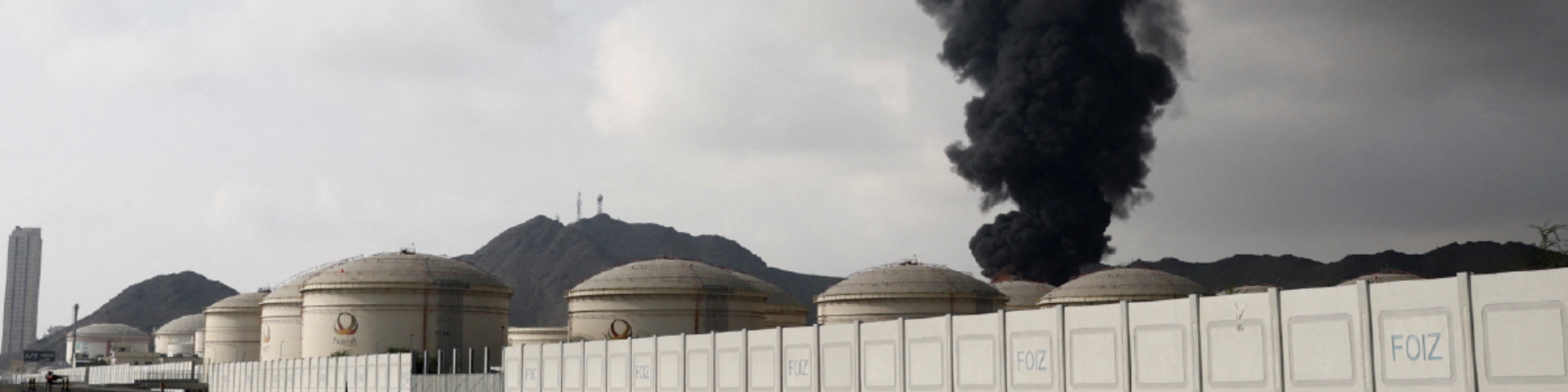
Image credit: Smoke rises in the Fujairah oil industry zone following a fire caused by debris after interception of a drone by air defenses, according to the Fujairah media office, amid the US-Israel conflict with Iran, in Fujairah, United Arab Emirates, March 4, 2026. REUTERS/Amr Alfiky