 A Nation Must Think Before it Acts
China’s Civil-Military Drone Fusion
A Nation Must Think Before it Acts
China’s Civil-Military Drone Fusion

A nation must think before it acts.

China’s Civil-Military Drone Fusion
Divining the intentions of the Chinese Communist Party (CCP) is never a straightforward task. But when it comes to assessing the future of China’s military technology, data from China’s civilian unmanned air system industries and research institutes is a treasure trove of information that can provide a better understanding of the CCP’s vision. From the highest echelons of consumer industries to the governmental sectors, assessing China’s private sector drone development provides insight into potential tributary routes for technology that may contribute to CCP military capabilities in the future.
From the ongoing Russia-Ukraine War to the US-Iran War, the future trajectory of unmanned warfare is clear. Widely available Ukraine War footage demonstrates that simple battery-powered propeller units are able to provide robust kinetic and reconnaissance capabilities. Complex, expensive cruise missiles that rely on jet engines and complicated fuel types have their role, but that role might be shrinking. It is clear that batteries are coming to the forefront as a significant energy source for propulsion, and the Chinese are leaps and bounds ahead of the rest of the world when it comes to producing batteries. They also understand the limitations of lithium-ion batteries and are making concerted efforts to increase energy density capabilities in battery technology. More energy in the same form factor and weight means your drone can go farther, hold more weight, or a middle-ground combination of those two. A May 2026 Nature article describes a potential method of enabling lithium-sulfur battery operation. If the authors’ theory holds up, they describe dramatic increases in energy density.
Data link technologies, anti-spoofing technology capabilities, and stealth coatings for drones are also gaining traction. A Chinese patent is specifically referenced in one of these documents exhibiting a stealth coating, suggesting a significant link between the research institution and military applications. The product description lists different “product models,” their recommended application thickness, application scenario, and radar band specifications. Broadly speaking, civilian unmanned aerial vehicle (UAV) users do not typically need ultra-high-temperature radar absorption materials.
A 100-kilometer data link is also atypical in the civilian market. Some enthusiasts could perhaps make use of that type of range, but that market is bound to be quite small. A more robust data link, combined with increased battery capacity, enables much longer-range reconnaissance roles that might not have been realistic for smaller UAV systems in the past. Another high-interest capability is drone swarming. Xuzhou Shuotai Technology claims to have an “AI Visual Module V-4100 that is equipped with ‘autonomous target recognition’ and fits on a 10-inch quadrotor ‘AI visual strike [first-person view]’.” Again, envisioning a civilian market for this type of technology, especially in China, is challenging to say the least.
While Xhuzhou Shuotai is a relatively small company likely hunting for People’s Liberation Army (PLA) contracts, a major player in the field is the China Electronics Technology Group Corporation (CETC). It now claims it has developed the capability for one person to control a ninety-six-drone swarm. In a 2026 Chinese state media closed-circuit television video, the engineers claim that “even with zero signal, they [the drones] still know how to complete the mission together” and “operate entirely on their own without human controls.” This, combined with China’s civilian sector having made claims about groundbreaking autonomous control and swarming intelligence, adds some credibility to CETC’s claims.
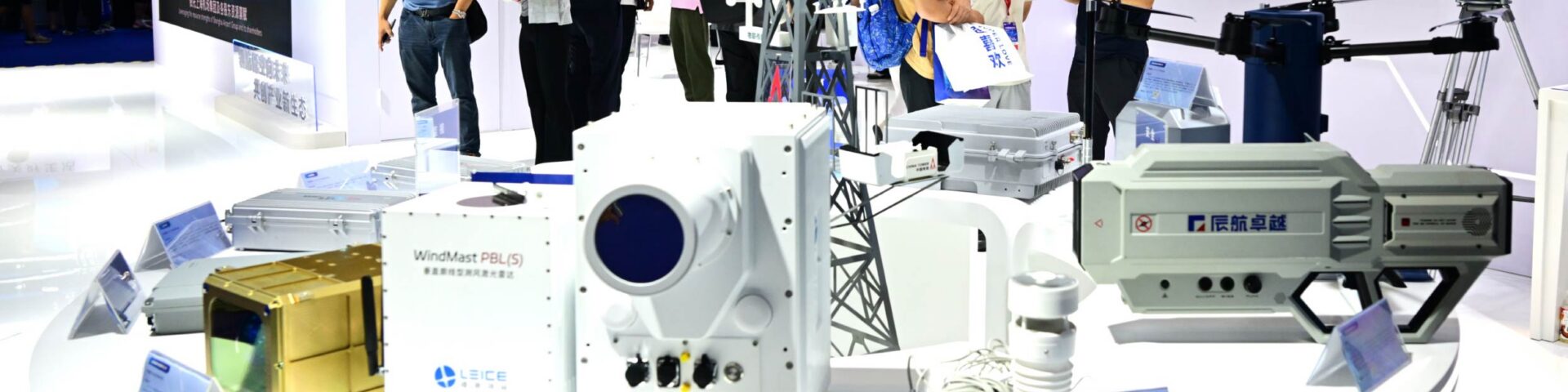
The way forward for the CCP and the PLA in the unmanned aircraft system (UAS) realm seems quite clear and is generally unsurprising. The integration of artificial intelligence (AI) into drone swarm–capable systems would lead to higher degrees of autonomous functioning, allowing the PLA increased volume of UAS deployment without increasing, or perhaps even reducing, the manpower and training requirements. Pushing ranges farther with better data link and battery technology and stealth coatings provides clear tactical advantages. The private sector research and development in these specific fields gives us a directional heading of the industry and allows a glimpse into the possibilities of the equipment and technology that the CCP and PLA will have access to. These exhibitions mix legitimate civilian-focused product offerings with the gray-area products such as data link and the overtly military goods such as AI target selection and stealth coatings, but it can be tough to parse through which is which. But with some creativity and a bit of luck, some trends become apparent when analyzing the civilian and private sector of UAS research, development, and production, and a clearer picture begins to emerge.
Image: Representatives from the Jiangsu Provincial Council for the Promotion of International Trade exhibition group attend the 2026 International Low-Altitude Economy Expo on July 23, 2026, in Shanghai, China. (REUTERS | Photo by Guan Yunan/VCG )