 A Nation Must Think Before it Acts
Nothing New Under the Golden Dome: Space-Based Interceptors in the Trump Administration
A Nation Must Think Before it Acts
Nothing New Under the Golden Dome: Space-Based Interceptors in the Trump Administration

A nation must think before it acts.


Nothing New Under the Golden Dome: Space-Based Interceptors in the Trump Administration
Executive Summary
Golden Dome has quickly become the signature defense program of President Trump’s second term. The most contentious element of this ambitious missile defense program is space-based interceptors; satellites designed to ram into ballistic missiles while they are still boosting. In this FPRI report, Aaron Stein, Jeffrey Lewis, and Sam Lair develop a model to tailor the size of space-based interceptor satellite constellations to various adversary missile threats based on open-source information, and estimate the cost of those constellations. The report demonstrates that:
- A key factor in the size, and therefore cost of a SBI constellation is target missile burn time, which can be derived from open-source information.
- Constellations are not a one-time purchase and need to be replenished over time as interceptor satellites deorbit. Launching a constellation is merely a down payment on an orbital defense.
- Depending on the threat and interceptor characteristics, constellations range from several thousand to tens of thousands of interceptors while upfront costs vary from tens to hundreds of billions of dollars.
- Highly effective passive and active countermeasures are within easy reach of adversaries like Russia and China.
Stein, Lewis, and Lair argue that given the economic, industrial, and strategic costs, space-based interceptors are a poor choice for American security. They would provide an expensive yet brittle defense which could be easily circumvented while encouraging destabilizing adversary responses.
Introduction [1]
On January 27, 2025, newly inaugurated President Donald Trump announced in an executive order that the United States would pursue a new missile defense initiative. This program, initially called “Iron Dome for America” but quickly redubbed “Golden Dome,” directed the Department of Defense (itself soon to be redubbed) to design an architecture that envisions “at minimum” the “development and deployment of proliferated space-based interceptors capable of boost-phase intercept.”[2]
There is a rich and contentious history of proposals for space-based anti-ballistic missile interceptors, the earliest being the Air Force’s Ballistic Missile Boost Intercept (BAMBI) program established in 1961 to compete with the Army’s Nike anti-ballistic missile (ABM) system.[3] The concept gained the most attention as part of the Reagan administration’s Strategic Defense Initiative (SDI). Out of SDI emerged Brilliant Pebbles, which is more or less the Golden Dome program under consideration now, 35 years later. The Brilliant Pebbles concept envisioned a kill vehicle housed in a “life jacket”—a satellite bus in orbit with a sensor payload that eliminated the need for a secondary layer of satellites to detect missile launches and to cue a separate “shooter” carrying satellite architecture.
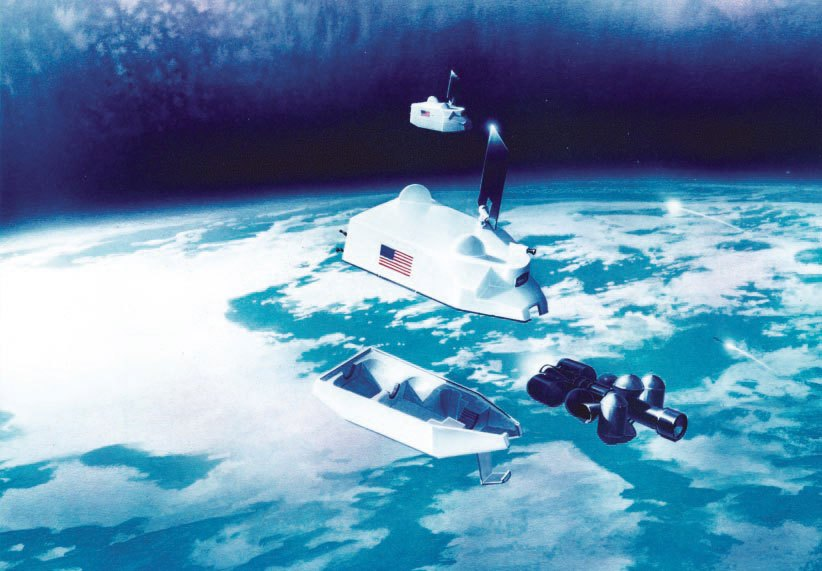
An artist’s concept of Brilliant Pebbles, 1987. (Strategic Defense Initiative Office/Missile Defense Agency)
Debates over space-based interceptors (SBIs) like Brilliant Pebbles revolved around the number of satellites needed and the necessary launch requirements, which were extremely demanding by the standards of the 1980s and early 1990s. Today, SpaceX and other commercial space actors have drastically reduced launch costs—making possible constellations like Starlink, which has more than 10,000 satellites—thereby eliminating some of the challenges inherent to the Brilliant Pebbles concept. Yet, the size and scale of the requirement remain considerable, raising valid questions about investments in space-based defense versus the financial, industrial, and strategic cost of any such investment, and whether the investment is purchasing a dependable defense against current and future adversary threats.
The size of a SBI constellation depends on the threat it must defend against. Constellation size is a function of the mission—that is, what role the administration decides it wants the constellation to serve. These decisions are certain to be anchored around a set of assumptions about current and future missile threats to the United States. Ultimately, the size of the constellation will determine the cost of any SBI system deployed under the Golden Dome.
To calculate the size and cost of any such system is relatively straightforward: For this paper, we use a model developed by Gregory Canavan and Edward Teller in 1990 to estimate the size of various SBI constellations using the absentee ratio.[4] Canavan and Teller used this calculation to determine the size of a constellation needed to negate Soviet SS-18 intercontinental ballistic missile (ICBM) silo fields. After sizing several constellations, we calculate their approximate costs. The second part of this paper considers possible adversary counter-measures against a Golden Dome space-based constellation. The paper is designed to present a range of potential scenarios, based on open-source data about adversary missile threats.
Methodology
These calculations depend on the specific characteristics of the SBI and the missiles to be intercepted. The central concept is the so-called absentee ratio—the ratio of interceptors in the constellation available to intercept an incoming missile at any given moment. The absentee ratio is a function of two interceptor characteristics and three characteristics of the missile threat. The interceptor characteristics are the defending interceptor’s velocity and release time.[5] The release time is the time between the launch of an attacking missile and the beginning of the defending interceptor burn towards the target missile. This period includes the time the defender has to detect and assess a missile launch as a threat and to assign an interceptor to the target. The release time can be impacted by the weather, as well as delays in decision-making, command and control, and signal transmission.
There are three characteristics of the missile threat which impact the absentee ratio: the burn time of the missile, the number of missiles in a salvo, and the radius of the area from which the salvo was launched. The burn time of the attacking missile establishes, after taking into account release time, how much time is available for the SBI to attempt an intercept. Once burn ends and the attacking missile’s warheads are deployed, the bright infrared signature the SBI would use to identify the target is lost and the post boost vehicle, or “bus,” will have had the opportunity to release warheads along with any decoys to confuse the defender. The number of missiles and the radius of the area from which the missiles were launched have straightforward effects on constellation size. The more missiles launched, the more interceptors needed. Launch area matters because the denser the area, the further away the launch area will be from the majority of interceptors. A large launch area will be more accessible to more defending interceptors in the constellation, whereas a dense launch area demands a more tightly packed SBI constellation to keep the absentee ratio low.
A final influence on the size of the constellation is what Teller and Canavan dubbed the “z” factor; this is dependent on the northernmost latitude defended by the constellation, which determines the effective surface area of the earth the constellation needs to cover. Not every constellation needs to defend every latitude and, depending on what type of threat it is designed against, fewer interceptors may be needed to achieve similar levels of coverage if the defender is not worried about missiles from higher latitudes.
The “z” factor is therefore calculated by taking the surface area of the defended spherical segment, and then dividing it by the surface area of a hemisphere of the earth:
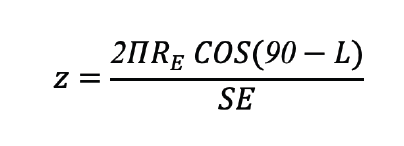
Where:
RE is the radius of the Earth in km.
L is the highest latitude defended in degrees.[6]
SE is the surface area of a hemisphere of the Earth in square km.
The “z” factor is an approximation, but one that Canavan and Teller said “agrees with near-exact analytical solutions within about 10–20 per cent.”[7] It is worth noting the northern and southernmost areas of an SBI constellation will be better defended than the areas over the equator, due to the orbital inclination of the interceptors.[8] While this better-defended band is narrow, it produces more porous coverage over areas near the equator as the interceptors spend relatively more time near those upper and lower latitudes.
The intercept window, the time the SBI has to catch the boosting missile, is missile burn time minus the interceptor release time. The volume of space an interceptor can defend is a spherical area defined by the duration of the intercept window multiplied by the interceptor’s velocity.

Where:
Rp is the radius of the patrol area or silo field in km.
From there, the absentee ratio is calculated:
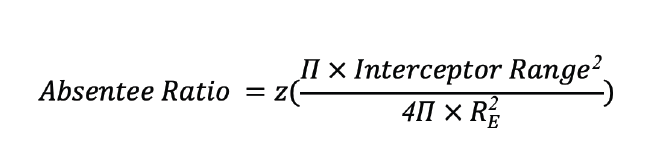
Constellation size can therefore be determined by taking the absentee ratio and dividing it by the number of enemy launchers to be defended against within a specific area.
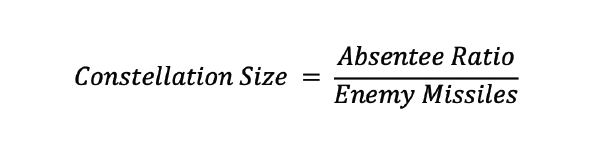
This equation sizes the constellation such that one interceptor will be available for each target missile. If an interceptor fails or misses, there would not be enough redundancy or slack in this constellation to prevent the missile from leaking. Some leakage might be acceptable if combined with effective midcourse defenses, but that is beyond the scope of this paper and worthy of more in-depth study to examine the requirements for coordinated space-based and ground-based missile defenses. To cover any gaps and ensure two-on-one targeting for each boosting missile, it would be necessary to double the size of any of the constellations we describe. Yet, these constellations are sized to the densest threat area under the latitude limit, meaning that all other areas enjoy similarly high levels of coverage even if they don’t require it.[9]
This model makes several simplifications. For instance, it does not account for interceptor acceleration or changes in interceptor altitude during intercept attempts. Any effort to build any of these constellations would involve more detailed calculations than we make in this paper. Nevertheless, we believe our model provides a good first-order approximation of the scale and cost of most space-based boost-phase intercept endeavors, and is illustrative of what factors are more or less important for determining constellation size, and therefore constellation vulnerability.
Missile Burn Time
Canavan and Teller assumed about 600 seconds would elapse from launch to the end of warhead deployment for a SS-18 ICBM. They then sized their proposed constellation around that timeline.[10] Based on their calculations and assumptions, they argued such a system would be cost effective at the margin and merited a trial constellation of 100 Brilliant Pebbles for $1 billion.[11]
The 600-second SS-18 deployment time deserves additional discussion. Modern liquid propellant ICBMs have much shorter burn times than 600 seconds, and it was likely the SS-18s burn time was shorter than that as well. US government officials, for example, told Ankit Panda at The Diplomat that the North Korean Hwasong-15 burned for 289 seconds.[12] Moreover, 600 seconds is not merely the period during which the missile is boosting (burn time), but also the time it takes for the bus to dispense warheads and decoys.[13] Intercepting the bus toward the end of the 600-second burn time means that many warheads have already been released, the so-called “leakage problem.” Most systems begin releasing objects well before 100 seconds after burnout, though the full dispense sequence can run considerably longer for a few. Reviewing dispense times across a range of US and foreign ballistic missiles, the Defense Science Board adopted 100 seconds post-burnout as its canonical cutoff for whether an intercept is “early” enough to provide a defense benefit—noting that this is the longest useful time, and in many cases already too late, since most first releases fall well inside it.[14]
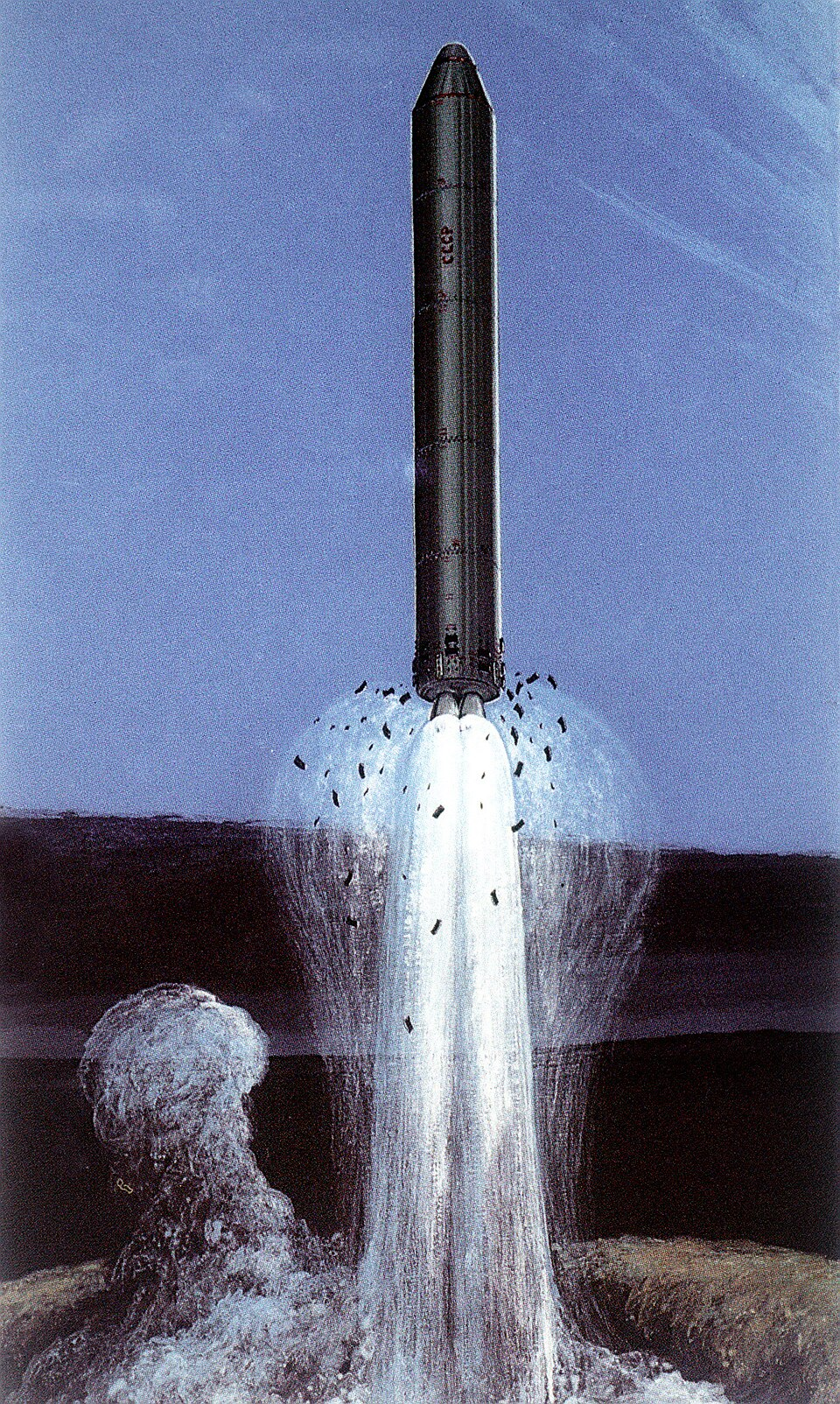
An artist’s concept of a Soviet SS-18 intercontinental ballistic missile being launched, 1986. (defenseimagery.mil)
A successful boost-phase intercept of the booster will not necessarily destroy the reentry vehicle, which could continue on a ballistic trajectory from the point of intercept. While the warhead would miss its intended target, it would still fall short along the flight path—and depending on geometry could detonate in populated areas, in allied countries, or, if the intercept is early enough for some scenarios, in adversary territory. This is the “shortfall” problem. To keep the surviving payload from reaching friendly territory, the missile must usually be intercepted prior to burnout—typically several seconds to several tens of seconds before, depending on trajectory. If intercept occurs after the release of the first reentry vehicle, the remaining reentry vehicles will simply impact downrange of the target. For example, an intercept against an SS-18 at the t=595 means nine of the 10 warheads and any decoys have been released on target, while the tenth reentry vehicle will likely still impact the interior of the United States, but not on target. While a technical success, this could hardly be considered a meaningful defensive intervention.
As a result, we consider two requirements: (1) intercept prior to the end of burn, after which leakage and shortfall become serious problems that must be mitigated by additional defense layers such as a robust midcourse system; and (2) 100 seconds after burn, at which point most warheads have been dispensed.
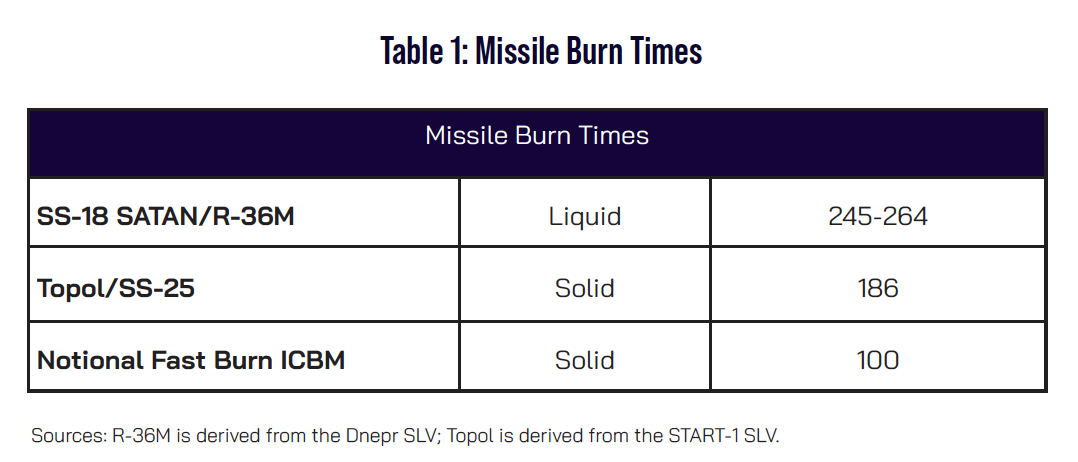
As it is still a part of the Russian arsenal, for this paper we examined the SS-18’s burn time by looking at data from Russia’s Dnepr space launch vehicle (SLV), which uses the first two stages of the SS-18 missile. It is also launched from the same silos and shares much of the same launch equipment. The SS-18’s actual burn time is closer to 245–264 seconds, which we derived by using simple calculations based on the propellant weight, specific impulse, and thrust of the stages.[15] With the added 100 seconds of deployment time, the total time before intercept is no longer possible is less than 360 seconds.
At the time of Canavan and Teller’s article in 1990, Richard Garwin noted the existence of fast burning Soviet ICBMs and argued adversaries could produce even faster-burning single-warhead solid propellant missiles with 100-second burn times. He suggested the Soviets could trade payload weight for a compressed burn timeline.[16] Solid-propellant missiles have much shorter burn times, in general. Garwin estimated that the road mobile SS-25/RT-2PM Topol had a 180 second burn time.[17] This estimate was later confirmed by data the Russian government provided for the START-1 space launch vehicle based on the SS-25/Topol, indicating the solid motors burn for 186 seconds.[18] It’s unlikely the Topol or the notional fast-burn ICBM would have significant deployment times since they only carried one warhead.
The totality of these calculations allows us to create a range of options, measured against faster and slower burning missiles, to then plug into our model.
Release Time
Another variable of the defense system to consider is release time. Release time includes decision time, as well as time for launch detection, threat characterization, track establishment and communication with the SBI.[19] We consider three cases: 15 seconds, 30 seconds, and 45 seconds.
The 2003 American Physical Society study argued that given cloud cover over the mid-latitude areas, ICBMs would not be detected until they had reached 7 km in altitude, and that it would take 45 seconds and 30 seconds respectively for liquid- and solid-propellant missiles to climb to that detection height.[20] They added an additional 20 seconds to characterize and determine the direction of a liquid missile’s flight before releasing the interceptor. The study assumed that process would only require 15 seconds with the faster burning solids. This resulted in release times of 65 seconds for liquid ICBMs and 45 seconds for solid ICBMs. The 2012 report of The National Research Council of the National Academies of Sciences, Engineering, and Medicine made the same assumption.[21] We use 45 seconds to be generous to the defender and account for progress in space-based infrared detection systems since 2003.
The 30-second release window is derived from Canavan. In 2003, he argued that successors to the Space-Based Infrared System (SBIRS) would have sensors with enough sensitivity and speed to make 30-second release times possible.[22]
Finally, we consider a 15-second release window. This window assumes some technological breakthrough for sensing and characterization will dramatically speed up the process as well as a highly automated command-and-control system. A recent Congressional Budget Office report on the subject appears to use a 15-second release window for their calculations.[23] While the report does not explicitly state the release time, our modeling suggests they used an optimistic release window in that range. Such a design decision would have some practical drawbacks, as there would be functionally no decision time. Moreover, it could result in the interception of peaceful space launches or make the system prone to intercept attempts against sounding rockets or other false positive signatures. However, it seems like the Golden Dome program has a focus on command and control and may produce some additional gains in efficiency in that area. Gen. Michael Guetlein, who is running the program for the Pentagon, stated in March: “We recognized on day one that command and control was going to be our secret sauce.”[24] Of course, given Guetlein’s resistance to providing any details about Golden Dome or its components, it is hard to say whether the command-and-control improvements he refers to would manifest in a quicker release time. Nevertheless, we consider a 15-second release window.
Interceptor Burnout Velocity
We chose to size our SBI constellations around three different interceptor burnout velocities—the added interceptor velocity from burn during an engagement—of 4 km/s, 6 km/s, and 8 km/s. The 2003 American Physical Society report on boost-phase missile defense considered a two-stage 4 km/s SBI to be reasonable and used it as their baseline case for analysis.[25]
We included 6 km/s since most studies on the Brilliant Pebbles program and the original proposals assumed an interceptor traveling at that speed. James Gattuso, Teller, and Canavan all based their models around a 6 km/s interceptor.[26] It is interesting to note that the state of the art for interceptor technology in 1987 when Boeing began working on the problem would have produced an interceptor with a delta velocity of only 1 km/s, aspiring to 2 km/s in a future prototype, while a failed 1992 test would have evaluated a 2 km/s interceptor.[27] These data points suggest the 6 km/s goal may have been optimistic. Indeed, the American Physical Society study considered interceptor speeds much above 5 km/s to be highly aspirational and argued they would incur severe weight penalties for the interceptor, dramatically increasing the cost of the constellation.[28] The National Research Council of the National Academies of Sciences, Engineering, and Medicine assumed a notional 5 km/s interceptor in their 2012 study.[29]
Finally, we included an 8 km/s interceptor velocity to account for unanticipated, yet unlikely, advances in propulsion technology. While a Government Accountability Office report from 1992 references a proposed constellation of about 8 km/s, there are few open-source indications that an interceptor with that speed could be produced at a reasonable weight.[30] Indeed, David Wright suggested an interceptor with a burnout velocity of 9.9 km/s would weigh nearly 20 tons.[31] Nevertheless, we included the 8 km/s case in our range of estimates to be generous to the defender.
To accelerate the interceptor and kill vehicle at higher burnout velocities, a more massive booster is required. We have scaled the size of the booster to the burnout velocity of the interceptor, which we will address below.
To simplify things, our model assumes the interceptor immediately accelerates to its burnout velocity. This assumption is generous to the defender as it adds range to the interceptor, rather than accounting for the slower acceleration of the interceptor to its burnout velocity. For missiles with shorter burn times, the range reduction from acceleration time could be quite significant, making required constellation sizes for those missiles even larger than we suggest. Ultimately, while we think a 4 km/s burnout velocity interceptor is the most feasible, we also included the 6km/s and 8 km/s cases to account for unanticipated technological developments.
Launch Costs
We calculated launch costs using recent public reporting on the price of SpaceX Falcon 9 launches. We chose Falcon 9 because it is one of the most prolific launch vehicles and one of the cheapest per kilogram launched on the market.[32] While SpaceX’s Starship launch vehicle has made progress, we are assuming it will be largely dedicated to Starlink and space-based data centers, as Elon Musk recently suggested.[33] The true cost of a Falcon 9 launch to place 17,500 kg in low earth orbit was reported in 2024 to be as low as $15 million, placing the true cost per kilogram at about $857.[34] It is worth noting, however, the SpaceX customers pay much more than that. In early 2026 SpaceX increased the price of a dedicated Falcon 9 launch to $74 million, about $4,200 per kg if the recoverable booster variant is used.[35]
In 2020, reports suggested the US Air Force satellite launches using Falcon 9 boosters paid approximately 50 percent more in added costs than a civilian launch.[36] Those extra costs presumably come from extra security measures surrounding sensitive payloads. For simplicity, we used the $74 million commercial launch cost for the calculation, rather than the government rate. However, this may be a 50 percent underestimate of the true cost of a SBI launch.
Building an SBI constellation is not a one-time purchase. Starlink satellites, for example, have an average lifespan of approximately five years because they are placed in low earth orbit at roughly 340 km in altitude,[37] which is similar to the altitude suggested for a hypothetical SBI constellation in the American Physical Society report.[38] If the SBIs are of similar size and weight to Starlink satellites, something many Golden Dome advocates have suggested, it is reasonable to assume that the Golden Dome satellites would experience similar deorbiting rates.[39] For any SBI constellation, roughly one fifth of the satellites will deorbit or fail each year and have to be replaced. That means one fifth of the initial cost to build and deploy the SBI constellation would have to be spent each year to sustain it.
While the constellation could include on-orbit refueling capabilities for the SBIs to increase their lifespan, there are a few potential problems. First, on-orbit refueling is still a relatively novel technology and may encounter difficulties in reliability and scaling. The scaling issue would require dramatic increases in both the number of refueling satellites and the refueling ports on the interceptors themselves. Conducting the thousands of rendezvous and proximity operations (RPOs) necessary to sustain a constellation with on-orbit refueling introduces new error modes and potential for accidents. Second, it would drive up the cost of the individual interceptor significantly. While on-orbit refueling makes sense for exquisite capabilities and satellites in geostationary or other orbits with more room to maneuver, it makes less sense for a proliferated constellation where thousands of similar satellites would be needed and are therefore rather interchangeable. Moreover, even with on-orbit servicing, other components will still fail, making some level of replacement necessary.[40]
Interceptor Cost and Weight
Two other essential components of constellation cost are more difficult to assess because they are disputed and uncertain; the cost and weight of the space-based interceptors. There are, however, some useful data points to allow for us to make informed assumptions to help guide the estimates.
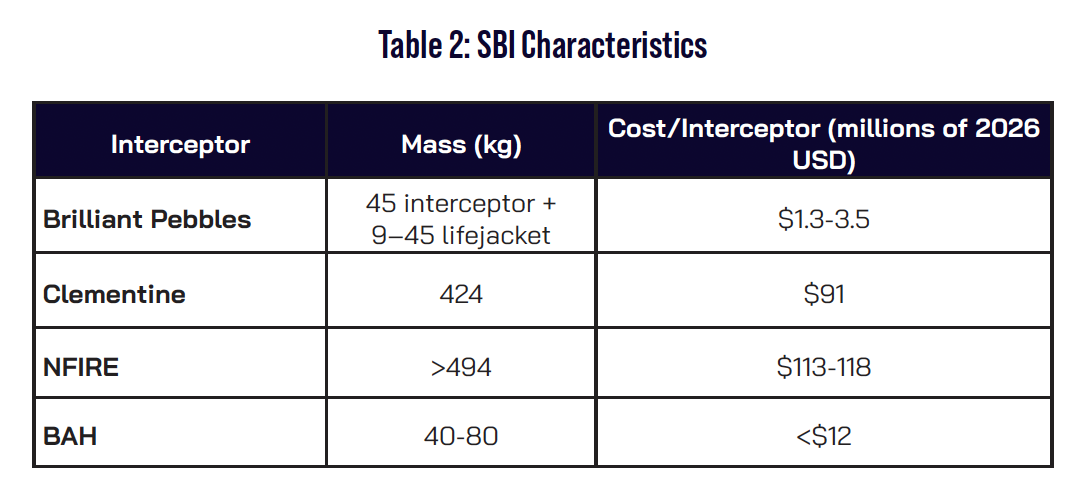
The first antecedent is the Brilliant Pebbles program which consisted of kill vehicles housed in “lifejackets”. The lifejacket would power, protect, and provide information to the Pebble. Brilliant Pebbles was eventually incorporated into the Strategic Defense System, Phase I of which was to include 4,600 Pebbles.[41] A Government Accountability Office report from March of 1991 stated the cost for the Brilliant Pebbles portion of Phase I would include $0.9 billion for the lifejackets and $1.6 billion for the interceptors, along with $3.9 billion for other fees, such as “facilities integration, project management, and procurement contract fees.”[42] For just the costs associated with the interceptors themselves, Brilliant Pebbles would have cost about $543,478 per interceptor in 1991 or $1,344,643 in 2026. Including other fees, the Pebbles would have cost $1,391,304 in 1991 or $3,442,288 in 2026. The higher estimates align with what the designer of Brilliant Pebbles claimed, from $1.1 to $1.4 million per interceptor in 1990 or $2.7 to 3.5 million today.[43]
There is much less variation in weight estimates for Brilliant Pebbles. Canavan assumed a 40 kg interceptor weight, a number accepted by Garwin in his rebuttal.[44] Contemporary estimates from Lawrence Livermore National Laboratory and the Heritage Foundation suggested the weight would be around 100 lb or 45 kg.[45] However, this weight estimate does not appear to account for the weight of the lifejacket.
One estimate suggested the weight of the seeker package including the optics, electrooptics, and computer would be just over 1 kg, the propulsion system could weigh 4.5 kg, plus 19–34 kg of hydrazine for propellant.[46] That would place the wet mass of the interceptor at around 25–40 kg. Additionally, this estimate suggested the lifejacket would weigh 9 kg, for an all-up satellite mass of 34–49 kg. Other estimates suggest the lifejacket could range from 20–100 percent of interceptor mass given the lifejacket’s shielding and stationkeeping functions.[47]
After Brilliant Pebbles was cancelled in 1993, NASA and the Ballistic Missile Defense Organization cooperated on the Clementine probe, which incorporated many Brilliant Pebbles technologies for a planetary science mission.[48] The total cost for Clementine, including launch on a Titan II(23)G SLV, was $75 million in 1993, which is equivalent to $170 million in 2026.[49] Some reports indicate that the cost of a Titan II(23)G launch at the time was approximately $34 million, suggesting Clementine itself cost about $40 million, or $91 million in 2026.[50] These numbers roughly align with the original goals of the Clementine project, which was to build two probes for $100 million.[51] While the dry mass of the satellite was approximately 200 kg, with propellant Clementine weighed about 424 kg.[52] However, since Clementine’s mission involved orbiting the moon, it may have been loaded with more propellant and other equipment than an SBI would have.
A decade later the Missile Defense Agency’s Near Field Infrared Experiment (NFIRE) project also tested some SBI technologies. In addition to missile tracking sensors, NFIRE was originally designed to fire a small projectile at an incoming warhead.[53] The projectile was dropped from the program after critics claimed it was a stepping stone to space-based interceptors.[54] NFIRE ultimately only deployed the lifejacket or bus without the interceptor, instead carrying a Track Sensor Payload to collect data on boosting missiles and a German-built Laser Communications Terminal to assess whether laser communications would be beneficial for space-based defenses.[55] NFIRE was launched in 2007 and remained in service until 2015.
For FY 2005 the NFIRE budget was $68 million and later reports suggested the spacecraft cost $65 million each, or $118 and $113 million respectively in 2026.[56] Contemporary reporting indicated NFIRE weighed 494 kg, though since the satellite did not include the interceptor, merely the bus or lifejacket and other sensor and communications packages, this would not have reflected the true weight of a weaponized NFIRE system.[57] NFIRE was much heavier than any of the predicted masses for Brilliant Pebbles, including lifejackets. This may have been a function of NFIRE’s more diverse functions.
In 2025, a Booz Allen Hamilton paper proposed an SBI system as part of Golden Dome named “Brilliant Swarms.”[58] Brilliant Swarms would consist of 2,000 small satellite interceptors and cost approximately $25 billion.[59] The proposed interceptors would weigh between 40 and 80 kg each.[60] A senior executive at the company said that they estimated it would cost about $70 million to put 100 satellites for the system in orbit.[61] This statement suggests the launch costs for Brilliant Swarms would be around $1.4 billion, leaving the remaining $23.6 billion to cover the research and development, engineering, and production costs for the interceptors. Divided equally, that comes out to over nearly $12 million per interceptor. It is worth noting the actual marginal cost of producing each interceptor will be lower than $12 million, as the $23.6 billion covers much more than production.
The lowest estimate for the price of an SBI in 2025 dollars is over $1.3 million, while the highest is over $110 million. There is a similarly vast range for possible masses, ranging from 40 kg to nearly 500 kg. For simplicity, and to be generous to the defender, we chose to base our cost estimates on a $1.3 million interceptor. This cost is unlikely to be realized. This is a best-case scenario for the defender and therefore should be considered at the extreme low end of any cost estimate.
It is worth comparing these to costs for existing exoatmospheric kill vehicles. The Capability Enhancement-II (CE-II) Exoatmospheric Kill Vehicle for the Ground-Based Interceptor cost roughly $39 million each in FY 2010, or about $60 million today.[62] Of course, the CE-II was not produced in large quantities, so economies of scale could bring the cost down somewhat. The SM-3 Block IIA costs around $27–30 million. Rounds bought before FY 2025 went for around $27 million, but the price has gone up and rounds purchased in FY 2027 will be $29.893 million.[63] However, as that price is for the whole interceptor, obviously the advanced Kinetic Warhead would cost somewhat less. Nevertheless, the SM-3 and the CE-II EKV both suggest that the kill vehicles used in an SBI constellation would cost more than the $1.3–12 million suggested by Brilliant Pebbles and Booz Allen Hamilton.
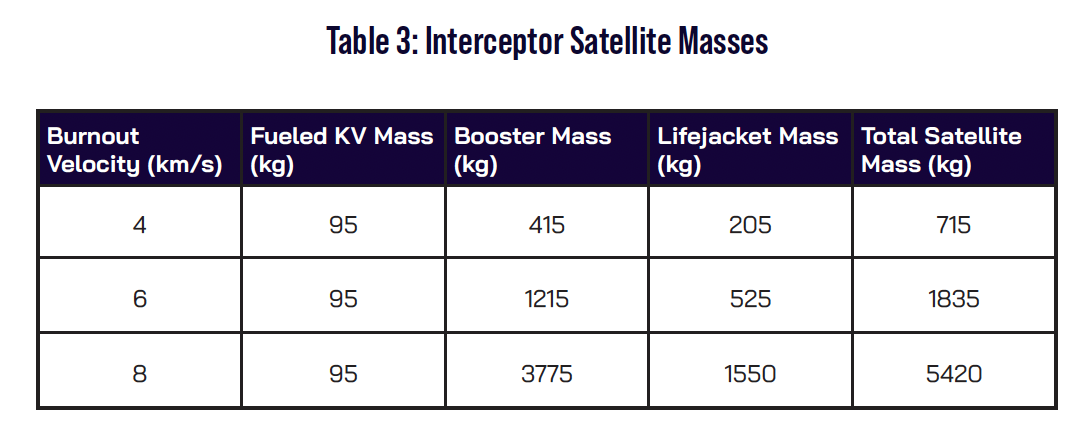
David Wright recently estimated the capabilities of space-based interceptors and concluded the notional Booz Allen Hamilton interceptors were far too light.[64] Wright divided the satellite into three component parts; an interceptor with a kill vehicle and booster, and a lifejacket. Based on the Clementine instruments and previous studies such as those conducted by the APS, and accounting for technological advances, he assessed the kill vehicle would weigh 30 kg excluding propellant and tankage.[65] With propellant and tankage, the kill vehicle would weigh 95 kg. Booster mass varied based on the needed burnout velocity of the interceptor. Using Wright’s equations, we calculated booster masses for interceptors reaching burnout velocities of 4, 6, and 8 km/s.[66] Wright further assessed the lifejacket would be approximately 40% of interceptor weight, consistent with previous estimates by Canavan, Teller, and others. Using Wright’s method, we calculated satellite mass for the different interceptors we model. Those masses, including booster mass and lifejacket mass, are presented in Table 3.
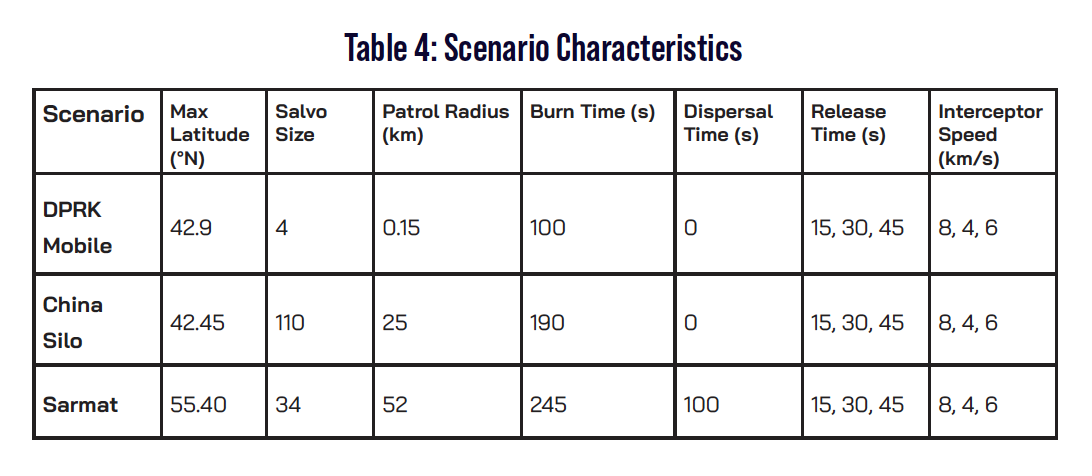
The following sections will examine different interceptors, decision times, and missile characteristics, and their impact on constellation size and cost. Three different release times will be considered, as well as three different missile burn times and three different interceptor speeds. The specific latitudes, burn time, dispersal time, number of missiles, and patrol area radius will be explained for each scenario.
A Mobile North Korean Missile Threat
One oft-cited case for SBIs is the North Korean ICBM threat.[67] One way to size a constellation against the North Korean ICBM force is to use a representative long-range missile base disguised as a golf course discovered in March 2025.[68] This garrison is designed to house mobile long-range ballistic missiles which would launch from paved, pre-surveyed launch sites in a relatively small patrol area.
The cluster of launch pads is about a third of a km wide, giving a patrol radius of 0.15 km. The northernmost latitude defended would be the northern-edge of North Korea at 42.9°N. The goal, of course, is to cover the entirety of the North Korean ICBM force, rather than just this representative garrison in the southern part of the country. Finally, based on the size of North Korean ICBM-class transporter-erector launchers and the size of the bermed storage annex for vehicles, we assessed that 4 launchers could be securely stored on site, suggesting the size of the garrison.[69]
We modeled a notional 100-second fast-burning ICBM, for this scenario, not necessarily because that is a capability the North Koreans could currently implement, but to demonstrate the importance of burn time on constellation size.
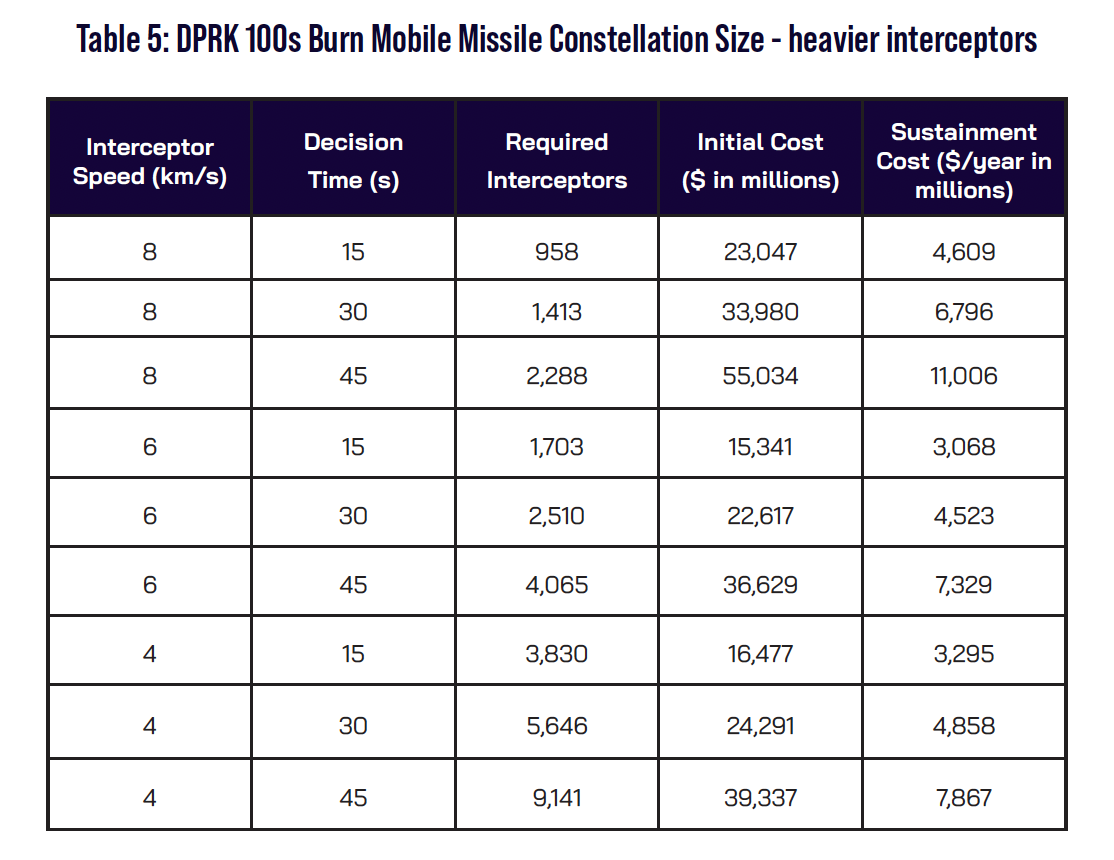
These figures demonstrate how sensitive constellation size is to the intercept window. For any given interceptor speed, the change in release window roughly doubles the constellation size. Under reasonable conditions, a 30-second release window, and a 4 km/s interceptor, defending against only a handful of North Korean ICBMs would demand over 5,000 interceptors.
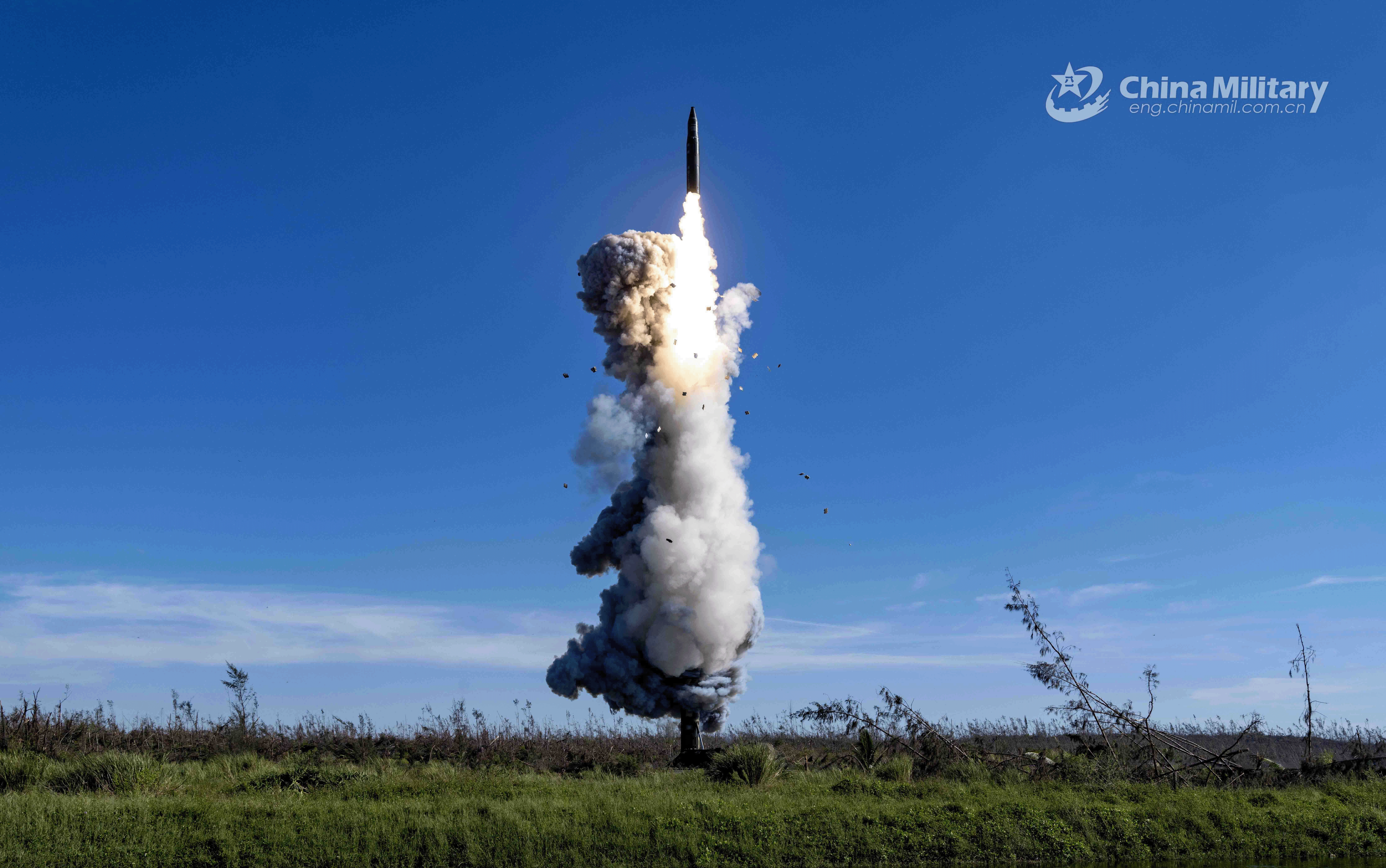
An image of the missile launch released by the Chinese People’s Liberation Army on September 25, 2024.
China’s Silo-Based Missiles
Since the discovery of the People’s Republic of China’s construction of hundreds of missile silos in 2021, analysts and policymakers have fretted about the impact this force will have on US forces and posture. Former Acting Assistant Secretary of Defense for Space Policy Vipin Narang has repeatedly stated the Chinese silo fields are intended to upset US strategic force structure.[70] Given the difficulties the silos pose for US force planning, one potentially attractive option for space-based interceptors would be to use SBIs to remove the new silos from the equation, tailoring a constellation to deal with that particular threat. Indeed, that is similar in principle to the proposal Canavan and Teller made, where an SBI constellation would counter the threat posed by the Soviet SS-18 silo fields.
We considered a 190-second burn time for this constellation. The Department of Defense assesses the silos in northern China will likely be filled with DF-31-class ICBMs.[71] More specifically, they will likely house the DF-31BJ, a silo-based variant of the mobile DF-31A that was unveiled during a parade in September 2025.[72] While we have not seen a full burn of a DF-31 variant ICBM, given the shorter burn times associated with solid propellant ICBMs it may be around 190 seconds.
To size a constellation against the silo fields two pieces of data are needed. First is the latitude of the northernmost point of the northernmost silo field. This will help determine the edge of the area protected by the constellation and calculate the “z” factor. In this case, that would be the northern edge of the Hami missile field, at 42.45°N.
Second is the radius of the densest silo field. Hami has 110 silos in about 802 square km, or about 0.137 silos per square km, with a radius of about 25 km at its widest point. Yumen has 120 silos in an area of roughly 990 square km, or about 0.12 silos per square km, with a radius of about 30 km at its widest point. Hanggin Banner/Yulin fits 90 silos in an area of about 775 square km, about 0.116 silos per square km, and is about 17 km in radius at its widest point. As Hami is the densest silo field, the radius of 25 km was used for the calculations.
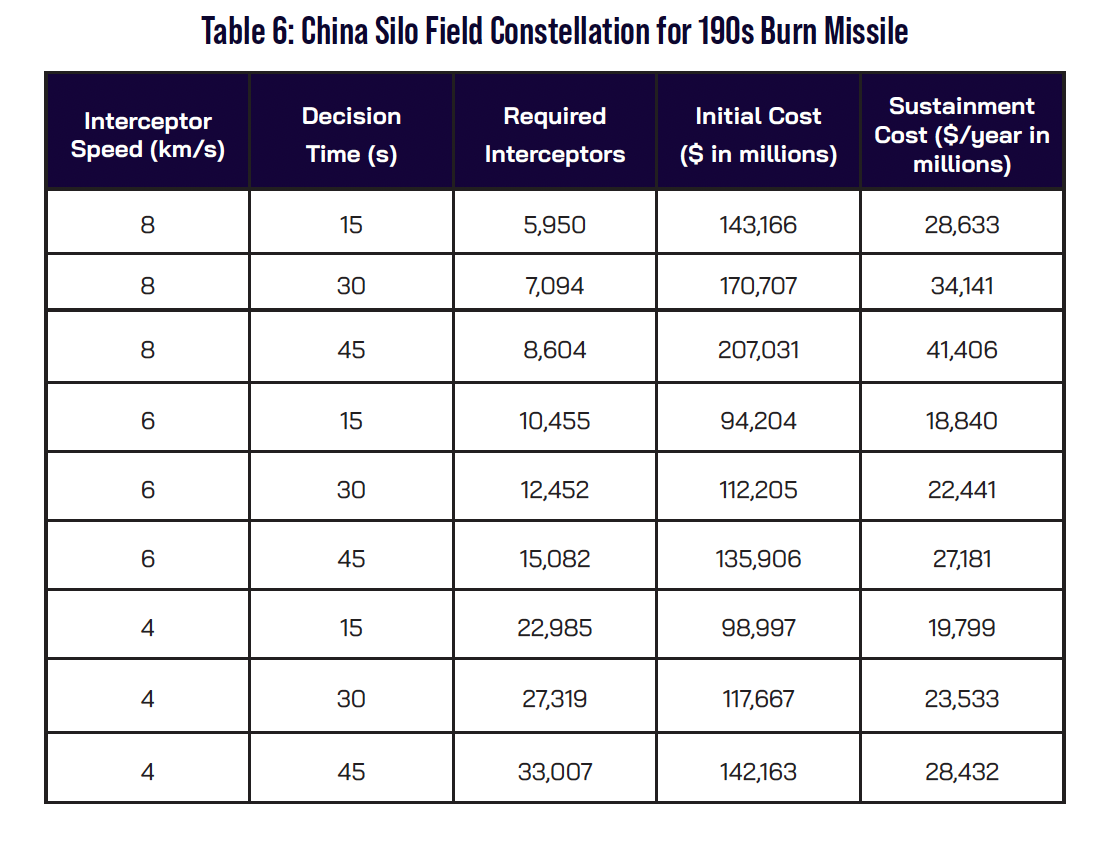
Even under the most optimistic conditions, at least several thousand SBIs are required to defend against China’s silo fields. Under less generous circumstances, tens of thousands are needed. Recall these constellations only ensure that at least one interceptor is in range of an ICBM. If one desired redundancy in the system for two-on-one targeting to raise the probability of kill, the constellations would be dramatically larger. As the intercept window closes, either due to a faster burning ICBM or a longer period of decision time, the constellations rapidly reach tens, or even hundreds, of thousands of satellites.
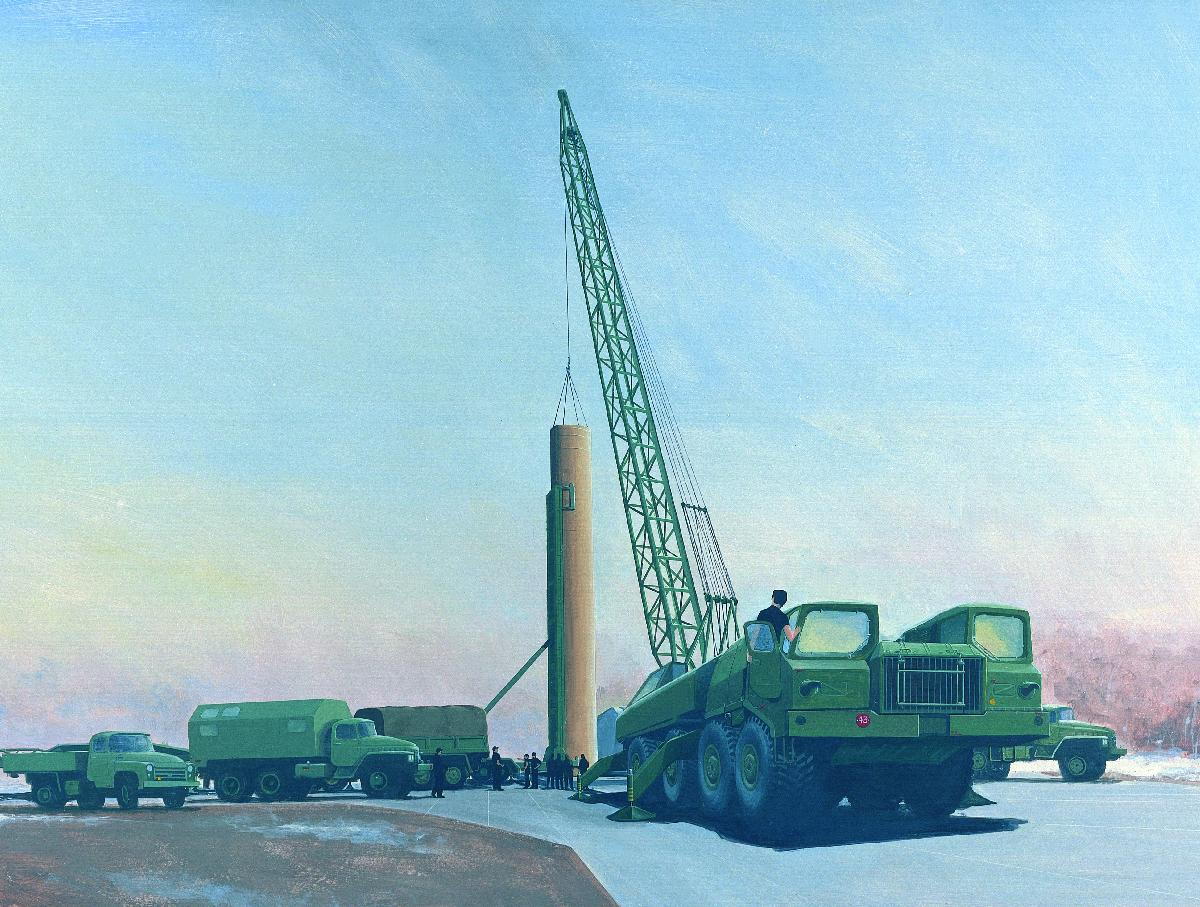
Soviet SS-18 MOD 5 Intercontinental Ballistic Missile – Ronald C. Wittmann, 1989 (DIA Military Art Collection)
RS-28 Sarmat Fields
In the 1990s Teller and Canavan proposed a Brilliant Pebbles constellation to counter the Soviet SS-18 Satan ICBM fields. Capable of delivering 10 warheads at intercontinental ranges, the SS-18 was the apotheosis of the Soviet liquid ICBM program. After several failures, Russia conducted its second successful test of the successor to the SS-18, called the RS-28 Sarmat by the Russians, in May 2026.[73] One could size an SBI constellation today, true to Teller and Canavan’s intentions, countering any new Sarmat deployments.
There are added benefits to attempting to target Sarmat in the boost phase. Russian President Vladimir Putin has suggested that the new large liquid-propellant ICBM has been built with the range to target the United States while flying over the south pole, rather than on a conventional ICBM trajectory over the north pole.[74] The southern shot would avoid much of the US missile detection and defense architecture, a perennial worry for the Russians. A boost-phase defense against Sarmat would prevent it from evading US defenses by going south, either to deliver a ballistic warhead or a Fractional Orbital Bombardment System (FOBS).
Sarmat will replace the SS-18 regiments which make up the 13th Missile Division at Dombarovsky and the 62nd Missile Division at Uzhur.[75] The SS-19 regiments at Dombarovsky are expected to eventually be replaced with Sarmat as well.[76]
Like the Chinese silo fields, information about which of the two fields is larger and the northernmost latitude to be defended are key to sizing an anti-Sarmat constellation. The silo field at Dombarovsky includes 34 silos spread over about 2400 square km, about 70 square km per missile. The 62nd Division at Uzhur houses 28 silos within about 1600 square km, or 57 square km per missile. Since the 13th Missile Division is more numerous, it demands more interceptors, so its 52 km radius and 34 launchers are used to size the constellation. However, the 62nd Missile Division will have the northernmost Sarmat silo, at 55.40°N. We use the size of Dombarovsky and the latitude of Uzhur to size the constellation.
Additionally, since Sarmat is a liquid propellant missile we have not included the 190- and 100-second burn times. Unfortunately we do not know the Sarmat burn time as the Russians have not released a video of the full burn, nor have they converted it to SLV. Instead, we consider the 245-second burn derived from the Dnepr. To all of these, we have added 100 seconds of deployment time. The SS-18 could carry as many as 10 warheads and it is likely Sarmat will carry a similar number. While this lowers the number of required interceptors for the constellation, it increases the leakage rate, as many of the warheads would get through the more porous defense. Whether the damage is limited by this marginal capability is a worthwhile subject for future study.
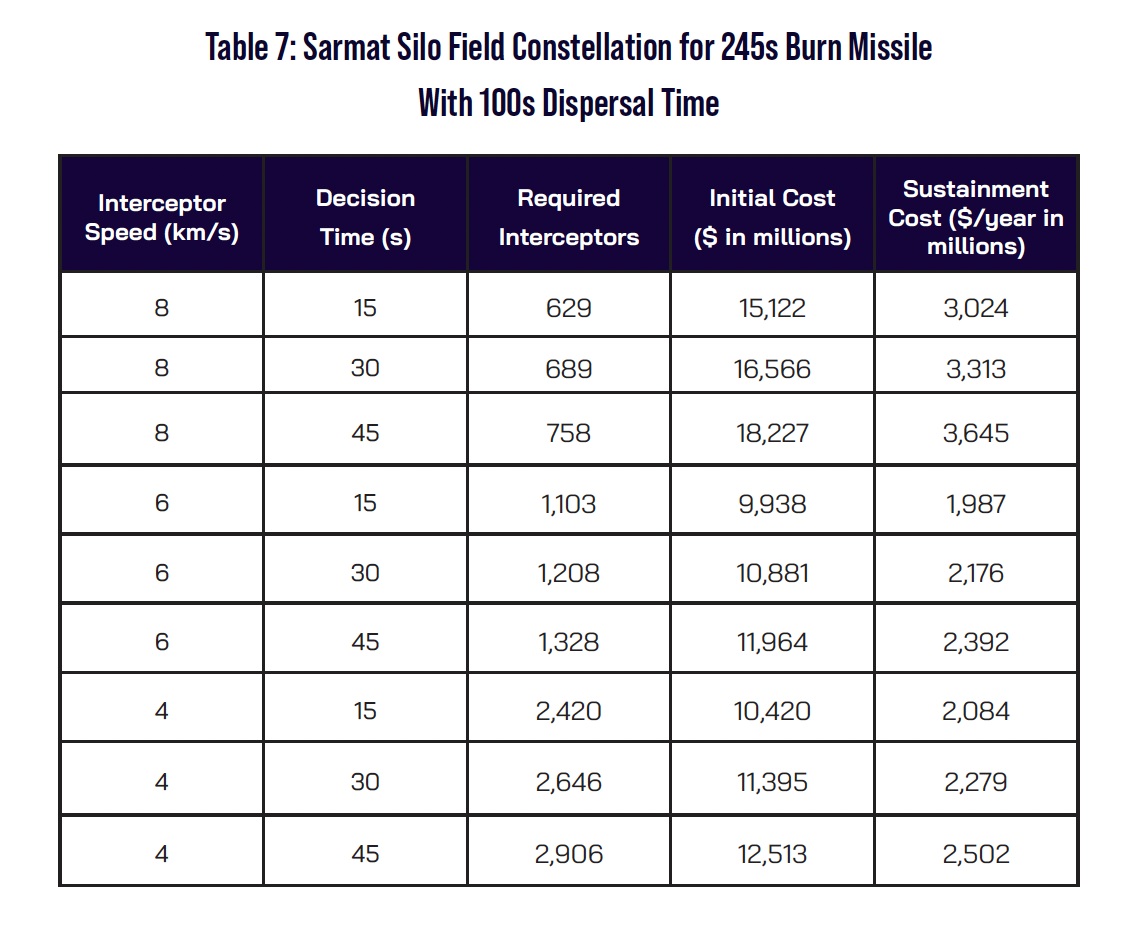
This constellation, along with the previous two, illustrate that while launch costs have declined significantly, they are still a limiting factor. Across the scenarios, while the 8 km/s interceptor constellation is the smallest, it is also the most expensive. This price is driven in large part by the mass of the booster, which must have more propellant to produce enough thrust. Given current launch prices and capabilities, it appears the 6 km/s interceptor constellations are the most modestly priced, closely followed by the 4 km/s interceptor. The small variance between the 4 and 6 km/s interceptor constellations reflects our model’s use of $1.3 million as the interceptor cost. In all likelihood, the faster interceptor would be more expensive. Whether that would be offset by the larger number of interceptors demanded in a 4 km/s interceptor constellation deserves further study. Nevertheless, the relative simplicity, smaller mass, and probable economies of scale associated with 4 km/s interceptor constellations may make them more desirable than more capable, yet more massive and expensive constellations.
SBIs could limit the effect of Sarmat, complicating any FOBS deployment or southern trajectory shots which would undermine other elements of the US missile defense architecture. Considering the 4 km/s case against a feasible 245 second burn Sarmat with 30 seconds of decision time, and doubling the size of the constellation for two-on-one targeting to improve coverage, it would only cost approximately $4 billion up front and $115 million each year to sustain an anti-Sarmat constellation. However, this constellation would be much more brittle and permeable since it would allow the majority of the warheads to leak as intercept would only have to occur before the final warhead was deployed. Nevertheless, there are some relatively simple countermeasures the Russians could take which would severely hamper or undermine such a constellation.
Potential Countermeasures and Responses
It is naive to think American adversaries would accept US deployment of any of these SBI constellations without strenuous objections and serious responses. Indeed, the Russians and the Chinese thought through their approaches to countering constellations akin to Brilliant Pebbles in the 1980s. Former Soviet officials suggested that official thinking around their “asymmetric response” was well reflected in public reports from the time.[77] Those reports indicated the strategy was built around two pillars, “active and passive countermeasures. The former would be based on the development of means for neutralizing and destroying the various components of a multilayered BMD [ballistic missile defense], and the latter on the buildup, modification, and diversification of strategic offensive nuclear forces.”[78] This approach appears to have been emulated by the Chinese. Senior Chinese diplomats and military specialists reportedly remarked they would mirror the Soviet “asymmetric response,” which they called the “Andropov solution.”[79]
A non-exhaustive list of the active countermeasures outlined by Yevgeni Velikhov and other Soviet academicians included ground-based direct ascent anti-satellite weapons (ASATs), ground-based high-power lasers, and space mines.[80] Velikhov noted that such a ground-based direct ascent system would be fast-burning, akin to the US Sprint ABM interceptor, to minimize the boost phase. A Lawrence Livermore National Laboratory study from 1990 argued there would be a cost ratio of about 40:1 in favor of small, ground-launched ASATs against un-defended Brilliant Pebbles.[81] China and Russia have both developed and tested kinetic, direct ascent anti-satellite weapons, though they are likely much more expensive than those considered in the study.
Among the goals articulated by North Korea at the Ninth Party Congress of the Worker’s Party of Korea in February 2026 included developing “special assets for attacking adversary satellites.”[82] Given the technical difficulties associated with hit-to-kill systems, including sensitive infrared sensors, and their relative independence from space-based assets, it would not be surprising if North Korea’s “special assets” included a nuclear-armed direct ascent ASAT.
Both Russia and China appear to have developed, and Russia has deployed, ground-based high-powered lasers to disrupt US space systems. Russia developed the Persevet laser system to protect its mobile ICBM by dazzling intelligence, surveillance, and reconnaissance (ISR) satellites.[83] In 2019, then-Defense Minister Sergei Shoigu stated the mobile laser had been deployed with at least five Russian mobile ICBM divisions.[84] Similarly, China has static laser dazzling sites and has likely developed a mobile anti-satellite laser as well.[85] Peresvet and its Chinese cousin could easily be turned against an SBI constellation, damaging sensors and other elements of early warning and detection satellites or the SBIs themselves.[86]
While there is less evidence of China testing, building, and deploying space mines, both China and Russia appear to have made significant investments in co-orbital anti-satellite weapons that could feasibly include explosive payloads of the sort described by Velikhov and his co-authors.[87] Moreover, senior US government officials have spoken quite frankly about intelligence indicating Russia has an active program to place a nuclear weapon in low-earth orbit.[88] While perhaps at the most extreme end of the spectrum of possible space mines, such a capability would allow the Russians to negate a SBI constellation by generating an electromagnetic pulse, damaging satellites within line of sight of the mine and pumping the radiation belts to damage those satellites which weren’t promptly affected.[89]
As for the passive countermeasures suggested by the “asymmetric response” strategy, those include saturating defenses by building more forces, deploying additional warheads on existing missiles, or building cheap, unarmed ICBMs with rudimentary guidance, innovative launch tactics including coordinated launches and depressed trajectories, shortening missile burn times, and reducing the infrared signature of the missile plume.[90]
Saturation is relatively straightforward and does not need much further explanation. At lower release windows, the system may be more sensitive and have more automaticity built into it, making it more susceptible to being fooled by cheap, unarmed missiles. One could envision the Chinese regularly launching sounding rockets with boosters designed to produce an infrared signature similar to that of the first stage of a DF-31 to attrit a SBI constellation over time.
There are many innovative launch tactics which could undermine SBIs. As an illustrative example, one could preposition mobile launchers further along the orbit of the constellation from a silo field. One would launch the missiles in the silo field first, and as the constellation intercepted them, it would open a window through which the mobile missiles could fire shortly thereafter. Of course, careful constellation design with multiple orbital tracks can account for this type of tactic. Yet, this example illustrates the kind of strategies that could be used to complicate SBI constellations.
More classically, an adversary could fire on depressed trajectories. Depressed trajectories complicate SBI interception as the missile spends less time outside the atmosphere. While there are significant range penalties and it puts the airframe under more stress and heat, the shorter flight times and lower apogees carry their own benefits, especially for adversary submarine-launched ballistic missiles.
As demonstrated by the constellation sizing exercises, attacking the intercept window is one of the most effective ways to drive up the required number of interceptors, best accomplished by shortening burn time. If the missile burns out and the warhead separates before the interceptor can arrive, the interceptor will miss and the warhead will continue into midcourse. Garwin in his response to Canavan and Teller suggested that 100-second burn solid propellant ICBMs were feasible with a missile only 5 percent heavier than otherwise.[91] Indeed, reporting indicated the Topol-M, the successor to the SS-25/Topol that Garwin cited, was designed with a much faster burn than the Topol to complicate defenses.[92] A report made to the Fletcher Panel, one of the early commissions to investigate issues surrounding SDI, reportedly indicated that burn time for a solid ICBM could be cut to 60 seconds with a payload penalty under 20 percent.[93] In more simple terms, an attacker could trade a small amount of weight for a faster burn. That weight requirement could simply mean an attacker carries fewer warheads, or could create an incentive to build lighter warheads.
Similarly, adversaries could use independent post-boost vehicles for their warheads rather than rely on a single post-boost vehicle (PBV). If an interceptor hit a regular PBV, it would likely destroy or mission kill all of the warheads which had not yet been dispersed. However, if each reentry vehicle had its own PBV, even if the SBI performed perfectly it would only hit one of several reentry vehicles deployed by the ICBM. Indeed, Russia tested such an independent PBV arrangement on a Topol-M in 2017 and some analysts believe the recently paraded Chinese DF-61 uses independent post-boost vehicles (IPBVs) based on Chinese missile naming conventions.[94] There would be weight penalties associated with IPBVs, reducing payload, but those would likely be considered worthwhile by adversaries seeking to overcome SBIs. IPBVs effectively reduce the intercept window to the period when the third stage is burning, otherwise the majority of the warheads will escape interception.
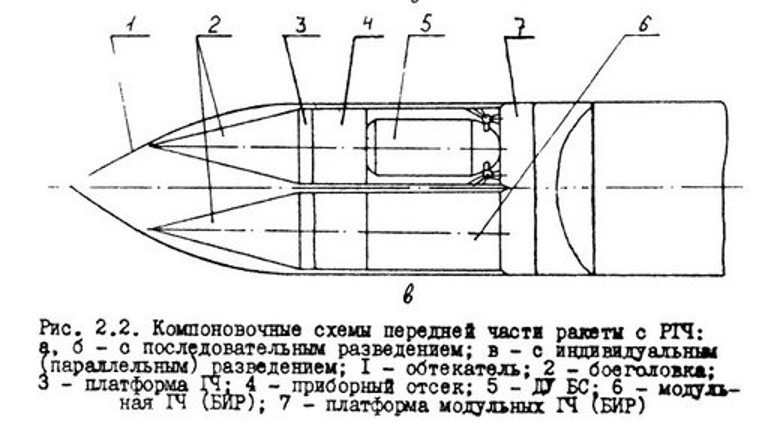
A diagram of an independent post boost vehicle arrangement from a textbook used at Bauman Moscow State Technical University, courtesy of Pavel Podvig.[95]
Given the sensitivity of modern space-based infrared systems for early warning and detection, it may not be worthwhile for adversaries to attempt to complicate SBIs by reducing the infrared signature of their rocket plumes. The SLOW WALKER program started in the 1980s to use the Defense Support Program satellites to track aircraft on afterburner suggests the sensors were sensitive enough not to be fooled by such tactics over 40 years ago, and have likely only gotten better over time.[96]
Conclusion
Using relatively simple tools and calculations, it is possible to approximate the size of various SBI constellations. Of course, the model we have developed is not perfect and we make several simplifications. Nevertheless, the model provides a good first-order estimate of the scale and cost of the space-based missile defense endeavor.
The constellation’s size is always going to be driven by the system’s overarching objective. We have presented three examples of targets: mobile North Korean missile forces, Chinese silo fields, and Russian heavy liquid ICBM silo fields. When using realistic assumptions about interceptor speed, release time, and burn time, the data clearly shows that constellations quickly become very large and very expensive. Most of the constellations we presented equal or exceed the largest existing satellite constellation: SpaceX’s Starlink constellation. As of the time of writing, Starlink has about 10,500 satellites in orbit.[97] Most of the constellations described here would comfortably surpass the size of Starlink, both in scale, complexity, and mass on orbit. While SpaceX has demonstrated that large constellations like Starlink are possible, space-based internet is much simpler than space-based missile defense. Even though launch costs have come down, the costs associated with more capable, yet more massive, constellations indicates launch costs are still prohibitive for some capabilities. Moreover, the complexity of command and control for an SBI constellation of any value would be an immense challenge.
Our analysis also identifies key factors determining constellation size: the duration of the intercept window and interceptor speed. While interceptor speed is something the United States can control, within the bounds of reasonable engineering, the intercept window is adversary-driven. There are many straightforward steps adversaries can take to narrow the intercept window and make it much easier to saturate a constellation or render it far too small to cope with the desired threat.
While the passive responses are effective and, in the main, rather benign for stability, the active measures are not. Persistent dazzling, aggressive ASAT attacks, and incentives to place space mines and nuclear weapons in orbit produce a more precarious security situation. As we revisit space-based boost-phase defenses, we should be conscious about the incentives SBIs create for adversaries. Is the marginal damage limited by any of these constellations worth the time, effort, cost, and rejoinders our adversaries will make? Our sense is no.
[1] Funding for this paper was generously provided by the New-Land Foundation, whose support allowed for this team to complete this research. The authors are grateful for New-Land’s support.
[2] Executive Office of the President, “The Iron Dome for America,” The White House, January 27, 2025, www.whitehouse.gov/presidential-actions/2025/01/the-iron-dome-for-america/.
[3] Ernest J. Yanarella, The Missile Defense Controversy: Technology in Search of a Mission (University Press of Kentucky, 2002), 74-75.
[4] Gregory H. Canavan and Edward Teller, “Strategic Defence for the 1990s,” Nature 344, no. 6268 (April 19, 1990): 699–704, https://doi.org/10.1038/344699a0.
[5] Velocity, usually given as burnout velocity, is itself a simplification because the interceptor must accelerate to its burnout velocity.
[6] Note that the term 90-L must be converted from degrees to radians.
[7] Gregory H. Canavan and Edward Teller, “Strategic Defence in the 1990s.”
[8] David K. Barton et al., “Report of the American Physical Society Study Group on Boost-Phase Intercept Systems for National Missile Defense: Scientific and Technical Issues,” Review of Modern Physics 76, Supplement 1 (October 2004), S107, https://doi.org/10.1103/RevModPhys.76.S1.
[9] Of course, it is possible that expending interceptors would create gaps in the constellation, but as the interceptors are unlikely to all be in identical orbits, those gaps are more likely to resemble thin areas of coverage rather than gaping holes.
[10] Gregory H. Canavan and Edward Teller, “Strategic Defence in the 1990s.”
[11] Gregory H. Canavan and Edward Teller, “Strategic Defence in the 1990s,” 704.
[12] Ankit Panda, “The Hwasong-15: The Anatomy of North Korea’s New ICBM,” The Diplomat, December 6, 2017, https://thediplomat.com/2017/12/the-hwasong-15-the-anatomy-of-north-koreas-new-icbm/.
[13] To successfully intercept the post-boost vehicle, the interceptor likely needs additional medium- and long-wave infrared sensors capable of seeing the bus against the cold background of space.
[14] William Fallon and Lester Lyles, “Science & Technology Issues of Early Intercept Ballistic Missile
Defense Feasibility,” Defense Science Board, US Department of Defense, September 2011, 10, https://apps.dtic.mil/sti/pdfs/ADA552472.pdf.
[15] SS-18 burn time was calculated using information on the SS-18-derived Dnepr SLV. Using the propellant mass of each stage, the given thrust, and accepted specific impulse numbers, burn time was calculated. See: “Space Launch System Dnepr User’s Guide,” Kosmotras, 18, https://sky-brokers.com/wp-content/uploads/2025/04/Dnepr-User-Guide.pdf.
[16] Richard L. Garwin, “Brilliant Pebbles Won’t Do,” Nature 346 (1990), 21, https://www.nature.com/articles/346021a0.
[17] Richard L. Garwin, “Brilliant Pebbles Won’t Do,” 21.
[18] “Space Launch System START-1 User’s Handbook Volume 1: Spacecraft & Launch Vehicles Interfaces,” May 31, 2002, United START, 16-17, https://snebulos.mit.edu/projects/reference/launch_vehicles/START/start-vI.pdf. The handbook notes that each of the boost stages burns for about one minute, with some 10–20 seconds of coasting between each stage. The coasting accounts for the reported third stage separation time of 211 seconds into flight for the various orbital injections. The burn time of the motors is 186 seconds.
[19] Gregory H. Canavan, Missile Defense for the 21st Century (The Heritage Foundation, 2003), 40, http://highfrontier.org/wp-content/uploads/2013/07/Canavan-Heritage.pdf.
[20] David K. Barton et al., “Report of the American Physical Society Study Group on Boost-Phase Intercept Systems for National Missile Defense,” S26.
[21] National Research Council, Making Sense of Ballistic Missile Defense: An Assessment of Concepts and Systems for U.S. Boost-Phase Missile Defense in Comparison to Other Alternatives (National Academies Press, 2012), 41, https://nap.nationalacademies.org/catalog/13189/making-sense-of-ballistic-missile-defense-an-assessment-of-concepts.
[22] Gregory H. Canavan, Missile Defense for the 21st Century, 40.
[23] See: David Arthur and Christopher Martin, “Potential Costs of a National Missile Defense System,” Congressional Budget Office, May 2026, https://www.cbo.gov/publication/62379.
[24] Jack Mellody, “Mission-Centric Integration Through Golden Dome,” National Defense, May 15, 2025, https://www.nationaldefensemagazine.org/articles/2026/5/15/missioncentric-integration-through-golden-dome.
[25] David K. Barton, et al., “Report of the American Physical Society Study Group on Boost-Phase Intercept Systems for National Missile Defense: Scientific and Technical Issues,” S114. Subsequent editions of the American Physical Society report such as the one issued in 2025 made similar judgments.
[26] James Gattuso, “Brilliant Pebbles: The Revolutionary Idea for Strategic Defense,” Heritage Foundation, January 25, 1990, https://www.heritage.org/defense/report/brilliant-pebbles-the-revolutionary-idea-strategic-defense; Gregory H. Canavan and Edward Teller, “Strategic Defense in the 1990s,” 700; Gregory H. Canavan, “High-Velocity Interceptors for Boost-Phase Intercepts,” Los Alamos National Laboratory, November 1993, 4, https://doi.org/10.2172/10188500.
[27] Dennis E. Morris, “Space Based Missile Interceptor Sizing Methodology,” 40th AIAA/ASME/ASEE Joint Propulsion Conference, Fort Lauderdale, FL, July 12-14, 2004, 12; Donald R. Baucom, “The Rise and Fall of Brilliant Pebbles,” The Journal of Social, Political and Economic Studies 29, no. 2 (Summer 2004), 181, https://highfrontier.org/wp-content/uploads/2012/09/The-Rise-and-Fall-of-Brilliant-Pebbles-Baucom.pdf.
[28] David K. Barton et al., “Report of the American Physical Society Study Group,” S114.
[29] National Research Council, Making Sense of Ballistic Missile Defense: An Assessment of Concepts and Systems for U.S. Boost-Phase Missile Defense in Comparison to Other Alternatives (National Academies Press, 2012), 60, https://nap.nationalacademies.org/catalog/13189/making-sense-of-ballistic-missile-defense-an-assessment-of-concepts.
[30] Brad Hathaway et al., “Strategic Defense Initiative: Estimates of Brilliant Pebbles Effectiveness Are Based on Many Unproved Assumptions,” Government Accountability Office, March 1992, 8, https://www.gao.gov/assets/nsiad-92-91.pdf.
[31] David Wright, “Space-Based Missile Defense,” Science & Global Security (June 2026), 16, https://doi.org/10.1080/08929882.2026.2690799.
[32]Julia Seibert, “ULA vs SpaceX – A Detailed Comparison in 2024,” Space Insider, July 31, 2024, https://spaceinsider.tech/2024/07/31/ula-vs-spacex/.
[33] Kevin Holden Platt, “SpaceX Vow To Loft 1 Million AI Satellites Could Spark Doomsday Dive,” Forbes, May 31, 2026, https://www.forbes.com/sites/kevinholdenplatt/2026/05/31/spacex-vow-to-loft-1-million-ai-satellites-could-spark-doomsday-dive/; Sebastian Moss, “Elon Musk says SpaceX “will be doing” data centers in space,” Data Center Dynamics, November 3, 2025, https://www.datacenterdynamics.com/en/news/elon-musk-says-spacex-will-be-doing-data-centers-in-space/.
[34] Eric Berger, “SpaceX Has Set All Kinds of Records with Its Falcon 9 Rocket This Year,” Ars Technica, December 4, 2024, https://arstechnica.com/space/2024/12/spacex-has-set-all-kinds-of-records-with-its-falcon-9-rocket-this-year/.
[35] “SpaceX Increases Falcon 9 Launch Prices to $74M – Rideshare Now $7,000/kg,” SatBase, February 27, 2026, https://satbase.com/articles/spacex-falcon-9-price-increase-2026.
[36] Morgan Brennan, “Elon Musk: SpaceX Falcon 9 Rocket ‘Over a Million Dollars Less’ to Insure,” CNBC, April 16, 2020, https://www.cnbc.com/2020/04/16/elon-musk-spacex-falcon-9-rocket-over-a-million-dollars-less-to-insure.html.
[37] Anthony Lemole, “SpaceX Launches First Starlink Mission of 2021,” NASASpaceFlight, January 20, 2021, https://www.nasaspaceflight.com/2021/01/spacex-launch-first-starlink-mission-2021/.
[38] David K. Barton, et al., “Report of the American Physical Society Study Group on Boost-Phase Intercept Systems for National Missile Defense,” S144. The report noted that basing the SBIs at that altitude would require the interceptor to have a propulsion system to maintain its desired altitude and momentum even if the interceptor has a high ballistic coefficient. Similar assumptions were made for subsequent editions of that report including the 2025 version.
[39] Sandra Erwin and Jason Rainbow, “Booz Allen Unveils ‘Brilliant Swarms’ Satellite Concept for Missile Defense,” SpaceNews, March 27, 2025, https://spacenews.com/booz-allen-unveils-brilliant-swarms-satellite-concept-for-missile-defense/.
[40] Mikayla Easley, “Space Force Still Weighing Cost, Operational Advantages of Satellite Refueling Tech,” DefenseScoop, May 15, 2025, https://defensescoop.com/2025/05/15/space-force-satellite-refueling-tech-weighing-cost-operational-advantages/.
[41] Frances Fitzgerald, Way Out There in the Blue: Reagan, Star Wars and the End of the Cold War (Simon and Schuster, 2000), 483.
[42] Government Accountability Office, “Strategic Defense Initiative: Need to Examine Concurrency in Development of Brilliant Pebbles,” NSIAD-91-154, March 27, 1991, https://www.gao.gov/products/nsiad-91-154.
[43] “Cost estimates of Phase 1 deployment lowered $14-billion: SDIO OFFICIALS SAY FIRST FLIGHT TEST OF BRILLIANT PEBBLES THIS SPRING,” Inside the Pentagon 6, no. 7 (February 6, 1990), 11-16, https://www.jstor.org/stable/43986067.
[44] Gregory H. Canavan, “Exchange Ratios for Singlet Boost-Phase Defenders,” Los Alamos National Laboratory, May 1990, https://www.osti.gov/servlets/purl/6856690; Richard L. Garwin “Brilliant Pebbles Won’t Do.”
[45] James Gattuso, “Brilliant Pebbles”; Gregory H. Canavan, “Exchange Ratios for Singlet Boost-Phase Defenders.”
[46] Lowell Wood and Walter Scott, “Brilliant Pebbles,” presented at the The Strategic Defense Initiative Technical Achievements Symposium of the National Academy of Sciences, Washington, D.C., 29-30 June, 1989, https://www.osti.gov/servlets/purl/7138932, 8.
[47] Congressional Budget Office, “Alternatives for Boost-Phase Missile Defense,” July 2004, https://www.cbo.gov/sites/default/files/108th-congress-2003-2004/reports/07-22-missiledefense.pdf.
[48] Aaron Bateman, Weapons in Space: Technology, Politics, and the Rise and Fall of the Strategic Defense Initiative (MIT Press, 2024), 194-197.
[49] “The Clementine Satellite,” Energy & Technology Review (June 1994), 2, https://www.llnl.gov/sites/www/files/2020-05/clementine-etr-jun-94.pdf.
[50] “Titan II SLV,” Encyclopedia Astronautica, http://www.astronautix.com/t/titaniislv.html; “Clementine,” Next Spaceflight, https://nextspaceflight.com/launches/details/1266.
[51] Eugene M. Shoemaker and Stewart Nozette, “Clementine: An inexpensive mission to the Moon and Geographos,” presented at Twenty-Fourth Lunar and Planetary Science Conference. Part 3: N-Z, January 1, 1993, https://ntrs.nasa.gov/citations/19940016292.
[52] “Clementine,” NASA, September 1, 2023, https://science.nasa.gov/mission/clementine/.
[53] Jeremy Singer, “MDA Budget Documents Detail NFIRE Experiments,” Space News, May 24, 2009, https://web.archive.org/web/20090524124347/https://www.space.com/spacenews/archive05/Nfire_041805.html.
[54] Jeremy Singer, “MDA Budget Documents Detail NFIRE Experiments.”
[55] “NFIRE Fact Sheet,” Orbital, 2014, https://web.archive.org/web/20140210225625/http://www.orbital.com/NewsInfo/Publications/NFIRE_Fact.pdf.
[56] Jeremy Singer, “MDA Budget Documents Detail NFIRE Experiments”; Gunter D. Krebs, “NFIRE,” Gunter’s Space Page, https://space.skyrocket.de/doc_sdat/nfire.htm; Claude Lafleur, “Spacecrafts Launched in 2007,” Spacecraft Encyclopedia, http://claudelafleur.qc.ca/Spacecrafts-2007.html#NFIRE.
[57] “Orbital Minotaur Launches US Missile Defense Agency NFIRE Satellite,” Space Travel: Exploration and Tourism, April 26, 2007, https://www.space-travel.com/reports/Orbital_Minotaur_Launches_US_Missile_Defense_Agency_NFIRE_Satellite_999.html.
[58] Sandra Erwin and Jason Rainbow, “Booz Allen unveils ‘Brilliant Swarms’ satellite concept for missile defense.”
[59] Sandra Erwin and Jason Rainbow, “Booz Allen unveils ‘Brilliant Swarms’ satellite concept for missile defense.”
[60] Sandra Erwin and Jason Rainbow, “Booz Allen unveils ‘Brilliant Swarms’ satellite concept for missile defense.”
[61] Mary Shinn, “Satellite swarm pitched as part of Golden Dome missile defense upgrade,” The Denver Gazette, March 30, 2025, https://gazette.com/military/satellite-swarm-pitched-as-part-of-golden-dome-missile-defense-upgrade/article_771a13f5-be22-4235-987c-05c73df83127.html.
[62] National Research Council, Making Sense of Ballistic Missile Defense, 255.
[63] Missile Defense Agency, “Fiscal Year (FY) 2027 Budget Estimates: Defense-Wide Justification Book Volume 2b of 2, Procurement, Defense-Wide (includes O&M and MILCON),” 40, 59, https://comptroller.war.gov/Portals/45/Documents/defbudget/FY2027/budget_justification/pdfs/02_Procurement/PROC_MDA_VOL2B_PB_2027.pdf.
[64] Wright, “Space-Based Missile Defense.”
[65] Wright, “Space-Based Missile Defense,” 9.
[66] Wright, “Space-Based Missile Defense,” Appendix B.
[67] David K. Barton et al., “Report of the American Physical Society Study Group.”
[68] Colin Zwirko, “North Korea builds secret long-range missile base disguised as golf course,” NK News, March 6, 2025, https://www.nknews.org/pro/north-korea-builds-secret-long-range-missile-base-disguised-as-golf-course/.
[69] Colin Zwirko, “North Korea builds secret long-range missile base disguised as golf course.”
[70] “Nuclear Threats and the Role of Allies: A Conversation with Acting Assistant Secretary Vipin Narang,” Center for Strategic and International Studies, August 1, 2024, https://www.csis.org/analysis/nuclear-threats-and-role-allies-conversation-acting-assistant-secretary-vipin-narang; Pranay Vaddi et al., “Part I of a (more) definitive conversation about China,” Strategic Simplicity, September 12, 2025, https://strategicsimplicity.substack.com/p/part-i-of-a-more-definitive-conversation.
[71] US Department of Defense, “Annual Report to Congress: Military and Security Developments Involving the People’s Republic of China 2025,” 24, https://media.defense.gov/2025/Dec/23/2003849070/-1/-1/1/ANNUAL-REPORT-TO-CONGRESS-MILITARY-AND-SECURITY-DEVELOPMENTS-INVOLVING-THE-PEOPLES-REPUBLIC-OF-CHINA-2025.PDF.
[72] Hans Kristensen et al., “Nuclear Weapons At China’s 2025 Victory Day Parade,” Federation of American Scientists, September 4, 2025, https://fas.org/publication/nuclear-weapons-at-chinas-2025-victory-day-parade/.
[73] “Putin says Russia will deploy new Sarmat nuclear missile this year,” Reuters, May 12, 2026, https://www.reuters.com/world/russia-says-it-successfully-tested-its-new-sarmat-strategic-nuclear-missile-2026-05-12/.
[74] W. J. Hennigan, “Russia Unveiled a New Arsenal of Nuclear Weapons. Should You Be Scared?” Time, March 2, 2018, https://time.com/5183489/russia-invincible-missile-nuclear-weapons-doubts/.
[75] Hans M. Kristensen, Matt Korda, Eliana Johns, and Makenzie Knight, “Russian nuclear weapons, 2025,” Bulletin of the Atomic Scientists 81 (May 2025), 216, https://doi.org/10.1080/00963402.2025.2494386.
[76] Hans M. Kristensen, Matt Korda, Eliana Johns, and Makenzie Knight, “Russian nuclear weapons, 2025,” 216.
[77] Jeffrey Lewis, “The Minimum Means of Reprisal: China’s Search for Security in the Nuclear Age,” (PhD diss., University of Maryland, 2004), 193.
[78] Yevgeni Velikhov, Roald Sagdeev, and Andrei Kokoshin, Weaponry in Space: The Dilemma of Security (Mir Publishers, 1986), 98.
[79] Jeffrey Lewis, “The Minimum Means of Reprisal,” 194.
[80] Jeffrey Lewis, “The Minimum Means of Reprisal,” 98-100.
[81] Roger D. Speed, “ASATs vs. Brilliant Pebbles,” Lawrence Livermore National Laboratory, March 1990, https://www.osti.gov/servlets/purl/6943660.
[82] Colin Zwirko, “Anti-satellite weapons, AI tech headline North Korea’s new military wish list,” NK News, February 2026, https://www.nknews.org/2026/02/anti-satellite-weapons-ai-tech-headline-north-koreas-new-military-wishlist/.
[83] Bart Hendrix, “Peresvet: a Russian mobile laser system to dazzle enemy satellites,” Space Review, June 15, 2020, https://www.thespacereview.com/article/3967/1.
[84] “В России завершили развертывание установок “Пересвет”, заявил Шойгу,” РИА Новости, March 3, 2020, https://ria.ru/20191224/1562774710.html.
[85] Eli Hayes, “The Bohu Laser Facility, Part 1: History and Organisation,” Arms Control Wonk, December 20, 2022, https://www.armscontrolwonk.com/archive/1216848/the-bohu-laser-facility-part-1-history-and-organisation/; Eli Hayes, “The Bohu Laser Facility, Part 2: Operations,” Arms Control Wonk, December 20, 2022, https://www.armscontrolwonk.com/archive/1216867/the-bohu-laser-facility-part-2-operations/.
[86] Yousaf Butt, “Effects of Chinese Laser Ranging on Imaging Satellites,” Science and Global Security 17(2009): 20-35. https://doi.org/10.1080/08929880902864376.
[87] Victoria Samson and Kathleen Brett, “2026 Global Counterspace Capabilities Report,” Secure World Foundation, April 8, 2026, https://www.swfound.org/publications-and-reports/2026-global-counterspace-capabilities-report.
[88] “The Nuclear Option: Deciphering Russia’s New Space Threat,” Center for Strategic and International Studies, May 3, 2024, https://www.csis.org/analysis/nuclear-option-deciphering-russias-new-space-threat.
[89] Victoria Samson, “FAQ: What We Know About Russia’s Alleged Nuclear Anti-Satellite Weapon,” Secure World Foundation, September 2025, https://www.swfound.org/publications-and-reports/faq-what-we-know-about-russias-alleged-nuclear-anti-satellite-weapon (accessed June 3, 2026).
[90] Yevgeni Velikhov, Roald Sagdeev, and Andrei Kokoshin, Weaponry in Space, 100-102.
[91] Richard L. Garwin, “Brilliant Pebbles Won’t Do,” 21.
[92] Philipp C. Bleek, “Russia Approves Topol-M; Warns Missile Could Defeat U.S. Defense,” Arms Control Today, June 2000, https://www.armscontrol.org/act/2000-06/news/russia-approves-topol-m-warns-missile-could-defeat-us-defense.
[93] Hans A. Bethe, Richard L. Garwin, Kurt Gottfried, and Henry W. Kendall, “Space-based Ballistic-Missile Defense,” Scientific American 251, no. 4 (October 1984), 43, https://www.jstor.org/stable/24969454.
[94] Ankit Panda, “Revealed: Russia’s New Experimental ICBM Warheads,” The Diplomat, October 4, 2017, https://archive.is/20240502025217/https://thediplomat.com/2017/10/revealed-russias-new-experimental-icbm-warheads/#selection-1067.24-1072.0; Hans Kristensen et al., “Nuclear Weapons At China’s 2025 Victory Day Parade.”
[95] Pavel Podvig, “Yars launch in September tested parallel deployment of warheads,” Russian Strategic Nuclear Forces, October 4, 2017, https://russianforces.org/blog/2017/10/yars_launch_in_september_teste.shtml.
[96] Jeffrey T. Richelson, America’s Space Sentinels: DSP Satellites and National Security (University Press of Kansas, 1999), 104-105.
[97] Jonathan McDowell, “Starlink Statistics,” Jonathan’s Space Pages, https://planet4589.org/space/con/star/stats.html.