 A Nation Must Think Before it Acts
Words Without Money: China as the Ambivalent UN Power
A Nation Must Think Before it Acts
Words Without Money: China as the Ambivalent UN Power

A nation must think before it acts.
Words Without Money: China as the Ambivalent UN Power
Over the past year, China has been quietly shifting its stance within the international system. The People’s Republic of China (PRC) is casting itself as an unlikely guardian of the post–World War II international order, uncomfortable with the rhetorical trappings of global leadership but increasingly willing to shoulder its financial burdens in the shadow of American unreliability.
Before the United Nations (UN) General Assembly in September 2025, Chinese Premier Li Qiang announced that his government would no longer seek “special and differential treatment” at the World Trade Organization, a lenient classification afforded developing states in international trade negotiations. During his remarks, Li portrayed the world’s second largest economy as “a responsible major developing country” while also decrying “unilateralism and protectionism” on the part of developed countries. Undergirding this perspective was an urgent call to revive multilateralism and “safeguard the UN-centered international system.”
The timing seems ripe for China’s repositioning in the international order. Recent US withdrawals from international fora have created an opening for China to translate its new vision of a reinvigorated United Nations into practice, yet little has changed in terms of Beijing’s material commitments to the UN system beyond talk. China still endorses General Assembly resolutions that seek to undermine human rights as a pillar of global governance. Chinese diplomats continue to extol the virtues of multilateralism while withholding UN contributions and supporting organizational budget cuts. One year after Premier Li’s speech, the PRC has hardly filled the vacuum left by the United States at Turtle Bay.
It is easy to perceive discontinuity between Beijing’s rhetoric and action within the UN system as part of a conscious anti-institutional strategy, though this conclusion is likely overstated.
China’s Limited Ambitions as Global Power
Despite its past criticisms of American leadership, China profited from the US-led international order’s stabilizing influence and now finds itself as the most viable candidate for ensuring its survival. However, as China’s day-to-day relationship with the UN system reveals, the world’s preeminent superpower is reluctant to fill the shoes of the United States as a global leader in the near term. This provides an opportunity for a future US administration to redefine Washington’s previous brand of leadership, beginning with the championing of overdue UN reforms that draw in the Global South and bolster the organization’s effectiveness as a guarantor of global stability.
Since 2025, the United Nations has faced severe challenges linked to American funding withdrawals from the international system. The United States withdrew from the World Health Organization (WHO) and the UN Human Rights Council once President Donald Trump took office. Legislation approved by Congress in July 2025 rescinded over $1 billion in spending earmarked for the United Nations. In January, the Trump administration withdrew US contributions from an additional thirty-one UN organizations. As a result, the United Nations increasingly lacks the liquid funds to pay its staff, manage aid programs, and conduct peacekeeping operations. A May 2026 UN evaluation of unpaid member-state dues found the United States owed $2 billion in spending obligations—equivalent to 22 percent of the organization’s overall 2025 budget of $9.3 billion.
China’s public response to US retrenchment from the liberal international order involves doubling down on appeals to multilateral cooperation and great power responsibility. In September 2025, PRC President Xi Jinping introduced the Global Governance Initiative (GGI), a “vision of global governance featuring extensive consultation and joint contribution for shared benefit.” The GGI features established mores of Chinese foreign policy such as broad deference to national sovereignty, but Xi’s speech was unique in elevating “the purposes and principles of the U.N. Charter” as well as “the status and authority of the U.N.” This pronouncement was followed by a Ministry of Foreign Affairs (MFA) white paper framing China as a “defender of the international order and provider of public goods.” In January 2026, an MFA spokesperson reacted to US funding withdrawals from the United Nations by calling for robust multilateralism to “stop the law of the jungle from prevailing” on the global stage. Addressing the UN General Assembly in May, Foreign Minister Wang Yi affirmed the organization as “the most authoritative platform for global governance” and encouraged reforms “to strengthen the U.N., not weaken it.” On the surface, Beijing and Washington’s putative roles as revisionist and status quo powers within international institutions appear to have been flipped.
More Chinese Words, Fewer Chinese Deeds
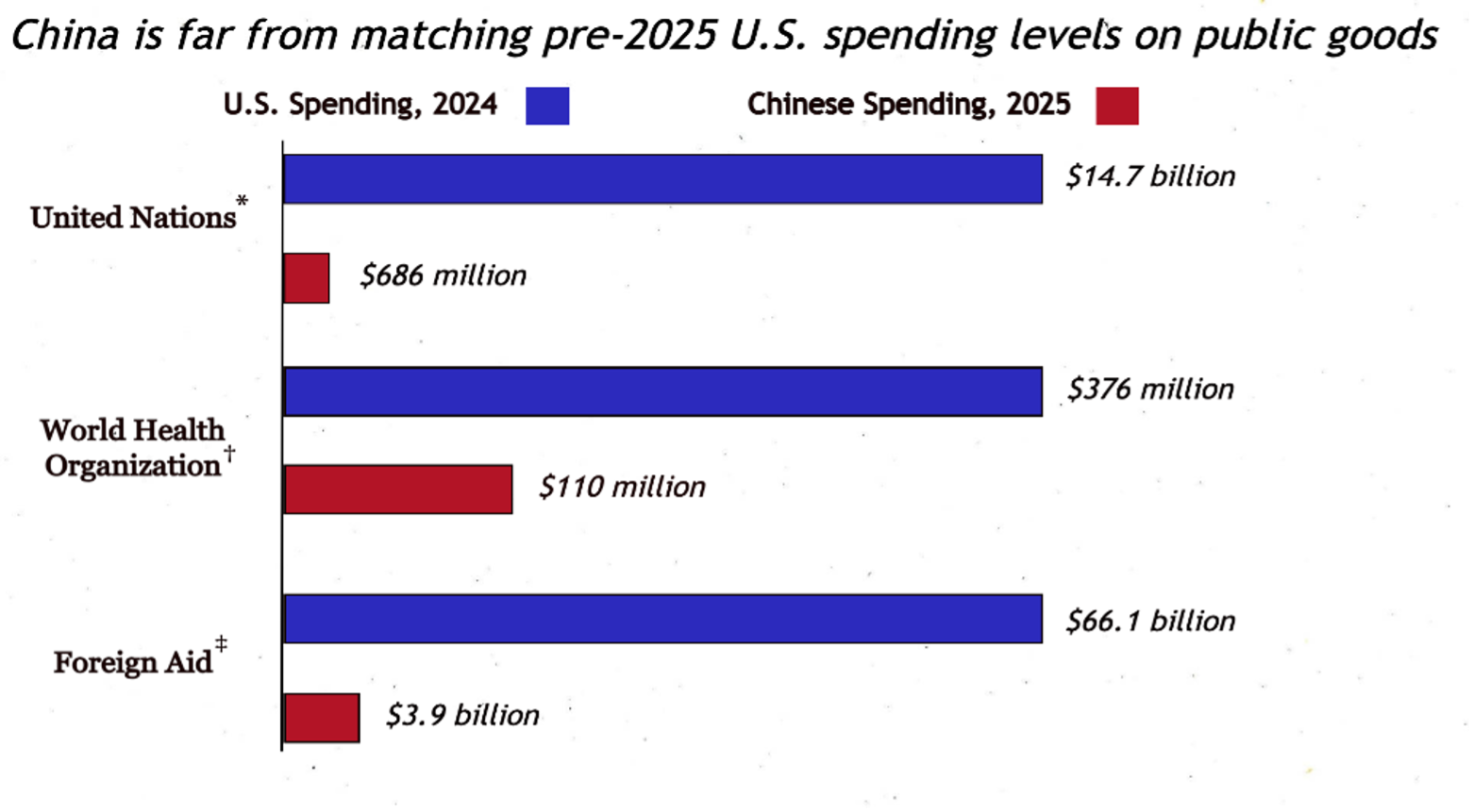
China’s bold rhetoric papers over its muddier, more frugal approach to the routine functioning of the UN system. As an active participant in the United Nations General Assembly’s Fifth Committee, Beijing held considerable sway over the 2026 UN budget process. In this position, contrary to the United Nations Charter, China co-sponsored a December 2025 amendment alongside Russia, Iran, and North Korea slashing implementation funds for Human Rights Council missions in various conflict zones. The May report highlighting billions in unpaid US contributions also revealed China owed $429 million in missing UN dues. In fiscal year 2025, Beijing withheld its UN-assessed contributions until only weeks prior to the funding deadline. China paid its 2026 contributions on September 1, giving the UN just 122 days to spend this amount before having to reimburse Beijing for unspent funds. The final 2026 combined UN budget, shaped in part by Chinese experts on the organization’s Advisory Committee on Administrative and Budgetary Questions, yielded a 5 percent cut relative to 2025 outlays.
Even where China has pledged to allocate new resources under the UN umbrella, these financial promises represent fractions of previous American commitments. Ahead of Washington’s official withdrawal from the World Health Organization in February 2026, Beijing announced a $550 million contribution over five years. Though China’s announcement was welcomed by remaining WHO members, the United States had contributed a larger sum of $752 million in the two-year span of 2024–25. Similar to the wider UN, the WHO program budget for 2026–27 is now 9 percent smaller than it was during the previous biennial period. Another challenge of scale confronts Chinese efforts to compensate for terminated American foreign aid programs through its UN-adjacent Global Development Initiative (GDI). Unveiled by Xi Jinping in 2021, the GDI aimed to expand China’s development finance portfolio beyond infrastructure into public goods such as health care, food security, and poverty to fulfill the UN’s 2030 Sustainable Development Goals. However, despite recent plans by Beijing’s foreign aid agency to “scale up ‘small and beautiful’ projects,” the $11 billion committed to the GDI over five years pales in comparison to the US Agency for International Development’s once-annual budget of $66 billion.
This gap between China’s words and behavior within the United Nations system is probably more a result of ambivalence than cynicism. Judging by official rhetoric, Chinese leaders clearly see some benefit to positioning themselves as a global force for stability. Furthermore, Beijing’s export-led economy and historical aversion to foreign entanglements are being challenged by American moves to undermine its own postwar world order. Yet the recent slowing of Chinese growth and the PRC’s ingrained discomfort with hegemony seem to explain its reluctance to supplant the United States as first among equals across international institutions. That China renounced its developing country privileges in the World Trade Organization and supplied new funds to the WHO at all shows some measure of sincerity beneath Beijing’s multilateral vision.
Momentum for US Recommitment to the United Nations
For US policymakers, Chinese ambivalence toward global leadership offers Washington a potential second wind under a future presidential administration. Now unconstrained by the inertia of being a status quo player at the UN, the United States can point out Beijing’s inconsistencies and throw support behind long-awaited reforms such as expanding the Permanent Five cohort on the Security Council and strengthening accountability for large member-states that avoid paying dues. Even if these proposals fail to enter into force, the signal that Washington is willing to overhaul rather than destroy the post–World War II international order would go far toward resurrecting US credibility.
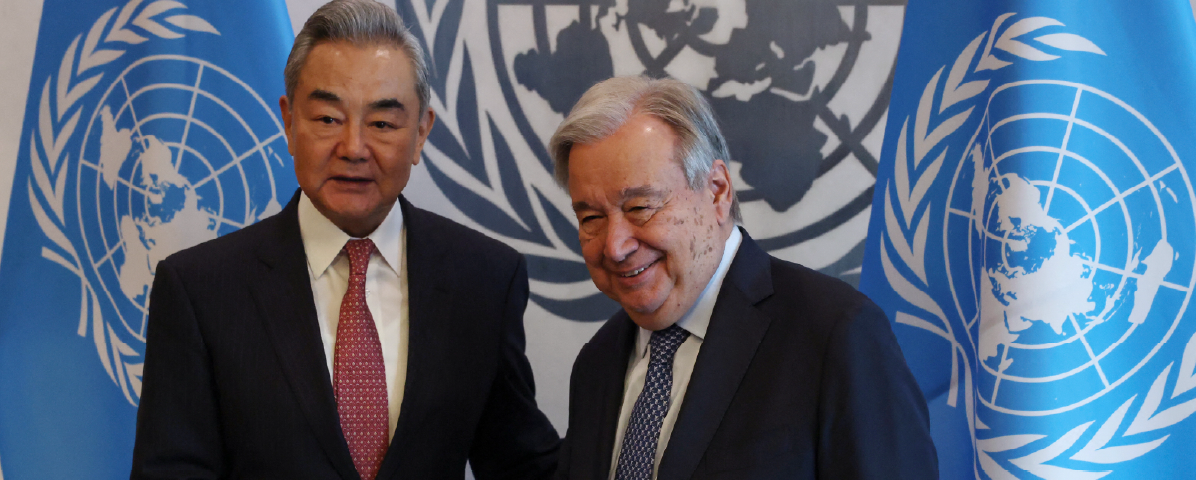
Featured Image: Chinese Foreign Minister Wang Yi shakes hands with United Nations Secretary-General Antonio Guterres at the U.N. headquarters in New York City, U.S., May 26, 2026. REUTERS/Shannon Stapleton
Chart Sources:
* https://www.state.gov/u-s-contributions-to-international-organizations-2024; https://www.un.org/en/ga/contributions/honourroll_2025.shtml.
† https://healthpolicy-watch.news/nations-approve-who-membership-fee-increase-as-us-exit-squeezes-budget/; https://www.statista.com/statistics/1552800/total-us-contributions-to-who-by-type/?srsltid=AfmBOor8fn6-2qR88MYeZQWwWBlh3AMbd4d6wyuEGDxBhNgVAizYpirI.
‡ https://www.congress.gov/crs-product/R48150; https://asia.nikkei.com/politics/international-relations/china-slowly-steps-in-to-fill-foreign-aid-vacuum-left-by-trump.