 A Nation Must Think Before it Acts
Decoding China’s 15th Five-Year Plan
A Nation Must Think Before it Acts
Decoding China’s 15th Five-Year Plan

A nation must think before it acts.
Decoding China’s 15th Five-Year Plan
Executive Summary
China’s latest Five-Year Plan signals that it has become more pessimistic about the global environment, seeing it as uncertain and unstable. However, the Chinese Communist Party sees opportunity in that instability to promote the Community of Common Destiny, their new model of global governance. The Five-Year Plan also signals that the Chinese will continue to use the United Nations to advance this new global governance system.
As a result of Beijing’s growing pessimism, the United States could see a China that retrenches itself in the Western Pacific, hoping to stabilize its economy and its borders. Although worried, China could also see an opportunity in the chaos to shape its neighborhood without US interference, with further island-building in the South China Sea or other aggression toward its neighbors. This China will also use the worry and malcontent of nations to advance its vision for global governance, using the United Nations and its four Global Initiatives.
China adopted its first Five-Year Plan in 1952, copying heavily from the Soviet system of five-year plans.[1] As the highest-level plans in the Chinese Communist Party (CCP) system, the Five-Year Plans provide centralized coordination to focus and guide the People’s Republic of China’s (PRC’s) efforts. The final product is referred to as an “Outline” as it is the highest-level plan that will guide lower-level plans throughout the ministries, agencies, provinces, and municipalities.[2] The latest Five-Year Plan will guide the PRC from 2026 to 2030, setting goals and benchmarks for the entire government to achieve by 2030. While it is an economic roadmap, a China watcher not reading the Five-Year Plan is akin to a US military watcher not reading the US National Security Strategy given the security implications of China’s economic ambitions.
Significant Changes Between Initial Recommendations and Final Outline
How the plan is drafted remains a secret. Nonetheless, there are some noteworthy milestones. The process begins two years before publication, with preliminary planning starting in March 2024. The “Recommendations for Formulating the 15th Five-Year Plan for National Economic and Social Development” (“Recommendations”) were presented during the Fourth Plenary Session of the CCP Central Committee meeting in October 2025.[3] Throughout this process, the Recommendations are the first draft that is available to the public. After refinement, the “Outline of the 15th Five-Year Plan for National Economic and Social Development of the People’s Republic of China” (“Outline”) was presented and approved at the National People’s Congress in March 2026.[4]
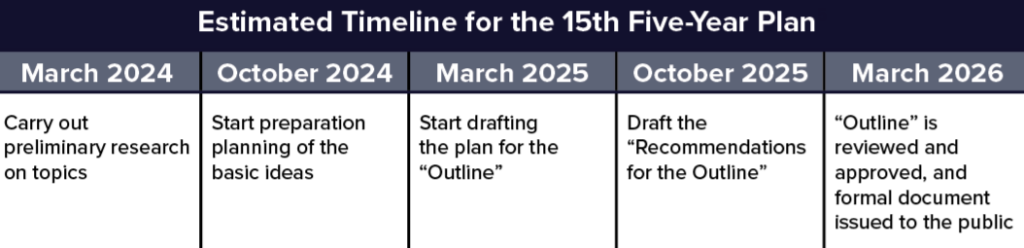
While there are many evaluations of the 15th Five-Year Plan itself, including the finer details of its industrial, technological, and economic plans, this paper explores the significant changes between the Recommendations published in October 2025 and the Outline from March 2026. Much of the text in the Outline is an exact copy of the language used in the Recommendations. But as the Outline is twice the length, it obviously adds more detail. However, as Recommendations are issued by the CCP Central Committee—the CCP’s leading body—any changes between the Recommendations and the Outline should reflect a change in the party’s thinking, not merely a difference of opinion between bureaucratic offices. These changes could help us understand the CCP’s thinking and its approach for the next five years.
Shifts in Global Risk Assessment and Chinese Domestic Priorities
Most of the differences between the documents are elaborations and explanations of the brief introductions in the Recommendations. However, there are three major changes between the two documents that give us a window into CCP thinking. In the five months between publications, the CCP changed its outlook on the international situation, elevated the Community of Common Destiny, and added a focus on the United Nations.
Five-year plans open with an assessment of the situation. Both the Recommendation and the Outline start with an optimistic outlook, saying, “Our country possesses many favorable factors for proactively managing its international space and shaping its external environment.”[6] Both documents start with identical language for the international situation.
From an international perspective, the profound global shifts unseen in a century are accelerating in their evolution, the balance of international power is undergoing deep adjustments, and a new round of scientific and technological revolution and industrial transformation is achieving rapid breakthroughs; consequently, China possesses numerous favorable factors enabling it to proactively navigate the international landscape and shape its external environment. At the same time, the world is characterized by an intertwined mix of change and turmoil, with intensifying instability and frequent outbreaks of geopolitical conflicts.[7]
After this preface, the documents diverge. The Recommendation continues:
Unilateralism and protectionism are on the rise; the threats posed by hegemonism and power politics are mounting; the international economic and trade order faces severe challenges; and the global economy lacks sufficient momentum for growth. Meanwhile, strategic rivalry among major powers has become increasingly complex and intense.[8]
In contrast, the Outline posits a much more uncertain future:
The global governance deficit is widening, and security issues are becoming more acute. Furthermore, unilateralism and protectionism are on the rise, while the threats posed by hegemonism and power politics are mounting; the international economic and trade order faces severe challenges, and the global economy suffers from insufficient growth momentum and accumulating risks. The strategic rivalry among major powers has become more complex and intense, leading to a marked increase in the uncertainty and instability of the external environment.[9]
Both documents then end their assessment by referring back to the original optimism: “Changes bring opportunities, and challenges inspire fighting spirit.”[10]
In the five months between versions, however, China’s view on the world situation soured, with it now seeing a “marked increase in the uncertainty and instability of the external environment.” The October 2025 Pakistan-Afghanistan border clashes certainly weighed on the CCP’s changing view of the global situation. But the many changes coming from the United States probably had more impact on the Chinese assessment. The US National Security Strategy,[11] released in December 2025, and the National Defense Strategy from January 2026 both signaled massive changes to US objectives.[12] Similarly, the American interventions in Venezuela (Operation Absolute Resolve, January 2026) and in Iran (Operation Epic Fury, February 2026) likely changed the CCP outlook on the opportunities ahead.
In the second major change, the CCP moved the chapter on the Community of Common Destiny (CCD) from chapter 60 of 61 in the Recommendations to chapter 24 of 62 in the Outline. Given China’s focus on the importance of protocol order, this shows a dramatic increase in prioritization. The elevation of the Common Destiny vision that espouses China’s broader foreign policy goal shows how the CCP sees the “widening deficit in global governance” as an opportunity to advance its alternative to the US-led global governance system. Launched globally in 2013 by General Secretary Xi Jinping, the CCD aims to use China’s growing power to reform the global governance system to advance a model more supportive of its authoritarian system.[13] Xi has not been shy in this goal, calling in 2018 for China to “lead the reform of the global governance system.”[14]
The CCP has long explained the common destiny vision through its contrast to the US-led system. In his 2018 speech at the Xiangshan Forum—Beijing’s alternative to the Shangri-La Dialogues—then-Minister of National Defense General Wei Fenghe said that Xi “puts forward the major initiative to build a community of shared future for mankind,[15] which has been widely acclaimed by all countries and peoples.” He then laid out a series of choices for the nations: “We should seek mutual benefit instead of playing a zero-sum game… we should pursue openness and inclusiveness instead of alliances and confrontation… we should pursue wide consultation and joint contribution instead of unilateralism… we should pursue mutual respect instead of bullying the weak.”[16] The CCP now sees an increased contrast between the current system and its proposed CCD, providing an opportunity to win others to its side.
In the last major change, a possible response to unilateral actions around the world, the Outline added a UN and multilateral focus to the section on the CCD.
We advocate and practice genuine multilateralism, firmly uphold the international system with the United Nations at its core, the international order based on international law, and the basic norms of international relations based on the purposes and principles of the UN Charter.
It is clear that the PRC sees the United Nations as part of its toolkit in managing the shifts in the global governance system.
Granted, the PRC’s use of the United Nations to advance its interests and the CCD is not new.[17] In his 2019 Xiangshan Forum speech, former Vice Chairman of the Central Military Commission Gen. Xu Qiliang said,
As a founding member of the United Nations and a permanent member of the Security Council, China always upholds the international order with the UN at its core, supports and implements multilateralism, and strives for peace, development and win-win cooperation. China will continue to build world peace, contribute to global development and maintain the international order. We have offered China’s approach. President Xi Jinping has put forth the initiative of building a community with a shared future for mankind, calling for all countries to jointly build an open, inclusive, clean, and beautiful world that enjoys lasting peace, universal security, and common prosperity.[18]
It is clear that the United Nations holds a key position in the CCP’s promotion of its alternate global governance system, lending the CCD legitimacy through multilateralism. Rather than directly confronting the current global order, China aims to co-opt organizations when it can, reforming them to advance their goals and alternative system.[19]
These three major changes—a changed outlook on the international situation, an elevation of the CCD, and a focus on the United Nations—clearly demonstrate that the CCP sees opportunities in growing instability worldwide.
Why China Leveraging Global Uncertainties Matters for the United States
The changes have three implications for the United States. There are opportunities and challenges, but the United States will see China aggressively promoting its vision across the world using the four Global Initiatives.
A pessimistic CCP offers opportunities. A CCP worried about the international environment could retrench itself in the Western Pacific, prioritizing its economy and focusing its security apparatus on keeping its borders stable. Xi has recently put a focus on security, saying, “Security is the precondition for development.”[20] A CCP focused on its periphery provides the United States with the space to achieve its goals in the Western Hemisphere. The 2026 US National Security Strategy calls for the United States to “restore American preeminence in the Western Hemisphere,” and a worried CCP is unlikely to be able to challenge the US goal to become “the Hemisphere’s economic and security partner of choice.”
This worried CCP also presents challenges. The CCP could see the United States as too distracted to focus on the Pacific. This CCP could fish in the troubled waters (混水摸鱼 húnshuǐmōyú) of the international situation, using the confusion to distract from its activities and to advance its objectives in nearby locations like Taiwan and the South China Sea. This may already be playing out, as China has recently renewed island construction in the South China Sea at Antelope Reef.[21] This is the first significant island-building by China since 2017, and it is on track to potentially be the largest of China’s man-made features in the South China Sea.[22]
This worried-but-opportunistic CCP could be further encouraged by US weapons stockpile depletions and weakened US deterrence. While Taiwan announced it plans to form a fourth Patriot air defense battalion,[23] the United States continues to expend Patriot missiles at a rate that far exceeds production. It is estimated that the United States fired hundreds of Patriots in the first weeks of the conflict with Iran.[24] Lockheed Martin plans to more than triple production, but the plan will take at least seven years.[25] With production unable to keep pace with expenditure, it is unlikely that Taiwan will receive missiles for its new Patriot battalion any time soon. This depleted capability also reduces the ability of the United States and Taiwan to deter China’s coercive actions toward Taiwan.
Lastly, the United States can expect the CCP to accelerate the push for its alternative global governance system—the CCD—using the United Nations. The United States should pay close attention to the CCP’s use of its four Global Initiatives: the Global Development Initiative, Global Security Initiative, Global Civilization Initiative, and Global Governance Initiative. Together, these initiatives form the backbone of the CCD and the CCP’s international push to change the global order. Both the Recommendations and the Outline link the CCD with the CCP’s four Global Initiatives:
We will implement the Global Development Initiative, Global Security Initiative, Global Civilization Initiative, and the Global Governance Initiative, actively advance major-country diplomacy with Chinese characteristics, and make Chinese contributions to building a community with a shared future for mankind.
The four Global Initiatives go beyond just monetary investments and include multilateral forums, such as the Global Public Security Cooperation Forum (Lianyungang) (GPSCFL).[26] At forums such as this, the CCP will propagate its norms, standards, and practices, furthering its alternative global governance system. According to the PRC’s State Council, in 2025 the GPSCFL brought in participants from 120 countries, regions, and international organizations.[27] The GPSCFL is one of many forums started or revamped in the name of the four Global Initiatives, each attracting an increasing number of participants, and each looking to spread and legitimize CCP ideas and norms.
With these three implications—opportunities, challenges, and promotion of the CCD—the United States cannot fall into the black-and-white fallacy, deciding that China will either retrench or be active. A pessimistic China can retrench into the Pacific while also pursuing its goals with a distracted United States. This is most likely in the CCP’s pursuit of the CCD, as it will push the four Global Initiatives throughout the world but will mainly focus near its borders.
Deciphering China’s Mindset
But what if this assessment is wrong? What indicators would suggest we have read too much into the changes between the Recommendations and the Outline? While the Five-Year Plan states that there is growing global instability, what if the CCP does not see this as a significant problem?
A CCP that was not worried about growing instability would not hold itself near its borders. Worried or not, the CCP will certainly continue with some investments around the world. But an unworried CCP will push large investments through the four Global Initiatives throughout the Western Hemisphere, western Africa, and the Middle East. Identification of increased Chinese resources being spent on the four Global Initiatives outside of the Pacific would suggest that the assessment of a worried CCP was incorrect.
Policy Recommendations
In an environment of limited resources, not every Chinese activity can—or must—be countered. China’s four Global Initiatives will mobilize hundreds of activities in the Western Pacific and around the world. As such,
- The United States must understand Chinese and US objectives to identify where they are complementary, neutral, or conflicting. As China focuses on its borders, the United States will need to decide where CCP goals and US goals conflict in the Pacific and prioritize its limited capital and time.
- As the CCP shifts its efforts to its periphery, the United States may find success closer to its own borders. The United States should plan for “catastrophic success” for competition with China in the Western Hemisphere, or at least plan for dwindling Chinese resources. The CCP shifting its efforts from the Western Hemisphere could also allow the United States to free up resources for allocation elsewhere.
The changes between the Recommendations and the Outline show that China has become more concerned about growing instability in the world. But this worried China also sees opportunities in this turmoil. The CCP will focus its efforts closer to home, while also continuing its aggressive actions near the border. But the CCP’s worry also offers the United States opportunities and challenges as the CCP tries to advance its alternative global governance system.
The views in this report are those of the author.
[1] Central Intelligence Agency, “Comparison of the First Five Years Plans of Communist China and the USSR,” June 1959, https://www.cia.gov/readingroom/docs/DOC_0000313443.pdf.
[2] Bert Hofman, “Deciphering the 15th Five Year Plan,” Mercator Institute for China Studies, March 19, 2026, https://merics.org/en/comment/deciphering-15th-five-year-plan.
[3] “The CPC Central Committee’s Proposal on Formulating the 15th Five-Year Plan for National Economic and Social Development,” Xinhua News Agency, October 28, 2025, https://www.news.cn/politics/20251028/08920d9f557c432e99459f8f468504db/c.html.
[4] “Outline of the 15th Five-Year Plan for National Economic and Social Development of the People’s Republic of China,” Xinhua News Agency, March 13, 2026, https://www.spp.gov.cn/spp/tt/202603/t20260313_723954.shtml.
[5] Translations by author. “国家“十五五”规划(2026-2030)” The National 15th Five-Year Plan (2026–2030), The People’s Government of Jingtai County, 景泰县人民政府, March 13, 2026,
[6] “我国具备主动运筹国际空间、塑造外部环境的诸多有利因素.” “Outline of the 15th Five-Year Plan for National Economic and Social Development of the People’s Republic of China,” Xinhua News Agency, March 13, 2026, https://www.spp.gov.cn/spp/tt/202603/t20260313_723954.shtml.
[7] “从国际看,世界百年变局加速演进,国际力量对比深刻调整,新一轮科技革命和产业变革加速突破,我国具备主动运筹国际空间、塑造外部环境的诸多有利因素。同时,世界变乱交织、动荡加剧,地缘冲突易发多发.” “Outline of the 15th Five-Year Plan for National Economic and Social Development of the People’s Republic of China,” Xinhua News Agency, March 13, 2026, https://www.spp.gov.cn/spp/tt/202603/t20260313_723954.shtml.
[8] “单边主义、保护主义抬头,霸权主义和强权政治威胁上升,国际经济贸易秩序遇到严峻挑战,世界经济增长动能不足;大国博弈更加复杂激烈.” “The CPC Central Committee’s Proposal on Formulating the 15th Five-Year Plan for National Economic and Social Development,” Xinhua News Agency, October 28, 2025, https://www.news.cn/politics/20251028/08920d9f557c432e99459f8f468504db/c.html.
[9] “全球治理赤字加重、安全问题凸显;单边主义、保护主义抬头,霸权主义和强权政治威胁上升,国际经济贸易秩序遇到严峻挑战,世界经济增长动能不足、风险积累;大国博弈更加复杂激烈,外部环境的不确定性不稳定性明显增强.” “Outline of the 15th Five-Year Plan for National Economic and Social Development of the People’s Republic of China,” Xinhua News Agency, March 13, 2026, https://www.spp.gov.cn/spp/tt/202603/t20260313_723954.shtml.
[10] “变局蕴含机遇,挑战激发斗志.” “Outline of the 15th Five-Year Plan for National Economic and Social Development of the People’s Republic of China,” Xinhua News Agency, March 13, 2026, https://www.spp.gov.cn/spp/tt/202603/t20260313_723954.shtml.
[11] White House, National Security Strategy of the United States of America, November 2025, https://www.whitehouse.gov/wp-content/uploads/2025/12/2025-National-Security-Strategy.pdf.
[12] Department of War, 2026 National Defense Strategy, January 23, 2026, https://media.defense.gov/2026/Jan/23/2003864773/-1/-1/0/2026-NATIONAL-DEFENSE-STRATEGY.PDF.
[13] Liza Tobin, “Xi’s Vision for Transforming Global Governance: A Strategic Challenge for Washington and Its Allies,” Texas National Security Review 2, no.1 (2018):154, http://dx.doi.org/10.26153/tsw/863.
[14] “Xi urges breaking new ground in major country diplomacy with Chinese characteristics,” Xinhua News Agency, June 24, 2018, https://www.xinhuanet.com/english/2018-06/24/c_137276269.htm.
[15] “Community of shared future for mankind” is the PRC’s preferred English translation for CCD, to distance it from its negative English connotations.
[16] Wei Fenghe, “Address by General Wei Fenghe, State Councilor and Minister of National Defense, China,” in Building a New Type of Security Partnership of Equality, Mutual Trust, and Win-Win Cooperation; Speech Collection of the 8th Beijing Xiangshan Forum, 8th Beijing Xiangshan Forum Secretariat, 2018.
[17] Kristine Lee and Alexander Sullivan, “People’s Republic of the United Nations: China’s Emerging Revisionism in International Organizations,” Center for a New American Security, May 14, 2019, https://www.cnas.org/publications/reports/peoples-republic-of-the-united-nations.
[18] Xu Qiliang, “Speech at the Welcoming Dinner of the 9th Beijing Xiangshan Forum by Gen. Xu Qiliang, Vice Chairman of the Central Military Commission,” Beijing Xiangshan Forum Secretariat, October 20, 2019, https://xiangshanforum.cn/speech.html?speechcode=5SeA8e4C6Kh8840K&currPage=1.
[19] Courtney J. Fung and Shing-hon Lam, “Mixed report card: China’s influence at the United Nations,” Lowy Institute, December 18, 2022, https://www.lowyinstitute.org/publications/mixed-report-card-china-s-influence-united-nations.
[20] “President Xi Jinping’s keynote speech at the opening ceremony of BFA annual conference,” The State Council, The People’s Republic of China, April 21, 2022. https://english.www.gov.cn/news/topnews/202204/21/content_WS62616c3bc6d02e5335329c22.html.
[21] Mike Cherney, “China Is Building Another Massive Base in the South China Sea,” Wall Street Journal, April 1, 2026, https://www.wsj.com/world/china/china-south-china-sea-military-base-3ebf3dc2.
[22] “Antelope Reef Could Now Be the Largest Island in the South China Sea,” Asia Maritime Transparency Initiative, March 19, 2026, https://amti.csis.org/antelope-reef-could-now-be-the-largest-island-in-the-south-china-sea/.
[23] “Patriot-3 extended-range missiles will begin delivery this year; the Air Force Air Defense Department will establish its fourth Patriot battalion,” Liberty Times, April 23, 2025, https://def.ltn.com.tw/article/breakingnews/5020578.
[24] Stavros Atlamazoglou, “US on Track to Triple Patriot Missile Production, Pentagon Says,” The National Interest, April 4, 2026, https://nationalinterest.org/blog/buzz/us-on-track-to-triple-patriot-missile-production-pentagon-says-sa-040426.
[25] J.D. Simkins, “Pentagon, Boeing agree to triple PAC-3 seeker production,” Defense News, April 1, 2026, https://www.defensenews.com/industry/techwatch/2026/04/01/pentagon-boeing-agree-to-triple-pac-3-seeker-production/.
[26] Sheena Chestnut Greitens, Isaac B. Kardon, and Cameron Waltz, “A New World Cop on the Beat? China’s Internal Security Outreach Under the Global Security Initiative,” Carnegie Endowment for International Peace, August 6, 2025, https://carnegieendowment.org/research/2025/08/a-new-world-cop-on-the-beat-chinas-internal-security-outreach-under-the-global-security-initiative.
[27] “2025 Conference of Global Public Security Cooperation Forum opens in east China,” The State Council of the People’s Republic of China, September 17, 2025, https://english.www.gov.cn/news/202509/17/content_WS68caaf45c6d00fa19f7a286e.html.
Image: Unsplash | Sou Jest