 A Nation Must Think Before it Acts
The Geopolitics of the Persian Gulf and War with Iran

A nation must think before it acts.
The Geopolitics of the Persian Gulf and War with Iran
Introduction
Geopolitics, which Webster’s Dictionary defines as the influence of geography, economics, and demographics on a state’s foreign policy, is the axis around which the US-Iranian conflict has revolved since 1979. Although the nuclear issue is highly visible and contentious, it is but a subset of this much broader conflict. Understanding the United States’ current war with Iran, the latest manifestation of five decades of US-Iranian strife, requires understanding its geopolitical background, current dynamics, and possible future directions. Essentially, this conflict is a struggle for control over the flow of economic goods from the Gulf through its chokepoint, the Strait of Hormuz, and the benefits that accrue from that control.
The region surrounding the Persian (or Arabian) Gulf has been geopolitically significant for millennia. Its indigenous empires consistently resisted the expansion of other empires from the Mediterranean; a history of conflict that helped develop the perceived divide between “Western” and “Eastern” civilizations that still resonates today. Persia’s Achaemenid empire (550-330 B.C.) challenged the existence of the Greek city-states until it was conquered by Alexander the Great, who transformed the region into the Hellenic Seleucid Empire (312-63 B.C.). That empire was later subsumed by the growing strength of Rome from the west and by revived Persian power on the Iranian plateau to the east that would become the Parthian Empire (247 B.C. – 224 A.D.). The Parthians resisted Rome’s eastward expansion for over two centuries until their empire weakened and dissolved into the Sasanian Empire (224-651), which assumed its predecessor’s role as Rome’s rival for the modern Near East. Both Rome’s eastern successor, Byzantium, and the Sasanians were threatened by the rise of a new threat from across the Persian Gulf—the Arabs, whose warriors were inspired by the new faith of Islam. Eventually, the Arabs would conquer Persia, bringing Islam with them, while the Ottomans, also infused with the faith, would conquer the Byzantine Empire. Other empires periodically rose and fell across the region. The Turkic Seljuks came first, adopting Persian culture before being overrun by the Mongols in the 13th century. Mongol rule was later replaced by the Safavid Empire (1501-1736), which brought Twelver-Shi’ism to Persia. This chronology is germane to understanding current geopolitical dynamics because it demonstrates that Persia’s history of resistance to foreign intrusion into its heartland predates the incorporation of Shi’ism into its national identity by over a millennium and a half.
The Beginning of Modern Geopolitics in the Persian Gulf
Within the Near East, the Persian Gulf did not achieve its current geopolitical importance until the early 20th century. This was due to the discovery of oil, the lifeblood of economies emerging from the Industrial Revolution and transitioning from coal to petroleum to power their internal combustion engines. British petroleum companies discovered oil in both southwestern Persia and Ottoman-controlled northern Iraq in 1908. The refinery built at Abadan, Iran in 1912 to process this oil would become the world’s largest single oil refinery for 50 years. That oil could only reach global markets by sea, a journey that began in the Gulf.
With access to this oil through the British-controlled Anglo-Persian Oil Company and Turkish Petroleum Company, the Royal Navy decided to fully convert its fleet from being powered by coal (which was available in great quantities in the United Kingdom) to oil (which was not). Oil-fired ships offered the Royal Navy numerous advantages, but it also required Britain to maintain control over foreign sources of this fuel. This development further increased the geopolitical importance of the region because the Royal Navy was key to Pax Britannica, protecting not only the United Kingdom but also the world’s sea lanes, guaranteeing the flow of international trade during that era.
After World War One, Great Britain solidified control over the region by creating protectorates in Iraq and Jordan in 1921, helping install Reza Shah Pahlavi on Iran’s throne in 1925, and supporting the House of Saud in the creation of Saudi Arabia in 1927. Great Britain had already been protecting the Arab Gulf States, then known as the Trucial States, for decades before World War I. In World War II, Great Britain continued to serve as the guarantor of the flow of oil from the Persian Gulf. In 1941, it overthrew a pro-German Iraqi government, and, together with the Soviet Union, occupied Iran, securing Allied access to crucial resources and strategic transportation routes.
After World War II, the United States joined Great Britain as a co-guarantor of stability and hence the flow of oil from the region. The US, along with Great Britain, covertly helped Reza Shah Pahlavi’s son remain on the throne in 1953. Two years later, the United States overtly supported the creation of the Central Treaty Organization (CENTO) to contain Soviet power, a military alliance modeled on NATO and consisting of the United States, United Kingdom, Turkey, Iraq, Iran and Pakistan.
British intervention in 1961 prevented Iraq from occupying Kuwait, but British power in the region was waning due to its deteriorating financial situation. In 1968, Britain announced that it would withdraw its military from “East of Suez” and did so in 1971. Yet even as Great Britain departed, the gulf’s importance to the world’s economy was growing. Saudi Arabia and Kuwait began exporting oil in 1946, Qatar in 1949, and the other Gulf States and Oman followed in the 1960s.
The United States replaced Great Britain as the guarantor of Gulf security to prevent the Soviet Union from exploiting a power vacuum. With America engaged in Vietnam, its initial policy was a “Twin Pillar” strategy wherein the US would rely on Iran and Saudi Arabia to maintain regional stability. The Shah, however, aspired to make Iran a regional hegemon and to establish himself as primus inter pares—first among equals—over Saudi Arabia. In May 1972, he successfully lobbied President Richard Nixon to rely on Iran as the primary protector of the Persian Gulf and approve massive arms sales to Iran.
But in Iran, the United States was leaning on a weak reed. Both Iran and the Shah were decaying from within, Iran from social unrest and the Shah from cancer. In 1978, a revolution erupted against the Shah’s rule and he fled the country in 1979. His departure was followed by immense political upheaval and the establishment of a theocratic state initially led by Ayatollah Ruhollah Khomeini. This was just the first shock to the international system to emanate from the region in 1979. It was followed that year by an abortive attempt by Sunni extremists to take over the Grand Mosque in Mecca and the Soviet invasion of Afghanistan. American eyes were transfixed on the region during the 444-day hostage crisis when 54 American diplomats were held captive by Iranian radicals with Khomeini’s tacit approval.
The US response was announced in President Jimmy Carter’s State of the Union address in January 1980. In that speech, President Carter declared, “An attempt by any outside force to gain control of the Persian Gulf region will be regarded as an assault on the vital interests of the United States of America, and such an assault will be repelled by any means necessary, including military force.” A Rapid Deployment Force, which later evolved into Central Command (CENTCOM), was created to provide the military means to back up what became known as the Carter Doctrine. Formed to balance and contain Soviet power (like CENTO before it), CENTCOM would spend most of its time dealing with Iran, Iraq, and terrorism. Under the Carter Doctrine, the US declaratively assumed responsibility to protect the flow of petroleum from the Persian Gulf, which in 1980 accounted for a third of the world’s oil. Washington accepted this obligation freely, because it judged that failing to do so would have led to geopolitical and economic turmoil.
The US-Iranian Conflict (1979-Present)
Iran’s geopolitical ambitions under Khomeini were similar to the Shah’s but with one major difference. The Shah sought to become a regional hegemon within a US-led security system. Khomeini rejected that system because he believed that it thwarted rather than enabled Iran’s hegemonic ambitions and was a threat to the basic existence of his theocratic regime.
Khomeini’s geopolitical goals were to survive the war with Iraq (1980-1988) and expand Iranian power through Shia communities across the region. This made Iran a natural ally of Syria and a natural enemy of the Sunni states, especially Saudi Arabia. Khomeini’s foreign policy also served to bolster the regime’s tenuous domestic legitimacy via virulent anti-American and anti-Semitic rhetoric, calling for the removal of the US from the region and the destruction of Israel. This rhetoric was followed by numerous terrorist attacks that made such rhetoric impossible to ignore.
The roots of the conflict that began with the American hostage crisis soon dug deeper into the soil of the Middle East, as Iran and the US vied over dominance in the region, particularly the Persian Gulf. Iran waged a covert war of terrorism against the United States and Israel, including bombings, aircraft hijackings, and hostage taking. Much of this effort was initially centered in Lebanon to support Shia Hezbollah in the Lebanese civil war. Between 1984 and 1988, Iran and Iraq waged economic warfare against each other by attacking oil tankers traveling between their ports. These attacks led to US naval operations in the Persian Gulf from 1987 to 1988, which attacked Iranian targets and successfully maintained the flow of oil from the region. After the First Gulf War, the US adopted a Dual Containment policy towards Iraq and Iran, which combined economic sanctions, embargoes, and an enhanced military presence in the region to prevent either from threatening Persian Gulf stability.
The US overthrow of the Taliban regime in Afghanistan after 9/11 and its subsequent occupation of Iraq further intensified the US-Iran conflict. While the basic essence of the conflict remained the same—America’s desire to be the dominant power in the region and Iran’s desire to replace it—the conflict gained two new dimensions: Washington’s fear of a nuclear-armed Iran and Tehran’s fear of regime overthrow orchestrated by the US President George W. Bush, in his 2002 State of the Union address, labeled Iran as part of an “Axis of Evil.” Later that year, the US accused Iran of pursuing a nuclear weapons program in violation of the Nuclear Non-Proliferation Treaty (NPT) and imposed sanctions intended to deter the program. By 2003, with US troops in Iraq and Afghanistan on Iran’s western and eastern borders, Tehran feared it could be next in line for US-backed regime change. In response, Iran covertly supported attacks against US forces in both countries.
The Conflict Goes Nuclear
US concerns about Iran’s nuclear program revolved around its efforts to enrich uranium beyond the level required for peaceful nuclear use and its parallel ballistic missile program, which could potentially deliver nuclear weapons if ever developed. Washington argued that a nuclear Iran would not serve US interests because it would undermine the NPT treaty, encouraging further nuclear proliferation, threaten US allies such as Saudi Arabia, and potentially pose an existential threat to Israel, which would be particularly vulnerable to a nuclear attack due to its small size and concentrated population. On the other hand, some Iranians argued that Iran needed nuclear weapons to preserve its sovereignty, pointing to the disparity between Libya’s fate when Gaddafi gave up his nuclear program and North Korea’s when Kim Jong IL did not.
After years of negotiations, Iran reached an agreement in 2015 with the five permanent members of the United Nations Security Council and Germany, known as the Joint Comprehensive Plan of Action (JCPOA). Under the JCPOA, Iran accepted a series of restrictions to limit its ability to produce weapons-grade uranium or plutonium. The agreement, however, did not eliminate Iran’s capacity to enrich uranium or constrain its parallel ballistic-missile program, and many of its key restrictions on uranium enrichment were set to expire after 15 years.
The first Trump administration withdrew from the JCPOA in May 2018 and reinstated US sanctions on Iran. Secondary sanctions led to a significant decrease in Iranian oil exports from 2.8 million barrels per day in 2018 to 680,000 barrels per day by mid-2020. The Biden administration tried to restart nuclear negotiations in early 2021 but strengthened sanctions in 2022 against Iran’s missile program and again in April 2024 after Iran attacked Israel with missiles and drones. When President Donald Trump returned to office, he revived his “maximum pressure” campaign against Iran in February 2025 by further increasing economic sanctions.
On May 31, 2025, the International Atomic Energy Agency announced that Iran had accumulated enough uranium enriched to 60 percent to produce nine nuclear weapons, as well as additional weapons at lower enrichment levels. Two weeks later, Israel launched strikes on Iranian nuclear and military sites. The United States followed on June 22, striking Iranian nuclear sites at Fordow, Natanz, and Isfahan. The United States estimated that these strikes set back Iran’s nuclear program by two years. Much of Iran’s highly enriched uranium (HEU) was buried underground by these attacks, although Israeli intelligence assessed that Iran had moved a certain amount of HEU and a number of centrifuges prior to the strikes, potentially allowing them to survive the attacks.
Negotiations over Iran’s nuclear program continued but while negotiations were still ongoing, Israel struck a meeting of senior Iranian officials on February 28, 2026, killing Iran’s supreme leader, Ali Khamenei, and numerous other officials and their family members. The US also attacked Iranian military targets that day. The United States’ stated objectives for the war are to destroy the remnants of Iran’s nuclear program, end its missile program, and end its support for terrorist organizations. However, the initial targeting of Iran’s senior leadership and other statements by US and Israeli officials indicate that regime change is also an objective, starting with a decapitation of the top of the government. In retaliation, Iran played its geopolitical trump card, blocking the Strait of Hormuz. This prevented the world from obtaining much of the region’s oil and other resources whose free passage the Royal and US navies had guaranteed for over a century. In retaliation, the United States subsequently instituted a naval blockade of Iranian ports.
Geopolitical Aspects of the War with Iran
American war aims have diminished, even if this has not been formally acknowledged, to a return to the status quo ante with the Strait of Hormuz reopened—but not under Iranian control. The United States cannot allow even nominal Iranian control of the Strait of Hormuz, which, according to the United Nations Convention on the Law of the Sea (UNCLOS), is a strait used for international navigation, because of the dangerous precedent this would set. Under UNCLOS, which entered into force in 1994, innocent passage through a strait used for international navigation cannot be suspended. Therefore, per customary international law, which is understood to be international legal obligations arising from established or usual international practices, ships and aircraft of all states enjoy the right of unimpeded transit passage through such straits. If Iran is allowed to violate this principle, it would de facto become the arbiter of maritime traffic through the Persian Gulf and, by extension, the new hegemon in the region in place of the United States. It would also set a precedence that would undermine UNCLOS rules governing international navigation through more than 200 straits worldwide including the Straits of Taiwan, Bab-al-Mandab, Gibraltar, Malacca, Sunda, Lombok, Bering, etc. Such a precedent would imperil the principle of freedom of the seas that underpins American trade and economic prosperity, and global influence; or, in other words, Pax Americana.
The United States remains concerned by the prospect of a nuclear-armed Iran, feels obligated to protect the Gulf States and Israel, and believes that retreating from the region would come at a significant cost to its credibility and national power. Therefore, the United States continues with this war in the near term, driven by what Thucydides identified as the fundamental forces of international conflict: fear, honor, and interests.
Iran’s current regime has three primary war aims: (1) remain in power; (2) control of the Strait of Hormuz as strategic leverage over the world’s economy, thereby deterring future American-Israeli attacks; and (3) eject the US from the region so it can pursue its long-term goal to control the Gulf. Since Iran’s aims, certainly the latter two, are at a wide variance from US war aims, negotiations are unlikely to close this gap unless other factors come into consideration.
For example, Iran is bedeviled by systemic economic problems that have been made worse by the continuing US naval blockade. The loss of oil revenues continues to harm its economy, as is the disruption of imports that normally arrive by sea. While this war has been a boon to Central Asian truckers, road and rail transport can never substitute for the volume of goods that can be imported or exported by sea. Will these economic pressures lead to popular unrest that will overthrow the regime? This is the hope for many in Washington and some in Iran. However, the willingness of a critical mass of the Iranian population to revolt should not be depended on to end this war. First, the murder of approximately 30,000 demonstrators in January indicates that the regime is willing to ruthlessly suppress dissent. Second, many Iranians who oppose the regime may be reluctant to protest against it while their nation is under attack by a foreign power. With the Islamic Revolutionary Guard Corps seemingly in control, Iran’s security services can be expected to continue suppressing dissent as soon as it appears. A fundamental shift in Iran’s internal balance of power would likely require severe damage to, or the destruction of, the military and security infrastructure of the regime. This shift could happen, but such a change usually requires a prolonged war.
Is the United States capable of fighting a long war? Its stockpiles of stand-off munitions, those that can be launched beyond the range of air defense weapons, have greatly decreased but there are plenty of other munitions available if the US is willing to send aircraft directly into Iranian air space. The US Navy can continue to blockade Iran’s coast, but is already facing logistical and personnel challenges in doing so. The US Navy is a “One Ocean Navy” and has other national security missions beyond the Persian Gulf and the Indian Ocean. CENTCOM cannot indefinitely monopolize the U.S. military’s air and sea assets.
There are several major geopolitical implications of this war. First, the status quo in the Persian Gulf that existed before the war may be lost for years and might never be fully restored. Even if Iran never acquires a nuclear weapon, it has gained something far more powerful: recognition as a major world economic power by its demonstrated ability to block access to the Strait of Hormuz. While CENTCOM is gradually degrading Iran’s ability to block maritime traffic, doing so requires substantial time and resources, a wartime effort that cannot continue forever. When some sort of peace is eventually reached, the Gulf’s underlying geography will remain unchanged and technology, especially drone technology, will continue to advance. While some hold that nuclear weapons may be useful only for deterrence and therefore are weapons of last resort, modern history has shown that economic weapons are weapons of first resort and Iran now possesses a particularly powerful one.
This war remains fundamentally about the geopolitical importance of the Persian Gulf and who will control it. As long as the world depends on oil, much of which is found on the Arabian Peninsula, then who can guarantee freedom of navigation through the Straits of Hormuz and Bab al-Mandab will be a matter of utmost importance. The US Navy assumed this duty from the Royal Navy after World War II, providing security for a global economy dependent on the maritime trade of hydrocarbon resources. Will that security continue or will control of those two straits end up in the hands of Iran and allies like the Houthis, who will seek to advance narrower regional interests rather than protect free trade across the world’s maritime commons?
Possible Future Geopolitical Realities
There is also a third option that, so far, has been like the Sherlock Holmes story of the dog that did not bark. That is that hegemony in the Persian Gulf might ultimately be neither maintained by the US nor taken over by Iran, but eventually pass to China. With the world’s largest surface navy and second largest economy, China could provide the naval force necessary to maintain the flow of oil from the Persian Gulf to the rest of the world. It certainly has reasons to do so.
China is the world’s largest importer of petroleum and dependent on imports for 70 percent of its oil supply. Iran, which ships 80 percent of its oil to China, is China’s third largest supplier of oil. If China decides to intervene diplomatically, it could make a reasonable offer to police the strait for both parties on either side of the Persian Gulf. Iran would obviously benefit from this. The Gulf States, seeing that US bases have not brought expected security, could reorient their security relationships away from Washington and towards Beijing—a patron who would not care about human rights or how its arms sales are used. How ironic it would be if the destroyed US Navy logistics base in Bahrain is one day rebuilt to support the Chinese Navy maintaining a peace treaty between Iran and the Gulf States that leaves out the United States. While this would be devastating in pride and security to the United States, to the rest of the world this would be just another changing of the guard in the Persian Gulf from the Royal Navy, to the US Navy, to the Chinese Navy.
If this were to happen, if China becomes the new guarantor of the flow of oil from the Persian Gulf, could a change in the world’s reserve currency be far behind?
Today, the US dollar serves as the world’s reserve currency, meaning it is the primary foreign currency held by the world’s governments and central banks to use in international transactions and investments. Just as the US Navy replaced the Royal Navy after World War Two as the guardian of international maritime trade, the US dollar replaced the British pound as the world’s reserve currency after the Bretton Woods agreement in 1944. A key factor in maintaining the US dollar as the world’s reserve currency, which allows American economic sanctions to have great effect, is the Petrodollar system. In that system, oil is priced in dollars and buyers must use dollars to purchase it (and therefore hold dollars). Exporters then invest these dollars in US Treasury bonds, US equities, and other dollar-denominated assets. This channels oil revenues back into the US financial system and, most importantly, allows America to run budget deficits decade after decade.
Could there be another changing of the guard, this time financial? If China moves to protect the world’s oil-exporting states, why not make its currency the one that oil is priced at and traded in? If this were to happen, the economic costs to the United States would be incalculable. While there are currently several reasons why China’s currency, the renminbi, may not yet be able to replace the dollar as a reserve currency, one can see where economics might be heading if Beijing ever supplants Washington as the protector of the Persian Gulf’s energy trade. This happened once before when Pax Britannica transitioned to Pax Americana. A transition from Pax Americana to Pax Sinica is not impossible if Gulf security and finances reorient eastward.
Conclusion
This is why the geopolitical objectives of this war are so important for both sides but especially for the United States’ ability to remain the world’s primary superpower. The US will try to restore the status quo in the Persian Gulf. Washington believes that doing so requires ending Iran’s nuclear weapons program and keeping the Strait of Hormuz open to navigation while preventing Iranian control. Iran’s regime, meanwhile, wishes both to survive and also supplant the US as the region’s hegemon. This is a rational geopolitical calculation based on more than two millennia of Persian geopolitics and not on Shia religious fervor or fanaticism and should be seen in that light. Iran’s support for radical Shia partners and its pursuit of a nuclear program are merely means to that broader strategic end. Iran’s objectives have changed little over the decades. What has changed is Iran’s now proven leverage in the Strait of Hormuz, which provides more tangible influence than a nuclear weapon ever could. Which of the two powers will outlast the other in this war remains to be seen. It is equally possible that both will become exhausted and unable to achieve their political goals. If that happens, could a third power, China, become the new guardian of access to Persian Gulf oil, the arbiter of Middle Eastern security, and eventually the world’s dominant economic power? Whatever happens next, the consequences will extend far beyond the Persian Gulf and are worth watching carefully.
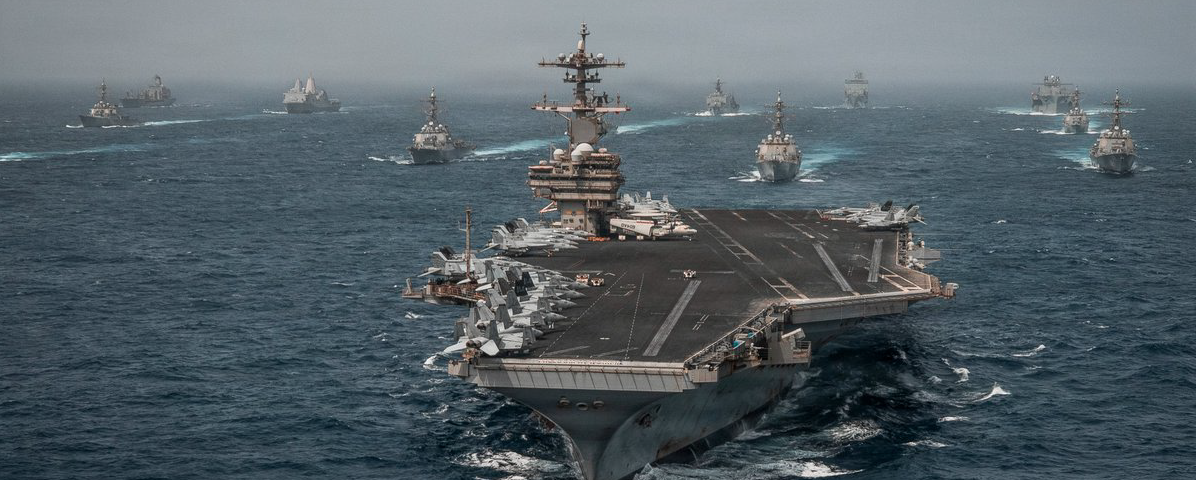
Image: US Navy warships transit the Arabian Sea in close formation as CENTCOM forces continue to promote regional security and stability, June 30, 2026. (US Navy)