 A Nation Must Think Before it Acts
Drone Defense and Deterrence Questions in Germany

A nation must think before it acts.

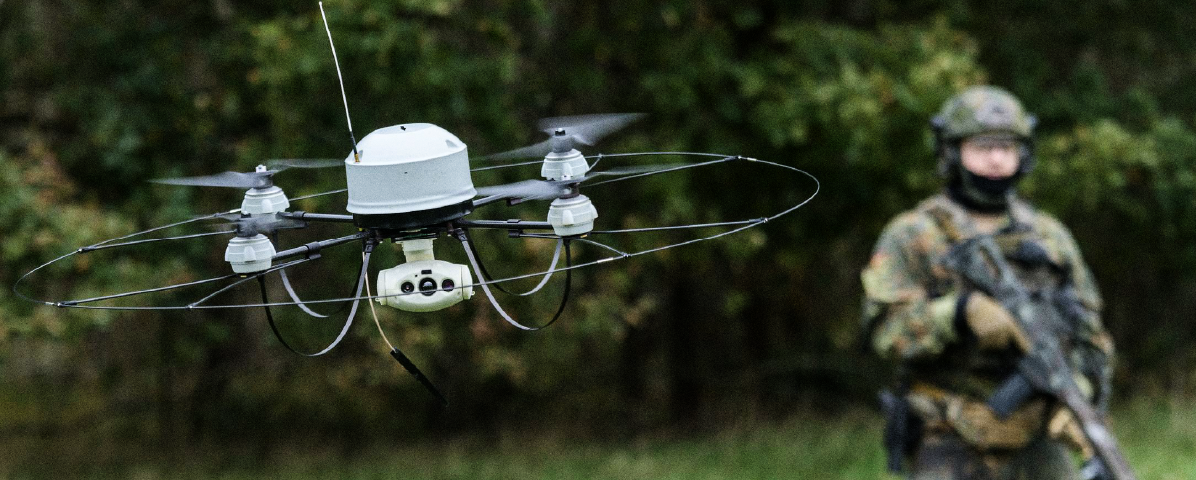
Drone Defense and Deterrence Questions in Germany
In early August, a small drone armed with Semtex failed to arm and explode after striking a Ukrainian Antonov aircraft parked on an isolated apron at the Leipzig airport. The attack failed, but a second drone collided with a cargo aircraft, forcing an emergency landing.[1] The event underscored concerns about Russian sponsorship of hybrid attacks in Europe, aimed at punishing supporters of Ukraine’s defense, and disrupting a major logistics hub for German and global support to Ukraine.
Europe is on high alert for a potential increase in Russia’s shadow war against the continent. Moscow has been linked to arson attacks throughout the continent, several attempts to sabotage civilian grids, attempting to down cargo planes flying over the Atlantic, using front companies to influence elections, violating airspace, and, in Leipzig, carrying out an armed attack at a civilian airport.[2] Russia’s increasingly visible hybrid attacks on the continent have spurred a considerable shift in European attitudes towards national defense. Germany has pledged billions of Euros to modernize its armed forces and has plans to be Europe’s strongest military by 2039.[3]
Germany’s investments and shift in thinking are welcome in Europe and in the United States. However, these investments may not yield the type of deterrence that politicians and the public may be seeking, especially after the Leipzig attack. In short: The ultimate challenge that Europe, the North Atlantic Treaty Organization, and Germany face is that much needed defense modernization, and procurement may not lead to the deterrence outcomes political leaders covet. The best way to conceptualize the challenge Germany — and Europe/NATO — faces is to understand how deterrence works, consider whether conventional deterrence is possible, and, if not, what domestic steps can be taken to better prepare the country for continued hybrid conflict.
Deterrence Revisited
The fear of nuclear escalation was ever-present during the Cold War. In the three decades between the end of Western-Soviet conflict and the resumption of Russia’s invasion of Ukraine in 2021, theorists and analysts have argued about the niche sub-field of nuclear deterrence. For the past half-decade of war, the basics of nuclear deterrence in Europe have worked — and worked well. The threat of nuclear escalation has restricted how and under what parameters Europe and NATO allies would provide aid to Ukraine. Similarly, the risk of nuclear war has halted Russian strikes on viable military targets in Poland, where the aid that Ukraine depends on for its war effort is stacked up before shipment across the border.
The Leipzig attack — and the proliferation of Russian-attributed hybrid attacks in Europe — is not an indication that extended deterrence is breaking down. Instead, it suggests that Moscow is now willing to assume more risk than it did at the beginning of the conflict. Thomas Schelling argued that analysts were mistaken to talk of the brink of nuclear war as if it were the “sharp edge of a cliff where one can stand firmly, look down, and decide whether or not to plunge.” A better description, he argued, was a “curved slope.” A leader might edge out onto this slope, but “the slope and the risk of slipping are rather irregular; neither the person standing there nor the onlookers can be quite sure how great the risk is, or how much it increases when one takes a few steps downward.”[4]
The equation is further muddled by the fact that a NATO-led nuclear response to conventional sabotage is unlikely. This rather obvious fact means that Russia can assume greater risk in its sponsoring of such attacks, precisely because the risk of exposure and response is certain to be limited. Further complicating a response is the fact that hybrid attacks that sit under the threshold of war are notoriously difficult to attribute. For NATO, a defensive alliance, positive legal attribution is critical to formulating actionable responses. The question, then, is whether Germany or Europe can ever achieve conventional deterrence from sponsored attack, or even if conventional deterrence is still possible.
Deterring Hybrid Threats
Deterring these types of attacks in Europe requires a fundamental shift from a reactive approach towards a strategy that combines deterrence by denial to deterrence by punishment. Russia consistently exploits the ambiguity and asymmetry of hybrid warfare to impose costs while remaining below the threshold of conventional military conflict. Building societal resilience and strengthening information-sharing and cooperation between governments, the private sector, and civil institutions are essential to reducing the effectiveness of such attacks. Civil society in Germany, however, is not as prepared as the Scandinavian, Nordic, and Baltic states, all of which issue emergency preparedness guidelines to their citizens. In these states, national security is treated as a civic duty and integrates volunteer militias and civil service into everyday life. Germany’s civil protections remain heavily bureaucratic and siloed: split between the federal police, state police, intelligence services, and the military. Further, although there has been a recent effort to increase enrollment into the military, Germany currently has neither universal conscription nor a system for civilian mobilization.[5]
Crucially, NATO and the European Union should move beyond treating hybrid attacks as isolated incidents and recognize them as elements of a strategic campaign to undermine European cohesion. Effective deterrence must change Russia’s cost-benefit calculation, demonstrating that hybrid attacks will fail to meet their political objectives.
No Conventional Deterrence
Beyond societal resilience, this uncomfortable conclusion should place the onus on Germany to make domestic reforms to manage the threats from small drones. Berlin does not actually face a unique problem in this regard. In the United States, there are now so many drones being flown by hobbyists and so many incidents around the country at airports that its easy to see how an adversary could use the surge in drone use for a hybrid-war campaign against soft targets. Indeed, China is most certainly behind a concerted collection effort, leveraging small drones to collect intel on military exercises, submarine movement, and even space launches.[6]
In Europe, the concerns about these small drones are not new. There have been multiple sightings of small drones near Ramstein throughout the 2020s. There are similar reports about the overflight of RAF Lakenheath, RAF Mildenhall, RAF Fairford, and RAF Feltwell in the United Kingdom, as well as US air bases throughout the United States.[7] As far back as 2024, reports also suggested that drones were overflying both Rheinmetall and BASF facilities in Germany.
The solution is not straightforward. Any effort to shoot these drones down runs the risk of injuring civilians or halting air traffic at major airports, as was recently the case in El Paso, Texas.[8] Jamming the drones risks disrupting mobile phone service. Further, in a federal governing system, authorities are often muddled between local and state authorities, who then have to coordinate with the central government.
Conclusion
As Germany continues its efforts to rearm and to transform the armed forces into Europe’s leader, it would be wise to consider how to pair these investments with domestic reforms to counter Russian hybrid warfare techniques. The Leipzig attack underscored what has been a recurring problem throughout the West for the past decade: Small drones are everywhere. The authorities to counter them are muddled and the options to shoot them down are not without risk. It is also important to frame these discussions in realistic ways. The ability for any state to meaningfully deter Russian hybrid warfare will be limited by Russia’s own ability to coerce regional states with nuclear weapons. This is an uncomfortable thing to admit, but it is how deterrence ultimately works.
Nuclear deterrence requires fear of catastrophic risk — mass death from nuclear attack. This deterrent relationship, then, sets broadly agreed upon guidelines for risk taking behavior. Russia is certainly pushing those boundaries, but its actions appear calibrated to obscure attribution and therefore minimize to the extent possible the risk it faces from counterattack. NATO nuclear deterrence is not a guarantee against conventional violence. Nuclear weapons do not — and have not ever — prevented conventional conflict. Instead, what Leipzig underscores is how Russian risk-taking is now set, requiring reflection and change within Germany — and Europe more broadly — about how to respond. The response, however, would be most effective if it focused on domestic reform, rather than solely on procurement.
Featured Image: Bundeswehr/Pia Martino
This report is part of an ongoing series on transatlantic relations created in partnership with Konrad Adenauer Stiftung USA.
[1] James Gregory and Jessica Parker, “Germany says Russia behind Leipzig airport drone attack,” BBC News, September 2, 2026, https://www.bbc.com/news/articles/c5ylm3m67n2o.
[2] Andrew Bowen, Sarah Garding, Derek Mix, and Catherine Theohary, “Russian Hybrid Warfare Activities in Europe: Considerations for Congress,” Congressional Research Service, August 11, 2026, https://www.congress.gov/crs-product/R49134.
[3] German Federal Ministry of Defence, “The Overall Concept of Military Defence: Military Strategy and Plan for the Armed Forces,” June 30, 2026, https://www.bmvg.de/resource/blob/6093998/678875025812878cfa657f9801f62ffc/dl-gesamtkonzeption-der-verteidigung-eng-data.pdf.
[4] Thomas Schelling, The Strategy of Conflict (Harvard University Press, 1960).
[5] Ieva Birka and Didzis Klavins. “Individual Threat Perception and Limits of Household Preparedness in Helsinki, Riga, and German Cities,” Central European Journal of International and Security Studies, Vol. 20, Issue 3, September 30, 2026, https://www.cejiss.org/individual-threat-perception-and-limits-of-household-preparedness-in-helsinki-riga-and-german-cities.
[6] Aaron Stein and Tim Ball, “Small Drones, Big Problems: Unmanned Threat to the Homeland,” Foreign Policy Research Institute, September 2, 2025, https://www.fpri.org/article/2025/09/small-drones-big-problems-managing-the-unmanned-threat-to-the-homeland/.
[7] Danica Kirka, “Drones spotted near 4 bases used by US Air Force in England,” Associated Press, November 25, 2024, https://www.airforcetimes.com/news/your-air-force/2024/11/25/drones-spotted-near-3-bases-used-by-us-air-force-in-england/.
[8] Seung Min Kim, Ben Finley, Mary Clare Jalonick, Konstantin Toropin, and Morgan Lee, “El Paso airspace closed as Pentagon let CBP use anti-drone laser,” Associated Press, February 11, 2026. https://apnews.com/article/faa-el-paso-texas-air-space-closed-1f774bdfd46f5986ff0e7003df709caa.