 A Nation Must Think Before it Acts
The Cosmos-ICEYE Incident: A Glimpse of the Past and the Future

A nation must think before it acts.

The Cosmos-ICEYE Incident: A Glimpse of the Past and the Future
A ground war rages in the heart of Europe for the first time in decades. As the conflict broadens, a Russian satellite positions itself near a US-owned reconnaissance satellite. The Russian satellite speeds towards the earth-observation satellite, prompting widespread concerns over potential anti-satellite weapons use. This, at first glance, is a zoomed-out description of the recent Cosmos 2612–ICEYE-X36 incident. The type of co-orbital confrontation we saw earlier this month may feel like a new development, yet such an attack is also a plot point in the 1986 Tom Clancy novel Red Storm Rising.
The scenario Clancy posited nearly came true, but the differences between the scenarios suggest what has and hasn’t changed about competition in space since the end of the Cold War. While reporting varies on just how proximate Cosmos 2612’s rendezvous operation came to ICEYE-X36, from 500 meters to as close as 26 meters, the incident underscores the enduring nature of the co-orbital antisatellite threat, as well as how commercialization is reshaping the threat environment in space, for better and for worse. We can expect to see more of this kind of behavior as US and allied militaries incorporate more commercial assets into their plans for conflict.
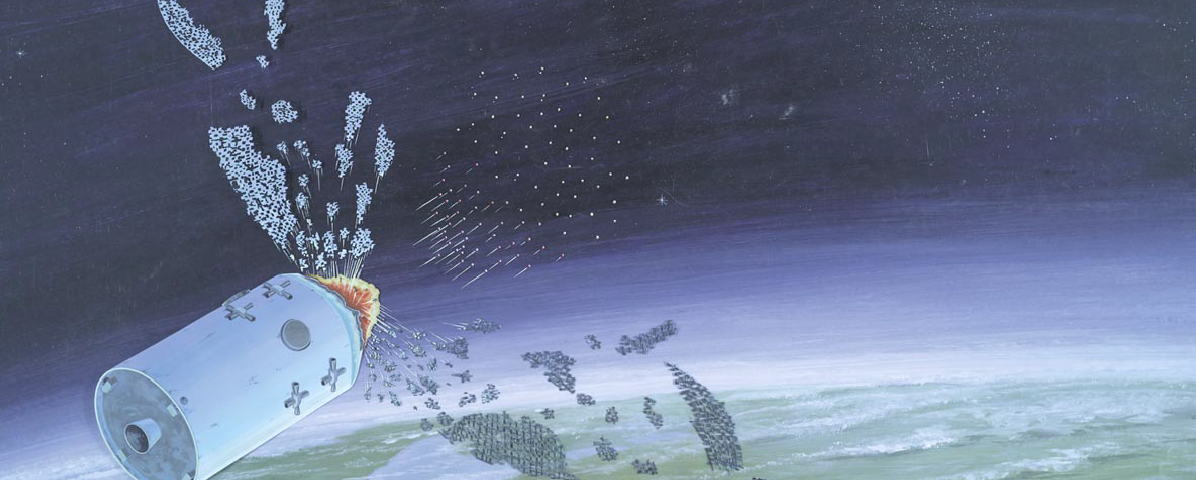
In Clancy’s techno-thriller, the United States detects the launch of a Soviet anti-satellite weapon in the midst of a Soviet invasion of western Europe. The Americans watch as a space-launch vehicle deploys a co-orbital anti-satellite weapon (ASAT) into a co-planar orbit with a KH-11 reconnaissance satellite. The ASAT sidles up behind its victim then rapidly moves in for the kill, detonating its explosive payload before the KH-11 can perform any defensive maneuvers. Aside from the war between NATO and the Warsaw Pact, one of the few differences between Clancy’s orbital scenario and the proximity operation Cosmos 2612 conducted around ICEYE-X36 is that the Russian satellite backed off rather than destroying its target.
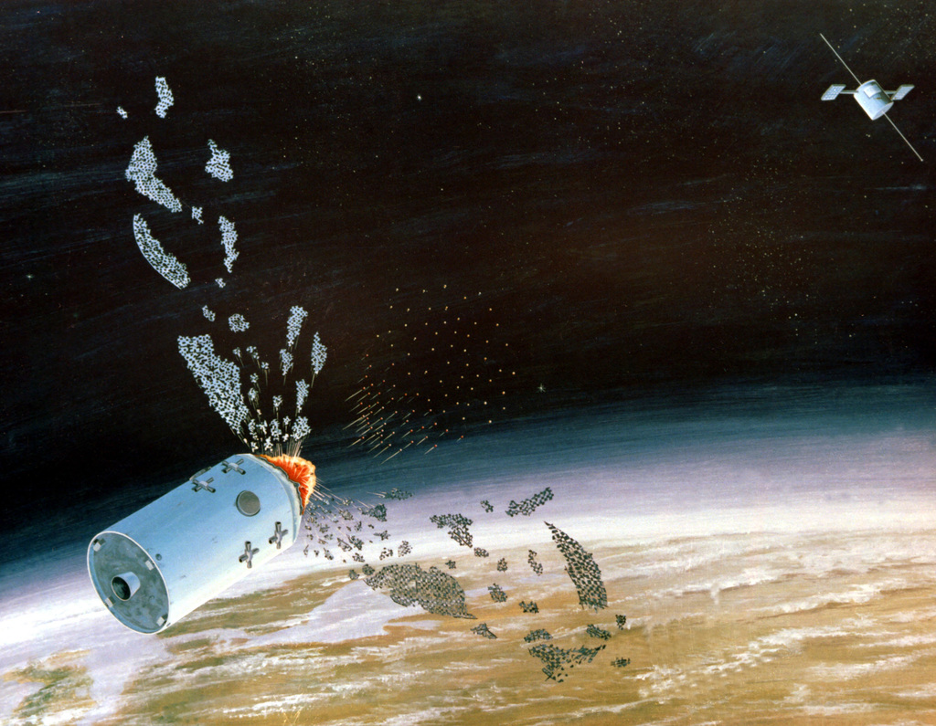
A Defense Intelligence Agency artist’s depiction of an anti-satellite weapon.
Like much of Clancy’s work, many technical elements of his scenario were grounded in reality, while a few were exaggerated for dramatic effect. In this case, the Soviet co-orbital threat to US satellites was real even if Clancy’s description of orbital dynamics is sketchy. The Soviets tested the ASAT program alluded to in the novel, named Istrebitel Sputnikov or “satellite destroyer” in Russian, extensively from 1962 to 1982. The United States monitored those tests through a variety of means including infrared sensors on the Defense Support Program (DSP) and early warning satellites under a program called FAST WALKER. The Soviets upgraded Istrebitel Sputnikov a number of times and later produced an improved co-orbital interceptor called Naryad.

A photo of Istrebitel Sputnikov, courtesy of RussianSpaceWeb.com who credits TsNII Kometa.
Russia continued to invest in this type of capability after the collapse of the Soviet Union. Novel potential co-orbital anti-satellite weapons programs include the air-launched Burevestnik (not to be confused with the nuclear-armed nuclear-powered cruise missile of the same name), the Luch (Olymp) inspector satellites, and the Project Nivelir “nesting doll” satellites. Russia has even placed a number of satellites, such as Cosmos 2576 and Cosmos 2558, into co-planar orbits with US government satellites. While the technology behind these systems has become more sophisticated, the basic model of their attack has not changed dramatically since Clancy wrote Red Storm Rising in the 1980s; enter a co-planar orbit with the target satellite, approach, then produce the desired effect on target, be it kinetic, grappling, directed energy, jamming, or otherwise.
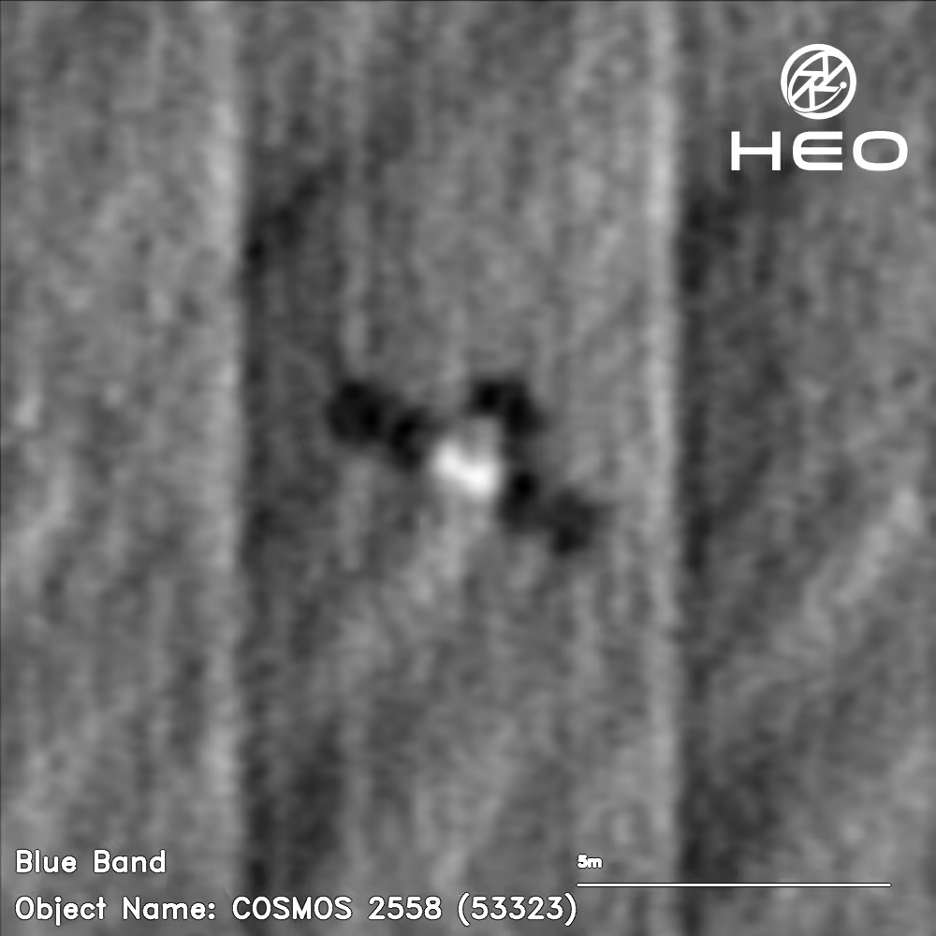
Photo of Cosmos 2558 taken by HEO Space using non-earth imaging.
What has changed is the massive growth of the commercial space sector. No longer primarily driven by the telecom industry, the modern commercial space industry has seen tens of thousands of satellites reach orbit for earth observation, communications, and other missions. The Cosmos-ICEYE incident illustrates how this development has driven positive and negative developments in the co-orbital threat landscape.
On the positive side, the commercialization of space includes the proliferation of space situational awareness technologies, making it easier to track orbital assets and flag nefarious activity. Such detection and monitoring have been possible to some extent since the start of the space age thanks to telescopes and amateur astronomers who have tracked satellites since Sputnik. However, new dedicated commercial SSA organizations like LEOLabs and non-earth imaging capabilities provided by companies like HEO Space and Vantor (née Maxar) provide new levels of transparency on-orbit. Indeed, Vantor captured an astonishing photo of the incident, showing Cosmos 2612 lurking about one kilometer from ICEYE-X36.
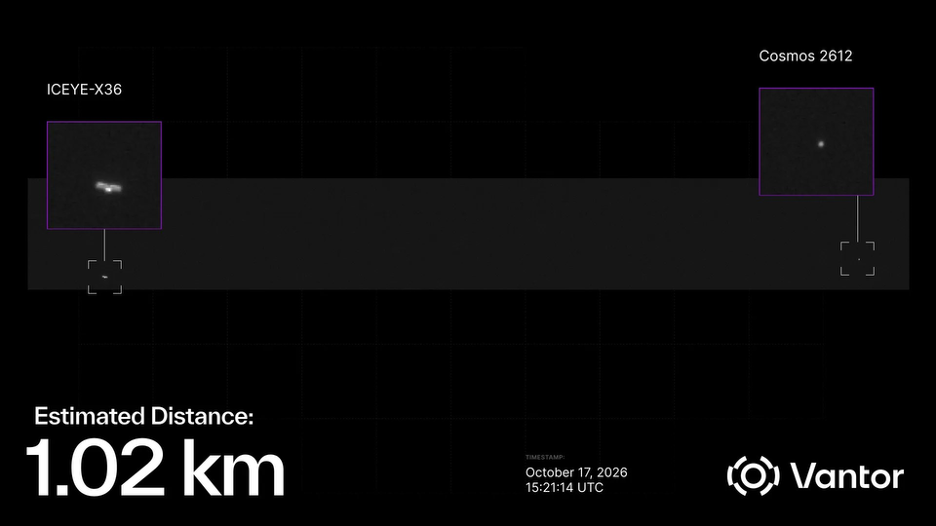
Cosmos 2612 and ICEYE-X36 seen in the same image, courtesy of Vantor via Axios.
While the increasing congestion of space, especially low earth orbit thanks to proliferated constellations like Starlink, is making it more difficult to keep track of satellites, these new unclassified situational awareness capabilities make it easier to identify, track, and discuss threatening behavior on orbit than ever before. Even if the transparency does not deter nefarious activity, as was the case with Cosmos 2612, it allows civil society and government to have frank conversations about increasing risks on orbit and organize accordingly.
As the Cosmos-ICEYE incident demonstrates, those risks are real, but somewhat different than during the Cold War. As the commercial space sector in the United States and Europe has grown, so has its involvement with the national security apparatus. The US Space Force runs the TacSRT program to acquire imagery and analytics from commercial vendors, for instance, while defense makes up an increasingly large part of business for commercial space companies. ICEYE is an excellent example of this phenomenon. They recently expanded their collaboration with Ukraine to provide additional synthetic aperture radar imagery to aid the Ukrainian fight against the Russian invasion, built sovereign synthetic aperture radar (SAR) satellites for the Polish military, and sold data to the German military. Commercial space assets have been crucial for Ukraine’s defense against Russia, as underscored by the recent fiasco SpaceX created by throttling Starlink over the combat zone. This type of relationship will only become more common as states like Ukraine and Poland, which would struggle to build and launch their own spacecraft but seek space capabilities on the cheap, turn to commercial partners to provide them with data or constellations off the shelf
The burgeoning role played by commercial assets has not gone unnoticed by Russia. Shortly after the invasion of Ukraine, Russian diplomat Konstantin Vorontsov suggested commercial constellations like Starlink may be “legitimate” military targets given their role in military operations. In a 2023 article called “The Role of US Space Group in Information Support of Ukrainian Armed Forces: Lessons and Conclusions” (Роль космической группировки США в информационном обеспечении вооруженных сил Украины: уроки и выводы), three Russian colonels took up the topic of commercial space assets and their importance to Ukraine. The article was published in Military Thought, the military-theoretical journal of the Russian Ministry of Defense. The authors characterized the distinction between commercial and US government assets on orbit as “imaginary,” suggesting constellations from companies like SpaceX, Maxar, and Capella were “dual-use satellite systems overseen by the Pentagon.” The part these commercial constellations were playing in Ukraine therefore “allows us to consider their infrastructure as the most important target for destruction, with all the ensuing consequences.” The authors recommended dazzling commercial electro-optical imaging satellites with lasers like Persevet, conducting electronic warfare against large constellations using co-orbital systems, and, under certain conditions, destroying the satellites and their ground stations. While the views of these three colonels may not perfectly reflect the attitudes of Russian military and political leadership, Cosmos 2612’s proximity operation around ICEYE-X36 might be a manifestation of a shift in Russian thinking presaged by their article.
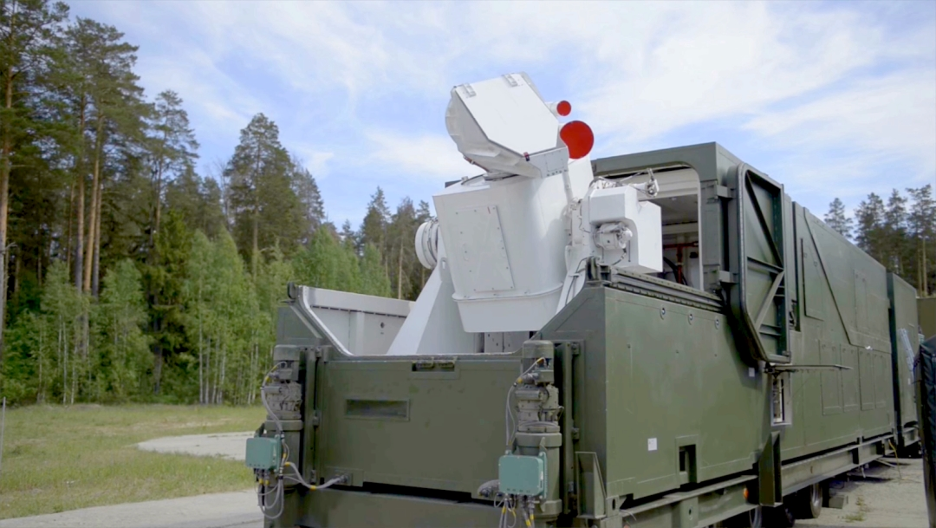
The Russian Peresvet laser dazzler, typically deployed near intercontinental ballistic missile brigades to help conceal mobile missile maneuvers. Courtesy of Mil.ru.
The threat to commercial space assets from state actors will grow in tandem with their importance to US and allied militaries. A state seeking to shape the military balance of power on the ground before or during a conflict may turn to escalation against commercial assets in space to weaken their opponent’s capabilities. Commercial assets on orbit might be at greater risk than government-controlled satellites. While seen as functionally under control of the US government, adversaries could perceive a distinction in escalatory potential between targeting commercial assets and those owned by the United States. The difference in ownership creates a buffer, another step between the US government and the object targeted, which might restrain any US response to provocation. This buffer created by commercial ownership might encourage adversaries to target commercial assets rather than state-owned assets, as they are perceived as safer, less escalatory targets. This distinction makes commercial assets the ideal victims of warning shots, letting the adversary release escalatory pressure and signaling the seriousness of a confrontation without directly imperiling more essential US government assets. The difference between commercial and government-owned spacecraft could even create a natural limit to escalation, establishing a zone in which conflict can be conducted, not unlike how geography provided a natural bound to escalation during the Korean War.
This lower threshold for escalation against commercial space assets, along with the increasingly provocative nature of Russian actions, raises a number of uncomfortable, yet important, questions for commercial actors. Will states feel obligated to defend commercial assets on orbit? How do we assure commercial space operators about the risks they are exposed to due to competition or conflict between states? Will satellite operators like ICEYE be compensated if their spacecraft are damaged or destroyed by Russia over their support for the United States or Ukraine? How can one deter provocation against commercial space assets? These are important conversations to have as commercial space assets become increasingly enmeshed into American and allied national security frameworks.
While the mechanics of the co-orbital ASAT scenario Clancy laid out in Red Storm Rising are little-changed, the commercialization of space has made the threat more complicated. Unclassified attribution is easier than ever, but the threats are more diverse, more difficult to deter. The dangerous fly-by conducted by Cosmos 2612 should provoke more conversations about the risks commercial actors take on when they get involved in defense missions. Days after the incident, ICEYE announced plans to partner with Nikon to build sovereign satellite communications systems for Ukraine. It is reassuring to hear ICEYE has not been deterred by what is clearly Russian intimidation. But the incident demonstrates that risks are present, and we should continue to think about what they mean for escalation dynamics in space and the consequences for industry.
Image: Defense Intelligence Agency