 A Nation Must Think Before it Acts
Middle East
A Nation Must Think Before it Acts
Middle East

A nation must think before it acts.

Middle East
New Pressures on the UN Security Council to Lift Its Arms Embargo on Libya
Pressures mounted on the United Nations Security Council yesterday to lift its international embargo on arms to the Libyan government. In an interview with journalist Valerio Robecco, Libyan UN ambassador Ibrahim Dabbashi said, “A time limit should be set...
Read more »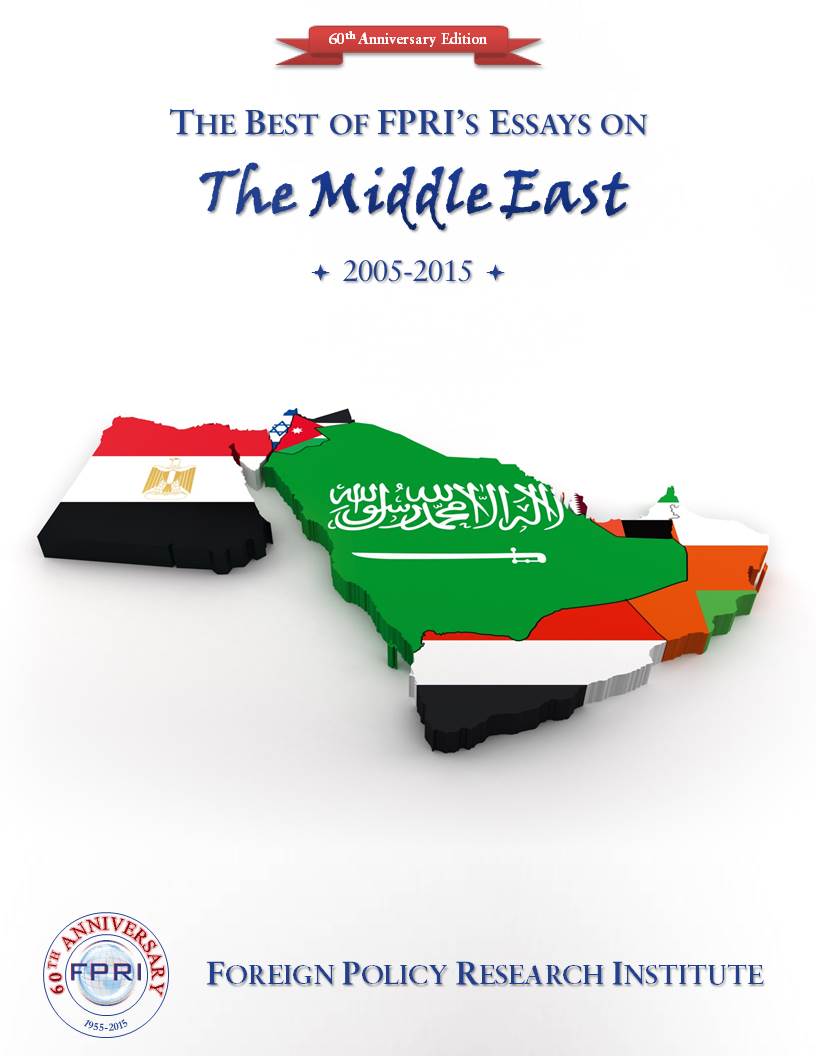
The Best of FPRI’s Essays on the Middle East, 2005-2015
he Middle East - a region as complex and fraught with challenges as ever - continues to hold U.S. policymakers in its thrall. Though they may want to pivot elsewhere, the Middle East keeps pulling them back because the...
Read more »Negotiating a Strong Deal with Iran
In his recent book Nuclear Iran (Harvard University Press, 2014), Jeremy Bernstein notes that centrifuge plants are simpler to conceal than nuclear reactors. Under the terms of a nuclear deal between Iran and the EU3+3 (Britain, France, Germany, China, Russia, and the United States) that have been...
Read more »With Friends Like These
On September 10, 2014, President Obama laid out American objectives in Iraq. The U.S. would work to “degrade and ultimately destroy” the group that calls itself the Islamic State. This is a commendable objective, but no one has clearly...
Read more »How to Prevail Against a Poisonous Ideology
The following is the text of a speech by Mansour Alnogaidan, Director General of Al-Mesbar Center for Studies and Research. It was delivered on February 25 in Paris, at the headquarters of the United Nations Educational, Scientific and Cultural Organization (UNESCO), on...
Read more »As Egypt Fires at ISIS, the U.S. Still Wants to Talk it Out
The beheading of 21 Egyptian Copts working or seeking work in Libya and held hostage by ISIS for the past month was in effect a declaration of war by the extremist group against Egypt. We are at a turning...
Read more »Seven Problems with John Kerry’s Iranian Nuclear Clock
US Secretary of State John Kerry has repeatedly pledged that the prospective nuclear agreement being hammered out between the P5+1 world powers and Iran will extend the Islamic Republic’s “breakout time” – how quickly it can produce sufficient fissile material...
Read more »Gulf Monarchies in a Changing Middle East: Is Spring Far Behind?
Abstract More than three after the beginning of the Arab Awakening, it appears that the upheavals have, by and large, left the Gulf monarchies intact. While several dictators have fallen— from Ben Ali in Tunisia, Mubarak in Egypt and...
Read more »Origins and Evolution of Zionism
This essay is based on a lecture she delivered to FPRI’s Butcher History Institute on “Teaching about Israel and Palestine,” October 25-26, 2014. The Butcher History Institute is FPRI’s professional development program for high school teachers from all around...
Read more »The History of the Arab-Israeli Peace Process
This essay is based on a lecture he delivered to FPRI’s Butcher History Institute on “Teaching about Israel and Palestine,” October 25-26, 2014. The Butcher History Institute is FPRI’s professional development program for high school teachers from all around...
Read more »