 A Nation Must Think Before it Acts
FPRI Experts React | NATO Summit in Ankara
A Nation Must Think Before it Acts
FPRI Experts React | NATO Summit in Ankara

A nation must think before it acts.

FPRI Experts React | NATO Summit in Ankara
Emily Holland, Eurasia Program Director
This year’s NATO Summit in Ankara was less about substance than Trump centered theatrical spectacle, but the central message on Russia and Ukraine is consequential. Over the course of less than two days, President Trump threatened to withdraw all US troops from Europe, renewed his claim that Greenland should be under US control, called the Spanish “hopeless, bad people” and declared he desired to cut off all US-Spanish trade, termed Iran’s leadership “loco”, but perhaps most surprising, declared that he had “developed a good relationship” with Ukrainian President Volodymyr Zelenskyy.
The shift in tone on Ukraine is remarkable after years of volatility in Trump’s stance towards Kyiv. Trump’s comments, including remarking that Ukraine “has a lot of future,” were a reassuring surprise to European allies who are supportive of Kyiv and generally take a hardline approach towards Moscow. In the fifth year of war, NATO allies are attempting to move from sporadic support for Kyiv towards a more industrialized, long-war strategy. The clearest signal of this shift is the pledge of €70b in military equipment, assistance and training for Ukraine in 2026, with allies committing to sustain at least equivalent levels in 2027. Trump also said that the US would give Ukraine a license to manufacture Patriot missile interceptors, a move he deemed “pretty cool.”
This represents an enormous win for Kyiv, because Patriot systems are one of the few able to intercept Russian ballistic missiles, and Ukraine’s shortage has become a critical vulnerability. In recent weeks, Moscow has intensified its air campaign against Kyiv and other Ukrainian cities. As recently as Sunday night, the Ukrainian Air Force was not able to intercept any of the 23 ballistic missiles fired by Russia due to a critical shortage of interceptors and at least 22 people were killed in the wider Kyiv region.
The Ankara declaration reaffirmed its commitment to Article 5 and identified Russia as the long-term threat to Euro-Atlantic Security. It also states that European allies and Canada now finance the vast majority of security assistance to Ukraine. While Trump’s about face and Europe’s reaffirmation of support for Ukraine is promising for Kyiv, these commitments will not solve immediate capacity issues. Production of any future Patriot systems will likely be in Germany or another European country to avoid making Ukrainian facilities Russian targets.
The Patriot license issue highlights NATO’s broader shift towards building a defense industrial base within Europe. On July 7, the day before the Ankara Summit, NATO held its Defence Industry Forum, where tens of billions of new procurements were announced, including the NATO Drone Edge initiative. European allies know that they need to prove that they can produce critical munitions and systems fast enough to support their own defense.
Of course, the question of how Russian President Vladimir Putin will react to these developments remains crucial. Leaving Ankara, Trump said that he expected to speak on the phone with Putin, called him a “difficult character” and stated that both Moscow and Kyiv wanted to settle the conflict. On July 9, Moscow denounced the Ankara declaration, warning that the militarization of the European continent would have catastrophic consequences. NATO’s cohesive commitment to Ukraine should be worrying to Moscow, but the true test will be whether the alliance can manage its internal divisions whilst shifting the burden of European defense to the continent itself.
Aaron Stein, President
Turkish President Recep Tayyip Erdogan has clamored for the F-35 ever since he authorized a purchase of a Russian made missile system that every American that entered his orbit told him would lead to the country’s booting from the F-35 consortium. The sanctions stem from 2017 legislation passed almost unanimously in both houses of Congress to punish Russia for interfering in the election Trump won in 2016. Turkey was not the target but nevertheless ran afoul of the legislation’s secondary sanction provisions. Turkey’s S-400 purchase also ended up in its removal from the F-35 consortium.
Trump has never agreed with the sanctions, nor with the embargo. He was forced to sign the veto-proof legislation but has always maintained that it is a violation of Article II of the Constitution. He still thinks this way, and he wants to sell US military kit. This F-35 issue with Turkey is really that simple. In 2019, he told Erdogan that the F-35 embargo was “unfair” and that “we’re working through it …” The issue is explicit in language in the 2020 National Defense Authorization Act, which bars the transfer of the F-35 to Turkey so long as Ankara “possesses” the S-400.
Lawyers are paid to contort the law, so perhaps Trump’s team thinks they can change the meaning of the word possession. However, any such interpretation would have to pass the smell test with the folks who wrote the legislation, and whose blessing he needs for the jet’s export. So, is there a way forward? Maybe. There is a precedent for an exemption to sanctions, and they were used on India and Vietnam. However, lawmakers said at the time that Turkey did not qualify because it was ramping up its relationship with Russia, rather than toning it down.
This may be a point of contention the administration wants to exploit, along with the mangling of the English language. But it won’t be easy. The same barriers to the F-35 transfer remain, raising questions about whether Trump can follow through on his promise to Erdogan. A promise he has been making for more than half-a-decade without success. With Congress poised to change hands, and Turkey remaining unpopular, the challenges for working out this near decade old issue remains as prominent as ever. Regardless, the ball is now in Ankara’s court. If Ankara is willing to take head on the “possession” issue, in cooperation with the US, a pathway long on offer to end this saga, may finally happen.
Czechs Send Mixed Signals at NATO Summit – Robert Beck, Senior Fellow
Czech President Petr Pavel, at a meeting organized by the Munich Security Conference on the sidelines of the NATO summit in Ankara, Turkey on July 7, 2026, highlighted his country’s inclination towards a “false sense of security” given its location in the center of Europe, surrounded by other members of NATO and the European Union. According to Pavel, the Czechs, like the rest of the alliance, need to be self-sufficient in the defense realm to fulfill one of NATO’s core principles, “one for all and all for one.”
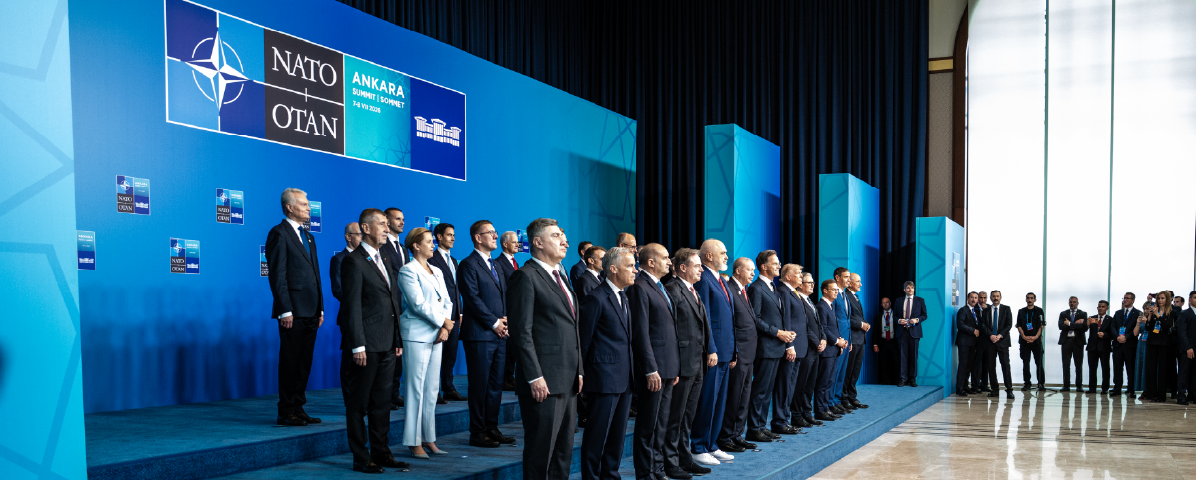
The president’s comments were a thinly veiled critique of his own government which had unsuccessfully attempted to keep him out of the Czech delegation to the summit. Following a last-minute reprieve by the country’s constitutional court, Pavel was included as an add-on to Prague’s official contingent in Ankara. Given the Czech president’s long-standing support to NATO and Ukraine, his presence in Ankara offered a stark contrast to the putative backtracking by the Andrej Babiš-led Czech government in its fidelity to NATO writ large, and Kyiv specifically. The yawning gap between Pavel and the government on security matters was on full display in the official photo from the summit’s first night’s dinner where the two Czech leaders stood at the extreme opposite ends of the platform.
In an effort to neutralize growing western doubts of the current government’s fealty to Prague’s erstwhile alliance commitments, Babiš declared in advance of his departure for Ankara that the Czechs would meet the minimum two percent of GDP in defense spending in 2027. Furthermore, Foreign Minister Macinka, a fierce political opponent of President Pavel, announced immediately prior to the summit that the Czechs would “redirect funds” to the Prioritised Ukraine Requirements List (PURL) program in support of Ukraine. This decision represents a significant volte-face by Babiš, who had previously rejected any attempt to provide Czech financial support to Kyiv.
As the summit ended on July 8, 2026, however, Babiš returned somewhat to form, claiming that the Czechs would not contribute to the NATO plan to provide Ukraine with 70 billion euro worth of support in the coming year. Additionally, the Czech leader complained to the press that during the summit “everybody talks about war, everybody talks about armaments, but not once did I hear the word peace.”
Consequently, during the Ankara meeting the Czechs sent, at best, mixed signals regarding Prague’s willingness to return to the fold as a reliable member of the alliance in the critical central region of NATO’s eastern flank.
The Hungarian Dogs That Didn’t Bark – Hadas Aron, Senior Fellow
One of the interesting features of the NATO summit was what did not happen: Hungary did not make headlines. Péter Magyar, Hungary’s new Prime Minister, did say that Ukraine is the victim and Russia the aggressor and scheduled bilateral meetings with Zelenskyy, while also repeating that Hungary would not send troops to Ukraine. But compared with Viktor Orbán’s usual role as the disruptive bad boy of the European Union, Hungary was almost quiet.
This silence is interesting for two reasons. First, it raises the broader question of whether illiberal states matter for foreign policy and for the global order. For great powers, the answer is obvious. Illiberal leaders in the United States and Turkey made major headlines once again in ways that are both distinctly illiberal and genuinely reshaping the world order. But despite its limited geopolitical weight, Hungary matters too. Orbán’s anti-EU stance and favorable position toward Russia were partly symbolic and partly a tool of blackmail, but even symbolism is significant in alliances. These moves weakened the appearance of European unity inside NATO and contributed to the sense that the alliance is increasingly divided among liberal democracies, illiberal members, and an unpredictable United States.
Second, Hungary itself is undergoing a dramatic domestic transformation. Magyar’s first days in office are marked by institutional ambition and an aggressive style, as seen, for example, in the very recent and highly demonstrative blackout of the Hungarian public broadcaster. Time will tell whether this produces democratic repair or another form of majoritarian politics. But internationally, Hungary is clearly quieter. Orbán placed Hungary on the global stage far beyond its actual power. But to what end? Illiberalism did not bring prosperity or protect Hungary’s sovereignty. For many Hungarians, the costs became clearer than the benefits: isolation, EU pressure, frozen funds, and eventually, economic failure.
The lesson, then, is twofold: illiberal small states are, at best, a headache for what remains of the liberal order. But being the perpetual renegade child, presenting yourself as standing up to great powers, and relying on influential illiberal friends do not guarantee the survival of an illiberal leader. At the end of the day, European liberals can defend themselves against such renegades, even if they do so slowly and indecisively.
The NATO Summit in Ankara—A View from Poland – Jakub Romaniuk, Fellow
From Poland’s perspective, the Ankara Summit should be assessed only positively. Minister of Foreign Affairs Radosław Sikorski even described the results of the meeting as “exceeding expectations.” Warsaw welcomed with satisfaction the clear and unanimous declaration by NATO members that Russia poses a “long-term threat to Euro-Atlantic security and stability,” as well as the reaffirmation of their “ironclad commitment to collective defense under Article 5 of the Treaty.” The member states’ commitment to achieve spending of 5% of GDP on defense was also clearly articulated—a goal Poland had previously advocated for as a leader in this field. During the summit, it was also decided to strengthen the fuel supply chain, specifically by extending “dual-use” fuel pipelines eastward (to Poland, the Baltic States, Southern Europe, and the Visegrad Group countries). Another major achievement of Polish diplomacy was securing recognition of the importance of the E5 format in the documents. This, in turn, led to what was perhaps Poland’s greatest success in Ankara: the cooperation of the Polish delegation. Although there had been numerous disagreements and differences of opinion between the president and the government in the past, this time all three—President Nawrocki, Foreign Minister Sikorski, and Defense Minister Kosiniak-Kamysz acted in unison, presenting Warsaw’s position in a coherent manner, which contributed to Poland being perceived as a reliable partner and one of NATO’s key members.
In addition, Poland secured very significant defense contracts, such as the agreement signed with the US, the Netherlands, Germany, and Sweden regarding the maintenance in Europe of PAC-3 missiles for Patriot launchers, as well as the contract with Anduril to produce Barracuda-500M missiles. The US decision to grant Ukraine a license to manufacture missiles for Patriot systems on its territory was also extremely important for Poland, given recent internal disputes on this issue. NATO’s unwavering support for Kyiv is also encouraging, as it translates into concrete financial commitments: member states will provide €70 billion for military equipment and training in 2026, and no less in 2027. The summit also served as an opportunity for talks between the presidents of Poland and Ukraine; while they were unable to reach an agreement on the difficult history between the two nations, they did agree that good relations are essential in the face of the Russian threat. “I am leaving Ankara with the profound conviction that today the Alliance is stronger than ever” – President Nawrocki concluded.
Featured image: NATO