 A Nation Must Think Before it Acts
Czech President, New Government in Early Power Struggle
A Nation Must Think Before it Acts
Czech President, New Government in Early Power Struggle

A nation must think before it acts.
Czech President, New Government in Early Power Struggle
Bottom Line
-
Since the return to power in Prague of Prime Minister Andrej Babiš in December of 2025, sharp disputes between the country’s president, Petr Pavel, and the new cabinet have erupted.
-
The main source of the political infighting has been inflammatory rhetoric by Babiš’ junior coalition partners, primarily Foreign Minister Petr Macinka.
-
The disagreements, which encompass Prague’s foreign policy orientation, threaten to damage the country’s international standing.
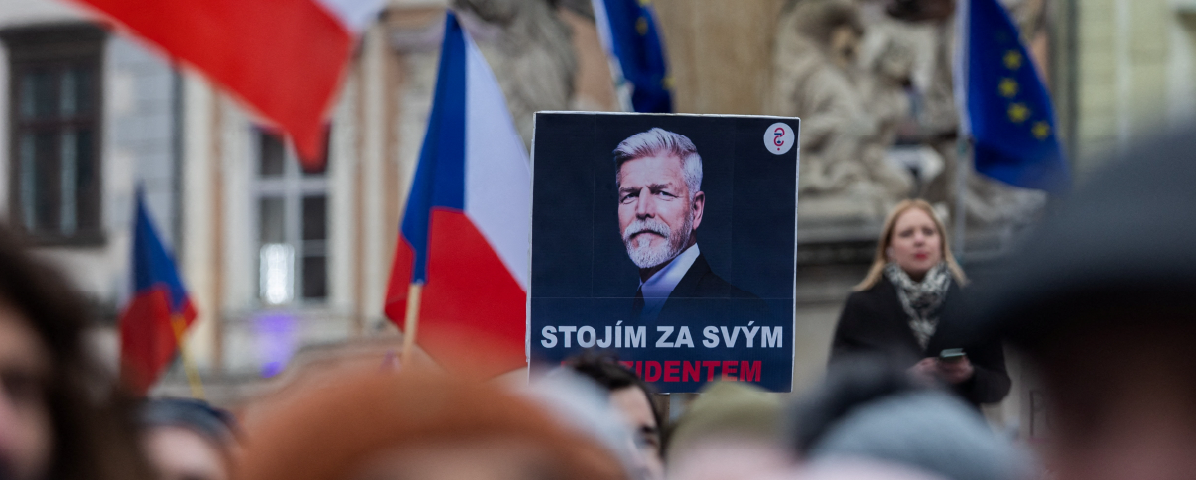
In an interview on Feb. 1, 2026 on the popular Czech television political commentary series “Questions with Vaclav Moravec,” Petr Macinka, the Czech foreign minister and head of the government’s junior coalition party Motorists for Themselves (Motoristé sobě), declared that his ministry would simply ignore the country’s president, Petr Pavel. On the same day upwards of 90,000 Czechs filled the streets of Prague in a show of support for the president. The rupture in relations between Pavel and Macinka, after a mere two months of the latter taking office, highlights more deep-seated conflicts between the new government and the popular Czech head of state. How the situation deteriorated so rapidly, what it means for Prime Minister Andrej Babiš, and what the possible ramifications will be for Prague’s status as a valued member in the heart of Europe of the European Union (EU) and North Atlantic Treaty Organization (NATO) are the focuses of this analysis.
Rapidly Developing Crisis
The current rancor started to build even before Babiš reclaimed the Czech premiership on Dec. 9, 2025 as head of the ANO (“action of dissatisfied citizens” in Czech, and also means “yes”) movement. As a condition for naming Babiš as prime minister, Pavel demanded in mid-November that the ANO leader publicly disclose his plan for resolving a longstanding conflict of interests as head of Agrofert, one of the central European country’s largest conglomerates, which had previously been a recipient of substantive EU agricultural funding. After several weeks of back and forth, Babiš complied with the president’s ultimatum, announcing on Dec. 4 his plan to sever all ties with Agrofert, leading quickly to his assumption of the prime minister post. While Pavel and Babiš appeared to put the conflict of interests dispute behind them for the good of the country, the junior members of the new coalition government would prove to be less accommodating to the views of the president.
Tranquil political waters in Prague soon fell victim to another tempest between Hradčany (the seat of the president, commonly referred to as “the castle” in Czech) and the incoming government. The Czech president has the constitutional authority to name or reject nominees for cabinet posts. Pavel used that authority to reject the nomination as Minister of the Environment of Filip Turek, the honorary president of the Motorists and a close confidant of Macinka. Pavel’s action was viewed by the Motorists—as well as the other right wing junior party in the new coalition, SPD (Freedom and Direct Democracy)—as unwarranted interference in the formation of the new cabinet. Pavel’s justification for the slight was well documented, focusing on Turek’s unsuitability for a ministerial position due to his oft-chronicled history of racist, sexist, homophobic, and pro-Nazi posts on social media. As a result of the president’s position, Macinka became, at least temporarily, dual-hatted as Minister of Foreign Affairs and Minister of the Environment. From the standpoint of the Motorists and of Macinka, however, the Turek affair was far from over.
The castle’s misgivings about the new government are not limited to the quarrel with Macinka and the Motorists. The most radical party in the Czech coalition, SPD—specifically in the person of their firebrand leader, Tomio Okamura—has openly questioned Prague’s erstwhile ironclad support to Ukraine, a cause for which Pavel has been a European champion. On Nov. 6 Okamura, in his first act after being elected as the President of the Chamber of Deputies (Speaker of the House), in a very public manner removed the Ukrainian flag that had been hanging from the Czech parliament building since 2022.
Rubbing salt in Pavel’s wound, Okamura brazenly lashed out at Ukraine in a New Year’s speech, criticizing the West for supporting a senseless war and helping the “Ukrainian criminals in Zelensky’s junta” stay in power. The remarks, sharply rebutted by the Ukrainian Ambassador in Prague as well as a broad spectrum of the Czech opposition, deepened the president’s apprehension about the foreign policy views of the new regime.
In a further blow to the fragile relationship, Pavel, on a mid-January 2026 visit to Kyiv, promised his Ukrainian counterpart that the Czechs would provide four L-159 combat aircraft to assist with the country’s air defense mission, specifically in counter-drone operations. The aircraft transfer had been discussed with the previous government of Petr Fiala but no contract had been signed. No sooner had Pavel returned to Prague than Defense Minister Jaromír Zůna rejected the proposal, citing domestic air defense requirements. This view, however, was openly questioned by Karel Řehka, the chief of the Czech General Staff, who on Jan. 23 stated bluntly in a press conference that providing Kyiv with the four L-159 aircraft would not damage the country’s security. In the end, Babiš decided to put the aircraft deal on ice, in the process securing another nail in the coffin of the castle/government relationship.
The Political Pot Boils Over
The political crisis in Prague reached a nadir in late January as the result of a series of text messages Macinka sent to a senior advisor to Pavel, where Macinka warned of “consequences” should the president not reconsider his decision to reject the nomination of Turek as Minister of the Environment. Not surprisingly, Pavel pushed back immediately and forcefully on the perceived threat, publicly releasing the text conversation, accusing the foreign minister of attempted blackmail in a hastily-arranged press conference on Jan. 27 and subsequently referring the matter to the Czech police for further investigation.
For his part, Macinka stood his ground in the face of the president’s charges, upping the political ante by suggesting that Babiš, not Pavel, should represent the Czech Republic at the July 2026 NATO summit in Turkey. Such an eventuality would break a long-standing Czech tradition of the country’s president heading the delegation to NATO summits while the prime minister fulfilled that responsibility at EU gatherings. Macinka’s comments also called into question the castle’s influence on the nation’s foreign policy orientation, a practice respected across the political spectrum since the birth of the post-Cold War Czechoslovakia.
In subsequent statements, Macinka poured oil on the fire, claiming that Pavel would no longer be “president of all Czechs” and that he had effectively “burned that bridge” with his stance regarding Turek’s nomination. The foreign minister, who has repeatedly cited the recent elections as a mandate for his fight with the castle, is skating on very thin ice in this regard. The numbers from the last elections don’t lie, showing that the Motorists garnered the least amount of support of any party represented in parliament with only 6.77 percent of the votes and a mere 13 members in the 200-seat body. Meanwhile, Pavel consistently ranks as the county’s most popular politician with, at the moment, no significant challenger for a presumed second term starting in 2028.
Aside from the widespread demonstrations mentioned at the beginning of this analysis, the somewhat fractious Czech opposition promptly spearheaded a vote of no confidence in the new cabinet because of Macinka’s broad-based public criticism of Pavel. Although the motion predictably failed due to the coalition’s majority of 108 seats in parliament, it served notice to Babiš that there was a limit to toleration of the rhetorical invective emanating from his radical coalition partners.
Can’t Live With Them, Can’t Live Without Them
So where does this leave the Czech prime minister? Since the start of the political pugilism between the castle and the foreign minister, Babiš has endeavored to play the role of peacekeeper. In a press briefing on Feb. 2, the day after Macinka’s comments about ignoring the president, Babiš stated clearly, “we don’t want to escalate this controversy; on this point the coalition is in agreement.”
In a bid to assuage Pavel’s wrath, the prime minister visited Hradčany on Feb. 4 to confer with the head of state. The country’s two most powerful men agreed that a deepening feud between the president and the foreign minister was not in Prague’s interest. In a statement published by the president’s office following the meeting, Pavel stressed that he was convinced that the prime minister would “silence any potential quarrels with his coalition partners and government ministers to avoid a situation which could threaten Czech interests or weaken the country’s position abroad.”
On the flip side of this coin, despite growing political opposition to Macinka’s rhetorical fireworks—illustrated by the aforementioned mass demonstration in Prague—Babiš shows no sign of dumping his foreign minister. In fact, though expressing mild disappointment in Macinka’s choice of words in the inflammatory texts, the prime minister has, so far, repeatedly expressed support for his junior coalition partner. In public comments on Jan. 29, Babiš praised his cooperation with Macinka as excellent and dismissed any idea of relieving the foreign minister of his duties.
To add insult to injury from the perspective of the castle, the new government, when it became clear that Turek would not be named as Minister of the Environment, appointed the controversial figure as the government’s commissioner for climate policy and the European green deal. It is unclear yet how much influence Turek will have on Czech environmental programs but, given the Motorists utter disdain for EU oversight in that sphere, one can assume that Turek will not be a popular figure with many of his more climate-conscious colleagues in Brussels.
Nevertheless, the prime minister finds himself between the proverbial rock and hard place, due in large part to the realities of the country’s parliamentary system. While ANO won last October’s elections convincingly, they still required a coalition partner or partners to form a majority government. Due to longstanding cantankerous relations with the country’s other centrist political parties, the ANO leader’s only choice was to team up with the two most radical parties in parliament, the Motorists and SPD.
The leaders of these two junior parties, Okamura and Macinka, have suddenly assumed sobering responsibilities as Speaker of the House and foreign minister, respectively, that are seemingly beyond the scope of their previous experience as rabble-rousers on the Czech political fringe. Babiš is now faced with the challenge of giving them both enough rope to placate their political bases while tempering their worst instincts which could damage the reputation, domestically and internationally, of the nascent cabinet. This task is exceedingly onerous in the present circumstances as the most recent polling (January 2026) from the Czech Center for Research of Public Opinion (CVVM) indicates that Macinka, Turek, and Okamura all are viewed unfavorably by over 60 percent of the population.
Consequently, it remains to be seen if Babiš is up to the task of managing his unruly political children, but the Macinka kerfuffle represents an unpropitious beginning for the new regime in Prague.
Effect on the Czech Republic’s Position in Europe
The recent governmental drama in the heart of Bohemia underscores a growing belief that Babiš has subcontracted the country’s foreign policy to the more radical elements of his coalition. Since returning to power, the ANO leader has avoided any strong statements regarding the most salient international dilemmas facing the EU and NATO. In response to press queries in late January about whether the Czech Republic stood with Denmark in reaction to pressure from Washington over Greenland, Babiš equivocated, arguing that he preferred an agreement within the framework of NATO. His comments were not received well by Pavel or the country’s opposition parties who have pushed for a united European response to perceived American provocations.
Furthermore, with respect to Ukraine, the prime minister and the president have, over the past several years, consistently expressed antithetical views, manifested most openly in the 2023 Czech presidential elections when the two men squared off. During that campaign, Babiš portrayed himself as a supporter of peace, insinuating that Pavel was a warmonger for his forceful support of Kyiv. Since returning to power in late 2025, Babiš has lowered the rhetoric on the Ukraine conflict but the president remains extremely apprehensive of the new government’s commitment to NATO’s strong pro-Kyiv policies.
Although Babiš warned repeatedly during last fall’s election campaign that his government would shut down the previous cabinet’s munitions initiative for Ukraine, the ANO leader backpedaled on this threat, instead on Jan. 6 that the Czech Republic would continue to manage the program but cease contributing financially to the heretofore successful effort at arming Kyiv. Thus, Babiš chose a middle ground between the anti-Ukraine elements in his coalition (SPD) and Pavel, who has been an ardent supporter of the project. Suffice it to say, neither side in the debate on the future of Prague’s backing of Ukraine was satisfied with the prime minister’s perceived ambivalence.
The ongoing variance erupted anew on Feb. 17 with the announcement of the proposed 2026 Czech defense budget by the parliament’s defense committee, which, if implemented, would cut approximately CZK 21 billion (USD 1.02 billion) from the previous government’s draft defense budget of CZK 176 billion (USD 8.6 billion) and, more importantly, not meet Prague’s NATO commitment of spending two percent of GDP on defense. For his part, Pavel immediately criticized the submission, warning that, if accepted, the new defense budget would put the Czech Republic in a small club of NATO countries actually reducing their security expenditures.
Earlier in February, Pavel reinforced similar themes at the Munich Security Conference, where he opined that the nation risked losing its credibility with its allies, adding that “our partners are closely following what our new government is doing” with respect to defense spending. Given the president’s background as a senior NATO official and fervently pro-Ukraine leader, one can expect that Pavel will continue to challenge the Babiš regime on any retrenchment from Prague’s fidelity to Europe’s pro-Kyiv posture.
Disputes over defense and security policy between Hradčany and the Babiš coalition will likely persist as Pavel’s views in this realm fundamentally diverge from those of the junior coalition partners SPD and the Motorists. From Okamura taking down the Ukrainian flag at the Czech parliament, to Babiš’ decision regarding the L-159s for Ukraine, to Macinka’s push to exclude Pavel from the upcoming NATO summit in Turkey, the new regime has publicly opposed the castle on salient issues related to the country’s foreign policy.
How the collective leadership resolves the growing altercation will likely define the country’s defense and security policy for the foreseeable future, in the process determining the Czech Republic’s reliability as a key player in Europe’s efforts to defend the continent from further Russian aggression.
Image credit: A demonstration in support of Czech President called “We stand for our President” in Prague, February 1, 2026. REUTERS/Eva Korinkova