 A Nation Must Think Before it Acts
Reading Germany’s Rearmament: The 2026 Military Strategy Between Ambition and Accountability
A Nation Must Think Before it Acts
Reading Germany’s Rearmament: The 2026 Military Strategy Between Ambition and Accountability

A nation must think before it acts.

Reading Germany’s Rearmament: The 2026 Military Strategy Between Ambition and Accountability
On April 22, 2026, Germany published what has been called the first military strategy in the Bundeswehr’s history. Signed by Chief of Defence Gen. Carsten Breuer, it is part of the broader “overall concept of military defence” (Gesamtkonzeption militärische Verteidigung) underlined as “Military Strategy and Plan for the Armed Forces” with the notable addendum “Responsibility for Europe.”[1] The Military Strategy describes Germany’s strategic environment, specifies how the Bundeswehr intends to deter within NATO and, if deterrence fails, to fight, and how to achieve this capability in the upcoming years. The so-called capability profile builds on this approach, folding NATO’s capability targets together with national objectives and turning the result into what a genuine plan for the armed forces. This core is completed by a personnel growth plan, a revised reserve strategy, and a modernization agenda. It highlights a German leadership ambition that now hinges on the accountability of those claims.
Evolution Not Revolution
Some observers claim that Germany’s military strategy marks a genuine shift in a country that spent 70 years avoiding exactly this kind of document as the infamous “reluctant hegemon”[2] of Europe, due to its economic power, size, and, hence, potential of military development. Yet, one could argue that the strategy is not a clear cut of former strategic orientation, but the latest and steepest development in a line of documents that runs back nearly a decade. The 2016 White Paper, following the beginning of Russia’s war efforts against Ukraine in 2014, already registered a hardening security environment and a more assertive Russia.[3] Chancellor Olaf Scholz’s Zeitenwende address of February 2022, quickly developing into a frequently used term even beyond Germany, became symbol of Germany’s strategic adaptation to Russia’s full invasion of Ukraine in 2022.[4] The 2023 National Security Strategy,[5] also a German primer, framed security as a whole-of-government task. The defense policy guidelines (Verteidigungspolitische Richtlinien) of the same year underlined national and collective defense as the Bundeswehr’s core mission and promised to translate that into a military strategy and a new capability profile. The given concept of military defense and its related documents further engage in exactly that promise. Each step in this sequence has moved further than the last, whilst the given 2026 strategy publicly creates the architecture and timeline to achieve. Hence, readers should treat the claimed novelty with some care. As has been underlined, Germany has always had functional equivalents of national security documents, notably its White Papers.[6] They represented the government’s overarching policy document on defense policy and have been published 11 times from 1969 until 2016.[7] Therefore, the change lies in the explicit architecture that now runs from strategy to a needs-based capability plan, not in the sudden invention of strategy where none existed.
In broader terms, a strategy is often called to follow the triad of ends, ways, and means. In its details, the strategy continues German and allied documents by naming Russia as the most immediate and significant threat and explains a hybrid, multi-domain conflict directed against the German state, the economy, and society at large. Four military-strategic priorities, the ends, are named to achieve and deal with the given and upcoming threat landscape: deterrence and collective defense, mitigation of hybrid attacks, stability in Europe and its southern neighborhood, and protection of sea lines of communication.
The main ambition to achieve that, the ways, is a three-phase build-up plan for the armed forces. It declares a maximized readiness by 2029, substantial capability growth to roughly 2035, and technological superiority by 2039, eventually. As underlined by Chancellor Merz, this intends to lead towards the stated goal of “Europe’s strongest conventional army.”[8]
To achieve those goals, the material base—the means—is planned to increase drastically and still continuously in the upcoming more than 10 years. Today, the defense spending stands above €108 billion in 2026, roughly 2.4 percent of GDP (coming from €32 billion in 2014 and 1 percent of GDP, respectively). In its newest variant, it became structurally protected by a constitutional amendment that exempts defense outlays above 1 percent of GDP from Germany’s so-called “debt brake,” which long capped military spending. Germany now intends to reach the 3.5 percent of GDP level in 2035, which would represent a volume of €150 billion by current numbers.
Finally, force build-up targets follow the three timeline numbers mentioned before. In the beginning, growing the active force takes priority. Drawing on the capability profile, the build-up unfolds in three phases. The first concentrates on rapidly raising defense readiness and personnel availability (until 2029). The second aims at a marked increase in capability across all domains (land, air, sea, cyber, and space) in line with NATO and national capability targets, further strengthening warfighting and staying power while meeting the personnel goals (until 2035). Together these two phases are meant to reach at least 460,000 combat-ready troops: a minimum of 260,000 active personnel and 200,000 reserve forces, until eventually reaching the status of what is called technologically superior forces (until 2039).
Implications For Allies
Since its foundation, the Bundeswehr acted and has been an allied force. Its missions and actions, preparation and plans developed in allied context. Interestingly, the strategy presents itself as an act of national strategic emancipation. Its substance, however, still derives largely from NATO’s defense planning process, most recently the expanded capability targets agreed at the 2025 The Hague NATO summit. This underlines the pledge to spend 3.5 percent of GDP on core defense and a further 1.5 percent on defense-related measures.
Therewith, Germany formulates national capability goals of its own to feed back mainly into NATO as its military alliance and anchor of collective defense. This builds on the premise and new understanding that national strength is the foundation of European and allied, NATO defense, and that cooperation for its own sake cannot substitute for capabilities a country simply does not have.[9] This, indeed, represents an acknowledgement of the lack of certain capabilities on the European continent. The document also explicitly names the American focal point of the Indo-Pacific. Therewith, it leads to the conclusion that Germany has to take up the role of the nation in Europe being capable to take over responsibility, most relevant capabilities and capacities, and “relieve the United States of this burden.”[10] Certain framings however, stating it aims at “less America, more Europe,”[11] do not represent the main intention. The strategy continues to treat the United States as the alliance’s important element. It therefore rather responds to Washington’s Indo-Pacific reorientation rather than purely distancing from it. It underlines the German pillar of the European pillar of NATO. As an interesting observation, however, the public document does acknowledge the American focal point whilst itself staying focused on Russia as the sole most important strategic threat for Germany.
A Claim to Lead, Eventually
From “reluctant hegemon” to “hesitant superpower in waiting”[12] to “Europe’s next hegemon,”[13] there is no lack of grand descriptions of Germany’s state of affairs, or state of arms. What it actually represents is the large-scale turn required to bring a very large tanker onto a new course. Germany’s capacity to defend itself and its allies rests on more than economic weight. It is also constrained by the psychological burden of the past, which makes it slow and heavy work to move not only the armed forces, but the federal budget, the Bundestag, and the public onto the track of hard power in a world that once again demands precisely that recognition, as also Merz has argued in explicit Realpolitik terms.[14] Isolated criticism exists, not always disinterested: France, for example, has reason to defend the established distribution of military weight and economic power in Europe.[15] But faced with the return of power politics, the judgment Radosław Sikorski offered 15 years ago remains the accurate allied perspective that German reluctance is more to be feared than German power. Reluctance, not power, is what European deterrence and defense can least afford.
For its allies and the international audience alike, it should be clear that German rearmament should have an unambiguous purpose: contributing to the deterrence of Russia, collective defense with its partners, and not resourcing a unilateral German position within Europe. That the overall concept was published simultaneously in German, English, and French underlines what it primarily is—a communicative document. More details on figures and timelines would perhaps serve the political debate about efficiency and effectiveness during implementation but are included in its classified parts.[16] What the text delivers instead is a statement of intent addressed to two audiences at once. To the public and to partners, it signals that Germany intends to become again the substantial allied force it was designed to be when the Bundeswehr was founded 70 years ago, adjusted to present needs and realities.
Words and paper alone, however, will convince neither allies of German ambition nor German society that it is being offered a well-equipped and credible force worth joining and serving in. Spending the money wisely and quickly, without the bureaucratic friction the German procurement system is known for, will determine whether Berlin meets both the expectations placed on it and the narrow timeline within which deterrence has to hold.
The Accountability Question: Ready to Deliver?
What remains, for the time being, is that Germany claims a leadership role it cannot yet perform at the required scale. The personnel picture of its force illustrates the problem. Despite years of declared growth targets, the active force has hovered around 180,000 men and women and has at times even shrunk rather than grown, while the average age of the force has risen. Reaching 260,000 active personnel therefore requires not only a larger intake but also a different distribution to decrease the large officer corps. The new service model rests on volunteering and is supplemented by compulsory registration and screening. It is not clear yet whether that produces the numbers required. It will be answered within the upcoming years, since, at the current state, a substantial share of new recruits have mostly left service already within the first six months of duty.
Procurement is the second accountability question. Germany’s acquisition system was built for peacetime deliberation with multi-stage requirements, definitions, a central procurement office employing thousands of civil servants, and parliamentary approval for individual contracts above a fixed threshold. Successive reforms since 2022 have fortunately raised such thresholds, simplified competition rules, and exempted defense contracts from parts of ordinary public procurement law. Yet, risk aversion, the so-called “gold standard” requirements, and a preference for perfect solutions over available ones seems to continue to slow delivery and procurement efforts. This is also the reason why the sharper external assessments hold that Germany’s difficulty is no longer fiscal willingness but slow, fragmented, and technologically conservative implementation.[17] Such assessment might not be too wrong, as, for the first time in recent history, money is not the main constraint for German defense. Hence the question will be if Germany creates a whole societal shift and eventually is “ready for war, or just ready to spend.”[18]
The third accountability element is perhaps the one hardest to measure, but also most consequential: whether German society follows where the documents and strategy plan to go. The strategy assumes a population willing to serve and to invest, and a political system willing to sustain expenditure through election cycles and perhaps different parties in government. None of these is guaranteed in a democratic system, even though a democratic consensus should support such efforts. Support for higher defense spending has held since 2022. Yet, the willingness to serve in the armed forces remains the weakest link in the personnel plan.
Outlook and Way Ahead
Germany’s 2026 strategy sets out its ends clearly enough, declares its ways in three phases, and, for the first time, secures its means for the long term. What the ends-ways-means triad does not capture is the fourth element on which everything depends: the capacity to execute and the willingness to be measured while doing so. Read against where Germany stood in 2014, the distance travelled is considerable, and the direction seems clear. That is also why the criticism worth making is that it took so long to eventually move and prepare its structures for this shift to hard power reality. The threat assessments underlying this strategy were available (and were made) years before Berlin seriously acted on them. The turn is overdue and the price of the delay is the tight timeline the Bundeswehr must now work against.
One thing the strategy cannot legislate is its own political durability. It commits Germany to a trajectory running to 2039, across at least three federal elections. The current consensus on defense spending is broad for the time being, and it rests on a threat perception that has held since 2022 without being seriously tested yet by competing budgetary demands. It has to be continued together with the increasing defense budget and more positive reputation of its armed forces if the force shall grow as intended. In the end, the accountability question and corrective is no external one, as Germany and its Bundeswehr, if necessary, will need to be ready to “fight tonight”[19] with the force, the industry, the people, and the politicians it has at the right given moment.
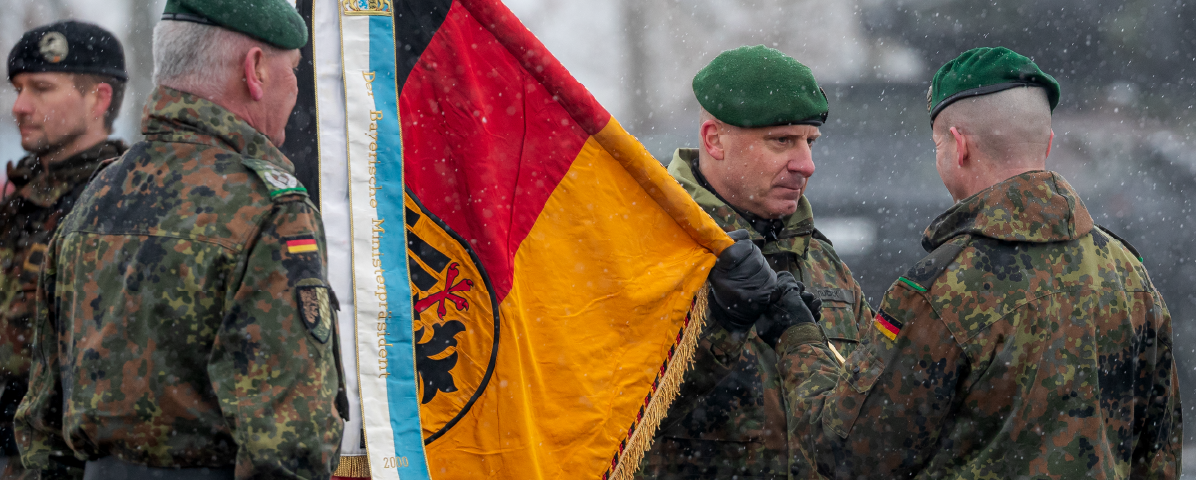
Featured image: Bundeswehr/Marco Dorow
This report is part of an ongoing series on transatlantic relations created in partnership with Konrad Adenauer Stiftung USA.
[1] Federal Ministry of Defence, “The overall concept of military defence: Military Strategy and Plan for the Armed Forces,” 2026, https://www.bmvg.de/resource/blob/6093998/678875025812878cfa657f9801f62ffc/dl-gesamtkonzeption-der-verteidigung-eng-data.pdf.
[2] Simon Bulmer and William E. Patterson, “Germany as the EU’s reluctant hegemon? Of economic strength and political constraints,” Journal of European Public Policy 20/10, August 2013, https://www.tandfonline.com/doi/full/10.1080/13501763.2013.822824.
[3] Federal Government, “White Paper on German Security Policy and the Future of the Bundeswehr,” 2016, https://www.bundeswehr.de/resource/blob/4800140/fe103a80d8576b2cd7a135a5a8a86dde/download-white-paper-2016-data.pdf.
[4] Federal Government, “Policy statement by Olaf Scholz, Chancellor of the Federal Republic of Germany and Member of the German Bundestag, 27 February 2022 in Berlin,” February 27, 2022, https://www.bundesregierung.de/breg-en/service/archive/policy-statement-by-olaf-scholz-chancellor-of-the-federal-republic-of-germany-and-member-of-the-german-bundestag-27-february-2022-in-berlin-2008378.
[5] Federal Ministry of Defence, “National Security Strategy,” 2022, https://www.bmvg.de/en/national-security-policy.
[6] Roderich Kiesewetter, “A Claim to Lead, a Hesitation to Act: Germany’s New Military Strategy,” War on the Rocks, June 23, 2026, https://warontherocks.com/a-claim-to-lead-a-hesitation-to-act-germanys-new-military-strategy/.
[7] Das Bundesarchiv, “Die Weißbücher der Bundesregierung,” https://www.bundesarchiv.de/staat-militaer-und-gesellschaft/streitkraefte-demokratie-rechtsstaat/die-weissbuecher-der-bundesregierung/.
[8] Nette Nöstlinger, “Germany’s Merz vows to build Europe’s strongest army,” Politico, May 14, 2025, https://www.politico.eu/article/friedrich-merz-germany-bundestag-europe-conventional-army/.
[9] Christian Mölling, “Germany’s first Military Strategy: progress, not a breakthrough,” LinkedIn, April 22, 2026, https://www.linkedin.com/pulse/germanys-first-military-strategy-progress-christian-m%C3%B6lling-fyvxf/.
[10] Roderich Kiesewetter, “A Claim to Lead, a Hesitation to Act.”
[11] Chris Lunday, “Less America, more Europe in Germany’s new military strategy,” Politico, April 22, 2026, https://www.politico.eu/article/germany-military-strategy-bundeswehr-boris-pistorius/.
[12] Grégoire Roos, “Germany rearms – but can it lead? Europe’s hesitant superpower in waiting,” Chatham House, May 1, 2026, https://www.chathamhouse.org/2026/05/germany-rearms-can-it-lead-europes-hesitant-superpower-waiting.
[13] Liana Fix, “Europe’s Next Hegemon,” Foreign Affairs, March/April 2026, https://www.foreignaffairs.com/germany/europes-next-hegemon-liana-fix.
[14] Federal Government, “Speech by the Federal Chancellor at the Munich Security Conference on 13 February 2026 in Munich,” February 13, 2026, https://www.bundesregierung.de/breg-en/federal-government/speech-munich-security-conference-2407298.
[15] “Why France is uneasy about German rearmament,” The Economist, June 3, 2026, https://www.economist.com/europe/2026/06/03/why-france-is-uneasy-about-german-rearmament.
[16] Roderich Kiesewetter, “A Claim to Lead, a Hesitation to Act.”
[17] Guntram B. Wolff, “German rearmament under the spotlight,” Bruegel, June 3, 2026, https://www.bruegel.org/first-glance/german-rearmament-under-spotlight.
[18] Dorota Vandakova, “Germany’s New Army: Ready for War, or Just Ready to Spend?,” Bloomsbury Intelligence & Security Institute, May 18, 2026, https://bisi.org.uk/reports/germanys-new-army-ready-for-war-or-just-ready-to-spend.
[19] Arthur Galbraith, “General Breuer erklärt die Strategische Ausrichtung der Bundeswehr,” Bundeswehr, April 22, 2026, https://www.bundeswehr.de/de/meldungen/nachgefragt-strategische-ausrichtung-6093202.