 A Nation Must Think Before it Acts
How War in Iran is Impacting the Baltic States
A Nation Must Think Before it Acts
How War in Iran is Impacting the Baltic States

A nation must think before it acts.

How War in Iran is Impacting the Baltic States
Each month, Dr. Indra Ekmanis writes a monthly roundup highlighting major political, cultural, and economic events in Estonia, Latvia, and Lithuania. Her commentary on the Baltic response to war in Iran is featured below, originally published in the March Baltic Roundup on Substack.
The rippling impacts of the US-Israeli war on Iran have quickly spanned the globe, and the Baltic countries are no exception. Most immediately, thousands of Baltic nationals were in the region when attacks began, necessitating quickly organized repatriation flights as Iran retaliated on civilian infrastructure in the Gulf states. A complex housing the Estonian Embassy in Abu Dhabi was among the high-rises struck.
Like the rest of the world, erratic prices have been the most tangible impact of the war locally as energy infrastructure has been damaged and Iran has effectively blockaded the Strait of Hormuz. While little Baltic supply runs through the strait and Lithuania’s liquefied natural gas (LNG) terminal is primarily served by the US, the global market still affects Baltics. Diesel fuel hit record highs, up between 30% and 43% since February. In Latvia, the Saeima approved a 15.2% reduction on the diesel fuel excise tax for the next three months in response, and all three countries are also prepared to release oil reserves to the market.
More existential consequences of the conflict also loom over the Baltic countries, which have tread a careful line in words and action in response to US-Israeli strikes. Maintaining a strong relationship with the United States remains paramount as they weigh their own security considerations and seek to keep international attention on Russia’s war in Ukraine.
Following the launch of Operation Epic Fury on February 28, the leadership of each Baltic country issued statements condemning the repressive Iranian regime and retaliatory attacks on Gulf states, while carefully sidestepping the potential violation of international law on the part of Israel and the US. Presidents Gitanas Nausėda (Lithuania) and Edgars Rinkēvičs (Latvia) called the US-Israeli attacks “understandable,” while Prime Minister Kristen Michal said Estonia’s position was clear in support of “the steps taken to reduce the threat” from the Iranian regime. Foreign ministers Margus Tsahkna (Estonia), Baiba Braže (Latvia), and Kęstutis Budrys (Lithuania) underscored the death of Ayatollah Ali Khamenei as an opportunity for the Iranian people to determine their own path forward.
Baltic representatives have pointed to the link between Tehran and Moscow, strategically emphasizing Iran’s role in supporting the Kremlin’s war of aggression, including supplying Russia with more than 50,000 Shahed-type drones that have killed thousands of civilians. While the degradation of the partnership between Moscow and Tehran is celebrated in the Baltic states, there is concern that Russia has, at least in the short term, benefited from the conflict with Iran. Surging energy prices and loosened sanctions have infused the Russian economy at a moment of great instability, and American-manufactured weapons potentially bound for Ukraine could be diverted to the Middle East. At the same time, Ukrainian attacks on Russian oil infrastructure have also limited Russia’s export capacity.
Though he made no attempt to assemble a “coalition of the willing” in advance of the operations, President Donald Trump chastised NATO allies for not joining the conflict, warning of a “very bad” future for the alliance if they did not heed his call to open the Strait of Hormuz and ease the blockade of energy, food, and fertilizer. Collectively, Europeans have drawn out their response, rejecting, for example, an option to change the mandate of Operation ASPIDES, which secures shipping through the Red Sea, and distancing themselves from the direct conflict. “This is not Europe’s war,” said EU chief diplomat and former Estonian Prime Minister Kaja Kallas on March 16, “nobody wants to go actively in this war. And of course, everybody is concerned what will be the outcome.”
Europeans are unwilling to make themselves direct targets of the Iranian regime — and a mercurial Trump may not even remember Europe’s support were it forthcoming: “They understand that any contribution they make will count for nothing,” argues historian Anne Applebaum in The Atlantic. But as small member states on NATO’s frontline with Russia, the Baltic countries do not have such a straightforward calculus available to them individually.
None of the Baltic countries has, as of this writing, received a direct request for assistance from the Trump administration. If one were to come, each has signaled they would take the request seriously. Nausėda noted that Lithuania cannot expect the US to send troops to Lithuania if it refuses to contribute to their missions. In Latvia, the Greens and Farmers Union (ZZS), a coalition partner, has urged Defense Minister Andris Sprūds to clearly articulate Latvia’s position in support of US operations, also noting the US’ role as the country’s largest strategic partner and Europe’s security guarantor. In Estonia, 30 members of parliamentary friendship groups signed on to a joint statement backing the US and Israel’s actions against the Iranian regime, though three MPs withdrew their signatures, uncomfortable with the “unequivocal support.” Estonian Defense Minister Hanno Pevkur has floated the idea of offering Estonia’s demining expertise in the Strait of Hormuz.
Maintaining the Baltics’ “model ally” status has been paramount in diplomatic strategy during Trump’s second term, but it is not unique to the Baltic states’ relationship with the current administration. Baltic leadership also backed the ill-fated US-led wars in Afghanistan and Iraq, bucking anti-war European powers and domestic opposition to curry favor with the US as they worked their way toward NATO membership. Then — particularly in the case of Iraq, an unpopular war with questionable legitimacy — justification was focused on “rhetoric about the need to disarm dangerous despots” and “democracy promotion,” observes Andris Banka.
Similar refrains echo from officials now, despite concerns that Washington may not be listening that closely, and as discomfort grows around a trend of powerful states, friends or not, exercising their will against smaller adversaries with little regard for international norms and laws. But for the moment, more concerning from the Baltic standpoint is Moscow picking up on discord among allies. NATO must not allow cracks in the alliance to advantage Russia, stressed Pevkur: “This is the time to build bridges, and we cannot lose our unity.”

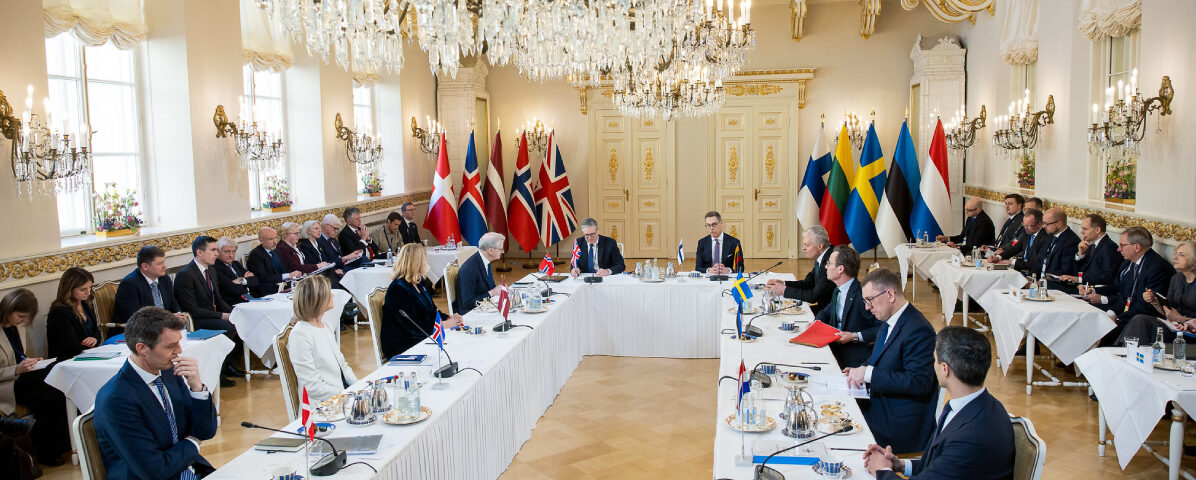
Image: The Joint Expeditionary Force (JEF) member countries convened in Helsinki for a March 26 summit. (Flickr | TPKanslia)