 A Nation Must Think Before it Acts
Four Years of War in Ukraine and Baltic Solidarity
A Nation Must Think Before it Acts
Four Years of War in Ukraine and Baltic Solidarity

A nation must think before it acts.

Four Years of War in Ukraine and Baltic Solidarity
Each month, Dr. Indra Ekmanis writes a monthly roundup highlighting major political, cultural, and economic events in Estonia, Latvia, and Lithuania. Her commentary on the Baltic response to Russia’s war in Ukraine is featured below, originally featured in the February Baltic Roundup on Substack.
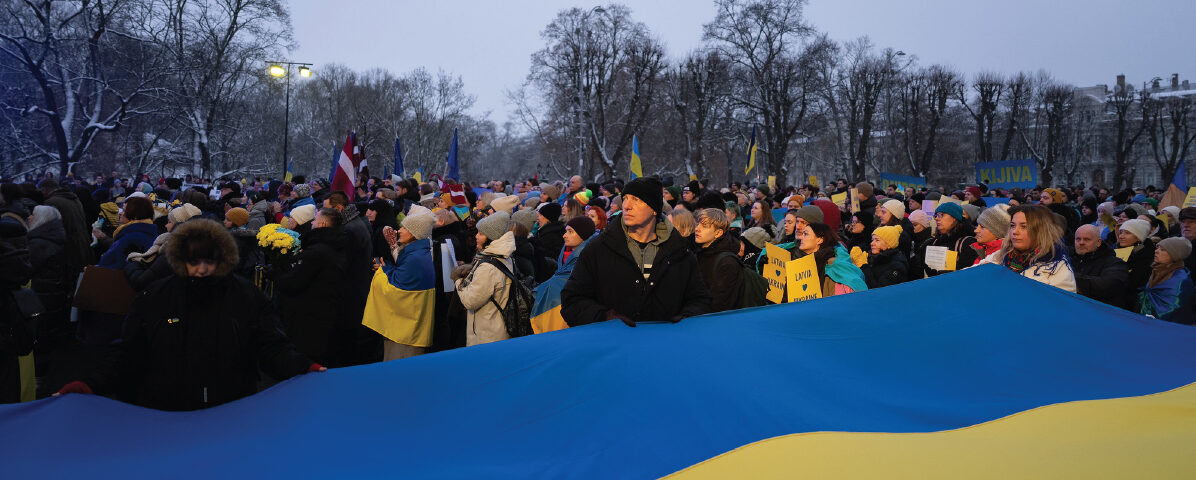
For decades, February 24 has been celebrated in the Baltic states as Estonia’s Independence Day. Since 2022, it has also somberly marked the anniversary of Russia’s full-scale invasion of Ukraine. Four years on, here is a brief reflection of how the security and social landscape has changed in the region since Russia initiated the largest conventional war in Europe since World War II.
Just days before February 24, 2022, there were palpable doubts that the troop buildup on Ukraine’s borders would erupt into conflict. When it did, many assumed that Kyiv would fall to Russian forces within days and that Ukrainian President Volodymyr Zelensky would accept offers to flee westward. Instead, his iconic response foreshadowed the years of determination of his countrymen: “I need ammunition, not a ride.”
The war prompted Baltic governments to invest rapidly and extensively in their own defense and urged NATO partners to do the same. Domestically, they examined their countries’ relationship with Soviet history and, more broadly, Russian culture, prompting a “decolonizing moment of sorts.” De-Sovietization projects, implemented quickly with little debate, included tearing down monuments and rechristening streets named for Russian cultural figures. Independent Russian media, which had found a haven in the Baltic countries, was caught up in debates about national security and lingering imperialism. Russian passport holders faced new hurdles in extending their permanent residence permits, while education policies shifted toward national language requirements. The escalated securitization also highlighted the fragmentation of the large Russian-speaking minorities in Estonia and Latvia, as individuals navigated their stance on the war and position in Baltic society.
Four years on, the Baltic states remain among the top four countries providing government support to Ukraine by GDP. While some fatigue has set in, support for the Ukrainian cause continues to come from all levels of society — from raising millions for advanced battlefield technologies, to extending support for war refugees, to policy shifts aimed at cutting off lingering economic and energy ties with Russia.
Days ago at the UN General Assembly, Latvia’s Foreign Minister Baiba Braže outlined, point by point, Russia’s actions that match the definitions of Article II of the Genocide Convention, including the removal and reeducation of children, intentional bombings of maternity wards, and the overarching devastation under tens of thousands of missile and drone attacks on people and infrastructure.
The war is grinding. The cost — in both human and material terms — has been astounding. Russia has control of some 20% of Ukrainian land, but is facing a stagnating economy and astonishingly high casualties. Ukrainian civilians have come under constant bombardment, including devastating hits to energy infrastructure during a record-cold winter, as its troops defy odds on the frontlines. Reconstruction needs are estimated at $588 billion to date.
For these past four years, Ukrainians have been heaped with international praise for their resilience, but this intended compliment has lost its sheen. The people of Ukraine have been heroic, undoubtedly, but they have been asked to endure too much with too little for too long.
The coverage of the first months of war shocked onlookers: The painted nails of a woman massacred by Russian soldiers in Bucha. The expectant mother carried out on a stretcher, killed by Russia’s attack on Mariupol’s maternity ward. The Russian bombing of a theater clearly marked “дети” — “children.” These are indelible images that appalled the world four years ago and still roil the stomach. And Russia continues to inflict new scenes of destruction across Ukraine on a daily basis.
As the conflict enters its fifth year, splits are emerging on how to push the war closer to a just conclusion, including how to ensure a European seat at the table in negotiations that have been dominated by the mercurial posturing of the US under Donald Trump, the significant reduction of US aid, and the overall American retreat from global leadership.
Though small individually, the Baltic countries continue to leverage their collective power in support of Ukraine, united in their moral clarity. Lithuania and Estonia commemorate their 1918 statehoods each February, with full recognition of how fragile that sovereignty is in the face of aggressive neighbors. The Baltic countries are well aware that Ukraine’s fight is more than just Ukraine’s to bear alone.

Image: Supporters gathered at Latvia’s Freedom Monument to commemorate the fourth anniversary of Russia’s full-scale invasion of Ukraine. (Flickr | Latvian Foreign Ministry)
