 A Nation Must Think Before it Acts
FPRI Experts React | The Trump-Xi Summit
A Nation Must Think Before it Acts
FPRI Experts React | The Trump-Xi Summit

A nation must think before it acts.
FPRI Experts React | The Trump-Xi Summit
The much-anticipated summit meeting in Washington between American President Donald Trump and Chinese President Xi Jinping masked any tensions that the two biggest powers of the world have. Both leaders were eager to portray confidence to their respective domestic audiences as much as to the world at large, seeking to project their presence as global statesmen. From a diplomatic perspective, both the United States and China could claim victory.
Their meeting has not, however, led to greater clarity regarding the future of US-China relations. Uncertainties over trade relations and artificial intelligence (AI) development remain, while China’s chokehold over critical minerals will continue to rattle not just the United States but the world at large. There are also no signs of Beijing backing down from its strategy of subsidizing overcapacity, which has distorted market mechanisms across the globe. Meanwhile, the status of Taiwan remains a source of tension and potential conflict between the two countries.
While China’s growth trajectory clearly shows signs of fragility, its position as the world’s second-largest economy remains unshaken. It also remains the military as well as the economic hegemon of the Indo-Pacific. At the same time, Beijing’s efforts to project itself as the predictable, reliable partner continue. The latest bilateral summit between the United States and China has only made clear that sources of tensions will persist and will continue to have repercussions far beyond the borders of both countries.
What the Trump-Xi Summit Means for Asia
Jessica C. Liao
When summit pageantry eclipses strategic reality, diplomacy often operates as a holding action rather than a genuine breakthrough. The latest Trump-Xi summit provided a case in performative stabilization. Despite the absence of a formal joint communique or detailed official readouts, both leaders deliberately projected bilateral warmth and goodwill. Xi, in particular, utilized the White House stage to articulate an expansive framework of “constructive strategic stability.” Positioning Beijing and Washington as necessary stewards of global policy, Xi noted that while bilateral cooperation “may not solve every problem in the world . . . without our cooperation, it would be hard to solve many of the world’s problems.” By characterizing great power rivalry not as a zero-sum collision but as “a race of catching up with one another, not a wrestle,” Xi underscored regular military dialogues, artificial intelligence governance, and crisis prevention mechanisms to argue that “the Thucydides Trap can be overcome.”
For the Indo-Pacific, this high-level summitry delivers an immediate, palpable relief valve. In the short term, the bilateral pause dampens acute macroeconomic shocks while cushioning vulnerable cross-border supply chains and mitigating regional anxiety over miscalculation. Confidence in near-term deconfliction had already received a tactical boost from rare theater-level engagements prior to the summit, notably between US Pacific Command Chief Adm. Samuel Paparo and his counterparts of the People’s Liberation Army. Yet beneath these high-level events lies an uncertain regional horizon. The great power cooperation at the operational level remains fragile and ill defined, leaving the foundational flashpoints of the Asian security architecture, from gray zone coercion across the Taiwan Strait to volatile maritime standoffs in the East and South China seas, fundamentally unresolved.
Importantly, this diplomatic thaw may serve Beijing’s calculated regional playbook. For Chinese leadership, bilateral stabilization is an active instrument of statecraft designed to secure the strategic bandwidth necessary to advance long-term objectives. Under Xi, Beijing’s overarching goal has consistently centered on consolidating an uncontested regional sphere of influence and establishing China as the preeminent power in Asia. By anchoring Washington in a personalized, cooperative dialogue, Beijing deliberately cultivates operational latitude along its maritime periphery. This diplomatic maneuvering allows Beijing to steadily normalize its expanding military footprint—from long-range intercontinental ballistic missile trajectory tests into the Pacific to intensified coast guard presence in its near waters—while minimizing the risk of immediate, coordinated friction with the United States.
Beijing’s embrace of this temporary truce reflects pragmatic calculation rather than genuine confidence in lasting stability. Well aware of the unpredictability of US foreign policy, Chinese strategic and military circles continue to define the bilateral dynamic as entering a protracted “strategic stalemate” (战略相持). Within this framework of strategic endurance, Beijing deploys top-level diplomacy not to achieve true accommodation, but to insulate itself against external containment measures, discourage regional partners from collective balancing, and safeguard its domestic development trajectory. Essentially, by leveraging the optics of stabilization to manage Washington while operationally entrenching its regional reach, Beijing continues to advance its core objective of steadily shaping Asia into a Sino-centric order.
Beyond the AI Race: China’s Play to Set the World’s Values
Shihoko Goto
Ahead of his meeting with Xi Jinping, President Trump made clear not only that the development of AI would remain a driving force for US economic growth, but also that the United States continues to win against China in the race to develop it. China is undoubtedly the only significant US competitor in developing AI technologies, but the gap between the two countries is clearly narrowing. The challenge, however, is not simply about the possibility of China overtaking the United States, but there are broader concerns worldwide about controlling, rather than simply harnessing, the power of AI.
At the summit, Xi’s public position was to promote closer cooperation between the two countries to ensure that AI would be a technology that would benefit humanity. He stated that China and the United States both have “the capability and responsibility to develop and manage AI for good and to ensure that a development of AI is always under human control and serves the wellbeing of the people.” Trump, on the other hand, has been less forthcoming on the prospect for coordination between the two sides, focusing instead on the economic competition as well as the national security concerns posed by AI.
Certainly, AI’s economic prospects and US business opportunities in AI were made clear at the White House state dinner, which included tech titans such as Elon Musk, Jensen Huang, Sam Altman, and Mark Zuckerberg.
But just as continued US supremacy in AI cannot be assumed, neither can the possibility of coordination between the United States and China, given the divergent goals of the two sides. For the Chinese authorities, AI is to be harnessed as a tool to protect the Chinese Communist Party rather than its people at large. That contrasts with the goals of US developers, who are focused on protecting social cohesion. That perspective has been most articulated not by US government officials, but rather by Anthropic’s chief executive officer Dario Amodei, who was notably absent from the state dinner.
Moreover, the proliferation of a Chinese AI model gives Beijing a previously unimaginable opportunity to export its value system to the world at large, as it increases global dependency, especially in the Global South, on Chinese AI and tech infrastructure. The United States and China will remain competitors in the AI race, but for China, its playbook will remain to undercut costs by the opposition and flood markets even at a loss as it has done in other sectors, including green technology. China’s AI goal will also include diffusing its own value sets through the technology and to make its world view the global orthodoxy. Cooperation between Beijing and Washington on AI governance is unlikely to make a breakthrough even in subsequent summits.
Taiwan’s Dilemma Continues
Jacques DeLisle
No news was the best news Taiwan could have hoped for from the Xi-Trump meeting in Washington. Measured against those low expectations, and assuming that the public record does not omit significant developments, Taiwan fared fairly well.
To be sure, China did press the Taiwan issue unilaterally. In closed-door meetings, Xi reportedly urged Trump to adopt the “correct” position of opposing Taiwan independence. That the summit did not produce worse results is no more than cold comfort for Taiwan. China’s reiteration of assertive positions threatens to further chip away at Taiwan’s chronically precarious international stature, as the sharp pushback from Taiwan’s Ministry of Foreign Affairs in response to China’s readout of the summit reflects. The vibe of Trump’s solicitousness toward Xi could hardly be reassuring to Taiwan.
The specter that the Trump administration will remain, or become more, accommodating toward Beijing, including through further delay of arms sales, is still more problematic for Taiwan in the politically charged context of the approaching November elections for local offices in Taiwan, which will set the stage for 2028 presidential and legislative elections. The reliability of US support is already a divisive political question in Taiwan, all the more so after Kuomintang chair Cheng Li-wun’s mid-year visits to Beijing and Washington exacerbated polarizing debates in Taiwan about whether the ruling Democratic Progressive Party was naïve about the United States and recklessly confrontational toward China or the opposition Kuomintang was feckless or treacherous in being so eager to engage with Beijing.
But the more fundamental, and mostly adverse, significance of the summit for Taiwan lay not in what was done or not done or in what it portended about near-term policy decisions or political advantage. Rather, the summit underscored the growing difficulties Taiwan faces in pursuing, or adapting, its strategy for international space and security. For decades, Taiwan has played the values card with the United States, attracting support and enhancing security through its shared commitment to democratic values and international norms. But that has not worked to Taipei’s advantage under the Trump administration.
The summit also confirmed some of the troubles facing Taiwan’s economic interests and its position in the global technology landscape. Trump’s eagerness for continuing the trade truce and maintaining stability in the US-China economic relationship to avoid further damage to the US economy can strain Taiwan’s own growth prospects. Persisting US reluctance to restrict the chip exports to China that boost the profits of key US tech companies seemed to signal a presidential perspective that discounted more nuanced Taiwanese arguments resting on longer-term shared interests in collaboration in tech sectors and beyond. Those arguments have already faced the headwinds of Trump’s complaints about Taiwan’s theft of the US chip industry and bilateral trade deficits, which have been growing amid the AI chip boom.
Faced with these mounting and summit-confirmed challenges, Taiwan increasingly has turned to arguing that support for Taiwan is in the United States’ security interests. Having to lean so heavily on one among what had been several bases for support is a loss for Taiwan.
Foreshadowing Washington’s Indecisive Decade in Asia
Chris Estep
With trade and technology issues dominating headlines ahead of the meetings, expectations for major defense announcements had been muted, and Trump and Xi seem to have done very little to defy them. The possibility of four meetings between the two leaders this year might be statistically interesting, but the results have been substantively inconclusive so far.
On Taiwan, the official Chinese readout on Thursday claimed that Xi pressed for the US government to revise parts of its longstanding stated policy. When the two leaders met in Beijing in May, the readout from the Chinese side was even more forceful, warning that a failure to manage cross-Strait stability on Xi’s terms would risk “clashes and even conflicts.” Whatever Beijing’s official tone, its historic military buildup and persistent pressure campaign across the Strait reveal even more about its ambitions.
For its part, the US government’s official readout from the meeting will likely not mention Taiwan at all, compounding a missed opportunity to have done so in May as well. More substantively, the Trump administration will probably still delay the release of a $14 billion arms sale to Taipei, which Trump has described as a “negotiating chip” in the US-China bilateral relationship, even though leading Republican lawmakers called this week for approval of the package.
More broadly, this week’s events provide an opportunity to take stock of where US defense strategy in Asia might be leading amid policy discontinuity in Washington, political change across the United States, and evolving perceptions among regional partners. The facts speak for themselves.
The White House is poised for more presidential transitions in the 2020s than in any decade since the 1960s—and potentially more changes in party control than at any point in the last 130 years. Meanwhile, the Pew Research Center recently found that many Americans’ views of China may be warming after a period of stronger disapproval in the early 2020s (though most survey respondents still view Beijing at least somewhat unfavorably even today). Elsewhere, among key US allies and partners in Asia, Pew found that public attitudes toward the United States are at their least favorable in years.
The potential consequences for American security and prosperity could not be more profound. The United States presently risks ending the 2020s in a less advantageous position in Asia than when the decade began: with a much stronger and more assertive Beijing, with regional alliances and partnerships overdue for reinvention, and with Washington’s policy apparatus in a near-constant state of limbo. The good news is that this future is not entirely guaranteed as of yet.
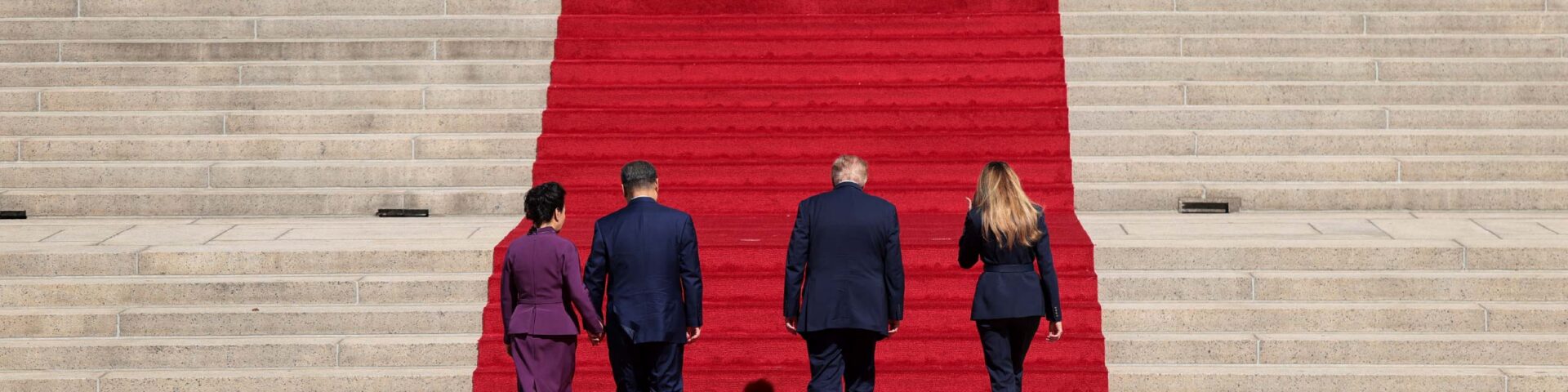
Featured Image: US President Donald Trump and First Lady Melania Trump, Chinese President Xi Jinping and his wife Peng Liyuan arrive at the National Archives Museum in Washington, D.C., US, September 25, 2026. REUTERS/Kylie Cooper