 A Nation Must Think Before it Acts
How UK Foreign Policy Is Changing Under Andy Burnham
A Nation Must Think Before it Acts
How UK Foreign Policy Is Changing Under Andy Burnham

A nation must think before it acts.
How UK Foreign Policy Is Changing Under Andy Burnham
Bottom Line
-
UK sanctions against Israeli settlements reflect an emerging “Burnham doctrine” that seeks to balance British interests and values, and build new coalitions of middle powers while keeping the United States on board
-
Burnham’s pragmatic transatlanticism differs from Canadian Prime Minister Mark Carney’s truth-telling about Washington
-
The Burnham doctrine faces real tensions, such as funding defense without gutting social spending and building coalitions that don’t trigger conflict with Washington
Last week, the Andy Burnham government in the United Kingdom announced sanctions on Israeli settlements in the West Bank, in coordination with Canada and 10 European countries. Although Burnham has only been prime minister since July, he broke with years of cautious UK foreign policy toward Israel. The sanctions reflect an emerging “Burnham doctrine” based on marrying hard power with British values, creating coalitions of middle powers, keeping the United States on board, and viewing domestic policy and foreign policy as intrinsically linked. Burnham, the so-called “King of the North,” who made his name in local politics, may end up as a foreign policy leader.
The Coronation
In the spring of 2026, Prime Minister and Labour Party leader Keir Starmer enjoyed a large parliamentary majority but faced a stuttering economy, sinking poll numbers, and talk of rebellion from members of Parliament. Labour MPs saw Andy Burnham, the popular mayor of Greater Manchester, as the great hope. When a Labour MP resigned in May, Burnham won the vacant seat in a June 18 by-election, beating the populist right Reform Party candidate. Within weeks, Starmer resigned, and Labour MPs elevated Burnham to Number 10, despite him never having won a national election.
One of Burnham’s first tasks in office was to write four identical handwritten letters known as the “Letters of Last Resort.” They were placed in safes inside the country’s nuclear-armed submarines and contained instructions for what to do if the leadership in London were annihilated in a nuclear strike—including whether to retaliate with nuclear weapons. For Burnham, it must have been a sobering reminder of the responsibility of leadership in the nuclear age.
What can we expect from the new prime minister? Is there a Burnham doctrine—or an individual set of foreign policy views that will shape UK foreign policy? At first glance, we might dismiss the idea of a Burnham doctrine because UK foreign policy is driven more by structural forces than the personal beliefs of the prime minister. The notion of a “doctrine” implies a degree of strategic autonomy and the ability to choose differently. We often apply the term to US presidents—a Biden doctrine, a Trump doctrine, and so on—because America’s expansive power means that US leaders can imprint their will on global politics, for better or worse. But the leaders of middle powers enjoy a more limited menu of options.
London is hobbled by some particularly stark constraints. The 2008 financial crisis hit the UK economy badly, and the country has suffered nearly two decades of low growth and high borrowing. The government can seem to be at the mercy of faceless bond investors—who brought down Liz Truss as Conservative prime minister in 2022, after her plan to cut taxes was viewed as reckless by the markets. London is keenly aware of the United Kingdom’s lack of tech giants and its dependence on US corporations for AI and other capabilities. Meanwhile, Donald Trump’s criticism of allies, including Britain, is a seismic shock for a country that relies on the “special relationship” with the United States as a keystone of its foreign policy.
The United Kingdom also faces multiple interacting crises. Brexit has overshadowed UK politics ever since the referendum to leave the European Union in 2016. Burnham is now the seventh prime minister in a decade to handle the messy divorce. Most British people regard Brexit as a mistake, and yet the champions of Brexit—the Reform Party—also lead in many polls.
The most salient threat is Russia. Indeed, London is locked in a virtual Cold War with Moscow. Following Vladimir Putin’s invasion of Ukraine in 2022, the UK became one of Ukraine’s strongest partners, and Russia’s bête noir. Moscow has been linked to assassination plots on British soil, arson attacks on Starmer’s home, explosives planted on cargo planes, sabotage of undersea cables, and cyberattacks. In July, a Russian warship carried out live fire exercises off the British coast. For Number 10, a host of other perils loom: growing Chinese power and assertiveness, the conflict in Gaza, and the climate crisis.
Another reason for skepticism about Burnham’s capacity to seize the diplomatic reins is that he is not really a foreign policy guy. Most of his experience is in domestic politics. He was first elected as an MP in 2001 and served in the New Labour governments of Tony Blair and Gordon Brown, including as health secretary. As mayor of Greater Manchester, he worked on everyday problems like buses and housing. As prime minister, he promised to restore some services to national control, expand social care for the elderly, and devolve power away from London to the regions by creating a “No. 10 North” in Manchester.
It’s no surprise that, in several respects, Burnham’s foreign policy has followed in the footsteps of Starmer. Burnham kept Jonathan Powell as national security advisor. To appease the markets, Burnham pledged fiscal discipline. He has not said much about UK policy toward China. He continued Starmer’s strong support for Ukraine. On his first foreign trip, Burnham lauded Ukraine’s resistance to Russia as reminiscent of the British fight against Nazi Germany: “My nation kept the flame of European freedom alive in the 20th century, you hold that flame in the 21st.”The United Kingdom and Ukraine signed an “AI Partnership” that gave London access to battlefield data to train AI models. The UK Chancellor John Healey described the new administration as a “continuity” government with a change of leader.
Sovereign Capabilities
The Burnham ascendence, however, does matter for UK foreign policy. Indeed, foreign policy could end up being a vital part of his premiership. For one thing, the leaders of middle powers—or even weaker powers—can make a big difference if they choose wisely from the available menu. For example, Singapore’s leader Lee Kuan Yew transformed his country’s international standing. British prime ministers sometimes claim their own doctrine. In 1999, Tony Blair outlined a doctrine of humanitarian interventionism.
Compared to Starmer, Burnham brings a different style to the office of prime minister. He is a natural communicator, and his northern accent is noticeable. More substantively, Burnham also has distinctive foreign policy views.
The first principle in the Burnham doctrine is a desire to balance interests and values. Of course, this is a classic dilemma of statecraft. But Burnham seems both eager to do right, and clear-eyed about the shadows that complicate an ethical path. In an op-ed in The Times in June, written during his leadership campaign, Burnham presented a somber vision of global threats and the need to boost military strength. As the title put it: “We must rebuild Britain’s hard power to face a darker world.” He promised to invest in the United Kingdom’s armed forces as well as its “sovereign capabilities,” from shipbuilding to AI, and he sought a closer relationship with European countries on national security. Still, he said that the United Kingdom would be “guided by our values,” including support for international law and the United Nations.
The second principle is Burnham’s commitment to the traditional pillars of UK national security: NATO, the nuclear deterrent, and the alliance with the United States. Here, there’s an important contrast with what we might term the “Carney doctrine,” or the thinking of Canadian prime minister Mark Carney. At first blush, Burnham and Carney are natural partners. They are both center-left leaders of middle powers (although Burnham sits further to the left and is more critical of “neoliberalism”). Carney used to be the governor of the Bank of England. Both men agree on many issues like Ukraine. Both of them claim to be practical and clear-eyed. Carney quotes Thucydides and endorses what he calls “value-based realism”—a framework borrowed from Finnish President Alexander Stubb. Burnham talks about hard power in an age of threats. They even both support the same English soccer team—Everton.
But the Burnham doctrine is distinct from the Carney doctrine, especially in terms of relations with the United States. In early 2026, Carney gave a landmark speech at Davos that described a rupture of the rules-based order, and promised that middle powers like Canada would build a new order, “something bigger, better, stronger, more just.” Carney called for “the end of a pleasant fiction and the beginning of a harsh reality.” He warned against the collapse of global norms, with the United States as an implicit target: “great powers have begun using economic integration as weapons, tariffs as leverage, financial infrastructure as coercion, supply chains as vulnerabilities to be exploited.” Middle powers must hedge against dependence—including on the United States.
Burnham is keen to work multilaterally and build coalitions of like-minded middle powers. He also worries about US reliability and disagrees with Washington on issues like the Iran conflict, where Britain has declined to join the US-Israeli war effort. But Burnham sees Washington as “our most important defense and security ally.” He aims to create energized coalitions of middle powers without causing a rift with the United States: achieving Carney’s ends through Burnham’s means.
The third principle of Burnham’s thinking is a pro-European outlook. In 2025, Burnham said that he hoped to see the UK return to the European Union in his lifetime. But he will tread carefully on the issue. As Matthias Matthijs and Benjamin Harris from the Council on Foreign Relations put it: “Burnham is personally the most pro-European prime minister since Blair but will likely talk about Europe less than Keir Starmer did.” Burnham said that he did not advocate rejoining the EU in the short run and that he respected the “red lines” of no single market, no customs union, and no free movement. Still, in the coming months, we may see a closer UK-EU relationship on security issues; for example, enabling UK involvement in SAFE (Security Action for Europe), the €150 billion defense fund, as well as pragmatic efforts to improve economic ties by easing border checks.
The fourth principle of the Burnham doctrine is the interwoven nature of domestic and foreign policy. In his mind, national security and domestic inequality are not competing issues. Rather, defense spending will spur a new era of reindustrialization and create jobs in left-behind communities. As he explained in the Times op-ed: “I see our strength at home and our strength in the world as indivisible … foreign policy, economic policy, security, social cohesion and British values as inextricably linked elements of the same strategic question.”
These themes played out in Burnham’s Cabinet picks. Several of Starmer’s key allies, like the former Chancellor Rachel Reeves, left the government. Meanwhile, in a surprise move, Burnham picked Healey as chancellor. Earlier this summer, Healey resigned as defense secretary under Starmer because the prime minister would not commit to spending 3 percent of GDP on defense by 2030 (as a step toward meeting an official NATO target of 3.5 percent on defense by 2035). Healey’s swift return to government suggests that Burnham is serious about boosting the United Kingdom’s hard power. Meanwhile, Wes Streeting, a moderate, moved to the Ministry of Defence, whereas Ed Miliband, a left-leaning champion of tackling climate change, became foreign secretary—balancing the wings of the Labour Party.
The decision to impose sanctions on Israeli settlements embodies the Burnham doctrine. The move is a big shift from London’s traditional bland statements of concern about settlement expansion. Number 10 claimed that the sanctions were directed at the Israeli government, not the Israeli people, and aimed to push back on violence by settlers and keep alive the prospects for a two-state solution.
Burnham described the move as a way to advance British values: “It is more important than ever that Britain stands for something.” His administration is the first UK government to describe Israeli actions in the West Bank as “ethnic cleansing.” But British moralism is tempered by realism. The sanctions are likely to have only a minimal material impact and could be largely symbolic. They only apply to West Bank settlements and may be easily evaded.
The sanctions coalition exemplifies the Carney model of middle powers banding together. London issued a joint statement with Canada and 10 other European countries that will either introduce, or are actively considering, sanctions against Israeli settlements. Crucially, however, London created this coalition without antagonizing the United States. President Donald Trump and Secretary of State Marco Rubio declined to criticize the sanctions decision—reflecting their own frustrations at the Israeli government. UK officials worked behind the scenes to mobilize the partnership and keep the United States informed of the plans ahead of time.
The sanctions decision also reveals how foreign policy is interconnected with domestic politics. The Burnham administration insists that the sanctions are purely about advancing national values and interests. Still, Burnham is surely keenly aware of the need to consolidate the left-wing vote and beat off the challenge from the Green Party—especially with an upcoming by-election in October to find a replacement in Parliament for Starmer, where Green Party leader Zack Polanski is the main challenger. One poll found that 52 percent of British people approved of the sanctions whereas just 17 percent disapproved, with the strongest support among Green Party voters.
Liberal Dilemmas
The Burnham doctrine is likely to face stiff challenges at home and abroad. Like many politicians, Burnham prefers to dodge difficult trade-offs and promise a “win-win”: investment in defense will reduce inequality and level-up Britain. But, given budget deficits, more money for defense means less money for social spending. As chancellor, Healey has already shelved the target of spending 3 percent of GDP on defense by 2030—even though he saw this as a resignation issue earlier this summer.
And autonomy is both inefficient and expensive. It means developing major capabilities at home—including the ones that Britain is not very good at—rather than focusing on areas of comparative advantage. Here, again, there’s a difference between Burnham and Carney. Burnham championed “boosting our sovereign capabilities” whereas Carney warned that a quest for autonomy could lead to “a world of fortresses.”
Promising an ethical foreign policy is also easier in theory than practice and leaves one vulnerable to the charge of hypocrisy. Burnham has long argued for returning the Elgin Marbles to Greece to boost Britain’s soft power, but as prime minister he backtracked and said it was a question for the British Museum.
Burnham managed to build a middle power coalition and keep Washington on board with sanctions on Israeli settlements, but this task may be more difficult on other issues where the United States is skeptical of the middle power push. And if tensions do arise, will the UK press on with the coalition, as the Carney doctrine would imply, or pull back and let Washington effectively veto the move? It’s also unclear whether sanctions will pressure Israel, or backfire and boost support for Netanyahu and reinforce his narrative of Israel as a nation under siege.
The Water’s Edge
For Burnham, the crises may be severe, but this only raises the importance of the United Kingdom’s role in foreign policy. London retains some important cards, from its globally connected economy and strong services sector, to its nuclear deterrent and permanent seat on the UN Security Council.
In the end, Burnham is surely right that foreign policy begins at home. Before he can buttress the global order, he must make sure that the buses run on time. If Burnham seeks to shape long-term UK foreign policy, his vital task is to defeat the Reform Party. A victory for Reform in the next general election, which must take place by 2029, could trigger a seismic shift in foreign policy and an abrupt worsening of UK-European relations. In that scenario, Burnham’s letters may be removed from the nuclear-armed submarines, still thankfully unread, and then destroyed and replaced with letters written by Nigel Farage.
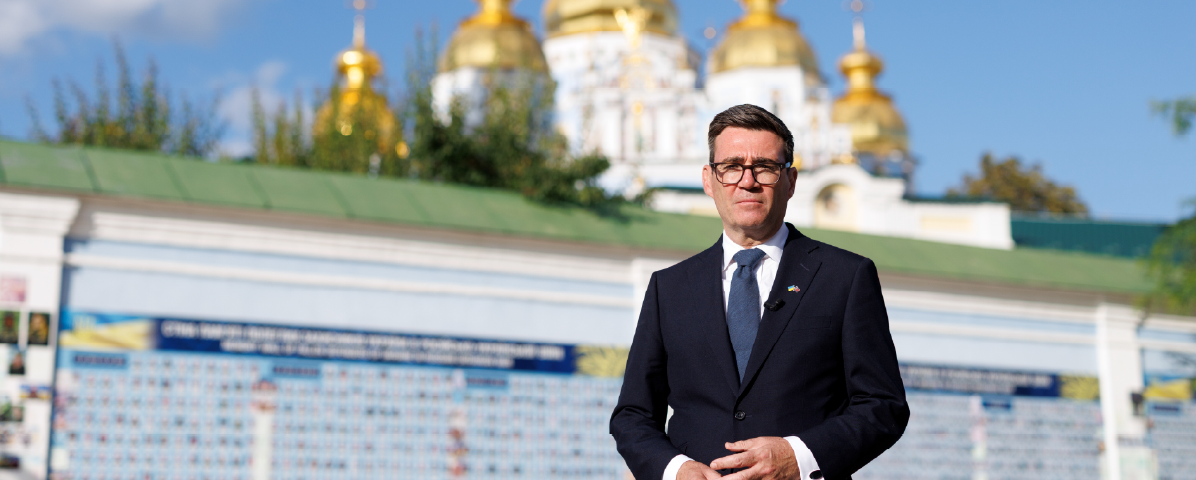
Featured image: Prime Minister Andy Burnham visits Kyiv to mark 35 years of Ukraine’s independence. Picture by Lauren Hurley / No 10 Downing Street