 A Nation Must Think Before it Acts
Russian Information War in the Baltic States: Mechanisms, Narratives, and Strategic Effects

A nation must think before it acts.

Russian Information War in the Baltic States: Mechanisms, Narratives, and Strategic Effects
The views expressed here are those of the authors and do not represent the official policy or position of the United States Military Academy, the Army, or U.S. Government.
Executive Summary
This report examines how Russia has used Estonia, Latvia, and Lithuania as testing grounds for information warfare over the last two decades. During that time, the methods associated with Moscow’s grand strategy have shifted from limited and ineffective soft balancing to a more coercive political warfare that blends identity politics, historical revisionism, and state-backed networks to counterbalance Russia’s western adversaries. The report argues that these efforts are not merely supplementary to Russian strategy but are at the heart of Moscow’s attempt to erode NATO cohesion and chip away at Western influence along its borders.
For decades, Russian actors have identified and weaponized existing social fractures, such as those tied to language, citizenship, and Soviet nostalgia, to divide and destabilize democracies on the former superpower’s periphery; they magnify these fissures through slanted narratives about discrimination, fascism, and NATO’s “provocations,” among others. Russian efforts have only grown more sophisticated in recent years, nurturing and mobilizing a dense ecosystem of cultural organizations, traditional media, and social media to manipulate existing cleavages and exploit democratic openness. Furthermore, the full-scale invasion of Ukraine in 2022 has generated new opportunities and constraints for Russian influence. The invasion aptly demonstrates how these narratives flood the information environment during moments of heightened political tension.
Alliance unity remains the bedrock of NATO’s deterrent posture against Russia. Allowing Russian information warfare to go unchecked in the Baltics and across the wider Euro-Atlantic community only serves Moscow’s interests by undermining the cohesion and resolve of NATO, leaving all members vulnerable to Russian aggression. The report concludes with several recommendations to shore up these vulnerabilities before it is too late.
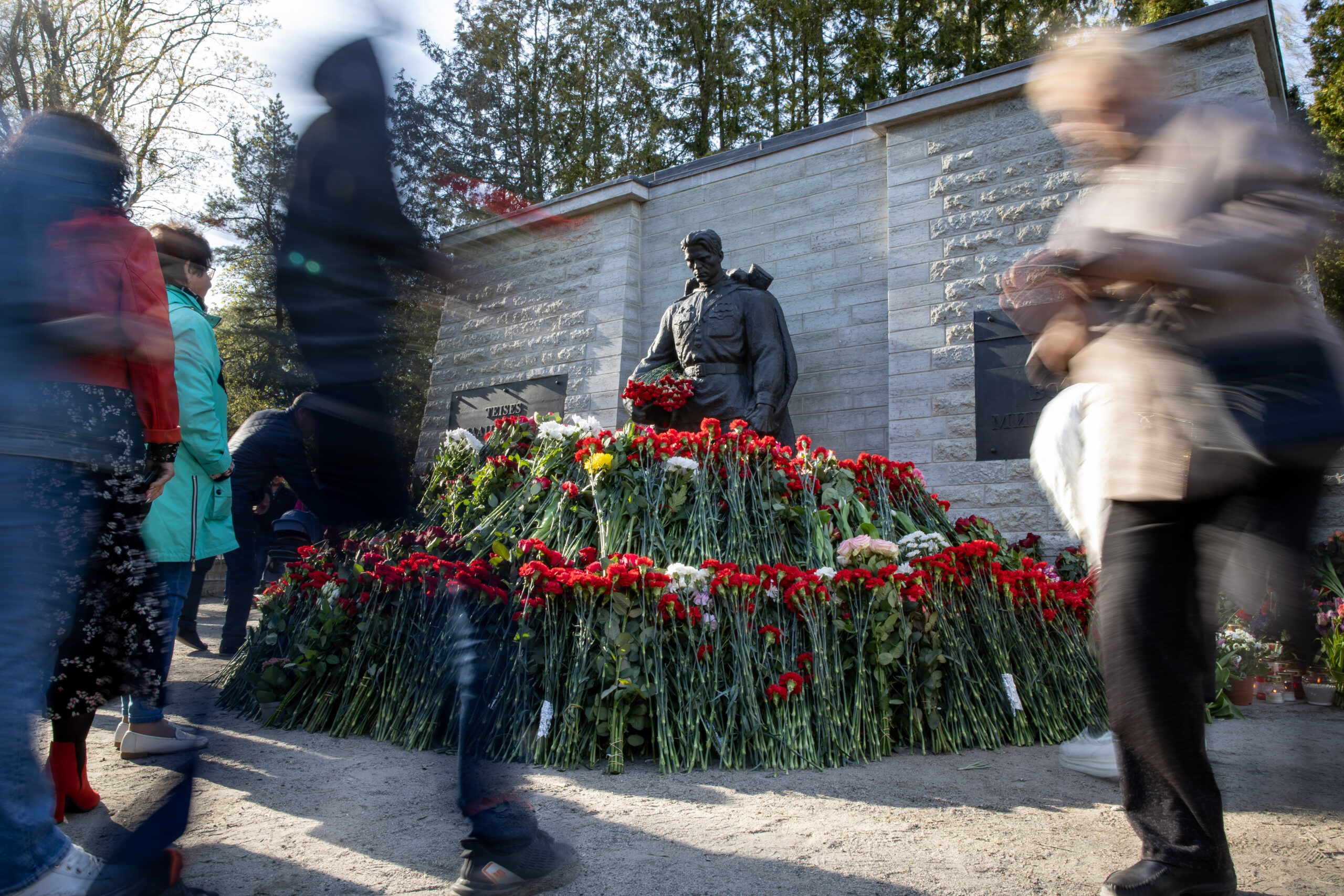
Thousands of people visited the Bronze Soldier Monument in Tallinn to honor the 1945 victory of the Soviet Army on May 9, 2023. Postimees/Scanpix Baltics via Reuters Connect
Introduction
On the evening of April 26, 2007, peace in the normally sleepy Estonian capital, Tallinn, was shattered by a violence unknown to the small Baltic country of 1.3 million since it had regained independence from the Soviet Union in 1991. By the end of the night, riots had spread throughout the city’s central district, leaving countless windows shattered, stores looted and vandalized, and cars set aflame. The human toll of what would become known as the infamous “Bronze Night” was no less shocking: more than 1,000 people were arrested, 150 were injured, and one man—a Russian citizen —was stabbed to death in the melee.[1] Little did the world realize at the time that this disturbing event resulted from a fundamental shift in Russia’s grand-strategic methodology: Moscow was abandoning the ineffective “soft balancing’’ of earlier years in form of a much sharper — and more insidious — pursuit of regional hegemony. From 2007 onward, Russia would employ increasingly aggressive information-warfare tactics to undermine, divide, and disrupt the foreign and domestic politics of its adversaries, initially targeting its neighbors as a kind of “laboratory’’ for a new form of political warfare. By the middle of the following decade, however, the Kremlin would extend its corrosive methods far beyond the post-Soviet region, reaching deep into the heart of the democratic West and exploiting liberalism’s openness against Moscow’s top geopolitical adversary: the United States.
The riots that shook Tallinn in 2007 revolved around the fate of a Soviet-era WWII memorial erected in 1947, known locally as the “Bronze Soldier’’ but formally dedicated to the “liberators’’ of Tallinn in 1944. While most Estonians viewed the Bronze Soldier as a symbol of a painful half-century of Soviet occupation and subjugation, the country’s ethnic Russian minority, comprising approximately 25 percent of the population, saw the statue as a sacred memorial to their Soviet ancestors who had fought and died to defeat the Nazi war machine. As such, the memorial held drastically different meanings for the Estonian and Russian communities, a contested legacy centered on an irreconcilable disagreement over historical memory and identity, the meaning of the Second World War, the Soviet era, and, ultimately, the question of who belongs in post-Soviet Estonia.[2] It is that deep and emotionally-charged division that the Kremlin would eventually exploit for political gains when the opportunity arose.
In fact, tension had been building between Estonia’s ethnic Russian population and the native Estonian population over war memorialization for several months as the government laid the legal groundwork to relocate the monument and the remains of the unknown Soviet soldiers buried beneath it.
By making inflammatory statements and mischaracterizing the objectives and actions of the Estonian government regarding the monument’s relocation, the Russian media and government officials stoked the grievances of the ethnic Russian minority and provoked nationalist reactions from Estonian elites, further reinforcing perceptions that the Russian identity was under threat.[3]
So charged was the atmosphere on both sides of the divide that, by April 26, 2007, when the newly-elected government of prime minister Andrus Ansip (who had campaigned on a promise to relocate the statue by Victory Day 2007) brought in trained archaeologists to determine the disposition of human remains buried at the site so that they may be honorably reburied, the powder keg was set to explode. As word leaked out that a tent had been erected around the Bronze Soldier obscuring the archaeologists’ exploratory work, Russia’s machinery of misinformation revved into high gear, claiming that the statue was being demolished and war graves were being desecrated.[4] As night fell and the angry Russophone crowd turned violent, a new narrative emerged in the Russian media emphasizing (baseless) claims of police brutality and torture of those detained by Estonian police.[5] Fearing further escalation of violence if the status quo remained, the Estonian government accelerated its plans, dismantling the monument and removing it from the site by sunrise the next morning.
But the importance of the Bronze Soldier incident extends far beyond a few weeks of unrest. Its enduring significance stems from the fact that it represented the opening gambit in a new era of Russian grand strategy, one that would aggressively deploy asymmetric tactics like information warfare to divide, weaken, and destabilize adversaries, amplifying and exacerbating existing cleavages and taking advantage of the openness of democratic societies. The 2022 Russian invasion of Ukraine and the resulting backlash and restrictions placed on Russia have merely changed the intensity and scale of the strategy, not the means or the ends. Echoes of the Bronze Soldier incident reverberated across the Baltics as governments removed Soviet-era statues in solidarity with Ukraine.[6] In time, the tactics that Moscow developed and refined against its post-Soviet neighbors, like Estonia, would be wielded with devastating effect against its greatest adversary: the United States.
Russian Information Warfare in the Baltics
In many respects, the Baltic states of Estonia, Latvia, and Lithuania can be considered “ground zero” of Russia’s information-warfare strategy, or at the very least, an ideal laboratory to observe Russia’s strategy at work. This is owing to the confluence of several characteristics–both domestic and geopolitical–that make the Baltics particularly vulnerable to Russian malign influence measures. As former Soviet republics, the Baltics’ geographic location places them within what Moscow considers to be its privileged sphere of influence. With their accession to NATO in 2004, the Baltics became potential front lines of geopolitical competition, bringing the transatlantic alliance to Russia’s immediate borders for the first time in history. This raised the stakes considerably, as the NATO’s presence in the Baltics simultaneously raised Russia’s perception of hostile encirclement while making the region an ideal target through which Moscow could undermine the alliance.[7] Russia has thus sought to leverage longstanding demographic divides and a history of ethno-national tension between the titular nationalities and the Russian-speaking populations to advance its strategic objectives.[8]
Since 2007 (though some would argue much earlier), Russia used a diverse toolkit of tactics to execute its information warfare in the Baltics. This case study will explore the objectives of Russian information warfare in the Baltics, the mechanisms through which Moscow has waged its information war, and the specific narratives that Russia has leveraged to sow discord and division within Baltic societies and between the Baltics and their Western allies.
Objectives of Russian Information Operations
Though some scholars have used the concept of “soft power” to understand Russia’s influence operations in the Baltics over the last two decades,[9] Moscow’s use of deliberate misinformation, fabrication and spreading of divisive “fake news,” and covert control and manipulation of NGOs, traditional media, and social media in the Baltic information space seem a far cry from the positive or aspirational emphasis of Joseph Nye’s original conception of “soft power.”[10] While some aspects of Russia’s information strategy are certainly intended to create an appealing image of Russia (particularly in the cultural and historical realms) such measures tend to be aimed more narrowly at Russian-speaking populations and are intended to serve the broader objective of societal and political division that lies at the heart of Russia’s information warfare strategy.
Russia’s influence measures rarely attempt to create social or political cleavages from scratch. Rather, they seek to identify and exploit existing divides within the target society, often through a trial-and-error approach designed to maximize the most divisive narratives.[11] In manipulating, amplifying, and exacerbating these narratives, Russia attempts to undermine public trust in target governments and democratic political institutions, amplify divisive fringe voices, polarize domestic debates, spread conspiracy theories, and sow confusion by blending real and fake news to create an information “fog” in which it is difficult to separate truth from fiction.[12] When successful, the net effect of these measures is to force target governments to expend effort on responding to manufactured controversies rather than solving genuine domestic problems.[13] Within Baltic societies, Russia’s manipulations have succeed in undermining trust in non-Russian domestic and international media.[14] In an interview, one Russian speaker in Latvia declared, “I believe that there’s propaganda in any TV, newspaper, magazine, online website.” Another was more succinct: “Everybody is lying or telling some half-truth.”[15] By sowing seeds of doubt and cultivating the vines that creep through society’s perceptions of government and media until “nothing is true and everything is possible,”[16] Russia has set the conditions to reap the harvest: a citizenry divided, not over domestic politics, but also over foreign policy.[17] This latter point–that Russian malign influence measures seek to influence public opinion to drive a wedge between Baltic countries and NATO–was an oft-repeated warning in interviews the author conducted with Estonian, Latvian, Lithuanian, and American defense officials in 2018 and 2019.[18]
Certainly, the shock of Russia’s 2022 invasion of Ukraine activated and accelerated a societal and institutional Baltic “immune response,” with all three Baltic countries hardening their information space and Baltic citizens increasingly questioning the credibility of Kremlin-backed narratives.[19] The evidence suggests, however, that despite public skepticism toward Russian media and tireless Baltic and EU counter-disinformation measures, Kremlin-aligned propaganda still reaches Baltic publics, serving as a low-cost balancing tool against the United States and its allies.[20]
Mechanisms of Influence
Russia exercises its influence and executes information warfare through a well-developed network of government-organized non-governmental organizations (GONGOs), sympathetic NGOs and other domestic organizations in target countries, traditional and online media outlets, and social media platforms. With Russia’s full-scale invasion of Ukraine, however, these organizations have faced increased scrutiny and legal pushback in the Baltics, forcing the Kremlin to adapt and evolve its strategies.[21]
Rossotrudnichestvo and Russia’s Compatriots Policy
The legal mechanism that Russia has used to justify–though not legitimize–its influence measures in the Baltics and other post-Soviet countries is its so-called “compatriots policy.” The concept of Russian “compatriots” is at times ambiguous, contradictory, and malleable, perhaps reflecting Russia’s internal struggle to define its own national identity in overlapping ethnic, civic, territorial, and linguistic terms.[22] The law ‘On State Policy of the Russian Federation Regarding Compatriots Living Abroad’ defines compatriots broadly:
They are persons born in one country, who live or have lived in this country and share a common language, history, heritage, traditions, and customs, as well as descendants of these persons in the direct line of descent. Russia’s compatriots are: Russian citizens permanently residing outside the territory of the Russian Federation and persons and their descendants living outside the territory of the Russian Federation and related to the peoples historically living in the Russian Federation, and who have made a free choice in favour of spiritual, cultural, and legal ties with the Russian Federation, and whose relatives in the direct ascending line previously resided on the territory of the Russian Federation.[23]
Thus, the concept of Russian compatriots includes not only Russian citizens and ethnic Russians abroad, but, in its most expansive interpretation, also any Russian speakers residing in any former Soviet country, regardless of citizenship or nationality. Though notionally adopted to maintain cultural ties to compatriots living abroad, Robinson et al (2018)–like many others–note that its application has served more malign purposes: “the Compatriot Policy has become more of a tool through which Russia can use Russian-speakers, former Soviet citizens, and affiliated groups to influence the politics of its neighbors, rather than a means to protect the interests of these individuals.”[24] Indeed, Russia’s use of its compatriot policy to justify the 2008 war with Georgia, the 2014 annexation of Crimea, and ongoing accusations of compatriot rights violations in the Baltics shows that “the protection of rights and legitimate interests may not be an end in itself, but is rather a tool for achieving strategic objectives.”[25] These manufactured “precedents” of using the protection of compatriots in launching military invasions of Georgia (2008) and Ukraine (2014 & 2022) stoke great anxiety in the Baltics whenever Moscow or its mouthpieces speak of protecting compatriot rights in the region.
Oversight and execution of Russia’s compatriots policy is carried out by multiple federal agencies,[26] most prominent of which is the Federal Agency for the Commonwealth of Independent States Affairs, Compatriots Living Abroad, and International Humanitarian Cooperation. The agency was created by presidential decree in 2008 and is known by its abbreviation Rossotrudnichestvo.[27] It describes its compatriot activities, among others, as follows:
Rossotrudnichestvo in cooperation with organizations of compatriots actively conducts various joint activities for people who feel their belonging to Russia, and makes every effort to develop friendly relations between countries…Rossotrudnichestvo in cooperation with the Ministry of Foreign Affairs of the Russian Federation provides assistance in protection of rights and legitimate interests of our compatriots, including by using the Fund for the Support and Protection of the Rights of Compatriots Living Abroad…The activities of Rossotrudnichestvo in the field of cooperation and consolidation of compatriots aim at strengthening links with the historical Motherland, supporting and preserving the national cultural heritage, ethnic and cultural identity, developing and disseminating of Russian language abroad and culture.[28]
Rossotrudnichestvo sits atop a pyramid of councils and congresses, including its World Congress of Compatriots and World Coordination Council, as well as five Regional Coordination Councils that divide the globe into regions. These regional councils oversee the activities of 103 country coordination councils, which in turn interface with local compatriot organizations.[29] Of critical importance, the Rossotrudnichestvo network coordinates with and provides funding for a variety of GONGOs and NGOs that propagate information–and misinformation–throughout target countries as part of Russia’s influence operations. Most prominently, this includes the Russkiy Mir (or “Russian World”) foundation as well as several other pro-Russian organizations in the Baltics.[30] The invasion of Ukraine in 2022 changed the nature of this sponsorship in the Baltics, as the Baltic governments have recently taken deliberate efforts to sever suspected ties between domestic organizations and Russia. The Kremlin, however, has persevered, and the Rossotrudnichestvo network has maintained its web of influence while deploying new, innovative methods including payment of high-influence individuals through constituent organizations such as Pravfond.[31]
Russian-supported organizations in the Baltics
Though the Russkiy Mir Foundation was founded by presidential decree in 2007, use of the “Russian World” concept in Russian political discourse long predates its founding. At the first World Congress of Compatriots in 2001, Vladimir Putin declared that “the concept ‘Russian World’ from time immemorial went far beyond Russia’s geographic boundaries and the Russian ethnos,”’ anticipating the way in which Moscow would use the concept as a vehicle to advance its interests far beyond Russia’s borders.[32] Since it began operations in the Baltic countries in June 2007, the Russkiy Mir Foundation has gone well beyond its stated mission:
Mir means Community. Peace. World. The three meanings of this small but eloquent word inspire and define Russkiy Mir’s mission–to promote understanding and peace in the world by supporting, enhancing and encouraging the appreciation of Russian language, heritage and culture. Russkiy Mir promotes the teaching of the Russian language within Russia and abroad–both to new learners of the language and to those who already know and love Russian and wish to recapture or maintain their fluency. Russkiy Mir brings Russia’s rich history to life, and showcases vibrant examples of Russian art and culture around the world. Russkiy Mir reconnects the Russian community abroad with their homeland, forging new and stronger links through cultural and social programs, exchanges and assistance in relocation.[33]
Under the cloak of its mission to promote Russian culture, language, and heritage, the Russkiy Mir Foundation has actively promoted and spread many of the divisive narratives among the Russian-speaking populations of the Baltics discussed below, particularly those related to the “Great Patriotic War.”[34] Simultaneously, the fund propagates the vision of the Russian Federation as the sole motherland for Russian speakers and the protector of Russians worldwide.[35] Disturbingly, earlier investigations found that Russkiy Mir had funded over 20 organizations in Latvia, many of which avoided publicly disclosing Russian support in clear violation of Latvian transparency requirements.[36] Despite reduced funding, EU sanctions, and increased transparency, more recent Latvian security reporting suggests that this network has not disappeared but instead adapted, as Latvia’s pro-Kremlin “compatriot” environment continues to disseminate narratives aligned with Russian interests.[37]
Though the distinction between government-organized non-governmental organizations (GONGOs) and non-governmental organizations (NGOs) is often deliberately obscured as part of Russia’s influence strategy in the Baltic states, there can be little doubt that the connections are real and widespread. A 2015 study by Re:Baltica, the Baltic Center for Investigative Journalism, found that from 2012-2015, Rossotrudnichestvo, Russkiy Mir, and other GONGOs provided at least 1.5 million Euros to over 40 NGOs operating in the Baltic States, a majority of which were also affiliated with pro-Russian political parties.[38] If the 2015 study revealed the visible architecture of Russian state-backed civil society funding in the Baltics, later investigations by Re: Baltica show its modern evolution: less overt NGO sponsorship and more covert, sanctions-evasive support for pro-Kremlin activists and online influence operations.[39]
Several pro-Russian political parties in the Baltics have well-documented ties (including formal cooperation agreements and suspected funding) with Russia’s ruling party, United Russia.[40] This includes Estonia’s Centre Party, which had a formal cooperation agreement with United Russia from 2004 to 2022 (when its popularity plummeted due to the war in Ukraine)[41] and Latvia’s pro-Russian Harmony Centre party, which won 19.8 percent of the vote in 2018 elections, giving it the single largest vote share of any party in Latvia before also collapsing in 2022.[42] The precipitous decline in popularity of these parties after the invasion is misleading, however, as the major pro-Russian parties that lost popularity were soon replaced by new parties with even more convoluted sources of funding, like the For Stability! party in Latvia.[43]
Some Russian-connected NGOs style themselves as promoters of Russian language and culture, such as the Estonian NGO “Russian School in Estonia.” Others present themselves as humanitarian organizations defending human rights, usually focused on the rights of supposedly besieged Russian-speaking minorities. This includes organizations like the “Foundation for Defense of the Rights of Compatriots Abroad” and the “Legal Information Centre for Human Rights.”[44] Still others, such as the Institute of Democracy and Cooperation, describe themselves as “think tanks” that offer unbiased analysis of regional and world politics.[45] A fourth category of NGOs claims to be engaged in the fight against fascism, thereby propagating the narrative (explored below) that Baltic states are breeding grounds for neo-Nazi sentiment. Prominent among these is the “Mir Bez Natsizma” (World Without Nazism), which has active operations in Estonia, Latvia, and Lithuania (among others) and frequently accuses Baltic governments of fascist policies and activities.[46] Though the funding, focus, and explicit ties to the Russian state varies, these NGOs have a proclivity in common to promote official Russian narratives about the Baltic states (often based on manipulated or fabricated information), thereby contributing to Russia’s strategic objective of sowing domestic instability and driving a wedge between the Baltic states and their NATO allies.
In the post-invasion political environment, some of Russia’s influence over organizations in the Baltics has eroded. However, the Kremlin has compensated for the gaps created by sanctions and bans by applying the same strategy through less traceable channels, such as individuals, academic organizations, online communities, influencers, and legal networks.[47] Social media and other adaptive strategies have become increasingly relevant: Russian-connected organizations in the Baltics have changed in form, rather than disappeared.
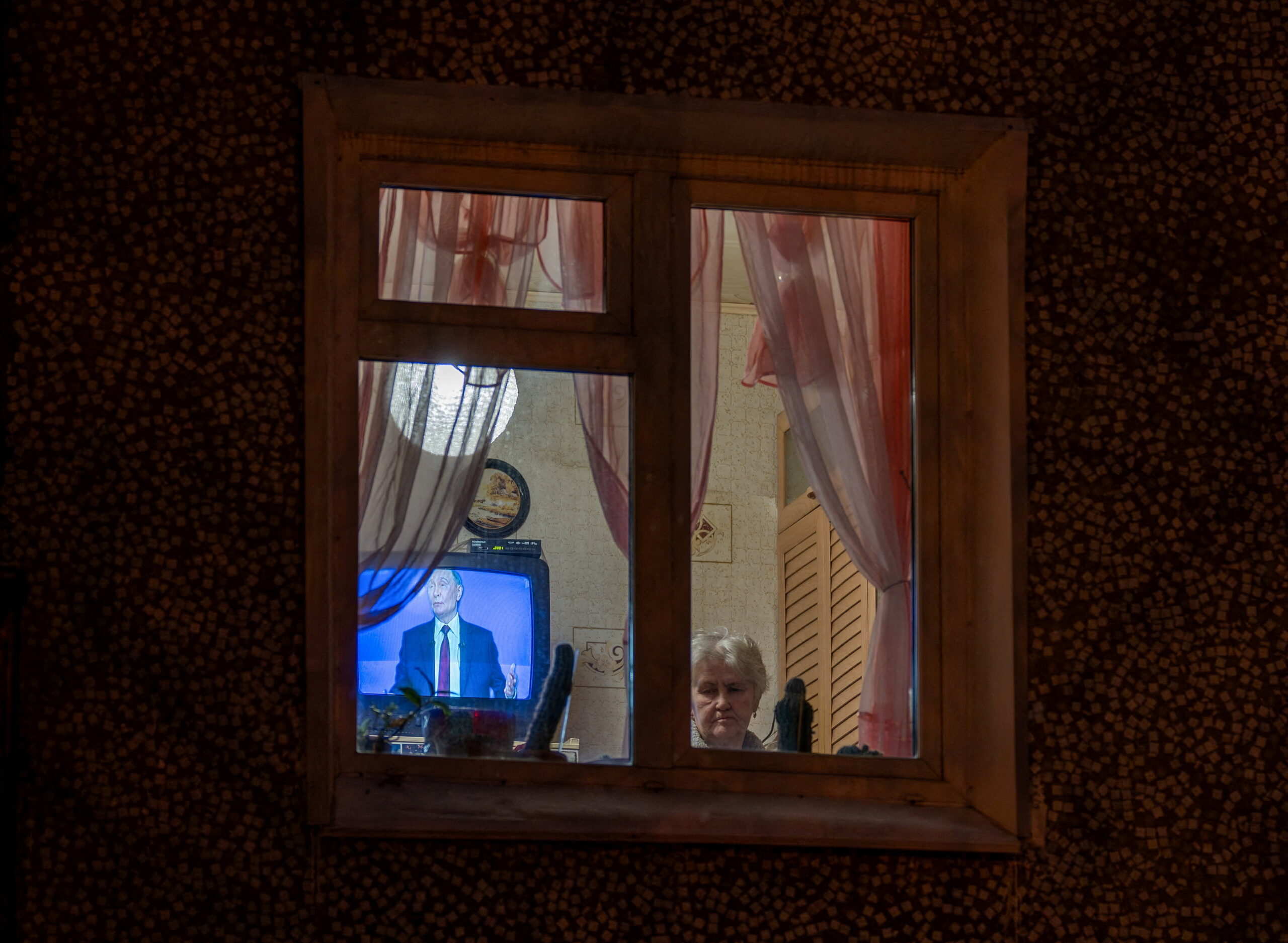
A TV screen shows a live broadcast of Russian President Vladimir Putin’s annual end-of-year press conference and phone-in, in an apartment building in Omsk, Russia December 19, 2025. REUTERS/Alexey Malgavko TPX IMAGES OF THE DAY
Broadcast and Online Media
As central as Russian-funded GONGOs and NGOs are to Moscow’s strategy of asymmetric balancing in the Baltics, the real heavy lifting of Russia’s information warfare in the region is carried out by broadcast, cable, and online media entities (though one hesitates to use the latter term given the heavily propagandistic nature of their operations). Russia’s effectiveness in using media as an instrument of malign influence in the Baltics stems from the reality that Russian and non-Russian speakers in the region have historically occupied separate and distinct media spaces.[48] The latter have generally consumed domestically-produced news and entertainment in local languages, while the former have disproportionately relied on Russian-language media produced in Russia, even in the face of complete bans on Russian-sponsored media within the Baltic states.
For example, a 2018 survey found that in Latvia, 96.6 percent of respondents who primarily speak Russian at home consume Russian-language media, but only 51 percent reported consuming media in Latvian.[49] More recent reports point to a more fragmented media environment: roughly one in five minority residents in Latvia consume public media exclusively in minority languages.[50] Nevertheless, this fragmentation has not resulted in full integration into Baltic national media spaces. With the exception of Estonia’s nascent Russian-language “ETV+” channel, launched in 2015 and Latvia’s bilingual LTV7 channel (both of which have found limited appeal among Russian-speakers), the news and entertainment space for the Russian-speaking populations of the Baltics has long been shaped by Russian state-owned and Russian-language media outlets.[51]
This has remained a challenge even following the 2022 bans that swept across the Baltics in an effort to limit Russian malign influence in the region. Russian-speakers in the Baltics continue to consume similar content through social media, the internet, VPNs, and Telegram, despite the availability of state-sponsored and locally produced Russian-language alternatives.[52] In Latvia, for example, a study estimated that about 20% of Latvia’s Russian-speaking viewers were still accessing banned Russian state television through VPNs in 2025.[53] Fittingly, a recent Latvian public media survey concluded that banning Russian TV channels did not push these audiences towards Latvian-language TV but instead accelerated a shift away from television toward online video, social media, and chat platforms.[54] Thus far, efforts by Baltic governments in the media sphere have done little to curb the linguistic minority’s appetite for Russian-sourced media, which they access by any means necessary.
With a captive audience and extensive control over the media content they consume, the Kremlin has achieved striking success in shaping the views and beliefs of Russian speakers in the Baltic states, cultivating and propagating the narratives discussed above through a good deal of deception and obfuscation. Spearheading the effort is Russia’s official international news agency, Rossiya Segodnya (“Russia Today”), which was founded by presidential decree in 2013 and, in 2026, received approximately $143 million per year in estimated annual state funding.[55] Though a multimedia organization that includes domestic and international radio broadcasting, online news feeds, international press centers, photo content, infographics, social media platforms, and mobile content, Rossiya Segodnya’s main outlet for foreign audiences is Sputnik, its online and radio platform launched in November 2014. Like its better-known television counterpart, RT, Sputnik publishes and broadcasts in a number of languages and has historically targeted a number of media markets, including the Baltics, to promote a positive image of Russia and discredit Russia’s main critics and adversaries.[56] RT, the network originally known as “Russia Today,” also changed gears (and its name) in 2009, shifting away from coverage of events inside Russia and toward presenting global news with what can best be described as a pro-Russian (and often anti-American) lens.[57] Following Russia’s invasion of Ukraine in 2022, however, both RT and Sputnik were banned under EU sanctions and subjected to additional national restrictions in Baltic states. These measures have reduced their ability to operate openly in the region, although their content and narratives continue to reach some audiences through mirror sites, social media, VPNs, and other workarounds.[58]
Primacy within the Russian-language Baltic media space was once held by the television station Perviy Baltiiskiy Kanal (PBK, or “First Baltic Channel”). A 2017 poll reported that 63 percent of Russian speakers in Latvia, 70 percent of those in Lithuania, and 73 percent of those in Estonia regularly watched PBK.[59] Although PBK is part of the international media group “Baltic Media Alliance” (registered in the UK), the network rebroadcasts most of its entertainment and international news content from the Russian state-owned First Russian Channel. Local news programs in Estonia, Latvia, and Lithuania are produced domestically but feature Russia-friendly viewpoints, voices, and narratives.[60] In addition to PBK, a number of additional Russian state-owned, state-controlled, or Kremlin-friendly networks have significant viewership–and trust levels–among the Russian-speaking Baltic populations, including Russia 24, NTV, First Russian Channel, REN TV, and RTR (Russia-1).[61] With Russian-produced news and entertainment dominating the Russian-speaking media space in the Baltics, Moscow has been able to engineer an alternate reality based on fact manipulation, misinformation, and outright fake news. As evidence of the effects of the divided media landscape, a 2025 survey in Estonia found that 74% of ethnic Estonians supported the statement that Ukraine should not make any concessions to Russia, compared with only 19% of ethnic Russians. This disparity is most likely the result of different media coverage in each language regarding history, ownership, and responsibility for the war.[62]
Russia has also sought to influence the Russian-language media space in the Baltics through more covert means than those described above. In 2014 the online news portal “Baltnews” (owned by a media holding company registered in the Netherlands) launched three editions–in Estonian, Latvian, and Lithuanian–with supposedly independent editorial teams. Since its launch, Baltnews has featured content from Russian media, including prominent anti-Western commentators from Russia.[63] Marketed as a nonpolitical, independent news portal, a 2017 investigation by the Baltic Center of Investigative Journalism revealed that ownership of Baltnews traced directly back to Rossiya Segodnya, the Russian state news agency, through a series of holding companies.[64] In additional to taking direction from Rossia Segodnya, it also appears that Baltnews frequently purchased page views (fake visitors) and paid comments from a troll factory to boost visibility for certain stories, including one provocatively titled “NATO’s Help for Estonia Might Not Arrive in Time.”[65]
Though the threat of Russian misinformation and manipulation is very real, the Baltic governments have struggled to address the problem head-on. According to interviews conducted by the author with government officials in the region, Russian-speaking audiences have not found the (Baltic) government-funded Russian language channels to be compelling replacements for the Russia-produced networks, which offer much higher production value and high-quality entertainment content, content which often subtly perpetuates pro-Russian narratives as well.[66] This challenge is especially prevalent in the post-2022 media space, where the explicit bans on Russian-sponsored content have done little to discourage Russian-speakers from utilizing other means to access the same media. The Baltic Media Health Check 2022-2023 noted that the Russian-speaking audience seemed to have “vanished” in the wake of these bans, moving to sources like Facebook and YouTube for reuploaded Russian content. The report also identifies a loyalty to these Kremlin-linked networks that the Baltic governments have failed to account for.[67]
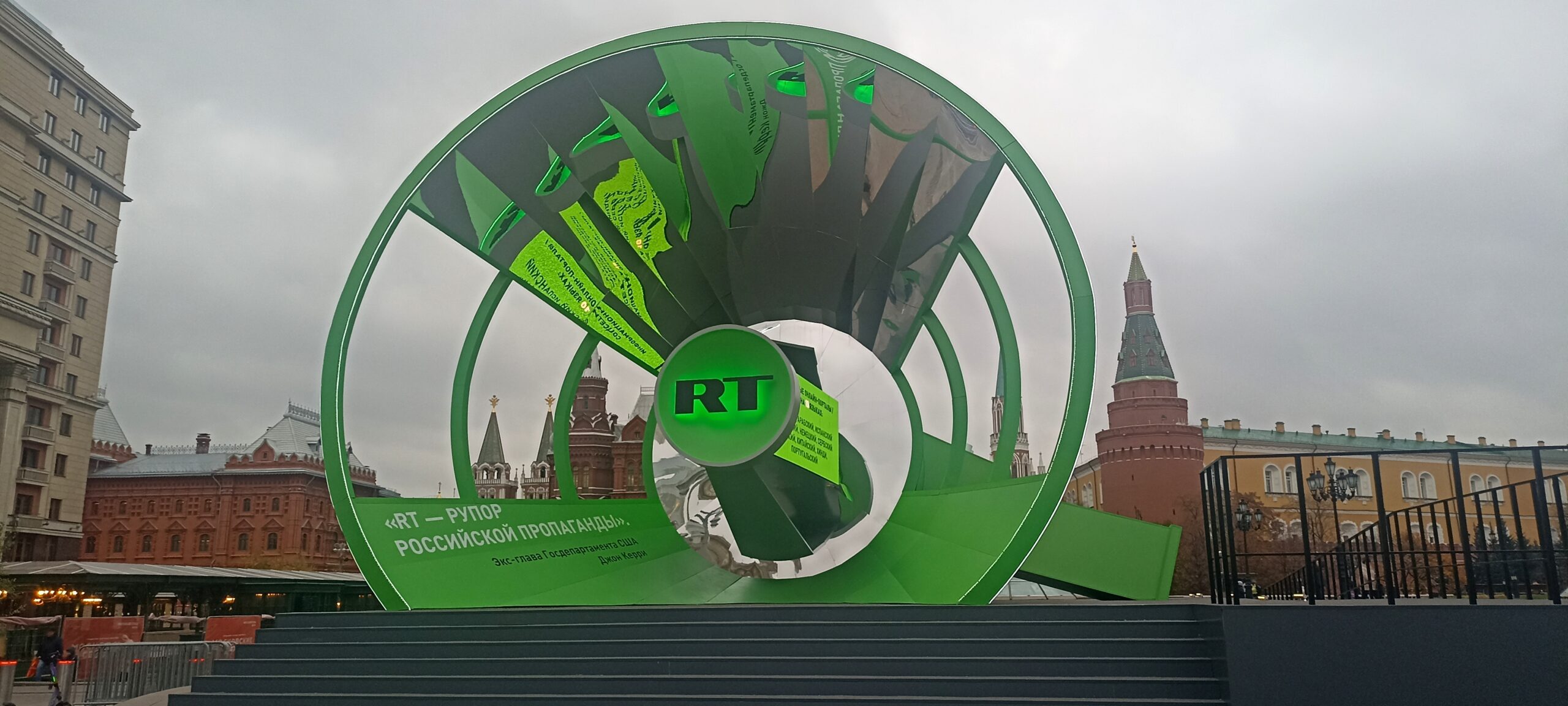
Moscow, Russia- October, 7, 2025, Television studio in the form of a loudspeaker, for the 20th anniversary of the Russian Today TV channel. (Adobe Stock)
Social Media and Modern Mechanisms
The final mechanism through which Russia has effectively waged its information warfare against the Baltic states is social media, where it supports pro-Russian narratives, counters viewpoints that portray Russia in a negative light, and promotes divisive social, political, and economic issues in target countries.[68] Social media has also served as a loophole, enabling the continuation and intensification of the mechanisms described above. The Russian disinformation apparatus has effectively used the internet to circumvent EU sanctions and bans imposed after the invasion of Ukraine.
As in the United States, Facebook has become a major vector for Russian information warfare in the Baltics. Beginning in early 2015, several Facebook pages emerged, claiming to represent separatist movements in northwest Estonia (the “Baltic Russian Republic”), Latvia (the “Latgalian People’s Republic”), and Lithuania (the “People’s Republic of Vilnius”). Responsibility for such pages is notoriously murky but it has occasionally been traced back to pro-Russian fringe parties and personalities in each country.[69] In January 2019, Facebook took action, shutting down 350 pages and accounts with hidden links to Rossiya Segodnya and Sputnik due to “coordinated inauthentic behavior.” These pages, established across the Baltic, CEE, Caucasus, and Central Asian states, were usually based on neutral topics like tourism, food, and sports, and would often accrue large audiences (nearly 800,000 followers in total) before inserting anti-NATO, anti-corruption, and pro-protest messages. In doing so, Russia sought to cultivate a sense of trust, common values, and shared community around non-political topics in order to groom such communities to be more receptive to political influence and manipulation.’[70]
Russia’s malign influence measures on social media extend to X (formerly Twitter), though the platform is less popular among Russian-language users than English speakers. Quarterly reports by the NATO StratCom Centre of Excellence on “Robotrolling” find significant evidence of Russian manipulation in the Baltic Twitter space. In late 2017, 55 percent of all Russian-language tweets about NATO in the Baltic States and Poland were generated by Russian-language bots, and 42 percent of Russian-language accounts in the region were found to be automated accounts.[71] More recent NATO StratCom COE analysis shows that Russian‑linked bot networks continue to shape NATO‑related discourse in the Baltic‑EU information space, with coordinated groups and AI‑assisted automation operating at scale across multiple platforms in 2024–2025.[72]
Though the effects of such interventions are difficult to measure in any language or region, studies of Russian malign influence activities on Twitter drawing on data from the United States, Ukraine, and Eastern Europe suggests that Russian bot and troll messages generate more polarized discourse among non-troll and non-bot users engaged (unknowingly) in discussions of controversial subjects. [73] These findings likely apply to other user communities–such as those in the Baltics–as well as other popular Russian-language social media platforms like Vkontakte and Odnoklassniki, which are also subject to significant troll and bot activity.[74] Not only do Russian trolls and bots stoke polarization and division on sensitive topics, their prolific output can significantly boost the visibility of Russia-supported news outlets and the narratives they seek to advance, making them critical foot soldiers in Russia’s information war in the Baltics and beyond.[75]
An additional key function of the social media within the Russian strategy of information warfare is “information laundering,” whereby the origins of (often false or misleading) news stories are obscured through traditional media, online media, and posting and re-posting on social media.[76] A 2018 RAND report on Russian social media influence explains the process:
In the first step, false or misleading content is created by Russian-affiliated media outlets, such as RT, Sputnik, and Russia Insider…Second, force multipliers, such as trolls and bots, disseminate and amplify this content, adding fear-mongering commentary. Third, mutually reinforcing digital entities pick up and perpetuate the narrative, whether they are ideologically friendly or simply fall under the category of “useful idiots.” These entities include news aggregators, far-right or far-left sites, blogs, and users drawn in by clickbait headlines that reinforce their previously held beliefs.[77]
In addition to bots and coordinated inauthentic behavior, the Russian strategy employs viral hashtag manipulation and weaponizes human pattern recognition through slogans and images. By including already popular, benign hashtags such as #Latvia alongside hashtags such as #Russophobia, pro-Russian posts can rapidly reach wider audiences. These tools have been further amplified by the AI’s ability to scrape social media and public data to maximize engagement. [78]
The weight and extent of this disinformation tactic cannot be understated. The 2025 Latvian State Security annual report noted the use of social media as a “catch-all” mechanism that can be even more difficult to identify than other forms of manipulation.[79] The report notes that content from broadcast media that is banned in the Baltics was regularly uploaded and spread on TikTok, Facebook, Instagram, and YouTube, while Telegram was used to proliferate banned Russian news outlets like RIA Novosti.[80]
Russia in recent years has increasingly been using social media to target individuals, rather than populations, to support Kremlin interests by committing violent crimes, becoming social media influencers, and transporting money across the border. This use of couriers is perhaps the most obvious way Russia has circumvented sanctions. In October 2024, border guards stopped a 65-year-old travel agent trying to carry 10,000 euros in cash into Estonia from Russia. The money had reportedly been provided to her by Pravfond to deliver to another party.[81] Most of these targeted “third-party” individuals come from low-income or criminal backgrounds and are motivated by money and opportunity rather than ideology.[82] The allure of the money and support that Russia has promised over social media and even through official VPN-accessible websites (like the Pravfond site which openly accepts email requests for funding abroad) makes it difficult to deter individuals in the Baltic states who are looking for ways to better their own lives.
Recalling that Russia’s strategic objectives in its information war in the Baltics (and beyond) are to sow doubt, division, discord, and mistrust of government and media, it is easy to see how Russia’s army of online trolls and bots contribute to this malicious strategic operation.
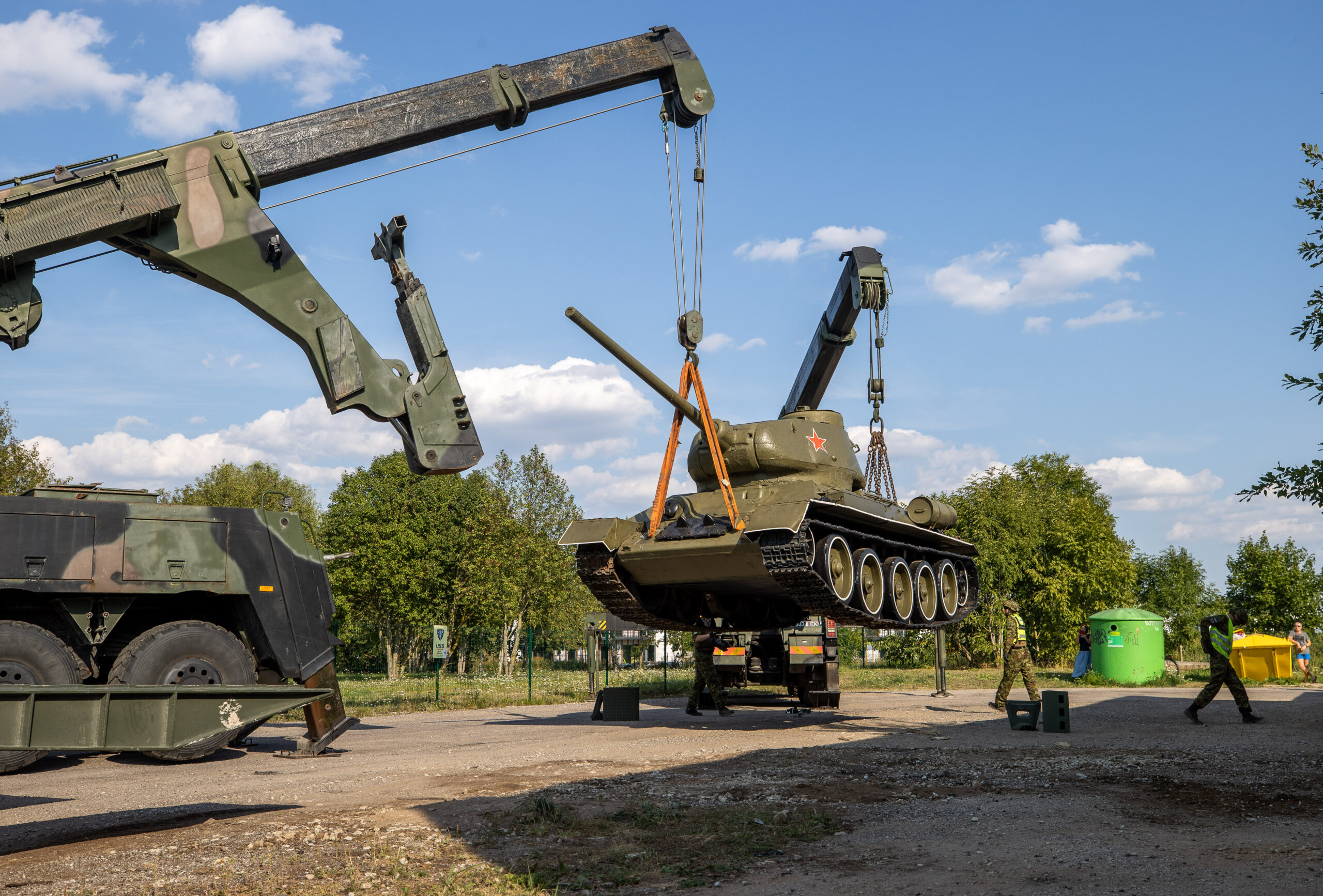
Removal of Soviet Monuments from Narva, Estonia, August 2022. Postimees/Scanpix Baltics via Reuters Connect
Russian Narratives in the Baltics
Having detailed the diverse array of mechanisms through which Russia conducts its information operations in the Baltics, let us now turn to the content delivered through these mechanisms, focusing on the false narratives meant to manipulate and exacerbate preexisting societal divisions in each country. These narratives can be divided into two main categories. The first consists of narratives that focus on domestic issues with the intent of stoking internal discord within Baltic societies, predominantly between the titular nationalities and the Russian-speaking minority. The second set of narratives are those oriented externally, attempting to turn public opinion against NATO and toward Russia, thereby driving a wedge between the Baltic states and their Western allies. To be sure, there is certainly overlap between the two. Accusations of fascist ideology, for example, might serve as both an internal and external wedge issue. Additionally, both types of narrative share a common audience: the Russian-speaking minority population. The narratives described below are delivered overwhelmingly through the Russian-language media and mechanisms described above; Moscow appears to have made little attempt to export these myths among the Estonian, Latvian, and Lithuanian-speaking populations.
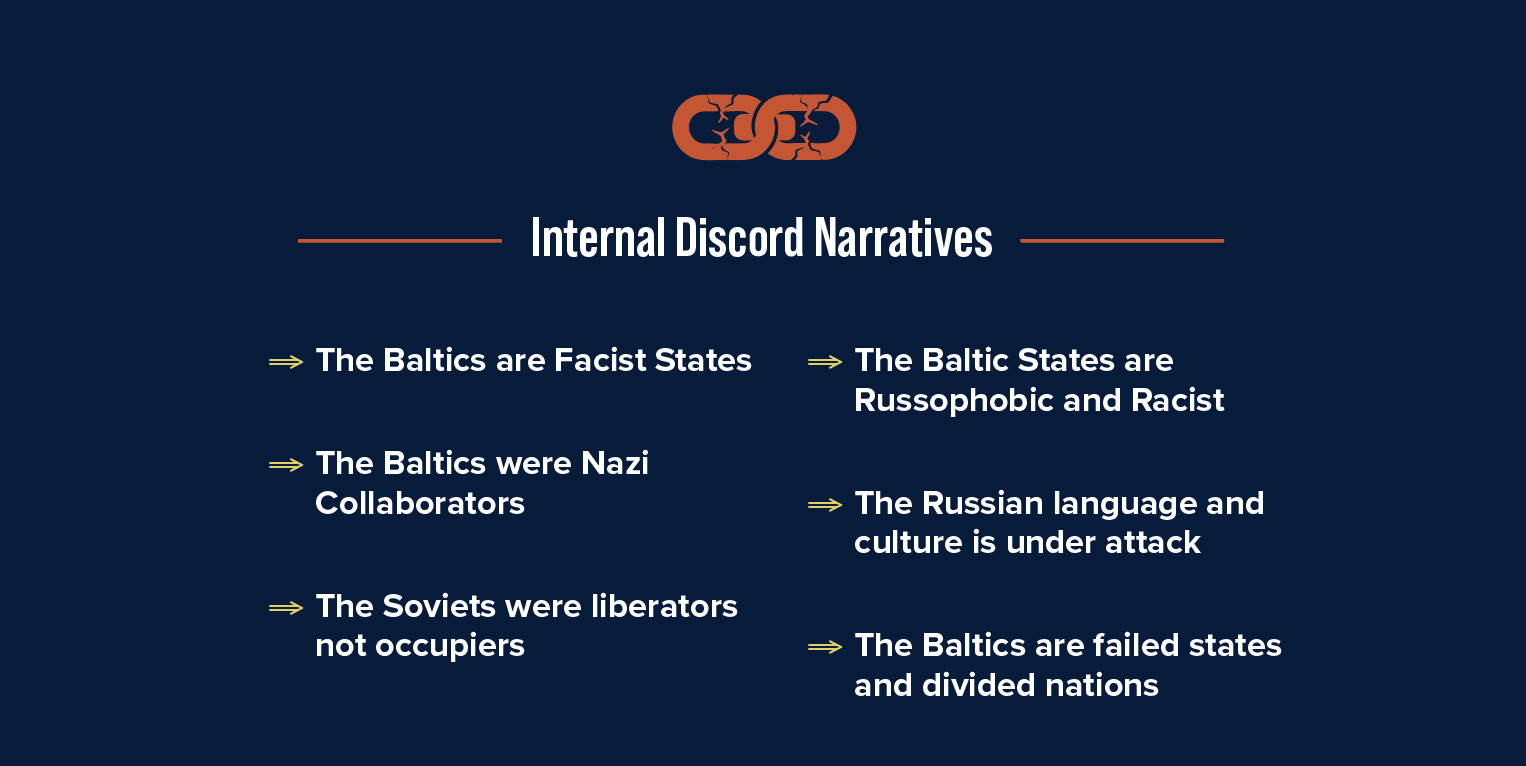
Internal Discord Narratives
The Baltics are Fascist States
Perhaps the most common narrative promoted by Russian information warfare to sow internal discord is the myth that the Baltic states seek to implement fascist ideology and policies and support the rise of neo-Nazi and other far-right nationalist groups.[83] Drawing loosely on historical instances of collaboration between native Baltic fighters and Nazi occupiers during WWII (discussed in greater detail below), the myth that the current Baltic governments are inheritors of a Baltic fascist movement gained greater prominence in 2007 in the midst of Estonia’s “Bronze Soldier” monument controversy, where the Estonian government relocated a Soviet-era war memorial and grave site from downtown Tallinn to a military cemetery outside the city center.[84] This controversial decision, quickly seized upon by the Russian propaganda machine, fueled accusations that the Estonian government was motivated by fascist ideology seeking to desecrate anti-fascist Soviet war heroes.[85]
Since then, accusations of Nazi heritage and fascist sympathies in the Baltic governments have been a frequent trope in the Russian-language media. For example, one pseudo-historical documentary equated arrests during the Bronze Soldier riots with the Holocaust, claiming that protesters were taken to concentration camps as part of the Baltic governments’ “policy of national segregation and the glorification of Nazis.”[86] A 2018 story reported by Zvezda TV and Sputnik falsely claimed that Hitler’s Mein Kampf was more popular than the Harry Potter series, based on just four used copies of the Nazi tract sold on a small online book exchange platform.[87]
The Baltics were Nazi Collaborators
Russia’s propaganda portraying the Baltic states as glorifying their Nazi heritage draws on the complicated and controversial legacy of Baltic collaboration with the Nazis during WWII. In 1942, the Nazis formed the Estonian Legion, whose legionnaires fought against the Soviet Union under the Waffen-SS. A similar Latvian Legion was organized by the Nazis in 1943.[88] Contemporary Estonian and Latvian narratives emphasize that the native Estonians and Latvians who fought in these units were illegally conscripted (though some did join voluntarily), and that those who did fight did so as freedom fighters with the hopes of eventually regaining independence from both Nazi Germany and the Soviet Union.[89] Nevertheless, this history is a stain that Russia’s information operations frequently exploit, most visibly during Latvia’s “Day of Remembrance” celebrations held each year on November 11 to honor the country’s fallen soldiers. Though explicit celebrations of the Legionnaires are few in number, small and size, and mostly concentrated in villages in Western Latvia, Russian-language news coverage of the day gives the impression that it is a nationwide memorial celebration of Latvia’s SS veterans.[90] A “report” by the Zvezda military channel covering a March 2017 event in remembrance of the Legionnaires is typical: contemporary footage of supporters marching in Riga is interspersed with historical footage of Nazi torch marches. The anchor reminds viewers of the Nazi invasion of the Soviet Union and subsequent war crimes before claiming that Latvian, Estonian, and Lithuanian marches are a continuation of the Nazi tradition of torch marches.[91]
These and similar representations give Russian-speaking viewers the impression that support for fascism in the Baltic states is widespread and growing, a narrative further reinforced and spread by Russia’s network of NGOs in the region, as well as by top Russian government officials like Russian Foreign Minister Sergei Lavrov.[92] Similarly, a 2017 NATO-produced film commemorating the Baltic “Forest Brothers”–irregular partisan units who fought against the Soviet occupation during and after WWII–prompted outrage from Russian Deputy Prime Minister Dmitry Rogozin, who declared that the video proved that “when we face NATO we face the heirs to those of Hitler’s collaborators who survived the war.”[93] The story that the film celebrated the Forest Brothers were being celebrated as Nazi collaborators was subsequently repeated by all major Russian TV channels, with Rossiya Segodnya chief Dmitry Kiselyov going so far as to falsely declare that the partisans were responsible for the deaths of “hundreds of thousands of Jews.”[94]
The Soviets were liberators…
Russia juxtaposes its portrayal of Baltic fascism with its preferred narrative of the Soviet Union as the world’s savior from fascism by defeating Nazi Germany in WWII (known more commonly in the former Soviet States as the Great Patriotic War). To be sure, the Soviet Union’s immense sacrifice in the war was central in stopping Hitler’s war machine. But in recent years, Victory Day (celebrated by Russia on 9 May) has been elevated to something approximating a civic holy day. This element of Russia’s information operations comes the closest to the definition of “soft power,” presenting a positive and attractive vision for others to ascribe and aspire to. The vision of the Soviet Union’s triumph of good over evil is portrayed throughout the Baltic Russian-language information space through traditional Victory Day celebrations, the accompanying St. George Ribbon campaign,[95] the “Immortal Regiment” campaign and marches, associated positive news coverage, historically-focused conferences and lectures, and popular historical dramas shown on television.[96] The juxtaposition of the narratives of “Baltics as fascist collaborators” and “Soviets as anti-fascist saviors” demonstrates the Kremlin’s keen use of history for instrumental political purposes.
…and definitely not occupiers
Related to the “liberators of fascism” narrative is another claim, often trumpeted in the Russian-language Baltic media space: that the Soviet Union did not forcibly occupy the Baltic States in 1940 (or again in 1944).[97] On the contrary, or so this narrative claims, the Soviet incorporation of Estonia, Latvia, and Lithuania was consistent with international law and norms of the time, based on mutual agreement and consent of the countries’ national leadership.[98] As such, there was no Soviet “occupation,” as the incorporation was both voluntary and legal. This, interestingly, is often contrasted with the “illegal” dissolution of the Soviet Union in 1991, for which the Baltic states played a leading role. Here too, Moscow has attempted to rewrite the historical record to discredit its adversaries. In 2013, the First Baltic Channel broadcast a conspiratorial pseudo-documentary produced by Russia’s First Channel about the fateful January 1991 Soviet special forces assault on the television tower in Vilnius, a confrontation that left 14 dead and hundreds injured. The 2013 “documentary” claimed falsely that Lithuanian Sąjūdis (independence movement) snipers were responsible for the deaths, not Soviet forces.[99] Tellingly, similar (and unsubstantiated) conspiracy theories arose in Ukraine in 2014 with claims that pro-Maidan protesters were killed by opposition snipers, not by Ukrainian “Berkut” forces loyal to then-president Viktor Yanukovych.[100]
The Baltic States are Russophobic and Racist
Another divisive narrative frequently repeated throughout the Russian information space is that the Baltic states and their titular nationalities are Russophobic and racist, a label that is increasingly applied globally to any country or individual who criticizes Russia and its government.[101] Such narratives complement the fascist narratives discussed above, particularly those that claim conspiracies of ethnic cleansing and concentration camps for Russian speakers. These narratives tend to be rooted in the contentious history of language and citizenship rights in the Baltic states following the collapse of the Soviet Union. Though Lithuania (with its comparatively small ethnic Russian population) granted full citizenship to nearly all those living in the country at the time of the Soviet collapse, Latvia and Estonia imposed strict citizenship restrictions that effectively excluded Russians and other Soviet nationalities from citizenship, those that “colonized” the two countries after 1940.
Latvian and Estonian language fluency requirements for naturalization guaranteed that the many Russian-speakers who never learned the local language would be locked out of citizenship and civil service employment, generating substantial grievances among the Russian-speaking “stateless” populations. Though these laws were relaxed as a condition of EU membership, they–and the politics of language and education–remain potent sources of grievance on which Russia’s information warfare can thrive, particularly after the invasion of Ukraine caused the Baltics to tighten their policies. Since 2022, no Baltic state has fundamentally changed its citizenship laws, but some have narrowed related policies in areas such as residency, language, and political rights in ways that affect Russian nationals and Russian-speaking minorities.
Narratives of discrimination against ethnic Russian minorities are common fodder for the Russian propaganda machine. While there may be more than a grain of truth to this charge–as Russian speakers do face real discrimination at times in the Baltic countries–Russia’s agents of information operations ensure that it remains a divisive domestic issue by ensuring that it remains it in the spotlight. At the same time, outright falsehoods, such claims that ethnic Russians are denied medical help or are barred from giving Russian names to their children, are purely manipulative lies.[102]
A popular offshoot of this narrative is the post‑invasion fallacy that large numbers of Baltic residents are immigrating to Russia and Belarus to escape “Russophobia.” Social media influencers such as Alexey Stefanov amplify this idea by highlighting stories of ethnic Russians who have emigrated from the Baltics, portraying them as having found newfound freedom from political persecution.[103]
The Russian language and culture is under attack
Related to the racist Russophobe narrative is the oft-repeated claim that Russian language and culture are under attack by the Baltic governments. Russia’s GONGOs and NGOs, many of which explicitly focus on promotion and protection of Russian culture and language, are particularly active in stoking this narrative.[104] Several instances of changes to language and education policy in the region have prompted accusations of attempts at cultural extermination from Russian and Russia-supported organizations.[105] This has been the reaction to policies meant to increase native language fluency among students in predominantly Russian-language schools: while Baltic governments see this as an effort to improve integration of the Russian-speaking population, it is often decried as an attack on the Russian language.[106] Similarly, a 2012 referendum held in Latvia and supported by the pro-Russian Harmony Centre Party and other fringe parties and figures asked whether the constitution should be amended to make Russian a second official language in Latvia. Not only was the ensuing campaign between “Yes” and “No” domestically divisive, evidence suggests that Russia provided covert funding in support of the “Yes” campaign through a variety of NGOs and Russian-connected figures, in addition to rhetorical support from Russian government officials and Kremlin-backed media.[107] In many respects, this was a win-win for the Kremlin: when the measure failed with 74.8 percent voting against the measure, Moscow could point to the results as further evidence of the Baltic population’s hostility to ordinary Russians and their culture.
The Baltics as failed states and divided nations
The final narrative of internal discord propagated by Russian information operations–drawing on all the previous narratives discussed above–is that Baltic states are failed states straining to hold together irreparably divided societies.[108] One article published on the pro-Russian portal Vesti.lv warned that Latvia was at risk of descending into civil war over language and education policies.[109] Another article published at Rubaltic.ru by a well-known Baltic critic argued that Latvia facing a demographic crisis such that the ethnic Latvian population would disappear within a century. Latvia’s declining population, the author claimed, was exacerbated by (falsely) atrocious health care facilities: “It is becoming frightening to give birth in Latvia…No one can assist in delivering a baby. No one can look after a child during the first years of his life.”[110] This Russian-sponsored narrative seems to come from every direction in Baltic society, as even politicians like Aleksejs Roslikovs, who is currently under investigation in Latvia for inciting hatred, have based their entire platform on slandering, doubting, and undermining local institutions and government.[111] These doubts in the state as a whole are almost always, presented as enduring and irreparable, giving the impression that the Baltics are too far gone to be saved.
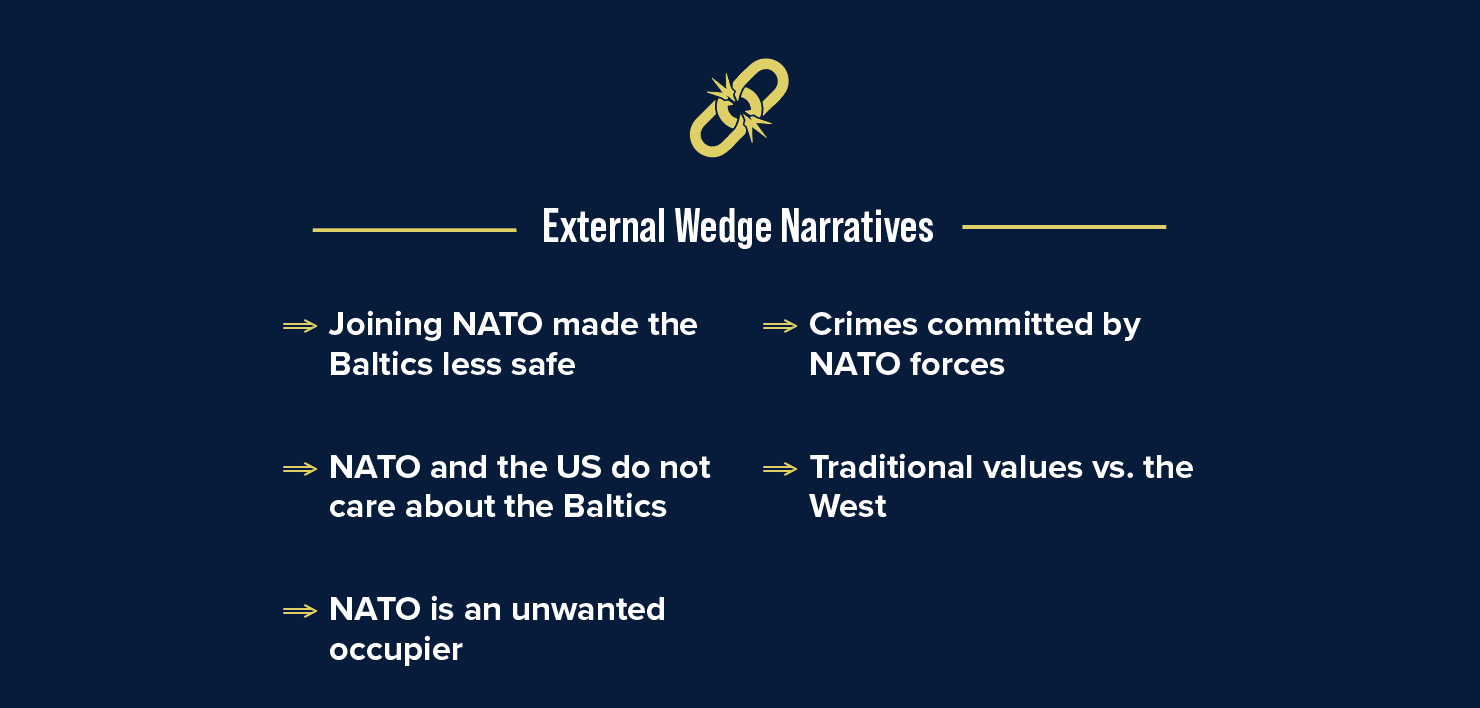
External Wedge Narratives
The narratives discussed above seek to exacerbate internal divisions between titular majorities and Russian-speaking minorities in the Baltics, attempting to sow discord, doubt, uncertainty, and instability in the NATO member states that sit on Russia’s doorstep, with the idea that if you weaken the allies, you weaken the alliance. Another set of Russian-backed narratives target ties between Baltic societies and NATO more explicitly, all serving the broader Russian strategy of asymmetric subtractive balancing.
Joining NATO made the Baltics less safe
This narrative emphasizes that, in joining NATO in 2004, Estonia, Latvia, and Lithuania became targets of the vastly superior Russian military, thereby making them less safe and the likely first casualties in any war between Russia and NATO.[112] A 2017 article published on Baltnews.lv distorted the findings of a 2016 RAND report wargaming a Russian attack in the Baltics, arguing that the Baltic states “will be the first targets” that Russia attacks in a coming war, illustrating the alarmist claim with a photoshopped image of Riga’s famous House of Blackheads in ruins.[113]
NATO and the U.S. don’t care about the Baltics
These claims of vulnerability are often accompanied by assertions that the United States and NATO don’t actually care about the Baltic states and would not (or could not) defend them in the event of war.[114] By promoting such a narrative, Russia seeks to undermine confidence in NATO’s Article 5 guarantees.[115] A 2017 article appearing on rubaltic.ru proclaiming that “Trump has cut funding for the Baltic states” is characteristic. Despite the fact that USAID had not provided funding to the Baltics since 2004, the article’s author misleadingly claimed that the Trump administration’s proposed funding cut for all public diplomacy programs was evidence of America abandoning its Baltic allies: “Washington has said the Baltic states and other parasites, who are used to living off U.S. State Department grants, won’t get a damn thing.”[116] Though it is unclear whether animus for, or even awareness of, Tallinn, Riga, or Vilnius was behind Trump’s budget machinations at the time, the original misleading article was subsequently republished by at least 37 different Russian-language websites, including vesti.lv and baltnews.lt.
Often accompanying these narratives of American indifference are related claims that the Baltic governments are simply American vassals, incapable of independent decision making or foreign policy formulation.[117] Another related narrative portrays the Baltics little more than playgrounds or experimental laboratories for the Washington elite, with everyone’s favorite global conspirator, George Soros as a primary culprit.[118] These narratives often fuel the “failed state” narrative discussed above, as a dependent state is not functional state.
NATO is an unwanted occupier
Attempting to turn the (factual) narrative of the Soviet occupation of the Baltics on its head, another common narrative in the Russian-language press portrays NATO instead as the unwelcome foreign occupier.[119] In an effort to portray NATO’s presence in Latvia as unpopular, the outlet Vesti.lv mischaracterized a German newspaper article and claimed that NATO forces risked provoking riots among the Russian-speaking population.[120] In another telling example of Russia’s instrumental, coordinated, and opportunistic use of traditional and social media to spread misinformation, a 2017 visit by the Estonian president to the Estonian-Russian border provided grist for the propaganda mill. Estonian social media users, observing photos of the President inspecting a border fence with inward-facing metal brackets on top, joked that the fence must be meant to keep Estonians in rather than Russia out. The joke was subsequently picked up by a Russian-speaking social media user in Estonia, who asserted that the fence was meant to keep Estonia’s Russian population from escaping in the event of war, a claim that was echoed by subsequent commenters on the post. Within days, these comments were used as source material for a Baltnews article asserting that the purpose of the Estonian-Russian border fence was to keep Estonia’s Russian-speaking population hostage in the event of war.[121]
Crimes committed by NATO forces
Another strand of anti-NATO propaganda in the Russian-language information space highlights crimes and misdeeds committed by NATO soldiers stationed in the region as part of NATO’s Enhanced Forward Presence. Sometimes these stories are based on a kernel of truth but often grossly mischaracterized; others are fabricated entirely. The purpose of these manipulated or fake stories is to turn public opinion–primarily the Russian-speaking population–against NATO’s presence in the region and, more broadly, against NATO membership itself. One 2018 story claimed that, in Lithuania, a child on a bicycle was run over by a U.S. Army armored personnel carrier during the Sabre Strike NATO exercise. Posted on a blog designed to look identical to a popular Lithuanian news portal, the article claimed that the child died instantly while 13 Americans were injured. In fact, no such death occurred and the story was eventually debunked by journalists and the Lithuanian Ministry of Defense.[122] Several articles published in Latvia during the 2017 Sabre Strike exercises claimed reports of sexual deviancy (Canadian soldiers wearing women’s underwear and predominantly gay units deployed to the region) and rape by NATO soldiers. One asserted, “NATO soldiers on Latvian territory can behave in a loose manner – up to the point of committing rape. And their violations will be hushed up under the pretext of the ‘Russian threat.’”[123] NATO’s 2017 Summer Shield exercises prompted an article on Baltnews claiming that NATO was planning to use Russian-speakers to test new physical, biological, and psychological methods of population control, a claim that originally appeared in the Russian newspaper Nezavisimaya Gazeta.[124] These are but a few of the many examples of falsified stories propagated throughout Russia’s mechanisms of information warfare. They are intended to sow mistrust of NATO forces among the Russian-speaking population and, if possible, undermine the strength of the Baltics states’ commitment to the alliance and vice versa.
Traditional values vs. the West
The final set of wedge narratives seeks to pit Baltic societies against their Western allies by exploiting a variety of potentially divisive social issues. Interviews conducted with Latvian government officials and American diplomatic personnel in 2019 indicated that the narrative that “NATO is bad for the environment” was gaining traction, perhaps indicating an attempt to woo the Latvian Green Party into coalition with the pro-Russian Harmony Centre Party. Yet other narratives emphasize the divide between traditional conservative values (embodied by Russia) and the decadent cosmopolitan values of the West.[125] Oftentimes these narratives focus on LGBTQ+ issues, contrasting the immoral West (sometimes referred to as “Gayropa”) with Russia as the defender of traditional values, particularly following the Russian designation of the “LGBT Movement” as an extremist organization in 2023.[126] “In doing so,” a RAND report notes, “Russia hopes to identify and make more salient the issues that would align the Baltic countries with itself rather than with the EU and the United States.”[127] While LGBTQ+ rights and attitudes vary from relatively progressive (Estonia), to moderately conservative (Lithuania), the issue represents a point of potential commonality between more conservative Baltic citizens and Russians.[128] In recent years, Russian-supported narratives emphasizing the purportedly destabilizing effects of Islamic culture and refugees have similarly sought to separate the Baltic countries from the EU and its unrestricted internal migration policies.[129]
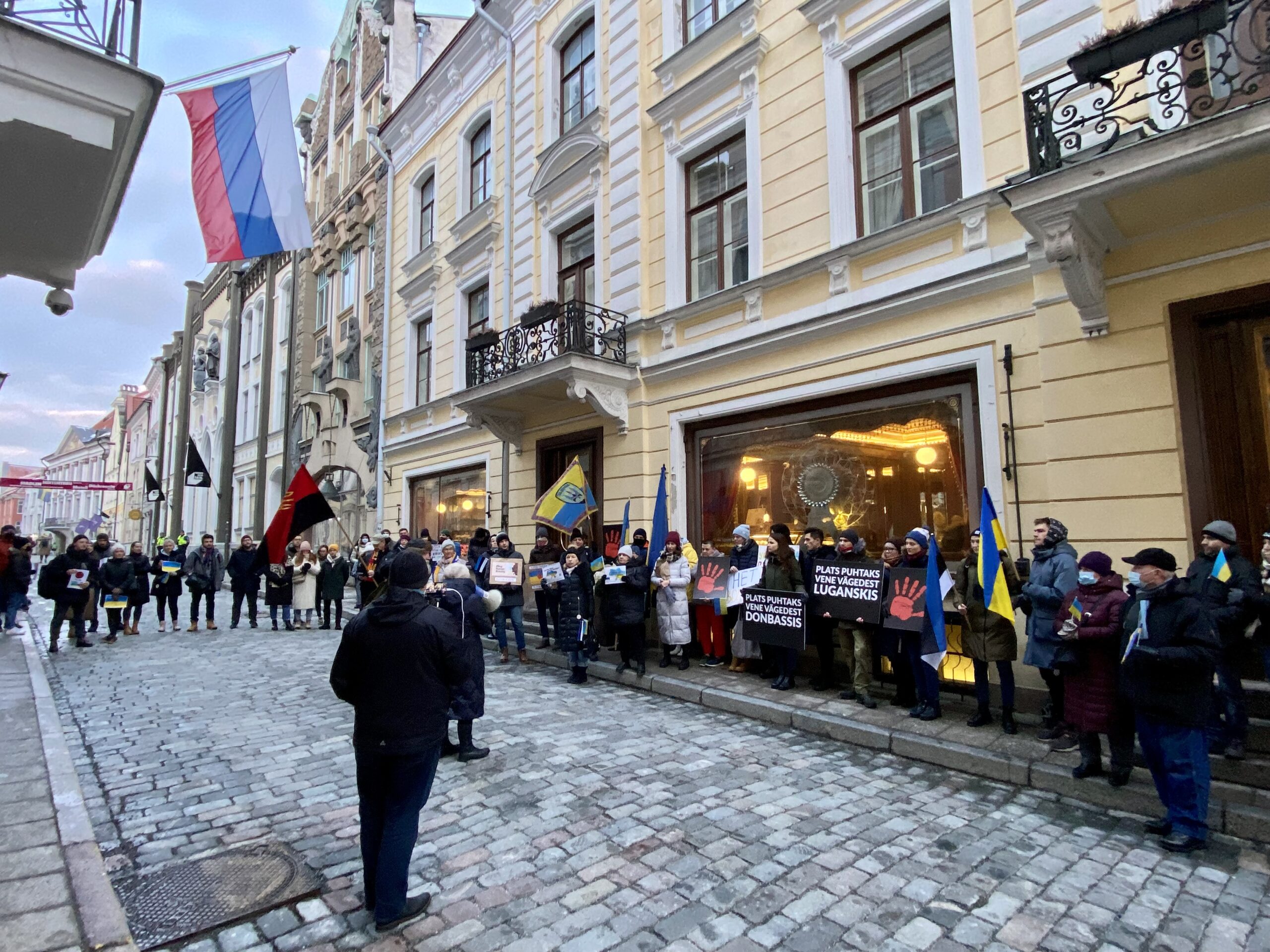
Pro-Ukranianan protest in front of the Russian Embassy in Tallinn, Estonia, February 23, 2022. (Photo by Silver Tambur)
Ukraine as a warning and weapon
After the full-scale invasion of Ukraine in 2022, the Kremlin has propagated Ukraine-related narratives in the Baltics not only to rationalize Putin’s war, but to also sow doubt into Baltic citizens on whether supporting Ukraine is an escalatory and risky economic “burden” that could put their own lives at risk. Russia’s invasion upended post-Cold War assumptions about the durability of European peace, but its messaging was hardly innovative. Instead, the war in Ukraine has served as a more vivid and emotionally charged update to earlier narratives.
For Russia, the war has provided plenty of material to paint Ukraine as a cautionary tale of a small state navigating the “consequences” of NATO partnership, a partnership that has not only cost Ukraine hundreds of thousands of lives but also complicated its path to Euro-Atlantic integration.[130] Russian media and proxies argue that the US and NATO used Ukrainian citizens as pawns to bleed out Russia’s military manpower and capability.[131] The implication is evident: the Baltics are expendable front-line states, not safeguarded allies, and their sons and daughters could be next. Disseminated throughout the information space in Latvia, Lithuania, and Estonia, messaging surrounding the war in Ukraine clearly aims to prompt the Baltic states to draw parallels between Kyiv’s fate and their own if they deepen their reliance on NATO.
Furthermore, Russia continues to portray Ukraine and the West as the aggressors, while amplifying the coercive pressure by claiming that the Baltic states are preparing for hostile actions against Russia. These states are painted as complicit in the war through measures such as sanctions, refugee assistance, and granting Ukraine access to airspace and military infrastructure access. The Baltic states and the European Parliament have fiercely denied any hostile intent or preparation for military action, while Russian propaganda builds the case for “a direct casus belli.”[132] This messaging’s effects are twofold: it twists Baltic solidarity with Ukraine into fear that these actions are only provoking Russian retaliation, and clouds Baltic leaders’ strategic clarity by forcing them to expend energy quelling domestic political instability. The spring 2026 drone incursions into Latvia and the ensuing flood of Russian misinformation are a textbook example of this dynamic, with the Latvian Prime Minister ultimately resigning over her handling of the situation.[133]
Finally, Russia portrays support for Ukraine as a futile and unworthy cause by amplifying messaging of wavering US support and NATO cohesion, refugee crises, Ukrainian corruption, and an impending Ukrainian defeat. This narrative is effective in that it does not sway Baltic citizens to Russia’s cause; it simply has to sow doubt, cynicism, and fatigue. Fabricated stories of Ukrainian leaders with lavish spending habits, for example, insinuate that foreign contributions to the war effort are wasted and that quotidian Baltic citizens are paying for the comfort of oligarchic Ukrainians.[134]
Consequently, narratives about Ukraine overlap with both the Kremlin’s external and internal wedge strategies. Externally, Russia’s manipulation of the information space erodes the Baltics’ trust in Western allies and partners by promoting the perception of fraught alliances and fragile security guarantees. Internally, it exploits difficult domestic issues such as immigration, the economy, and historical memory. In doing so, Russia has tweaked rather than completely overhauling its older Baltic narratives to suit the post-invasion reality: the central messages of an unreliable West remain largely untouched, but Kyiv serves as an emotionally and politically potent illustration of that warning.
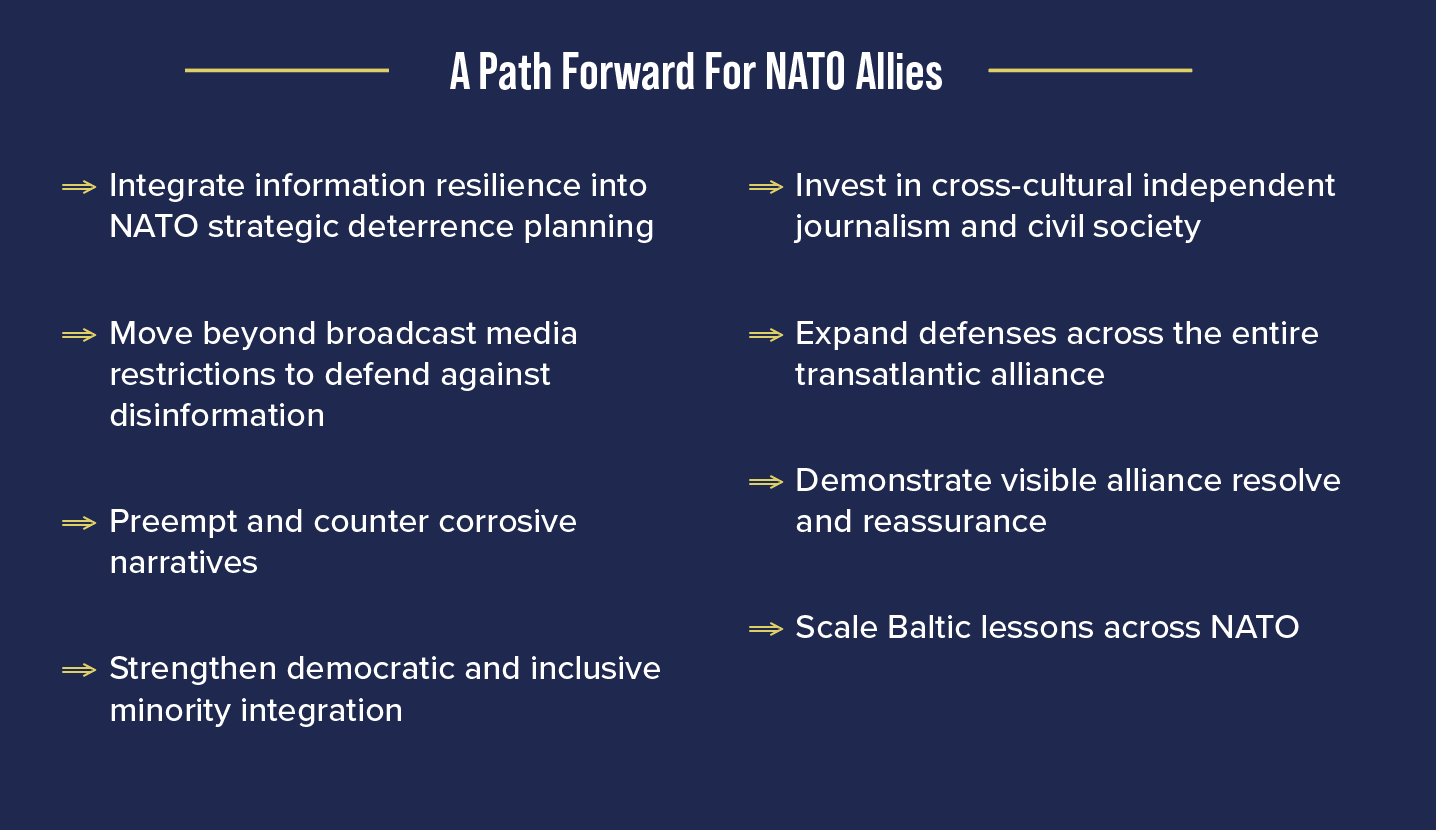
Policy Implications
The critical lesson to be learned from two decades of Russian information warfare against the Baltic states is that such efforts are not simply an effort to make target populations believe the lies manufactured by the Kremlin. Rather, it is a form of political warfare aimed at degrading social trust, exacerbating existing grievances, dividing societies along longstanding–and often contentious–linguistic, ethnic, and historical lines, and ultimately weakening trust in NATO’s ability and willingness to defend its eastern flank. Moscow does not need to win hearts and minds to succeed–it only needs to make democratic publics more cynical, more polarized, more divided, and more skeptical that their allies will defend them in case of an Article 5 scenario. Anything that weakens the cohesion and resolve of NATO and its member states furthers Russia’s strategic objective to eliminate the West as a check on Moscow’s neo-imperial ambitions.
For NATO, this makes information resilience a critical requisite for credible deterrence. Tangible indicators of military capacity–including troop readiness, forward presence, weapons stockpiles, and robust planning–remain indispensable. But these measures only enhance deterrence if both adversaries and allies alike regard NATO commitments as credible. NATO should therefore integrate assessments of social cohesion, public confidence, foreign-information manipulation, and narrative vulnerability into strategic planning while using exercises and deployments to visibly demonstrate Allied capability and resolve. Finally, they must anticipate and preempt corrosive Kremlin narratives before they take root.
The Baltic experience also demonstrates the limits of a counter-propaganda response centered solely on restricting traditional Kremlin-controlled media outlets. Restrictions imposed on Russian-backed media after the full-scale invasion of Ukraine have merely redirected–but not eliminated–Russian influence in the Baltics and beyond. Driven from traditional broadcast and print media, Kremlin-aligned content has migrated through social-media platforms, VPNs, mirror sites, Telegram channels, informal influencers, covert financing, and nominally independent organizations. Western governments must likewise adapt by shifting from a broadcast-era approach to one focused on targeting multidomain information laundering, cross-platform amplification, covert funding, and the rapid adaptation of malign influence networks.
These defensive efforts must not be limited to the Baltics alone, or even to just NATO’s eastern flank. The war in Ukraine has shown how Russian misinformation campaigns have spread lies and undermined support for decisive action as far away as the American heartland. Russia’s machinery of information laundering knows no geographical boundaries–and neither should our defenses.
NATO’s response must also pair these defensive measures with urgent efforts to enhance democratic resilience across the alliance. Within the Baltic states, the correct approach to countering Moscow’s exploitation of minority grievances is not to treat Russian speakers as potential security threats. Rather, governments and cross-cultural civic organizations must ensure that these populations have access to trusted independent media, public services, opportunities for civic participation that transcends linguistic and cultural boundaries, and a meaningful stake in democratic politics. Inclusive integration of minorities, transparent governance, independent Russian-language journalism, and a healthy local civil society are not peripheral social concerts; they are crucial strategic assets that reduce vulnerabilities Moscow seeks to exploit in NATO’s frontline defenders.
Nor can democratic resilience be limited to those closest to the physical threat of Russian aggression. A longstanding track record of Russian interference in democratic processes in the United States, the United Kingdom, and across Europe serve as constant reminders of Moscow’s unrelenting efforts to use democracy as a weapon against itself by seizing upon existing divisions and controversies to distract and disrupt a unified transatlantic response.
The United States and Europe can play a leading role in supporting this effort through sustained political reassurance, intelligence sharing, technical cooperation, and support for independent media and civil society. Together, we must loudly and credibly signal a clear commitment that the defense of Estonia, Latvia, and Lithuania is inseparable from the defense of the transatlantic community. The Baltic states are not simply a target for Russian political warfare–they are also a laboratory for democratic resilience. The policies developed there can help NATO meet a wider challenge: preserving the cohesion, trust, and political will on which collective defense and deterrence ultimately rests.
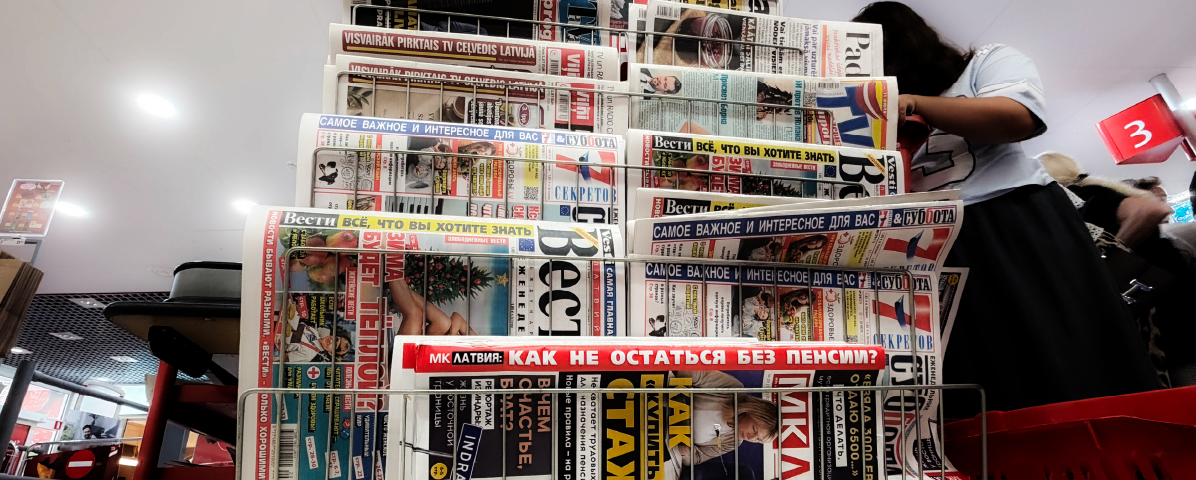
Featured image: Newspapers printed in Russian are displayed for sale on a supermarket shelf in Jurmala, Latvia, on July 26, 2026. Jaap Arriens/Sipa USA via Reuters Connect
[1]Robert Kaiser, “Reassembling the Event: Estonia’s ‘Bronze Night,’” Environment and Planning D: Society and Space 30, no. 6 (2012): 1046, https://doi.org/10.1068/d18210; Karsten Brüggemann and Andres Kasekamp, “The Politics of History and the ‘War of Monuments’ in Estonia,” Nationalities Papers 36, no. 3 (2008): 436, https://doi.org/10.1080/00905990802080646.
[2] Marko Lehti et al., “Never-Ending Second World War: Public Performances of National Dignity and the Drama of the Bronze Soldier,” Journal of Baltic Studies 39, no. 4 (2008): 393–418, https://doi.org/10.1080/01629770802461175; Brüggemann and Kasekamp, “The Politics of History and the ‘War of Monuments’ in Estonia”; James V. Wertsch, “Collective Memory and Narrative Templates,” Social Research 75, no. 1 (2008): 133–56; Siobhan Kattago, “War Memorials and the Politics of Memory: The Soviet War Memorial in Tallinn,” Constellations 16, no. 1 (2009), https://onlinelibrary.wiley.com/doi/abs/10.1111/j.1467-8675.2009.00525.x; Toivo U. Raun, “Estonia after 1991: Identity and Integration,” East European Politics and Societies 23, no. 4 (2009): 526–34, https://doi.org/10.1177/0888325409342113; Martin Ehala, “The Bronze Soldier: Identity Threat and Maintenance in Estonia,” Journal of Baltic Studies 40, no. 1 (2009): 139–58, https://doi.org/10.1080/01629770902722294; Jennie Schulze, “Playing the Compatriot Card in Estonia and Latvia: School Reform and the Bronze Soldier Crisis,” SSRN Scholarly Paper no. 1643469, Rochester, NY, 2010, https://papers.ssrn.com/abstract=1643469.
[3] Schulze, “Playing the Compatriot Card in Estonia and Latvia,” 7, 21–22.
[4] Nina Jankowicz, How to Lose the Information War: Russia, Fake News, and the Future of Conflict (Bloomsbury Publishing, 2020), 35.
[5] Schulze, “Playing the Compatriot Card in Estonia and Latvia,” 23.
[6]Isabella Kwai, “Latvia Tears down a Controversial Soviet-Era Monument in Its Capital.,” World, The New York Times, August 26, 2022, https://www.nytimes.com/2022/08/26/world/europe/latvia-soviet-monument.html; Andrew Higgins, “Estonia Says It Repelled a Major Cyberattack Claimed by Russian Hackers.,” World, The New York Times, August 18, 2022, https://www.nytimes.com/2022/08/18/world/europe/estonia-cyber-attack-russia.html; Raphael S. Cohen and Andrew Radin, Russia’s Hostile Measures in Europe, 2019, 19–24, https://www.rand.org/pubs/research_reports/RR1793.html.
[7] Raphael S. Cohen and Andrew Radin, Russia’s Hostile Measures in Europe, 2019, 19–24, https://www.rand.org/pubs/research_reports/RR1793.html.
[8] As of the 2025 census, approximately 23 percent of Latvians identify as ethnically Russian. The latest census that measured language was conducted in 2011, when approximately 38 percent of Latvians identified Russian as the main language spoken in their home. In the latest population surveys in Estonia and Lithuania (2021), approximately 23 percent of Estonians and five percent Lithuanians self-identified as ethnically Russian. However, around 38% of Estonians and 60% of Lithuanians self-identified as having command of the Russian language (this surpasses the number of English speakers in Lithuania). “Population by Ethnicity at the Beginning of Year by Ethnicity and Time Period, 2025,” National Statistical System of Latvia, accessed March 9, 2026, https://data.stat.gov.lv/pxweb/en/OSP_PUB/START__POP__IR__IRE/IRE010/sortedtable/tableViewSorted/; “TSG11-08. Resident Population of Latvia by Main Language Spoken at Home and Use of Latgalian, Subtype of Latvian Language, on a Daily Basis by Age Group,” Official Statistics Portal, National Statistical System of Latvia, March 1, 2011, https://data.stat.gov.lv/pxweb/en/OSP_OD/OSP_OD__tautassk__taut__tsk2011/TSG11-08.px/table/tableViewLayout1/; “RL21428: POPULATION, 31 DECEMBER 2021 by Ethnic Nationality, Place of Residence and Sex.,” Statistics Estonia, Statistics Estonia, 2021, https://andmed.stat.ee/en/stat/rahvaloendus__rel2021__rahvastiku-demograafilised-ja-etno-kultuurilised-naitajad__rahvus-emakeel/RL21428/table/tableViewLayout2; State Data Agency, “Population by Ethnicity and Municipality,” Official Statistics Portal, Statistics Lithuania, 2021, https://osp.stat.gov.lt/en/statistiniu-rodikliu-analize?hash=0078cd86-acd6-46a8-9843-623bdf998aba#/.
[9] Agnia Grigas, “Legacies, Coercion and Soft Power: Russian Influence in the Baltic States,” Chatham House Briefing Papers, August 2012, https://www.chathamhouse.org/publications/papers/view/185321; Kristian Nielsen and Heiko Paabo, “How Russian Soft Power Fails in Estonia: Or, Why the Russophone Minorities Remain Quiescent,” Journal on Baltic Security 1, no. 2 (2015): 125–57; Greg Simons, “Perception of Russia’s Soft Power and Influence in the Baltic States,” Public Relations Review 41, no. 1 (2015): 1–13, https://doi.org/10.1016/j.pubrev.2014.10.019.
[10] “Soft co-optive power is just as important as hard command power. If a state can make its power seem legitimate in the eyes of others, it will encounter less resistance to its wishes. If its culture and ideology are attractive, others will more willingly follow. If it can establish international norms consistent with its society, it is less likely to have to change. If it can support institutions that make other states wish to channel or limit their activities in ways the dominant state prefers, it may be spared the costly exercise of coercive or hard power.” Joseph S Nye, “Soft Power,” Foreign Policy, no. 80 (1990): 167.
[11] Stefan Meister, “Russian Communication Strategy: Aims, Instruments, Stakeholders of Disinformation and Propaganda,” in Understanding Russian Communication Strategy: Case Studies of Serbia and Estonia, ed. Stefan Meister (Institut für Auslandsbeziehungen, 2018), 9, https://www.ssoar.info/ssoar/bitstream/handle/document/59979/ssoar-2018-meister-Understanding_Russian_Communication_Strategy_Case.pdf; Linda Robinson et al., Modern Political Warfare, 2018, 66, https://www.rand.org/pubs/research_reports/RR1772.html.
[12] Meister, “Understanding Russian Communication Strategy,” 9; Kendrick Foster, “A Walk Down Baltic Avenue,” Harvard Political Review, 2019, http://harvardpolitics.com/world/a-walk-down-baltic-avenue/; John D. Gallacher and Marc W. Heerdink, “Measuring the Effect of Russian Internet Research Agency Information Operations in Online Conversations,” Defence Strategic Communications 6 (2019): 155; Mārtiņš Kaprāns, “The Fog of Fakes: Pro-Kremlin Media Present an Alternative Reality in Latvia,” Center for European Policy Analysis, 2017, http://infowar.cepa.org/Briefs/Lat_20_Feb17.
[13] Paul Goble, “Baltic Region Is Stable; But in Terms of Information War, It’s Not, Latvian Expert Says,” Window on Eurasia, January 2018, https://windowoneurasia2.blogspot.com/2018/01/militarily-baltic-region-is-stable-but.html.
[14] Aiden Hoyle et al., Do(n’t) Shoot the Messenger: Psychological Responses to Kremlin Narratives in Nordic-Baltic Audiences (NATO Strategic Communications Centre of Excellence, 2024), 15; Hugh Cook, BALTIC RESPONSES: COUNTERING RUSSIAN INFORMATION WARFARE OPERATIONS IN THE 21st CENTURY INFORMATION, CYBER, AND PSYCHOLOGICAL SPACES, January 10, 2021; AOWG, Ambiguous Threats and External Influences in the Baltic States – Phase 2: Assessing the Threat (Unclassified), 2015, 34, http://www.stratcomcoe.org/ambiguous-threats-and-external-influences-baltic-states.
[15] Aija Krutaine and Andrius Sytas, “Battle of the Airwaves: Baltics Compete with Russia for Hearts and Minds,” Reuters, n.d., https://www.reuters.com/article/us-baltic-russia-propaganda/battle-of-the-airwaves-baltics-compete-with-russia-for-hearts-and-minds-idUSKBN0LH1OD20150213.
[16] Peter Pomerantsev, Nothing Is True and Everything Is Possible: The Surreal Heart of the New Russia (Public Affairs, 2014).
[17] Cohen and Radin, Russia’s Hostile Measures in Europe, 31; Foster, “A Walk Down Baltic Avenue;’ Mangirdas Morkūnas, “Russian Disinformation in the Baltics: Does It Really Work?,” Public Integrity 25, no. 6 (2023): 599–613, https://doi.org/10.1080/10999922.2022.2092976.
[18] For example, one American diplomat warned that with the right coalition partners, the largest pro-Russian party in Latvia, Harmony Centre, could form a government that while maintaining Latvia’s membership in NATO could nonetheless put the brakes on further integration and cooperation as the alliance seeks to contain Russian aggression in the region. While Harmony Centre has been kept out of Latvian government despite controlling approximately 35 percent of the vote in Latvia, this official expressed concern that “creative” coalition formation with green and farmer parties in Latvia could give Harmony the 51 percent necessary to form a governing coalition, a scenario that was not out of the realm of possibility.
[19] Dr Nerijus Maliukevičius, Fortifying Democracies: Lithuania’s Comprehensive Approach to Counter Disinformation and Propaganda, (Vilnius), April 2024, 8; Viktoriia Ponomareva, “Changing Channels: How Three Years of Kremlin Propaganda Bans in the EU Have Affected Russian-Speaking Audiences,” The Insider, 2025, https://theins.ru/en/politics/279746.
[20] Adam Czarnota et al., “Developing a Legal Framework for Resilient Societies in Latvia and the European Union,” Riga Graduate School of Law, Riga Graduate School of Law, 2024, https://www.rgsl.edu.lv/uploads/recent-publications-list/82/developing-legal-framework-for-resilient-society.pdf?
[21] Martin Laine, Russian State-Backed Foundation Paid Allies in the EU Despite Sanctions (Organized Crime and Corruption Reporting Project, 2025), https://www.occrp.org/en/project/dear-compatriots/russian-state-fund-paid-allies-in-the-eu-despite-sanctions; NATO StratCom COE, Information Laundering Via Baltnews on Telegram: How Russian State-Sponsored Media Evade Sanctions and Narrate the War (Riga, Latvia, 2022).
[22] Oxana Shevel, “Russian Nation-Building from Yel’tsin to Medvedev: Ethnic, Civic or Purposefully Ambiguous?,” Europe-Asia Studies 63, no. 2 (2011): 179–202.
[23] NATO StratCom COE, Russia’s Footprint in the Nordic-Baltic Environment: Report 2016/2017 (NATO StratCom COE, 2017), 37, https://www.stratcomcoe.org/russias-footprint-nordic-baltic-information-environment-0.
[24] Robinson et al., Modern Political Warfare, 57.
[25] NATO StratCom COE, Russia’s Footprint in the Nordic-Baltic Environment: Report 2016/2017, 35.
[26] In addition to Rossotrudnichestvo, this includes the Ministry of Foreign Affairs’ Department for Cooperation with Compatriots and other lesser institutions under the Russian MFA, Government, and Duma.
[27] Simons, “Perception of Russia’s Soft Power and Influence in the Baltic States,” 5.
[28] Rossotrudnichestvo, “Support for Compatriots Abroad,” 2019, http://rs.gov.ru/en/activities/5.
[29] “Геннадий Алексеевич Овечко о Работе с Российской Диаспорой в Новых Геополитических Реалиях,” Русский Век, Министерство иностранных дел РФ, May 12, 2026, https://ruvek.mid.ru/publications/gennadiy_alekseevich_ovechko_o_rabote_s_rossiyskoy_diasporoy_v_novykh_geopoliticheskikh_realiyakh/?
[30] Cohen and Radin, Russia’s Hostile Measures in Europe, 41–42; AOWG, Ambiguous Threats and External Influences in the Baltic States – Phase 2: Assessing the Threat (Unclassified), 36.
[31] Laine, Russian State-Backed Foundation Paid Allies in the EU Despite Sanctions.
[32] NATO StratCom COE, Russia’s Footprint in the Nordic-Baltic Environment: Report 2016/2017, 46.
[33] Russkiiy Mir Foundation, “Mission Statement,” https://russkiymir.ru/en/fund/index.php.tement.
[34] NATO StratCom COE, Hybrid Threats: A Strategic Communications Perspective (NATO StratCom COE, 2019), 86–87, https://www.stratcomcoe.org/hybrid-threats-strategic-communications-perspective.
[35] Juulia Barthel, “Communication Strategy of Russia: A Case Study of Estonia,” in Understanding Russian Communication Strategy: Case Studies of Serbia and Estonia, ed. Stefan Meister (Institut für Auslandsbeziehungen, 2018), 38, https://www.ssoar.info/ssoar/bitstream/handle/document/59979/ssoar-2018-meister-Understanding_Russian_Communication_Strategy_Case.pdf.
[36] Inga Spriņģe et al., “Spreading Democracy in Latvia, Kremlin Style,” Re:Baltica, March 19, 2012, https://en.rebaltica.lv/2012/03/spreading-democracy-in-latvia-kremlin-style/?utm_source=chatgpt.com.
[37] Latvian State Security Service, Annual Report on the Activities of Latvian State Security Service (VDD) in 2025 (2026), 30–34.
[38] Mikk Salu Šarūnas Černiauskas Sanita Jemberga, “Kremlin’s Millions,” Re:Baltica, n.d., https://en.rebaltica.lv/2015/08/kremlins-millions/.
[39] Re:Baltica, “Re:Baltica Exposes Kremlin Support for Its Activists in Latvia / Article,” Latvian Public Service Media, May 26, 2025, https://eng.lsm.lv/article/politics/politics/26.05.2025-rebaltica-exposes-kremlin-support-for-its-activists-in-latvia.a600547/; Oleksandra Levchak et al., “Russian Historian Expat in Latvia Leads Kremlin-Funded ‘Russophobia’ Research,” Re:Baltica, March 2, 2026, https://en.rebaltica.lv/2026/03/russian-historian-expat-in-latvia-leads-kremlin-funded-russophobia-research/.
[40] Robinson et al., Modern Political Warfare, 98; Cohen and Radin, Russia’s Hostile Measures in Europe, 33.
[41] Gert Armand Valgerist, “Estonia: Rise and Fall of the Centre Party,” Europe Elects, 2024, https://europeelects.eu/2024/04/26/estonia-rise-and-fall-of-the-centre-party/.
[42] Jānis Ikstens, The 2018 Latvian Elections: New Faces, Old Patterns, n.d., https://blogs.lse.ac.uk/europpblog/2018/10/16/the-2018-latvian-elections-new-faces-old-patterns/;
[43]NATO StratCom COE, Russia’s Information Influence Operations in the Nordic-Baltic Region (Riga, 2024), 83–84.
[44] Sanita Jemberga et al., Kremlin’s Millions, August 27, 2015, https://en.rebaltica.lv/2015/08/kremlins-millions/.
[45]NATO StratCom COE, Hybrid Threats: A Strategic Communications Perspective, 76–77. NATO StratCom COE, Hybrid Threats, 76–77.
[46] AOWG, Ambiguous Threats and External Influences in the Baltic States – Phase 2: Assessing the Threat (Unclassified), 37–38; Jemberga et al., Kremlin’s Millions; Aleksandra Kuczyńska-Zonik, “Antidiplomacy in Russia’s Policies Regarding Russian-Speakers in the Baltic States,” Baltic Journal of Political Science, no. 5 (2016): 97–98; Robinson et al., Modern Political Warfare, 97; Cohen and Radin, Russia’s Hostile Measures in Europe, 34.
[47] Laine, Russian State-Backed Foundation Paid Allies in the EU Despite Sanctions; Alva Ree, “Presentation of the Baltic Platform: A New International Dialogue Initiative in Kaliningrad,” World Reporter, November 6, 2024.
[48] Toms Rostoks and Nora Vanaga, “Latvia’s Security and Defence Post-2014,” Journal on Baltic Security 2, no. 2 (2016): 87.
[49] Ieva Berzina, “Political Trust and Russian Media in Latvia,” Journal on Baltic Security 4, no. 2 (2018): 4.
[50] LSM et al., Sabiedriska-Labuma-Aptaujas-Zinojums-2025-3 (2025 Survey on the Public Benefit of Latvia’s Public Media) (n.d.), 82, accessed June 29, 2026, https://ppdb.mk.gov.lv/wp-content/uploads/2025/04/Sabiedriska-labuma-aptaujas-zinojums-2025-3.pdf.
[51] Rostoks and Vanaga, “Latvia’s Security and Defence Post-2014,” 87–88.
[52] Jana Altenberga et al., Baltic Media Health Check 2022-2023, January 2024, 47.
[53] Elina Vroblevska and Beniamino Irdi, “What’s the Best Way to Deal with Russian Information Manipulation? Latvia Has Answers.,” Atlantic Council, May 5, 2025, https://www.atlanticcouncil.org/blogs/new-atlanticist/whats-the-best-way-to-deal-with-russian-information-manipulation-latvia-has-answers/.
[54] Andris Saulītis, “LATVIJAS MAZĀKUMTAUTĪBU IEDZĪVOTĀJU SABIEDRISKO MEDIJU LIETOJUMA PARADUMI UN VAJADZĪBAS (Public Media Usage Habits and Needs of Latvia’s Minority Population,” Public Electronic Mass Media Council (SEPLP), 2024, 34, https://www.seplp.lv/lv/media/2775/download?attachment=.
[55] Dollar conversion is the author’s calculation using the 2026 budget allocation of 11.179 billion rubles. The 2026 budget also includes broader state-media subsides under the same « Information Society » program, including large allocations to VGTRK, Channel One, TASS, and other outlets. Rossiya Segodnya is part of a much larger state-media funding ecosystem. Федеральный Закон От 28.11.2025 № 426-ФЗ «О Федеральном Бюджете На 2026 Год и На Плановый Период 2027 и 2028 Годов» (Federal Law No. 426-FZ of November 28, 2025 “on the Federal Budget for 2026 and the Planning Period of 2027 and 2028”), Pub. L. No. No. 426-FZ (2025).
[56] Juulia Barthel, “Communication Strategy of Russia: A Case Study of Estonia,” in Understanding Russian Communication Strategy: Case Studies of Serbia and Estonia, ed. Stefan Meister (Institut für Auslandsbeziehungen, 2018), 42, https://www.ssoar.info/ssoar/bitstream/handle/document/59979/ssoar-2018-meister-Understanding_Russian_Communication_Strategy_Case.pdf.
[57] Robinson et al., Modern Political Warfare, 63.
[58] Council of the European Union, “EU Imposes Sanctions on State-Owned Outlets RT/Russia Today and Sputnik’s Broadcasting in the EU,” March 2, 2022, https://www.consilium.europa.eu/en/press/press-releases/2022/03/02/eu-imposes-sanctions-on-state-owned-outlets-rtrussia-today-and-sputnik-s-broadcasting-in-the-eu/?utm_source=chatgpt.com&__cf_chl_f_tk=RMQvv4u460e0KHcrWrUQdUTRP19.hStw2WuuwCC1Tlc-1782836292-1.0.1.1-UWKnnqGh8t.Nnhy.mtew5JH1hWFQqC_yArLQus4htdE; Maliukevičius, Fortifying Democracies: Lithuania’s Comprehensive Approach to Counter Disinformation and Propaganda, 7; Daniel Kosoy and Amira Barkhush, How Russian Propaganda Targets the Baltics Online Beyond TV Bans — UNITED24 Media (1), August 2025; Altenberga et al., Baltic Media Health Check 2022-2023, 7.
[59] NATO StratCom COE, Russia’s Footprint in the Nordic-Baltic Environment, 88.
[60] Barthel, “Understanding Russian Communication Strategy,” 40.
[61] Robinson et al., Modern Political Warfare, 63; Aleksander Krol, “Russian Information Warfare in the Baltic States — Resources and Aims,” Warsaw Institute Review, July 2017, https://warsawinstitute.org/russian-information-warfare-baltic-states-resources-aims/.
[62] ERR, Sharp Divide Between Foreign Policy Views of Estonians and Russians in Estonia, 2025.
[63] Krol, “Russian Information Warfare in the Baltic States — Resources and Aims.”
[64] Inga Spriņģe and Sanita Jemberga, “Sputnik’s Unknown Brother,” Re:Baltica, n.d., https://en.rebaltica.lv/2017/04/sputniks-unknown-brother/.
[65] Roonemaa and Spriņģe, “Kremlin’s Millions”
[66] Nerijus Maliukevičius, “‘Tools of Destabilization’: Kremlin’s Media Offensive in Lithuania,” Journal on Baltic Security 1, no. 1 (2015): 122.
[67] Altenberga et al., Baltic Media Health Check 2022-2023.
[68] NATO StratCom COE, Russia’s Footprint in the Nordic-Baltic Environment, 28.
[69] Mindaugas Kuklys and Raul Carstocea, “Instigations of Separatism in the Baltic States,” European Centre for Minority Issues Brief 35 (2015): 5–7, http://www.ecmi.de/publications/detail/instigations-of-separatism-in-the-baltic-states-328/.
[70] Indra Ekmanis, “Defriending in the Baltics: Lessons from Facebook’s Sputnik Crackdown,” Baltic Bulletin – Foreign Policy Reserach Institute, 2019, https://www.fpri.org/article/2019/01/defriending-in-the-baltics-lessons-from-facebooks-sputnik-crackdown/.
[71] NATO StratCom COE, ed., “Robotrolling 2018,” Robotrolling 2018, no. 1 (2018), https://www.stratcomcoe.org/robotrolling-20181.
[72] NATO Strategic Communications Centre of Excellence, Virtual Manipulation Brief 2025: From War and Fear to Confusion and Uncertainty (2025), https://stratcomcoe.org/publications/download/VMB-Final-5aa5d.pdf; European External Action Service, 3rd Report on Foreign Information Manipulation and Interference (March 2025), https://www.eeas.europa.eu/sites/default/files/documents/2025/EEAS-3nd-ThreatReport-March-2025-05-Digital-HD.pdf.
[73] Todd C Helmus et al., Russian Social Media Influence (RAND Corporation, 2018), 27–45, https://www.rand.org/pubs/research_reports/RR2237.html; Gallacher and Heerdink, “Measuring the Effect of Russian Internet Research Agency Information Operations in Online Conversations.”.
[74] NATO StratCom COE, ed., “Robotrolling 2019,” Robotrolling 2019, no. 2 (2019), https://www.stratcomcoe.org/robotrolling-20191.
[75] Helmus et al., Russian Social Media Influence, 22–25; Michael Weiss, “The Baltic Elves Taking on Pro-Russian Trolls,” The Daily Beast, n.d., https://www.thedailybeast.com/the-baltic-elves-taking-on-pro-russian-trolls.
[76] Author’s interview, Latvian Ministry of Defense, June 2019
[77] Helmus et al., Russian Social Media Influence, 12–13.
[78] Peter Dizikes, “Study: On Twitter, False News Travels Faster than True Stories,” MIT News, Massachusetts Institute of Technology, March 8, 2018, https://news.mit.edu/2018/study-twitter-false-news-travels-faster-true-stories-0308.
[79] Latvian State Security Service. Annual Report of the Activities of Latvian State Security Service (VDD). n.d.
[80] Latvian State Security Service, Annual Report of the Activities of Latvian State Security Service (VDD) (n.d.).
[81] Laine, Martin. Russian State-Backed Foundation Paid Allies in the EU Despite Sanctions. Organized Crime and Corruption Reporting Project, 2025. https://www.occrp.org/en/project/dear-compatriots/russian-state-fund-paid-allies-in-the-eu-despite-sanctions.
[82] Semjonova, Ella. Russia Strengthens Operations in Baltic States – Increasingly Recruiting Youth. n.d.
[83] NATO StratCom COE, Russia’s Footprint in the Nordic-Baltic Environment, 42, 63; Barthel, “Understanding Russian Communication Strategy,” 32–33; Foster, “A Walk Down Baltic Avenue”; Andrey Makarychev, “Centenary Anniversaries of Independence: Baltic, East European, and Caucasian Contexts,” PonarsEuarasia – Policy Memo No. 586, March 2019, 6, http://www.ponarseurasia.org/memo/centenary-anniversaries-independence-baltic-east-european-and-caucasian-contexts.
[84] For background see (Karsten Brüggemann and Andres Kasekamp, “The Politics of History and the ‘War of Monuments’ in Estonia,” Nationalities Papers 36, no. 3 (2008): 425–48; Martin Ehala, “The Bronze Soldier: Identity Threat and Maintenance in Estonia,” Journal of Baltic Studies 40, no. 1 (2009): 139–58)
[85] NATO StratCom COE, Hybrid Threats, 84–85; Barthel, “Understanding Russian Communication Strategy,” 32–33.
[86] AOWG, Ambiguous Threats and External Influences in the Baltic States – Phase 2, 31.
[87] Polygraph.info, Sputnik and Zvezda Falsely Claim Hitler’s Mein Kampf Is More Popular Than Harry Potter in Latvia, n.d., https://www.polygraph.info/a/factcheck-harry-potter-hitler-latvia/29166375.html.
[88] Mārtiņš Kaprāns, “Disinfo Seeks to Discredit Latvia’s National Celebrations,” Center for European Policy Analysis, 2017, http://infowar.cepa.org/Briefs/Lv/Disinfo_LV_national_celebrations.
[89] NATO StratCom COE, Russia’s Footprint in the Nordic-Baltic Environment, 68.
[90] Kaprāns, “Disinfo Seeks to Discredit Latvia’s National Celebrations.”
[91] Lukas Andriukaitis, “Russia’s ‘Nazi’ Narrative Against Lithuania and the Baltic States,” Integrity Initiative, n.d., https://www.stopfake.org/en/russia-s-nazi-narrative-against-lithuania-and-the-baltic-states/.
[92] Kuczyńska-Zonik, “Antidiplomacy in Russia’s Policies Regarding Russian-speakers in the Baltic States,” 97.
[93] EU vs Disinfo, The Nazi-obsession of Pro-Kremlin Propagandists, n.d., https://euvsdisinfo.eu/the-nazi-obsession-of-pro-kremlin-propagandists/.
[94] EU vs Disinfo, The Nazi-obsession of Pro-Kremlin Propagandists.
[95] The orange and black ribbons of the Tsarist-era Order of St. George and Soviet-era Victory over Germany medal are ubiquitous in early May throughout the post-Soviet world.
[96] Maliukevičius, “‘Tools of Destabilization’,” 123; NATO StratCom COE, Russia’s Footprint in the Nordic-Baltic Environment, 45–46, 51; NATO StratCom COE, Hybrid Threats, 86–87.
[97] AOWG, Ambiguous Threats and External Influences in the Baltic States – Phase 2, 38.
[98] NATO StratCom COE, Russia’s Footprint in the Nordic-Baltic Environment, 68.
[99] Kuczyńska-Zonik, “Antidiplomacy in Russia’s Policies Regarding Russian-speakers in the Baltic States,” 96; Viktor Denisenko, “How Kremlin Uses the ‘European Field’ to Win the Propaganda Game,” StopFake / Vilnius Institute for Policy Analysis, n.d., https://www.stopfake.org/en/how-kremlin-uses-the-european-field-to-win-the-propaganda-game/.
[100] Mattathias Schwartz, “Who Killed the Kiev Protestors? A 3-D Model Holds the Clues,” New York Times Magazine, n.d., https://www.nytimes.com/2018/05/30/magazine/ukraine-protest-video.html.
[101] Brian Whitmore, “The ’Russophobia’ Weapon,” RFE/RL, n.d., https://www.rferl.org/a/the-russophobia-weapon/28476678.html; Urve Eslas, “How a Social Media Joke Became Anti-NATO Propaganda in Estonia,” Center for European Policy Analysis, n.d., http://infowar.cepa.org/Briefs/Est/How-a-social-media-joke-became-anti-NATO-prop-Estonia; Владимир Симиндей, “Прибалтика 2026: Громко Стартовала Гонка По Русофобской Вертикали,” 2026.
[102] NATO StratCom COE, Russia’s Footprint in the Nordic-Baltic Environment, 69.
[103] While there have been cases of immigration, independent investigative sources and state migration databases estimate less than 2,000 indiviuals have moved from the Baltics to Russia since 2022. Spriņģe, Inga and Re:Baltica. Kremlin Propaganda Revives as ‘Neutral’ YouTube Channels Amid Claims of Baltic Migration | Re:Baltica. January 28, 2025. https://en.rebaltica.lv/2025/01/kremlin-propaganda-revives-as-neutral-youtube-channels-amid-claims-of-baltic-migration/.
[104] NATO StratCom COE, Hybrid Threats, 86–87.
[105] Kuczyńska-Zonik, “Antidiplomacy in Russia’s Policies Regarding Russian-speakers in the Baltic States,” 95–96; Страны Прибалтики и Украина лидируют в проявлениях русофобии, заявили в МИД РФ, б. д.
[106] Interview, Latvian Ministry of Defense official, June 2019
[107] NATO StratCom COE, Russia’s Footprint in the Nordic-Baltic Environment, 46–47.
[108] Barthel, “Understanding Russian Communication Strategy,” 33.
[109] Mārtiņš Kaprāns, “Civil War in Latvia? Not so Fast,” Center for European Policy Analysis, n.d., http://infowar.cepa.org/Lat/Civil-war-in-Latvia-Not-so-fast.
[110] Kaprāns, “Civil War in Latvia? Not so Fast.”
[111] Hirss, Echoes from Kremlin: New Platforms, Old Narratives.
[112] Mārtiņš Kaprāns, “Russia Ratchets up Rhetoric in the Baltics,” Center for European Policy Analysis, 2017, http://infowar.cepa.org/Briefs/Lv/Russia-ratchets-up-rhetoric-in-the-Baltics.
[113] Ben Nimmo et al., “Russian Narratives on NATO’s Deployment,” Atlantic Council Digital Forensic Research Lab, n.d., https://medium.com/dfrlab/russian-narratives-on-natos-deployment-616e19c3d194.
[114] Nimmo et al., “Russian Narratives on NATO’s Deployment.”
[115] Rostoks and Vanaga, “Latvia’s Security and Defence Post-2014,” 77.
[116] Inga Spriņģe, “Small Time Propagandists,” Re:Baltica, n.d., https://en.rebaltica.lv/2017/04/small-time-propagandists/.
[117] AOWG, Ambiguous Threats and External Influences in the Baltic States – Phase 2, 31; NATO StratCom COE, Russia’s Footprint in the Nordic-Baltic Environment, 67.
[118] NATO StratCom COE, Russia’s Footprint in the Nordic-Baltic Environment, 63.
[119] Nimmo et al., “Russian Narratives on NATO’s Deployment.”
[120] Kaprāns, “The Fog of Fakes.”
[121] Urve Eslas, “How a Social Media Joke Became Anti-NATO Propaganda in Estonia,” Center for European Policy Analysis, n.d., http://infowar.cepa.org/Briefs/Est/How-a-social-media-joke-became-anti-NATO-prop-Estonia.
[122] “Baltic Brutality?” EU Vs Disinfo, n.d., https://euvsdisinfo.eu/baltic-brutality/.
[123] Mārtiņš Kaprāns, “Latvia’s Pro-Kremlin Media Spread Crude NATO Disinformation,” Center for European Policy Analysis, 2017, http://infowar.cepa.org/Briefs/Lv/Latvias-pro-Kremlin-media-spread-obscene-NATO-disinformation.
[124] Mārtiņš Kaprāns, “Latvia Inundated with Anti-NATO Narratives While Hosting Alliance Exercise,” Center for European Policy Analysis, 2017, http://infowar.cepa.org/briefs/Latvia-inundated-with-anti-NATO-narratives-while-hosting-alliance-exercise.
[125] Daria Litvinova, “Human Wrongs: How State-Backed Media Helped the Kremlin Weaponise Social Conservatism,” Reuters Institute Fellowship Paper, University of Oxford, 2018, https://reutersinstitute.politics.ox.ac.uk/sites/default/files/2018-10/Daria Litvinova Journalist Fellow paper.pdf.
[126] Barthel, “Understanding Russian Communication Strategy,” 36;“Russia: Supreme Court Bans ‘LGBT Movement’ as ‘Extremist,’” Human Rights Watch, November 30, 2023, https://www.hrw.org/news/2023/11/30/russia-supreme-court-bans-lgbt-movement-extremist.
[127] Cohen and Radin, Russia’s Hostile Measures in Europe, 46.
[128] “LGBT Equality Index in Baltic Countries ,” Equaldex, 2023, https://www.equaldex.com/equality-index?region=Baltic+Countries.
[129] NATO StratCom COE, Russia’s Footprint in the Nordic-Baltic Environment, 62.
[130] Helene Cooper, “Troop Casualties in Ukraine War Near 2 Million, Study Finds,” U.S., The New York Times, January 27, 2026, https://www.nytimes.com/2026/01/27/us/politics/russia-ukraine-casualties.html; “EU and Ukraine Open First Accession Negotiations Cluster – Enlargement and Eastern Neighbourhood,” accessed June 16, 2026, https://enlargement.ec.europa.eu/news/eu-and-ukraine-open-first-accession-negotiations-cluster-2026-06-15_en.
[131] TACC, “В МИД РФ Назвали Заявление По СВО Совета НАТО – Украина Примером Антироссийской Пропаганды.”
[132] “Russia’s Unfounded Allegations: EP Leaders Express Full Solidarity with the Baltic States,” accessed June 21, 2026, https://www.eeas.europa.eu/delegations/ukraine/russia%E2%80%99s-unfounded-allegations-ep-leaders-express-full-solidarity-baltic-states_en?s=232.; Re:Baltica, “How Russian Propaganda Created the Tale of Baltic’s Opening the Skies to Ukrainian Drones,” European Digital Media Observatory, Baltic Engagement Centre for Combatting Information Disorders, April 9, 2026, https://edmo.eu/publications/how-russian-propaganda-created-the-tale-of-baltics-opening-the-skies-to-ukrainian-drones/.
[133] Mathieu Pollet, “Latvian Prime Minister Quits after Backlash over Stray Ukrainian Drone Strikes – ,” POLITICO, May 14, 2026, https://www.politico.eu/article/latvian-prime-minister-quits-after-backlash-over-stray-ukrainian-drone-strikes/.; Budginaite-Froehly, “How Russia Exploits Drone Incursions in the Baltics—and How to Respond,” Atlantic Council, May 20, 2026, https://www.atlanticcouncil.org/dispatches/how-russia-exploits-drone-incursions-in-the-baltics-and-how-to-respond/.
[134] Regional EU Disinformation Resilience-related Network of Journalists, “Results of Pro-Russian Information Manipulation and Disinformation Monitoring Targeting Ukraine-EU Relations during June–August, 2025,” Delegation of the European Union to Ukraine, European External Action Service, October 24, 2025, https://www.eeas.europa.eu/delegations/ukraine/results-pro-russian-information-manipulation-and-disinformation-monitoring-targeting-ukraine-eu_en?s=232.; EU vs Disinfo, “5 Insidious Disinfo Narratives Spread by the Kremlin,” EU vs Disinfo, European External Action Service, December 16, 2025, https://euvsdisinfo.eu/5-insidious-disinfo-narratives-spread-by-the-kremlin/.