 A Nation Must Think Before it Acts
Russia’s War of Self-Destruction
A Nation Must Think Before it Acts
Russia’s War of Self-Destruction

A nation must think before it acts.

Russia’s War of Self-Destruction
Executive Summary
Russia’s war against Ukraine has precipitated a large-scale structural decline for the Kremlin across economic, military, and geopolitical dimensions. Domestically, its war-driven economy is consistently strained by rising fiscal pressure, inflation, and structural imbalances linked to continuous military spending. While the war remains challenging for Ukraine to sustain as well, Kyiv has demonstrated it is increasingly capable of sustaining a war of attrition. On the battlefield, Ukraine’s destruction of key logistical targets inside Russia has been weakening the aggressor’s ability to wage war. Meanwhile, Russia continues to lose soldiers at an alarming rate with little results to show for it. Although both sides receive assistance from external partners, these support systems differ in important ways: Ukraine is backed by an integrated and technologically advanced coalition, while Russia relies on more limited, transactional relationships. Additionally, Russia’s broader support network is itself coming under pressure, as recent developments in Iran and Venezuela illustrate a weakening or reorientation of Moscow’s key partners. To make matters worse for Russia, the Kremlin is steadily losing geopolitical influence across many regions of the globe. These dynamics suggest that time is more likely to disadvantage Russia than Ukraine. Premature negotiations would interrupt this trajectory and risk converting Russia’s self-inflicted strategic erosion into a political outcome it could not achieve militarily. The West should therefore pursue strategic patience by sustaining support for Ukraine, maintain pressure on Russia and its partners, and avoid forcing a settlement that rewards aggression.
Introduction: Time Does Not Favor Russia
One of the prevailing narratives on questions of war termination in Ukraine portrays the conflict as a strategic stalemate in which time favors Russia. Through this lens, Ukraine would be wise to accept a negotiated settlement even with unfavorable terms.[1] This view is most commonly seen across the “restraint” circles in Washington and aligns closely with the Kremlin’s own portrayal of the war.
The Kremlin has pursued an expansive information campaign aimed at shaping perceptions of the war both domestically and abroad aimed at convincing audiences that a Russian victory is inevitable despite evidence to the contrary. This effort has been reinforced by a roughly 54 percent increase in funding for state-controlled media in 2026.[2] The current US presidential administration also seems to be sympathetic to this view, as officials have been heard making statements such as “the Europeans don’t get to prolong this war and backdoor unreasonable expectations, while also expecting America to bear the cost.”[3] Even President Donald Trump echoed this line of thinking when he suggested that a Russian victory would be inevitable because of its relative size compared to Ukraine. “Russia,” he said, “has the upper hand. And they always did. They’re much bigger. They’re much stronger, at some point, size will win.”[4]
This interpretation, however, misreads the trajectory of the war. Russia’s larger resources have not produced decisive battlefield gains, only high losses for minimal returns. Not only is Russia fighting inefficiently, but evidence also suggests that Russia is exhibiting demonstratable weakness across multiple sectors including its economy and its global standing. In this context, calls for a premature settlement risk turning Russia’s inability to win on the battlefield into a political success.
Russia’s battlefield approach remains costly and inefficient, expending large amounts of manpower and materiel for limited territorial gains.[5] Its economy has been restructured around wartime production, which has created long-term inefficiencies such as rising fiscal pressure, inflation, and dependence on continued conflict to sustain growth.[6] In contrast, Ukraine, fighting largely from a defensive position, is exhibiting a lower casualty rate and has increasingly leveraged drone warfare and other innovations to inflict disproportionate costs onto Russia.[7]
Geopolitically, Russia’s ability to sustain the war relies on a broader network of external partners that help Moscow evade sanctions and maintain economic and military flows.[8] That network is now coming under increasing pressure. Developments in Iran and Venezuela suggest that key components of Russia’s support system are weakening or reorienting, making it more of a challenge for Russia to sustain its war effort over time. In addition, increased pressure on Russia’s “shadow fleet” as well as Ukrainian strikes on important military logistics sites and oil refineries have reduced valuable sources of revenue. Moscow’s global standing has started to erode, both in places it traditionally held influence, such as former Soviet states, to a certain extent Europe, and in many parts of the Global South.[9]
Although Russia may have greater resources, time may increasingly work against it. Premature negotiations risk interrupting this trajectory. Instead, the West should pursue a strategy of sustained support for Ukraine while continuing to apply pressure not only on Russia itself, but also on the broader network that enables its war effort.
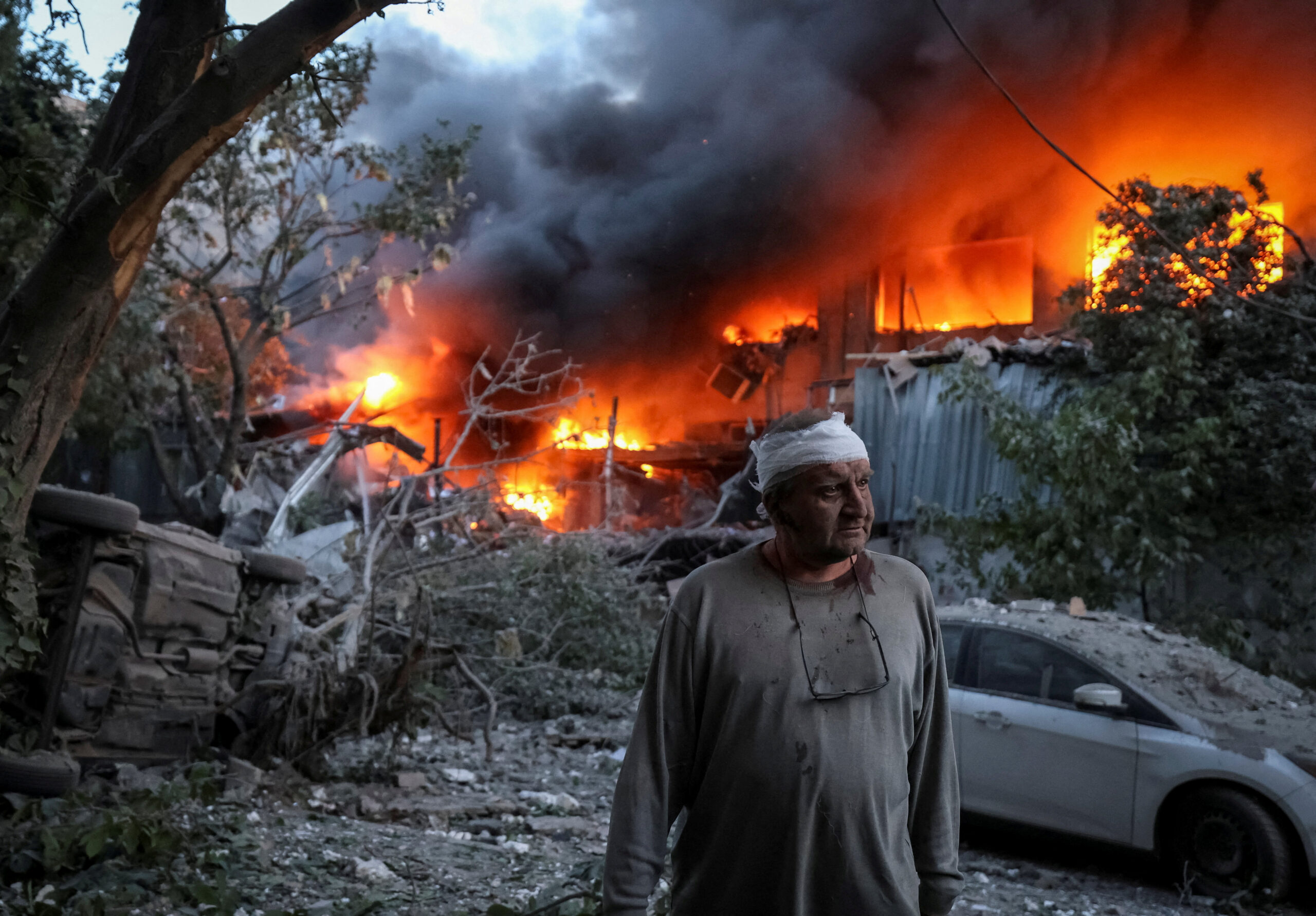
A resident stands at a site of a Russian drone and missile strike, amid Russia’s attack on Ukraine, in Kyiv, Ukraine June 2, 2026. REUTERS/Stringer TPX IMAGES OF THE DAY
A Strategy of Exhaustion
On the battlefield, Russia’s approach has relied on sustained pressure through manpower and firepower, but this has failed to produce meaningful strategic breakthroughs. Russia continues to fight inefficiently, losing many men while capturing little territory. According to a report from the Center for Strategic and International Studies, Russia is advancing at an average rate of 15–70 meters per day. Since 2024, only 1.5 percent of Ukraine has been captured, showing that Russia is not translating effort into meaningful strategic gains. In addition, Russia’s offensive comes at historically unprecedented human costs, with nearly 1.2 million casualties, indicating a strategy of exhaustion rather than success. Ukraine’s casualties are estimated at 500,000 to 600,000 total, exhibiting a roughly 2:1 ratio of Russian to Ukrainian casualties between February 2022 and December 2025.[10]
To make matters worse for the Russian military, the rate at which it can replace casualties has now declined significantly. As Michael Kofman notes, between 2022 and 2024 the Russian military was able to absorb high casualty rates while still expanding its overall force structure. Recruitment was sufficiently robust that roughly 30 percent of new personnel could be used to form new units, allowing the force to grow from approximately 900,000 before the invasion to around 1.3 million by 2025. Thereafter, however, most recruits, coming in at about 35,000 per month, were required simply to replace battlefield losses. These trends suggest that Russia’s ability to sustain both force generation and offensive operations at current levels is increasingly constrained.[11] Therefore, core objectives of the Kremlin such as capturing the entirety of Donetsk seem unachievable militarily as they would require a prolonged and resource-intensive campaign. This may explain Moscow’s interest in securing this area through negotiations rather than relying solely on continued offensive operations.
Ukraine on its side continues to face significant challenges, including manpower shortages and sustained infrastructure damage. Yet, it has adapted in ways that significantly increase the cost of Russian operations. Ukraine has substantially expanded its domestic defense industry, focusing on the mass production of long-range drones as well as indigenous ballistic and cruise missile systems. This growing self-reliance allows Kyiv to circumvent limitations placed on Western-provided weapons and maintain the capability to conduct strikes deep inside Russian territory.[12] Ukraine’s campaign against Russia’s energy infrastructure has managed to weaken Russia’s ability to wage war by constraining the revenue generated from energy exports. Damage to refining infrastructure has reduced Russia’s processing capacity by an estimated 17 percent, with disruptions at times taking up to 40 percent of capacity offline.[13] Beyond their economic effects, these operations have also degraded Russia’s air and missile defense capabilities. Ukrainian strikes have targeted critical components such as radar systems, launchers, and electronic warfare assets, complicating Moscow’s ability to protect both frontline forces and its strategic infrastructure. Russia’s growing economic constraints render it more challenging to restore and expand these defensive capabilities, particularly since they require specialized components difficult to acquire under Western sanctions. In other words, the cumulative effect of Ukraine’s strikes may end up outpacing Russia’s ability to fully repair and defend its critical infrastructure over time.[14]
Technological adaptation is also reshaping the battlefield. Although Russia has increased its own drone production at scale, Ukraine has leveraged its defensive position and integrated unmanned systems into a networked command structure. Gen. David Petraeus notes that this integration of drones into a networked command-and-control system has created a highly transparent and lethal battlefield where Russian forces are quickly detected and targeted. In his view, the ability to link surveillance and strike capabilities in near real time is allowing Ukraine to offset Russia’s numerical advantages and achieve more consistent gains.[15]
In another setback for Russian forces, a newly declassified US intelligence assessment found that Ukraine gained a significant battlefield advantage after disabling thousands of illicit Starlink terminals used by Russian forces for communications, drone coordination, and artillery targeting. Working with SpaceX, Ukraine imposed geographic restrictions on the systems in early 2026, disrupting Russian command-and-control capabilities and contributing to Kyiv’s recapture of roughly 400 square kilometers of territory.[16]
Nonetheless, Ukraine still faces pressing challenges such as Russia’s expanding long-range strike capability, including its own use of thousands of drones per month in combination with cruise and ballistic missiles, which strain Ukrainian air defenses. While Ukraine is developing more integrated air defense systems and cheaper interception methods, defending against advanced ballistic systems such as the Iskander remains difficult and underscores Kyiv’s continued dependence on Western-supplied capabilities. Overall, the battlefield dynamics suggest a war in which Russia can sustain pressure, but only at rising cost and without achieving decisive gains. Ukraine, however, continues to adapt in ways that increase the long-term burdens on the Russian war effort while maintaining a lower casualty rate.[17]
Sustainability at Rising Costs
The Economy
While Moscow has managed to sustain its war effort, it is doing so under increasing economic strain. The Russian economy depends on significant levels of state expenditure and internal borrowing rather than on true economic strength. In 2025, Russia’s national debt rose by roughly 21 percent, an increase of more than €65 billion, reaching a total of nearly €375 billion.[18] Fiscal pressure is spreading across the country, with most regions running deficits driven in part by the demands of the wartime economy.
While sanctions have not halted Russia’s war effort, restrictions on technology, finance, and trade have significantly constrained its economic capacity by weakening key sectors and driving up interest rates.[19] Russia has adapted by developing alternative trade networks, particularly with China, and by relying on illicit channels such as its “shadow fleet” to sustain energy exports. Yet these adaptations come with limitations since they are notably more costly and inefficient and remain under pressure by Western governments. Recent seizures of Russian-flagged tankers by Western governments highlight a shift toward more assertive sanctions’ enforcement. Such measures could reduce Russian federal revenues from energy exports by between 5.6 and 14 percent, demonstrating that sustained pressure can meaningfully constrain the Kremlin’s war financing capacity.[20]
Domestically, industrial capacity is stretched, labor shortages are widespread, and rising wages in military sectors are fueling demand that the domestic economy cannot fully meet. In addition, during much of the war’s trajectory, Russia has been forced to sell oil at discounted rates due to Western sanctions, further constraining total state income.[21] Moreover, Russia relies heavily on imports and foreign currency, which places downward pressure on the ruble and causes inflation to rise. GDP expansion has decelerated through 2024, and defense-sector growth no longer matches earlier wartime surges.[22] It remains uncertain how long Moscow can sustain allocating roughly 40 percent of the federal budget—equivalent to nearly eight percent of GDP—to military expenditures and the war effort.[23]
However, recent analysis suggests that the war in Iran is having a net positive effect on Russia as it benefits from higher oil prices.[24] Indeed, Russia is filling its coffers thanks to additional oil revenue, but this is by no means a solution to Russia’s deep structural limitations in its oil and gas sector. In recent months, production has stagnated or slightly declined due to underinvestment and reduced drilling activity, particularly in the second half of 2025. Over the longer term, these issues, combined with limited access to Western technology, declining investment, and growing dependence on a narrow set of buyers such as China and India, suggest that Russia cannot easily scale production or fully replace disrupted global supply.[25] A recent assessment by Swedish military intelligence also indicates that elevated oil revenues have not been sufficient to restore Russia’s economic stability. Thomas Nilsson, head of Sweden’s Military Intelligence and Security Service, noted that the Kremlin would need Urals crude prices to remain above $100 per barrel for an extended period simply to cover its budget deficit.[26] Moreover, analysis from Re:Russia indicates that intensified Ukrainian strikes on Russia’s oil export infrastructure have temporarily wiped out roughly two-thirds of the additional revenue Moscow gained from the Iran-related oil price surge.[27]
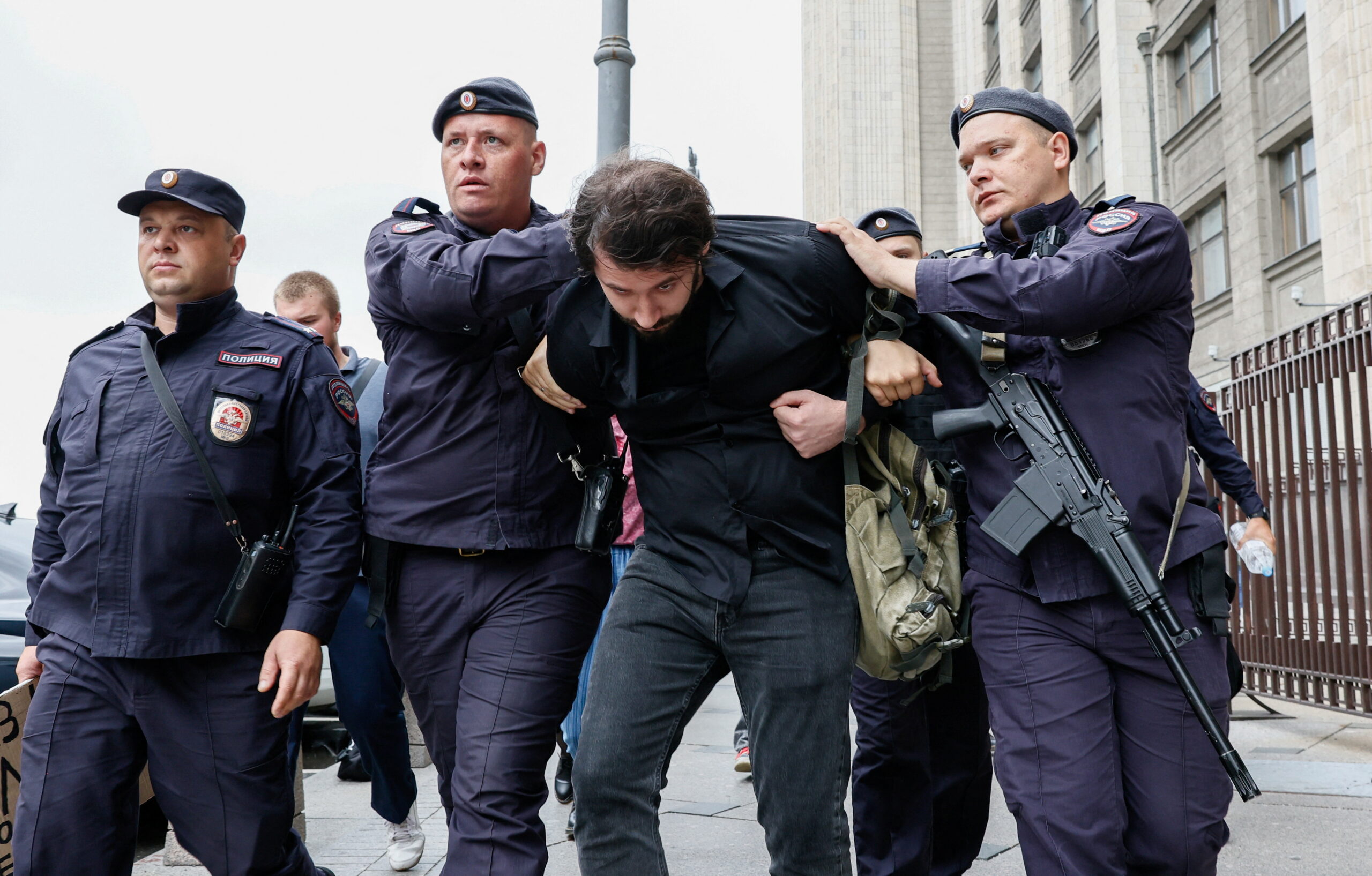
Police officers detain the political strategist Dmitry Kisiyev during a picket held to protest against an expected new legislation, that is set to impose restrictions on internet searches, near the headquarters of the lower house of Russia’s parliament, State Duma, in Moscow, Russia, July 22, 2025. REUTERS/Yulia Morozova
Domestic Sentiment
Domestically, the population of Russia now faces increased repression in the media sphere. Recently, the Kremlin took measures to impose mobile internet shutdowns, block Telegram, adopt state-backed alternatives, and restrict VPNs.[28] This move may have been precipitated by the mounting success that “war bloggers” were generating in forming ultra-nationalist views about ongoing operations in Ukraine. These campaigns were likely affecting societal unity on the government’s messaging on the war.[29] These restrictive measures are likely to generate dissent among Russians, who, for the past two decades, have become accustomed to a highly digitized society where access to services, communication, and information has largely occurred online.[30] While implementing stricter controls may help the Kremlin consolidate control in the short term, it reveals growing internal pressures and the trade-offs required to sustain the war effort. These restrictions have also triggered a rare and visible split between political figures and security agencies. While the latter favors tighter control over information flows amid concerns about unrest, especially as economic conditions deteriorate, political actors have resisted such measures due to their reliance on these platforms to manage public opinion and mobilize voters.[31]
There are also indications that public sentiment on the war may be shifting. Survey data shows that in May 2023, most Russians (57 percent) believed their close social circles supported the war, while 39 percent perceived opposition. By October 2025, this perception had reversed, with 55 percent reporting that those around them opposed the war, compared to 45 percent who supported it.[32] In addition, recent data from the state-run pollster VTsIOM indicates a decline in President Vladimir Putin’s approval and trust ratings. His approval fell to 65.6 percent, down from 73.3 percent in March, while trust in him has dropped from over 77 percent to around 71 percent over the same period. Although these figures remain relatively high by Western standards, the downward trend may reflect growing public unease, potentially linked to tighter internet restrictions and mounting economic pressures. At the same time, the reliability of such polling remains contested given the constraints of censorship and the wartime environment.[33]
While some Russians are indeed growing more critical of the war, a report by the Foreign Policy Research Institute highlights how a significant portion of society has become financially dependent on the war’s continuation.[34] The war has generated significant wealth transfers, especially to poorer regions and lower-income households, through salaries, pensions, and compensation for injury or death. For many households, especially in poorer regions that have borne a disproportionate share of mobilization, military service has become one of the few viable paths to upward mobility. However, sustaining these payments has become financially challenging for the state, particularly as the number of veterans rises and long-term care costs such as disability and mental health treatment accumulate. Scaling back benefits would risk alienating veterans and their families, potentially creating a politically volatile group, yet maintaining them indefinitely strains state capacity and constrains other spending priorities. This reveals yet another set of challenging trade-offs the Kremlin must juggle in its effort to sustain the war.
Demographic Challenges
Russia also faces mounting demographic challenges that undermine its long-term capacity to sustain the war effort. The country is grappling with a shrinking and aging population, compounded by low birth rates and high mortality, particularly among working-age men. On top of that, a significant outflow of skilled workers has further weakened the labor force, depriving key sectors of technical expertise and innovation potential. [35]
These trends suggest that while Russia may be able to sustain the war for now, it is doing so with mounting economic and political costs that will become harder to absorb over time. The Kremlin is increasingly forced to balance the demands of financing the war against maintaining domestic stability, a trade-off that is likely to grow more acute as the conflict continues.
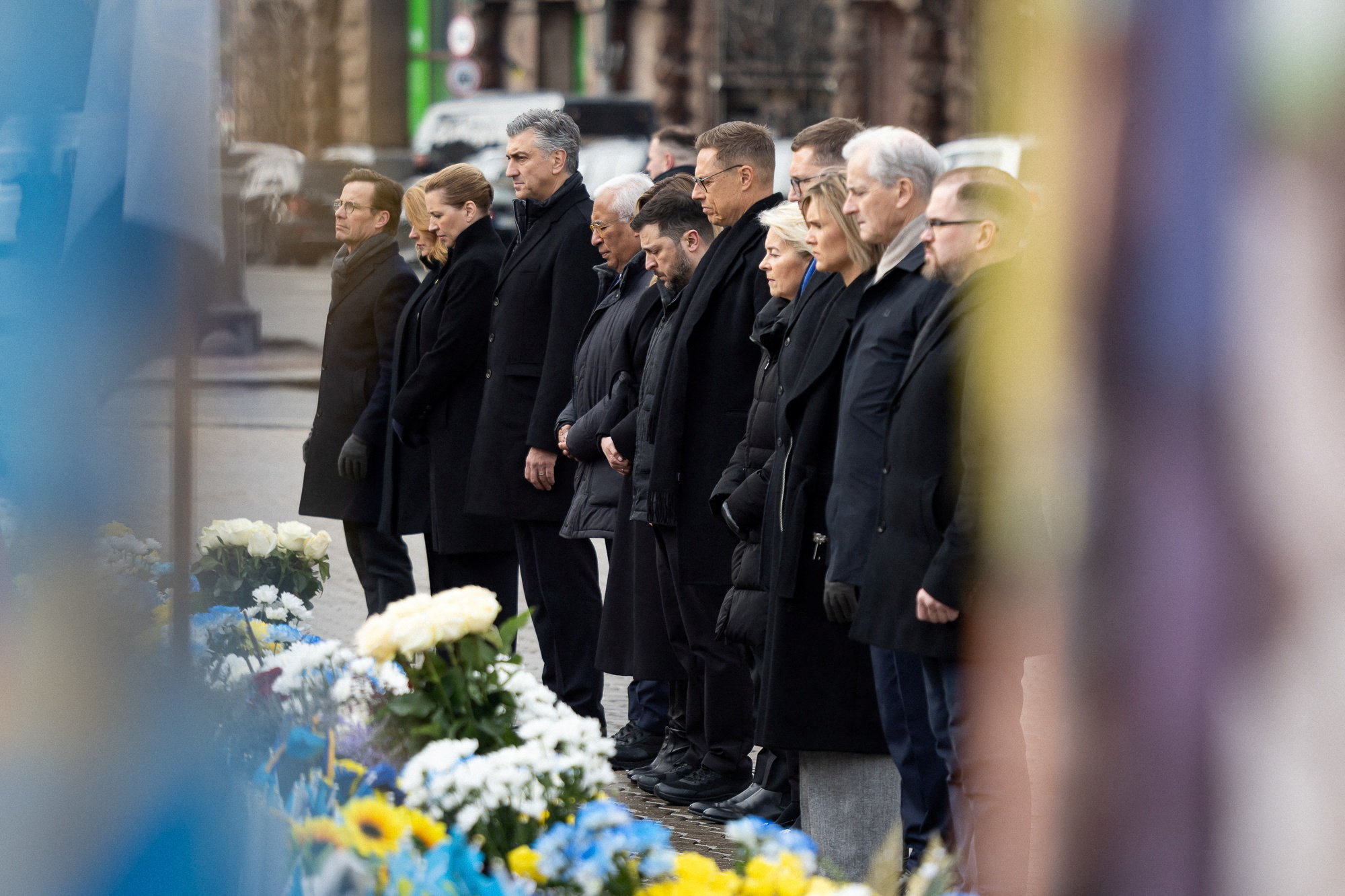
Ukraine’s President Volodymyr Zelenskiy and his wife Olena, Finland’s President Alexander Stubb, Estonia’s Prime Minister Kristen Michal, Croatia’s Prime Minister Andrej Plenkovic, Denmark’s Prime Minister Mette Frederiksen, Iceland’s Prime Minister Kristrun Mjoll Frostadottir, Latvia’s Prime Minister Evika Silina, Norway’s Prime Minister Jonas Gahr Store, Sweden’s Prime Minister Ulf Kristersson, Lithuanian Minister of National Defence Robertas Kaunas, President of the European Commission Ursula von der Leyen and European Council President Antonio Costa visit a makeshift memorial to fallen Ukrainian defenders at the Independent Square on the fourth anniversary of Russia’s full-scale invasion, in Kyiv, Ukraine February 24, 2026. Ukrainian Presidential Press Service/Handout via REUTERS
Support Networks
Ukraine’s Cohesive Coalition
In terms of external support, Ukraine has the advantage of being supported by a coalition of nations that provide weapons, intelligence, and economic assistance. European nations are currently contributing more support to Ukraine than the United States, but the United States is still providing Ukraine with critical air defenses through European partners.[36] Trump has allowed the sale of US weapons to Ukraine through a plan known as the Prioritized Ukraine Requirements List (PURL), in which NATO allies pay for US weapons and transfer them to Ukraine. The program is providing advanced weapons such as Patriot missiles and is supplying the majority of the missiles used in Ukraine’s air defense systems.[37]
Additionally, the European Union has recently unblocked a €90 billion loan to help Ukraine cover its financial needs primarily in the military sector for the next two years. Even with shifting political winds in the United States, Europeans for the most part are still highly committed to supporting Ukraine for the long haul due to their recognition of Russia’s direct threat to Europe.
Further out into the world, Ukraine has expanded its partnerships into the Gulf by supplying expertise and drone interceptors to nations that have been under Iranian fire. Ukraine has signed 10-year defense partnerships with Saudi Arabia, the United Arab Emirates, and Qatar.[38] This signifies Ukraine’s increased diplomatic and military relevance in modern-day warfare, an important element that should remain central in Western deliberations on keeping Ukraine as a military partner.
Russian Partners: Breadth Without Cohesion
Russia also depends on an external network of partners to help it sustain its war in Ukraine. China is Moscow’s main energy export market and supplies Russia with dual-use technology. Iran has supplied the Kremlin with ballistic missiles and drone technology, with which it has created its own domestic drone production line. North Korea has supplied Russia with ammunition, ballistic missiles, and limited numbers of troops. Russia has created a parallel trading network with these countries as well as other nations that have not signed onto the US-led sanctions regime. China, Turkey, the United Arab Emirates, Central Asian countries, Iran, North Korea, Belarus, India, and Georgia have all helped Russia maintain access to prohibited technologies.[39]
However, while Moscow has managed to circumvent Western sanctions through intermediary states, results are rather inefficient as rerouted trade increases transportation expenses and introduces middlemen who extract profits and slow delivery times.[40] Access to critical dual-use technologies such as semiconductors and machine tools has become more expensive and less reliable, raising the cost of military production. Additionally, relying on a narrow group of partner countries creates new vulnerabilities, as Russia becomes increasingly dependent on their continued cooperation amid growing threats of secondary sanctions.
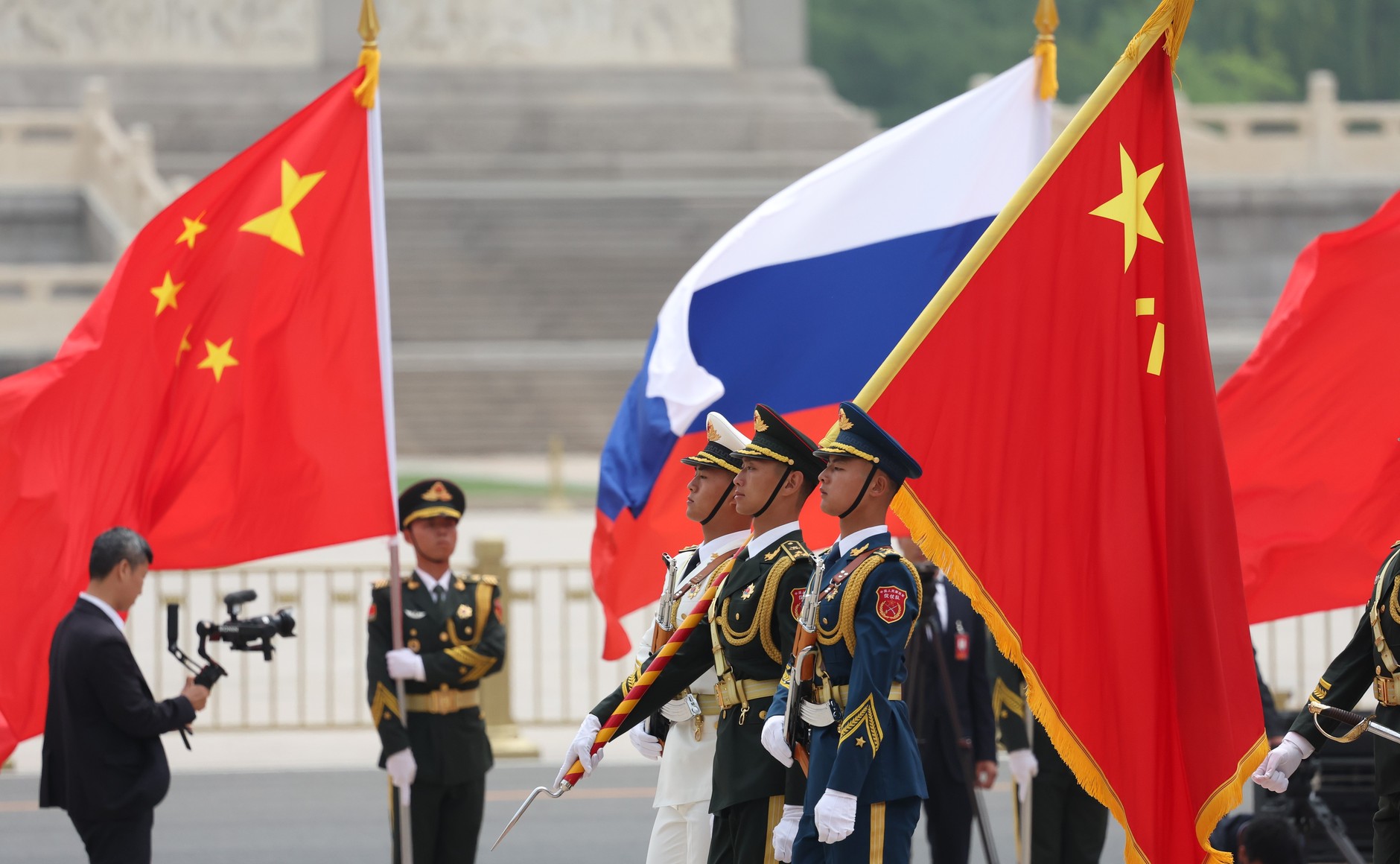
Servicemen of the Guard of Honour standing at attention as President of China Xi Jinping hosts the official welcoming ceremony for Vladimir Putin. (Kremlin.ru)
Rising Pressure on Russia’s Network
Important to note is America’s renewed willingness to use hard power to coerce friends and competitors alike, which may be affecting Russia’s support network and altering Moscow’s strategic environment.[41] Regardless of the war in Iran’s future trajectory, US and Israeli strikes have degraded Iran’s capabilities, thereby weakening its ability to supply weapons to its partners and project regional influence. As of early April 2026, the Institute for the Study of War reports that joint US-Israeli operations have significantly weakened Iran’s ballistic missile capacity, cutting launch rates by about 90 percent. Around two-thirds of Iran’s missile arsenal has been damaged, destroyed, or rendered unusable, and by early March roughly 330 out of 470 launchers were no longer operational, leading to a substantial drop in overall capability.[42]
In addition, the instability generated by the war has stalled Russian involvement in Iran’s energy sector, with two nuclear power projects put on hold, alongside a halt in oil and gas exploration. Moscow’s broader ambition to develop the “North-South” transport corridor linking India to Russia via Iran now faces growing uncertainty. While its economic viability has always been debated, the project held significant strategic value for reducing Russia’s reliance on Western-controlled routes.[43]
Furthermore, the fall of Nicolas Maduro in Venezuela and renewed US alignment suggest the loss of a key partner in the Western Hemisphere for Russia. Potential pressure on Cuba and other aligned regimes increases pressure on Russia’s partners, as do more serious threats of secondary sanctions on entities aiding in oil sales, particularly from major firms like Rosneft and Lukoil.[44]
Structural Asymmetry
These dynamics underscore a widening asymmetry between Russia and Ukraine’s external support networks. Ukraine is embedded in a durable and increasingly capable coalition, while Russia’s support network is ad hoc, constrained, and under mounting external pressure. Thus, while Russia may seemingly be “weathering the storm” of Western sanctions, it is doing so quite inefficiently. As Western enforcement tightens and Moscow’s partners face growing costs for cooperation, Russia’s ability to sustain its war effort is likely to erode over time as the country faces a broader trajectory of strategic decline.
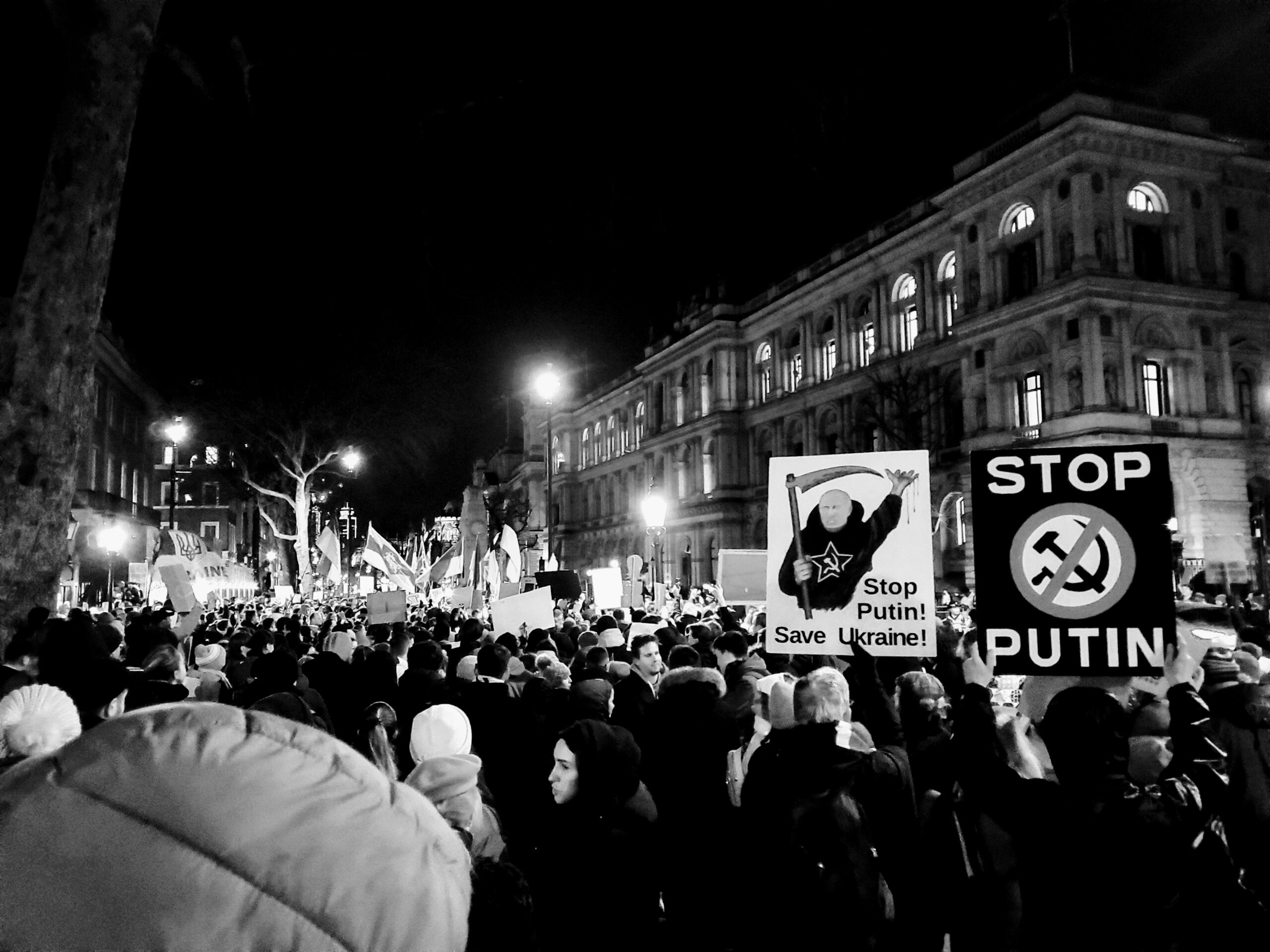
Anti-war protest in London, October 2022. (Aniket Das/Unsplash)
Russia’s Geopolitical Erosion Abroad
Russia’s war in Ukraine is a military and economic strain that is accelerating a broader erosion of Moscow’s geopolitical position. As the Kremlin concentrates resources on sustaining the war, states across Europe and Eurasia are reassessing their relationships with Russia and moving to reduce their dependencies, resulting in a gradual contraction of Russian influence across multiple regions.
Europe
Where Russia once enjoyed a certain level of soft power in Europe, its broader political position on the continent has substantially deteriorated. Economically, the European Union’s rapid move to reduce its dependence on Russian energy has significantly weakened one of Moscow’s most important sources of revenue. Prior to the war, Russia supplied roughly 50 percent of the European Union’s gas imports, making Europe its most lucrative and stable market. However, under the REPowerEU initiative, the share of Russian gas, oil and coal in the bloc’s energy imports dropped significantly between 2021 and 2025. Russian gas dropped from 45 percent to 13 percent, oil imports were reduced from 27 percent to below 3 percent, and coal imports decreased from 50 percent to zero.[45] These initiatives have forced Russia to redirect exports toward more distant markets such as China and India, often at discounted prices and higher transportation costs.
However, the Iran-related conflict is driving up energy prices costing the bloc around €500 million daily and raising risks like fuel shortages. While the European Union has decided to fully phase out Russian gas imports by 2027, a planned legal proposal on the full banning of Russian oil has been postponed following Iran’s blockage of Middle Eastern oil around the Strait of Hormuz. The European Union is expected to introduce measures to eliminate Russian oil imports by the end of 2027, but as long as the geopolitical situation remains unclear, some EU nations may push to reopen this debate.[46] President of the EU Commission Ursula Von der Leyen and other officials caution that reopening the door to Russian hydrocarbons would be unwise and argue that the long-term solution lies in accelerating energy independence through greater use of renewables and nuclear power, while expanding electrification across transport, heating, and industry.[47]
Politically, anti-Russian sentiment in Europe is widespread because of the war in Ukraine and Moscow’s use of hybrid warfare, sabotage, and disinformation campaigns across the continent. Even among previously pro-Kremlin far-right parties, such as France’s National Rally under Marine Le Pen and Italy’s Lega, Russia’s declining reputation across Europe has led to a more cautious and ambivalent tone in their rhetoric.[48]This suggests that Russia has lost its status as a political model or ally for these parties and has instead become a politically costly reference point. Importantly, Viktor Orbán’s defeat in Hungary’s recent parliamentary elections signals a major political blow for Russia. Budapest’s continued purchase of Russian energy and its repeated efforts to stall funding for Kyiv or delay Ukraine’s path toward European integration had given Moscow leverage inside Europe. Most recently, Orbán had blocked the now released loan to Ukraine.[49] The victory of Péter Magyar’s Tisza party in Hungary’s parliamentary election may have just removed Russia’s most useful ally in Europe.
In strategic terms, Russia no longer holds substantial naval power in the Black Sea following Ukraine’s success in degrading its Black Sea Fleet and forcing it into retreat.[50] Furthermore, militarily across the continent, European nations are investing substantial amounts into their future defense needs through initiatives such as “ReArm Europe Plan / Readiness 2030,” which aims to unlock up to €800 billion in investment. They have also adopted lessons learned from the battlefield in Ukraine, are incorporating evolving technologies into their military planning and have institutionalized Ukraine as a long-term security partner.[51]
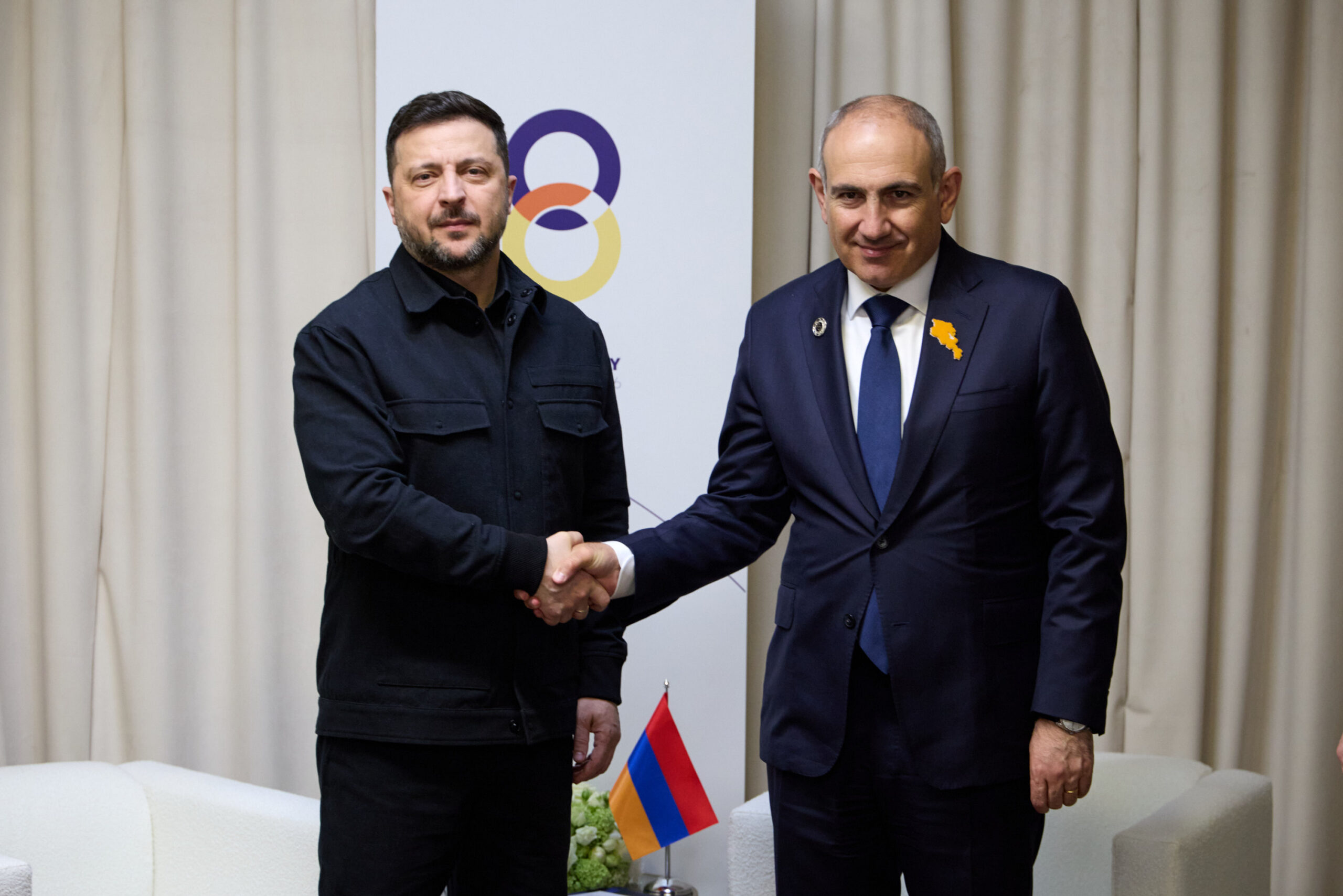
President of Ukraine Volodymyr Zelenskyy with Prime Minister of Armenia Nikol Pashinyan during the European Political Community Summit in Yerevan, May 2026. (Office of the President of Ukraine)
Former Soviet States
Further into the South Caucasus, Russia’s declining regional authority continues to unravel. Moscow’s failure to support Armenia during its conflict with Azerbaijan undermined one of the central premises of Russian influence in the region, acting as a credible security guarantor. Although Armenia remains economically dependent on Russia in important respects, it has increasingly sought to reduce its political and security dependence on Moscow. Yerevan has moved away from the Collective Security Treaty Organization and Moscow’s Eurasian Economic Union to pursue closer ties to the European Union.[52] It has also explored normalization with Turkey through a broader peace process involving Azerbaijan.[53] Armenia and Azerbaijan have now committed to an important US-designed connectivity deal named the Trump Route for International Peace and Prosperity (TRIPP). For international actors, TRIPP is also potentially a new East-West transit route linking Central Asia to Europe, which would reduce dependence on Russian and Chinese infrastructure.[54]
Russia’s growing economic isolation is also reshaping migration in the former Soviet space. Historically, Russia functioned as a major labor magnet for workers from Central Asia and the South Caucasus. But as Western investment and technology disappeared and Russia became more dependent on a narrower range of partners and markets, its attractiveness as a destination for labor and opportunity began to erode.[55] Migrants increasingly have alternatives in Turkey, the Gulf, and, where possible, the European Union, reducing one of Russia’s long-established influence mechanisms across the region.
In Central Asia, China’s position has become much stronger than Russia’s in economic terms. Moscow still retains cultural influence, political relationships, and in some cases security ties, but Beijing increasingly dominates the economic sphere. Countries across the region have established “multi-vector” foreign policies to hedge among major powers instead of deferring primarily to Moscow. The power that once served as the central pole of regional order is now increasingly just one actor among several.
Elsewhere in the post-Soviet space, similar patterns are visible. In Moldova, pro-European forces consolidated their position after voters rejected pro-Russian parties despite Russian-backed influence operations.[56] Moreover, the Commonwealth of Independent States is increasingly hollow as countries such as Moldova and Armenia take concerted steps to withdraw from this institutional framework.[57] The Eurasian Economic Union, another one of Russia’s regional integration projects, has also failed to achieve meaningful results due to persistent disputes over trade rules and a distribution of benefits that favors Moscow. The union has struggled to expand, as key states such as Uzbekistan have avoided membership due to concerns over sanctions exposure and constrained trade autonomy. As a result, member states increasingly hedge by pursuing alternative partnerships, revealing Russia’s declining regional influence.[58]
Middle East and Global South
In the Middle East, the war in Iran may weaken Russia’s position across the Persian Gulf. For the past decade, Moscow has sought to deepen ties with Gulf states to expand energy partnerships, defense cooperation, and sanctions evasion pathways. However, rising security concerns related to Iran may push Gulf monarchies closer to the United States, potentially leading to a more cautious and limited engagement with Russia, particularly as Moscow has been actively supporting Iran’s war efforts. Russia’s position in the Middle East had already began exhibiting signs of decline when Bashar al-Assad was removed from power, the Syrian dictator who had been propped up by Moscow during the country’s long-standing civil war.
In Africa, Russia attempted to replace the Wagner Group with the Africa Corps, a state-controlled structure meant to help support certain governments in Africa with their insurgency and security challenges. At the time of writing, after sustained violence in Northern Mali, Tuareg rebels have announced an agreement for Russian Africa Corps forces and Malian troops to withdraw from the strategic town of Kidal, effectively leaving it under rebel control.[59] The developments suggest setbacks for Russia’s role in Mali, with weakening control on the ground and growing challenges to its security partnerships in the region. Niger and Burkina Faso have also displayed indications of growing disappointment with Russia’s security role and mercenary presence, leading to growing overall dissatisfaction with Russia as a security partner across the region.[60]
Structural Decline
On top of its waning global influence, Russia is exhibiting signs of long-term strategic erosion. It possesses a total of zero companies in the global top 100 tech firms; its AI ranking is 28th out of 36 countries;[61] and it boasts 17 total space launches compared to 193 for the United States and 92 for China.[62] Russia is a declining power and is quickly becoming a junior partner of China. China represents 33.8 percent of Russia’s trade (up from 11 percent) and provides Moscow with chips, drones, and missile components, proving that Russia is not self-sufficient. On top of that, the discounted oil Russia has been selling to Beijing has resulted in billions in lost revenues. In this sense, while Russia may claim that its pivot to Asia was a strategic shift, it came at a tremendous financial cost.[63]
By weaponizing hydrocarbons, Moscow pushed the European Union to rapidly diversify away from Russian energy, permanently reducing demand for its exports and reinforcing long-term decarbonization strategies. This shift comes at a moment when global energy systems are moving away from hydrocarbons toward electrification and clean technologies, sectors in which Russia is notably weak. Russia’s oil sector faces a long-term production decline driven by structural constraints such as sanctions, lack of investment, and limited access to advanced technologies. Russia lacks competitive capacity in the industries that will dominate the energy transition, such as refining critical minerals, manufacturing components, and producing clean technologies. Beijing controls much of the processing and manufacturing infrastructure for key inputs like rare earths, batteries, and solar components. As Russia becomes increasingly dependent on exporting raw energy and materials to China, it effectively cedes higher-value industrial and technological leadership. In this sense, Russia’s strategic choices have not only weakened its own leverage but also accelerated a global energy transition that redistributes power toward states that dominate the emerging clean energy supply chains.[64]
These developments suggest that Russia’s war in Ukraine is accelerating its wider geopolitical contraction. Europe is less dependent on Moscow, the South Caucasus is becoming less Russian-centered, Central Asia is balancing more heavily toward China and other partners, and even Russia’s peripheral relationships are showing signs of wear. Russia may still retain coercive power, but its ability to translate that power into lasting regional influence is weakening.
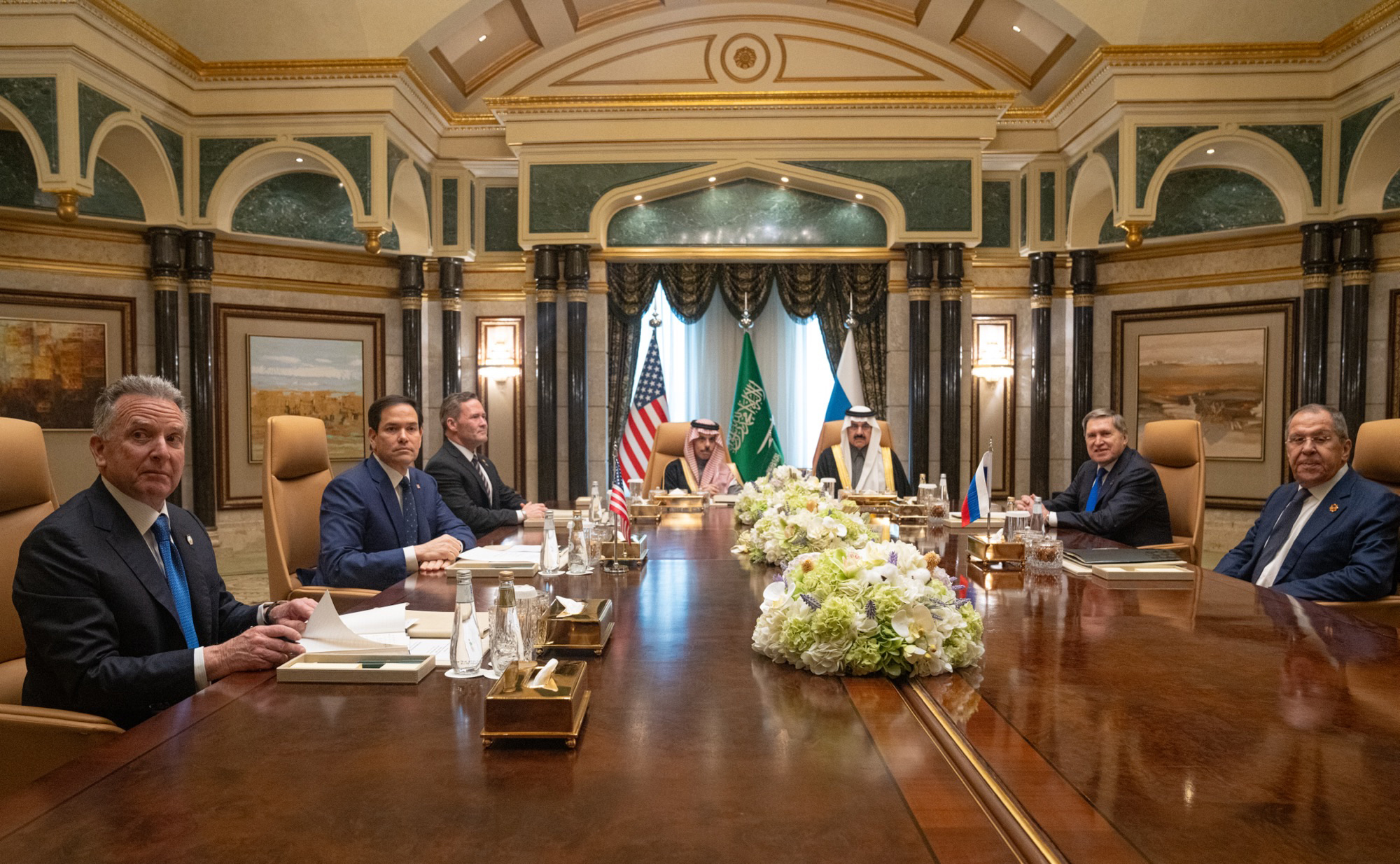
Secretary Marco Rubio, with from left, US Middle East envoy Steve Witkoff, National Security Advisor Mike Waltz, Saudi Arabia’s Foreign Minister Prince Faisal bin Farhan al-Saud, National Security Advisor Mosaad bin Mohammad al-Aiban, the Russian president’s foreign policy advisor Yuri Ushakov, and Russia’s Foreign Minister Sergei Lavrov attend a meeting together at Diriyah Palace in Riyadh, Saudi Arabia, February 18, 2025. (Official State Department photo by Freddie Everett)
The Risk of Premature Negotiations
The negotiation process between Russia and Ukraine has largely stalled in recent months. Talks remain deadlocked primarily over territorial issues, with Russia demanding that Ukraine cede the remaining parts of the Donbas under Kyiv’s control. Broader security questions are also unresolved as Russia pushes for Ukrainian neutrality and limits on the size of its military. Ukraine on the other hand seeks robust, long-term security guarantees to deter future aggression.
Calls for Ukraine to concede to Russian terms to end the war quickly assume that continued fighting would worsen Ukraine’s position. They also overlook significant strategic risks. Firstly, signing a premature agreement would allow Russia to convert limited battlefield gains and mounting structural weaknesses into a political outcome it has been unable to secure militarily. Despite sustained offensive operations, Russian forces have struggled to achieve decisive breakthroughs and key objectives such as full control over the Donbas. For Ukraine, areas such as the Donbas are integral to its defensive posture, forming part of a fortified belt that complicates Russian advances. Ceding such territory would weaken its long-term security and reduce its ability to deter future aggression.
Secondly, such an outcome would reward aggression and effectively risk re-writing the European security architecture. Through its invasion, Russia would have been able to seize territory and impose constraints on a neighboring state’s sovereignty, including its security and military arrangements. This would advance the Kremlin’s longstanding objective of reestablishing a sphere of influence in Europe. It also raises broader concerns about the durability of the post-Cold War order: If these demands are accommodated, what additional “security concerns” might Moscow advance from its enduring list of grievances about its diminished role in shaping European security? In this sense, and perhaps most importantly, a premature settlement would not produce lasting stability.
A 2026 report by the Netherlands’ Military Intelligence and Security Service (MIVD) has concluded that Russia is already laying the grounds for a future conflict with NATO if the war in Ukraine ends on favorable terms to Moscow.[65] The report suggests that under favorable conditions, Moscow could rebuild enough combat capability to initiate a limited regional confrontation with NATO within roughly a year after hostilities in Ukraine end. The report emphasizes that Russia’s objective in such a scenario would not be to defeat the alliance outright, but to secure limited territorial gains to fracture NATO politically, potentially backed by nuclear coercion.
This assessment aligns with a broader consensus among European intelligence agencies. German officials have also warned that Russia may be preparing for a large-scale conventional conflict with NATO by the end of the decade, with estimates pointing to 2028–2029 as a possible timeframe. Similarly, Denmark’s intelligence service has indicated that Russia could be capable of launching a regional war against the Baltic states within two years after the Ukraine conflict ends, and a wider European war within five.
The MIVD further characterizes the war in Ukraine as part of a broader Russian effort to reshape Europe’s security order and challenge the existing international system. It argues that the war in Ukraine carries existential significance for the Kremlin, extending beyond territorial ambitions to encompass Russia’s global standing, national identity, and what it frames as the defense of traditional values. In this view, Moscow sees external threats and internal stability as closely linked, portraying liberal-democratic norms as a direct challenge to regime survival.
Based on these intelligence assessments, the urgency grows to deter these potential threats by continuing to apply pressure on Russia in Ukraine until it has reduced capacity to continue the war and agrees to terms that are more favorable for Ukraine and the future of the broader European security architecture.
Conclusion: Strategic Patience
Instead of pushing Ukraine into a premature negotiated settlement, the United States and its partners should prioritize a strategy of strategic patience. This entails sustaining military, financial, and intelligence support to Ukraine to ensure it can continue imposing costs on Russian forces. At the same time, escalation should be carefully managed through deterrence, clear signaling, and the maintenance of communication channels with Moscow to reduce the risk of unintended confrontation. In parallel, Western strategy should place greater emphasis on indirect pressure. Targeting Russia’s broader geostrategic ecosystem, including its economic networks, sanctions evasion mechanisms, and key external partners amplifies the constraints already facing Moscow. The United States and Europe have yet to fully exploit Russia’s vulnerabilities. Absent increased pressure, Putin is likely to prolong negotiations and continue the war, even at the cost of massive casualties on both sides.
To remain resilient in this approach towards Russia, the United States and Europe should deepen cooperation in critical areas such as energy. The United States is well positioned to expand energy exports to Europe and should do so to help the region manage supply disruptions from the Middle East. For their part, European countries should continue diversifying their energy sources to reduce dependencies on single partners and strengthen long-term resilience by accelerating energy independence through greater use of renewables, nuclear power, and electrification.
While Russia is not collapsing, it is steadily weakening militarily, economically, and geopolitically. Its support network is under strain and its ability to translate battlefield pressure into decisive gains remains limited. Ukraine’s position is not without risk and remains dependent on Western support, but its capacity to endure, adapt, and inflict high costs on Moscow is noteworthy. In this context, time is more likely to disadvantage Russia than Ukraine. The strategic imperative for the West is therefore not to rush toward a settlement, but to allow this trajectory to continue shaping the conditions under which the war ends rather than prematurely concluding it on terms favorable to Moscow.
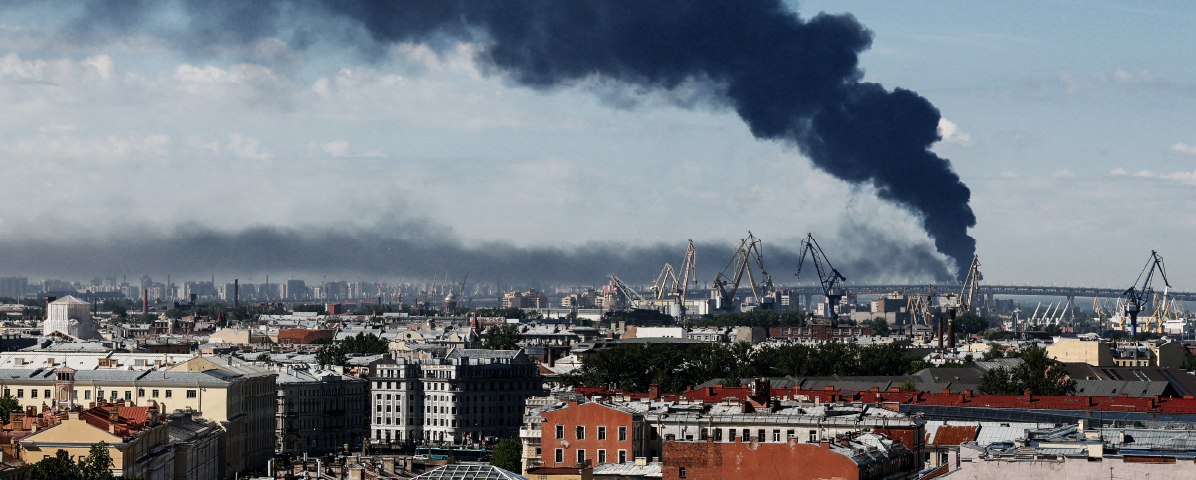
Featured image: Heavy smoke billows after Ukrainian drones hit an oil terminal in St. Petersburg, Russia at the kickoff of the St.Petersburg Economic Forum, June 3, 2026. REUTERS/Stringer
[1] Michael C. Desch, “Ukraine Is Losing the War: With Moscow Pressing Its Advantage, Kyiv Should Trade Land for Peace,” Foreign Affairs, February 26, 2026, https://www.foreignaffairs.com/russia/ukraine-losing-war.
[2] Yuri Lapaiev, “Kremlin Shifts Focus to Information Warfare,” Jamestown Foundation, November 6, 2025, https://jamestown.org/kremlin-shifts-focus-to-information-warfare/.
[3] “US Officials Accuse Europe of Prolonging Russia’s War in Ukraine, Axios Reports,” The Kyiv Independent, August 30, 2025, https://kyivindependent.com/us-officials-accuse-europe-of-prolonging-russias-war-in-ukraine-axios-reports/.
[4] Peter Baker, “Trump Calls Europe ‘Decaying’ and Suggests ‘Size Will Win’ in Ukraine War,” The New York Times, December 9, 2025, https://www.nytimes.com/2025/12/09/us/politics/trump-europe-decaying-weak-ukraine.html.
[5] Seth G. Jones and Riley McCabe, “Russia’s Grinding War in Ukraine: Massive Losses and Tiny Gains for a Declining Power,” Center for Strategic and International Studies, January 27, 2026, https://www.csis.org/analysis/russias-grinding-war-ukraine.
[6] Alexander Kolyandr, “Addicted to War: Undermining Russia’s Economy,” Center for European Policy Analysis, February 5, 2025, https://cepa.org/comprehensive-reports/addicted-to-war-undermining-russias-economy/.
[7] David Kirichenko, “The Next Evolution in Ukraine’s Drone Defense,” The National Interest, January 4, 2026, https://nationalinterest.org/feature/the-next-evolution-ukraines-drone-defense.
[8] Suzanne Loftus, “Why Russia Is Worried About the Iran War,” The National Interest, March 23, 2026, https://nationalinterest.org/feature/why-russia-is-worried-about-the-iran-war.
[9] Mamuka Tsereteli, “Russia’s Strategic Losses Are the US’ Gain in Eurasia,” Silk Road Studies Program, February 17, 2026, https://www.silkroadstudies.org/publications/joint-center-publications/item/13573-russia%E2%80%99s-strategic-losses-are-the-us%E2%80%99-gain-in-eurasia.html.
[10] Seth G. Jones and Riley McCabe, “Russia’s Grinding War in Ukraine.”
[11] Michael Kofman, “Ukraine’s War of Endurance: The Fight for Advantage in the Conflict’s Fifth Year,” Foreign Affairs, February 16, 2026, https://www.foreignaffairs.com/russia/ukraines-war-endurance.
[12] Peter Dickinson, “Ukrainian long-range drones are turning Russia’s size into a weakness,” The Atlantic Council: Ukraine Alert, May 12, 2026, https://www.atlanticcouncil.org/blogs/ukrainealert/ukrainian-long-range-drones-are-turning-russias-size-into-a-weakness/
[13] Fabian Hoffmann, “Ukraine’s Deep-Strike Drone Campaign Against Russian Oil Infrastructure,” Missile Matters, April 12, 2026, https://missilematters.substack.com/p/ukraines-deep-strike-drone-campaign.
[14] Fabian Hoffmann, “Ukraine’s Deep-Strike Drone Campaign Against Russian Oil Infrastructure.”
[15] Aidan Stretch, “Ex-CIA Director Says US Needs to Learn ‘New Concept of Warfare’ from Ukraine,” CBS News, April 7, 2026, https://www.cbsnews.com/news/ex-cia-director-david-petraeus-us-ukraine-new-concept-warfare/.
[16] “US Intelligence Says Ukraine Regained Territory After Cutting Off Russia’s Illegal Starlink Use,” Kyiv Post, May 22, 2026, https://www.kyivpost.com/post/76614.
[17] Michael Kofman and Ryan Evans, “Update from the Battlefield: Drones, Distance, and Diminishing Returns for Russia,” War on the Rocks, April 9, 2026, https://warontherocks.com/update-from-the-battlefield-drones-distance-and-diminishing-returns-for-russia/.
[18] Tom Masters, “Russia’s National Debt Rises by 21% as 73 Regions Report Budget Deficits,” Novaya Gazeta Europe, March 31, 2026, https://novayagazeta.eu/articles/2026/03/31/russias-national-debt-rises-by-21-as-73-regions-report-budget-deficits-en-news
[19] Philip Luck, “How Sanctions Have Reshaped Russia’s Future,” Center for Strategic and International Studies, February 24, 2025, https://www.csis.org/analysis/how-sanctions-have-reshaped-russias-future.
[20] Robin Brooks, Kate Davidson, Ben Harris, Harold Hongju Koh, and Liam Marshall, “Stiffening European Sanctions Against the Russian Oil Trade,” Brookings Institution, February 3, 2026, https://www.brookings.edu/research/stiffening-european-sanctions-against-the-russian-oil-trade/; Alice Johnson, “Sanctions: Seizure of Russian-Flagged Tanker Demonstrates Major Shift in Enforcement,” International Bar Association, March 2, 2026, https://www.ibanet.org/Sanctions-seizure-of-Russia-flagged-tanker-demonstrates-major-shift-in-enforcement.
[21] “Russia’s Oil Discounts to China Cost Billions Despite Price Surge, Study Finds,” The Moscow Times, March 20, 2026, https://www.themoscowtimes.com/2026/03/20/russias-oil-discounts-to-china-cost-billions-despite-price-surge-study-finds-a92291.
[22] Guy Faulconbridge, Dmitry Antonov, and Elena Fabrichnaya, “Russia Looks for a Way Out of Its Sharpest Economic Contraction in Three Years,” Reuters, April 16, 2026, https://money.usnews.com/investing/news/articles/2026-04-16/russia-looks-for-a-way-out-of-its-sharpest-economic-contraction-in-three-years.
[23] Michael Kofman, “Ukraine’s War of Endurance.”
[24] Elina Ribakova and Alicia García-Herrero, “How Russia and China Are Winning the War in Iran,” Peterson Institute for International Economics, March 30, 2026, https://www.piie.com/blogs/realtime-economics/2026/how-russia-and-china-are-winning-war-iran.
[25] Sergey Vakulenko, “What the Russian Energy Sector Stands to Gain From War in the Middle East,” Carnegie Politika, March 24, 2026, https://carnegieendowment.org/russia-eurasia/politika/2026/03/russia-oil-iran-war-consequences.
[26] Iryna Kutielieva and Oleksandr Shumilin, “Swedish Intelligence: Russia’s Economy Remains Under Strain Despite Oil Windfalls,” Yahoo Finance, April 20, 2026, https://finance.yahoo.com/economy/articles/swedish-intelligence-russias-economy-remains-101800579.html.
[27] “The Kremlin’s Baltic Hormuz: Ukrainian Attacks on Russian Ports Cut Russia’s Gains from the Iranian Oil Crisis by Two Thirds,” Re:Russia, April 7, 2026, https://re-russia.net/en/analytics/0412/.
[28] Yuliya Talmazan, “Russia Is Killing Telegram, Its Most Popular Messaging App, Despite Fears of Pushback,” NBC News, March 22, 2026, https://www.nbcnews.com/world/russia/russia-killing-telegram-popular-messaging-app-fears-pushback-rcna263904.
[29] Mariya Omelicheva, “Putin Is Not Trapped: Why Regime Survival Does Not Depend on Victory,” War on the Rocks, March 30, 2026, https://warontherocks.com/putin-is-not-trapped-why-regime-survival-does-not-depend-on-victory/.
[30] Tatiana Stanovaya, “Is Opposition to Online Restrictions an Inflection Point for the Russian Regime?,” Carnegie Endowment for International Peace, April 21, 2026, https://carnegieendowment.org/russia-eurasia/politika/2026/04/russia-elites-internal-conflict.
[31] Andrey Pertsev, “Blocking of Telegram App Sparks Rare Public Rift Among Russia’s Elites,” Carnegie Politika, April 2, 2026, https://carnegieendowment.org/russia-eurasia/politika/2026/04/russia-elites-internal-conflict.
[32] “Russia Is Not as Resilient as It Wants You to Think,” The Economist, December 10, 2025, https://www.economist.com/europe/2025/12/10/russia-is-not-as-resilient-as-it-wants-you-to-think.
[33] “Putin’s Approval Rating Falls to Lowest Since Before Ukraine War, State Pollster Says,” Reuters, April 24, 2026, https://www.reuters.com/world/europe/putins-approval-rating-falls-lowest-since-before-ukraine-war-state-pollster-says-2026-04-24/.
[34] Andras Toth-Czifra, “From Front Line to Fault Line: Russia’s Challenge Managing Veteran Reintegration,” Foreign Policy Research Institute, December 19, 2025, https://www.fpri.org/article/2025/12/from-front-line-to-fault-line-russias-challenge-managing-veteran-reintegration/.
[35] Seth G. Jones and Riley McCabe, “Russia’s Grinding War in Ukraine.”
[36] “Here’s How Much Aid the United States Has Sent Ukraine,” Council on Foreign Relations, updated February 23, 2026, https://www.cfr.org/articles/how-much-us-aid-going-ukraine.
[37] Mark Rutte and Volodymyr Zelenskyy, “Press Conference by NATO Secretary General Mark Rutte with President Volodymyr Zelenskyy of Ukraine,” NATO, February 3, 2026, https://www.nato.int/en/news-and-events/events/transcripts/2026/02/03/press-conference-by-nato-secretary-general-mark-rutte-with-president-volodymyr-zelenskyy-of-ukraine.
[38] Sasha Vakulina, “What Are Ukraine’s New Gulf Defence Deals? Here Is What Zelenskyy Signed,” Euronews, March 30, 2026, https://www.euronews.com/2026/03/30/what-are-ukraines-new-gulf-defence-deals-here-is-what-zelenskyy-signed.
[39] Anna Kholodnova, “Politico: The US Has Identified Five Countries That Help Russia Circumvent Sanctions. Further Restrictions Are Under Discussion,” Babel, June 8, 2023, https://babel.ua/en/news/94833-politico-the-us-has-identified-five-countries-that-help-russia-circumvent-sanctions-further-restrictions-are-under-discussion; “Russia Circumventing Sanctions via CIS Countries and Turkey,” ifo Institute and EconPol Europe, February 21, 2024, https://www.ifo.de/en/press-release/2024-02-21/ifo-institute-econpol-europe-russia-circumventing-sanctions-cis-countries.
[40] “Russia Circumventing Sanctions via CIS Countries and Turkey”; Anna Kholodnova, “Politico: The US Has Identified Five Countries That Help Russia Circumvent Sanctions.”
[41] Suzanne Loftus, “Why Russia Is Worried About the Iran War.”
[42] “Iran Update Special Report, April 3, 2026,” Institute for the Study of War, April 3, 2026, https://understandingwar.org/research/middle-east/iran-update-special-report-april-3-2026/.
[43] Jana Kobzova, “From Good to Not Good: The Impact of the War in Iran on Russia,” European Council on Foreign Relations, April 14, 2026, https://ecfr.eu/article/from-good-to-not-good-the-impact-of-the-war-in-iran-on-russia/.
[44] Jonathan Yerushalmy, “Will US Sanctions on Russian Oil Companies Be Effective, and Why Is Trump Imposing Them Now?,” The Guardian, October 23, 2025, https://www.theguardian.com/world/2025/oct/23/will-us-sanctions-russia-oil-companies-be-effective-why-trump-now; Ron Bousso, “West Hits ‘Peak Sanctions’ on Russia’s Energy Sector,” Reuters, September 2, 2025, https://www.reuters.com/business/energy/west-hits-peak-sanctions-russias-energy-sector-2025-09-02/.
[45] “Ending Russian Energy Imports,” Council of the European Union, 2026, https://www.consilium.europa.eu/en/policies/ending-russian-energy-imports/.
[46] Bob Savic, “EU Bans All Russian Gas for Good,” GIS Reports Online, April 21, 2026, https://www.gisreportsonline.com/r/eu-russian-energy/.
[47] Lorne Cook, “EU Chief Warns Billions Could Be Wasted if Energy Aid Is Not Well Targeted as the Iran War Bites,” The Washington Post, April 29, 2026, https://www.washingtonpost.com/world/2026/04/29/eu-energy-iran-war-renewables-russia-crisis/c2afd23c-43b1-11f1-b19d-32431046b5b4_story.html.
[48] Chendi Wang and Argyrios Altiparmakis, “What Happened to Putin’s Friends? The Radical Right’s Reaction to the Russian Invasion on Social Media,” European Union Politics 26, no. 2 (June 2025): 393–417, https://doi.org/10.1177/14651165251321802.
[49] Lucian Kim, “Orbán’s Defeat Lifts Block on EU Support for Ukraine, but Frictions Remain,” International Crisis Group, April 13, 2026, https://www.crisisgroup.org/anb/europe/hungary-ukraine/orbans-defeat-lifts-block-eu-support-ukraine-frictions-remain.
[50] John Grady, “Battles in the Black Sea Changing the Character of Naval Warfare, Experts Say,” USNI News, June 13, 2024, https://news.usni.org/2024/06/13/battles-in-the-black-sea-changing-the-character-of-naval-warfare-experts-say.
[51] Linus Höller, “EU Pumps Over $1 Billion into Defense R&D, Centered Around Ukraine War Lessons,” Defense News, April 16, 2026, https://www.defensenews.com/global/europe/2026/04/16/eu-pumps-over-1-billion-into-defense-rd-centered-around-ukraine-war-lessons/.
[52] Cyril Barabaltchouk, “Armenia Sets Sights on EU—Not Russia, as Pashinyan and Putin Meet in Moscow,” United24 Media, April 2, 2026, https://united24media.com/latest-news/armenia-sets-sights-on-eu-not-russia-as-pashinyan-and-putin-meet-in-moscow-17541.
[53] Alpaslan Özerdem, “Türkiye-Armenia Border Reopening: A Turning Point for the South Caucasus,” Eurasianet, April 17, 2026, https://eurasianet.org/turkiye-armenia-border-reopening-a-turning-point-for-the-south-caucasus.
[54] Thomas de Waal, Areg Kochinyan, and Zaur Shiriyev, “Rewiring the South Caucasus: TRIPP and the New Geopolitics of Connectivity,” Carnegie Endowment for International Peace, April 1, 2026, https://carnegieendowment.org/research/2026/03/rewiring-the-south-caucasus-tripp-and-the-new-geopolitics-of-connectivity.
[55] “Net Migration—Russia,” Statbase, accessed April 17, 2026, https://statbase.org/data/rus-net-migration/.
[56] Adrian Karatnycky and Alexander J. Motyl, “Russia’s Influence Is Shrinking Across Europe and Beyond,” Foreign Policy, October 3, 2025, https://foreignpolicy.com/2025/10/03/russia-putin-moldova-ukraine-europe-africa-geopolitics-power-influence/.
[57] “Moldova Leaves CIS as Russian Influence Crumbles Across Former Soviet Space,” AzerNews, April 9, 2026, https://www.azernews.az/analysis/256733.html.
[58] Elvira Aidarkhanova, “Why Is the Eurasian Economic Union Broken?,” The Diplomat, November 23, 2023, https://thediplomat.com/2023/11/why-is-the-eurasian-economic-union-broken/.
[59] “Mali’s Tuareg Rebels Announce Deal for Russian Africa Corps Withdrawal from Kidal,” France 24, April 26, 2026, https://www.france24.com/en/africa/20260426-new-fighting-erupts-in-north-mali-s-kidal-as-army-clashes-with-rebels.
[60] Benoit Faucon and Nicholas Bariyo, “Russia’s Ambitious Plans in Africa Are Unraveling: Russian Operations Are in Tatters Two Years After Death of Head of Mercenary Outfit,” The Wall Street Journal, September 29, 2025, https://www.wsj.com/world/africa/russias-ambitious-plans-in-africa-are-unraveling-f151906d.
[61] “Which Countries Are Leading in AI?,” Stanford University Global AI Vibrancy Tool, https://hai.stanford.edu/ai-index/global-vibrancy-tool.
[62] Seth G. Jones and Riley McCabe, “Russia’s Grinding War in Ukraine.”
[63] “Russia’s Oil Discounts to China Cost Billions Despite Price Surge, Study Finds,” The Moscow Times, March 20, 2026, https://www.themoscowtimes.com/2026/03/20/russias-oil-discounts-to-china-cost-billions-despite-price-surge-study-finds-a92291.
[64] Sergey Vakulenko, “A Tight Spot: Challenges Facing the Russian Oil Sector Through 2035,” Carnegie Endowment for International Peace, March 20, 2026, https://carnegieendowment.org/research/2026/03/russia-oil-situation-assessment.
[65] Maria Tril, “Dutch Intelligence: Russia Could Strike NATO Within a Year After Ukraine War Ends,” Euromaidan Press, April 23, 2026, https://euromaidanpress.com/2026/04/23/dutch-intelligence-russia-could-strike-nato-within-a-year-after-ukraine-war-ends/.