 A Nation Must Think Before it Acts
Ülle Madise: Could a Lawyer Unify Estonia?

A nation must think before it acts.
Ülle Madise: Could a Lawyer Unify Estonia?
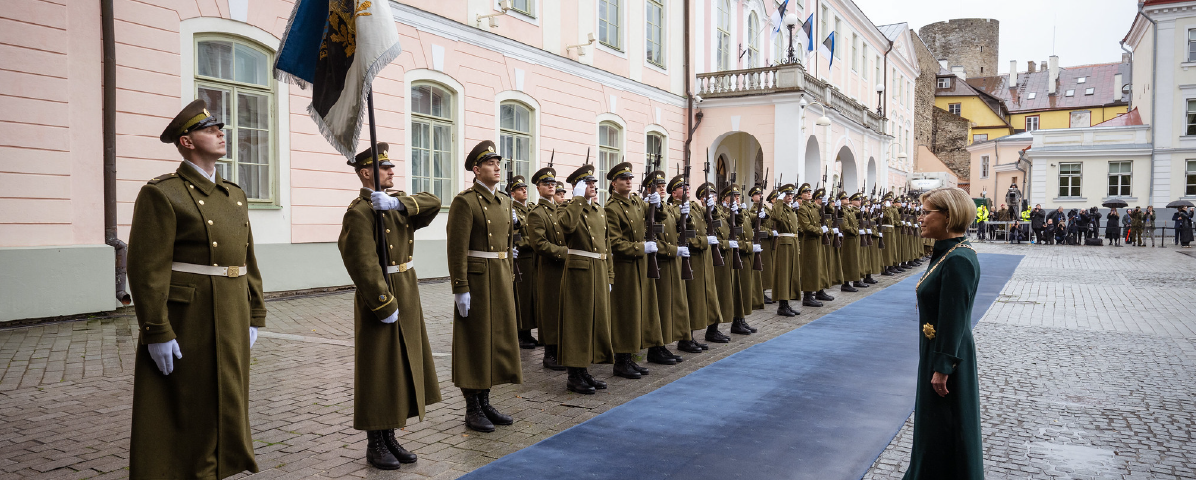
In Shakespeare’s Henry VI, the rebel Dick the Butcher proposes, “The first thing we do, let’s kill all the lawyers.” The line is often read as a backhanded compliment: Those who want to tear down the state begin by attacking its ablest defenders. The law, in other words, is the retaining wall between order and chaos. It is quite telling that in September 2026, Estonia’s parliament chose a jurist to be the head of state. Estonia’s recently elected president Ülle Madise will be the country’s seventh president and only the second woman to hold this office. Unlike her post-1991 predecessors, President Madise has over a decade of legal experience, both as a jurist and as Justice Chancellor (Õiguskantsler). In a tense and fragmented political environment leading to the 2027 parliamentary elections, her legal and administrative experience may help reduce the country’s divisions.
Madise was born to a family steeped in the law. Her father, Tõnu Anton, voted to restore Estonian independence in 1991 and helped draft the country’s new constitution in 1992. Anton would later serve on the Estonian Supreme Court. Madise followed in his footsteps, graduating in 1998 from the University of Tartu’s Faculty of Law and obtaining her PhD in public administration from the Tallinn University of Technology in 2007. From 2005 to 2016, she taught law at universities in Tartu and Tallinn. Outside of academia, Madise was deeply involved in government: She advised the Riigikogu (Estonian Parliament)’s Constitutional Committee and headed its Secretariat from 2002 to 2005. She also served as Chief Auditor of the National Audit Office’s Audit Department II, which oversaw the Ministry of Justice, Ministry of Defence, Ministry of Internal Affairs, and county-level administrations. Between 2009 and 2015, she advised President Toomas Hendrik Ilves on constitutional matters. Her most prominent government role, however, has been that of Justice Chancellor, a position she held from 2015 to 2026. In 2021, Madise was reappointed to a second seven-year term, the only Justice Chancellor so honored. The new president’s work experience gives her a comprehensive perspective on Estonia’s administrative and policy challenges.
The president’s role is one of oversight; most of the office’s power revolves around upholding the constitutional validity of government actions. The Estonian presidency’s most visible remit is in the realm of international relations. The president represents Estonia at various international fora. Under the constitution, the president also has “both active and passive right of embassy,” appointing diplomats and receiving credentials from envoys to Estonia. Moreover, the president’s signature is necessary for ratifying treaties. The president can also declare war in response to aggression against Estonia, as well as request the Riigikogu to order mobilization. While not as numerous as the domestic competencies, the powers held by the president regarding foreign affairs are more visible and substantive. Considering the repeated Russian infringements on Estonian sovereignty, these aspects of Madise’s new role will be subject to scrutiny.
Madise’s resumé engendered two concerns during her presidential campaign: potential partisan bias and limited international experience. The president’s partisanship is a sensitive point for a nominally apolitical post in a country divided along ethnocultural and political lines. The leader of the far-right Conservative People’s Party of Estonia (EKRE), Martin Helme, told the press his party would not support Madise on ethical grounds. After Madise announced she would run, Helme insisted that she should have resigned before declaring her candidacy because her office monitored the Riigikogu’s activities, and its members would be the electors. Nine EKRE members of parliament submitted a petition to the Electoral Commission in August 2026 asking it to disqualify Madise over this alleged conflict of interest. The matter reached the Estonian Supreme Court, which ruled that the law did not require Madise to resign before beginning her campaign. The court also found no sign she had breached her independence or disregarded her duties as Justice Chancellor while campaigning. The court did warn Madise not to make political statements that would affect her role as Justice Chancellor.
EKRE’s complaint matters considering the Justice Chancellor’s traditional neutrality. In the past, public opinion polling showed that over two-thirds of respondents considered the Justice Chancellor’s office trustworthy, roughly proportionate to the number that expressed confidence in law enforcement and emergency services. So, the question of the new president’s impartiality is germane; answering it would determine the presidency’s credibility across the political spectrum. Madise’s tenure in office counters Helme’s critique. Madise spoke repeatedly about the Justice Chancellor’s role as arbiter and promised to keep the office out of party politics. A 2024 survey conducted by the chancellor’s office found that 66% of the Estonian population believed the Justice Chancellor upheld their rights. The Justice Chancellor’s 2024/2025 annual report supports this sentiment, reporting a 15 percent increase in caseload. The office interpreted this as growing engagement with the Justice Chancellor, suggesting confidence in the institution and promoting the perception that the Justice Chancellor was considered an effective defender of the public interest.
Madise’s personal popularity is equally important to understanding how she and the public will perceive her presidency. The candidate’s high ratings are partly due to her role in making the Justice Chancellor accessible. Contrary to Helme’s statement, a Norstat poll commissioned by the Ühiskonnauuringute Instituut found that in late August 2026, 43 percent of respondents backed Madise for president. Madise had support from a majority of Reform, Social Democratic, Isamaa, and Parempoolsed voters, crossing the political spectrum. Even the populist Center Party was split in support for Madise. EKRE was the only party whose membership opposed her candidacy. By late September 2026, a survey by Emor found Madise’s nationwide support had risen to 63 percent. While popularity alone does not determine competence or ethics, it is proof that Madise’s conduct as Justice Chancellor bolstered the Estonian citizenry’s trust in the office and her personally.
The second, more pressing concern about the new president is her relatively limited foreign policy experience. Silver Tambur, publisher of Estonian World magazine, observed that “her weakness, at least on paper, is limited foreign policy experience.” Even her supporters acknowledge she is an administrator, not a politician. Given the fraught regional security climate, some have expressed concern that Madise has not held the diplomatic posts needed to represent the country abroad. Three of the five post-1991 presidents were either diplomats or foreign ministers. An outside observer might claim that Madise’s predecessors possessed direct experience managing Estonia’s international relations which she does not.
Yet one could argue that Madise’s experience is remarkably beneficial to her diplomatic portfolio. Auditing the Ministry of Defense and the Ministry of Internal Affairs for years gave her a strong understanding of their remits and internal workings. She presumably knows the challenges and capabilities of these ministries as well as the individuals running them. Additionally, her career centered around justice, and her commitment to constitutionalism mirrors the country’s support for a rights-based foreign policy. Respondents listed values including human rights and democracy as an important area in foreign policy according to a Ministry of Foreign Affairs survey. Given the growing number of conflicts worldwide, Madise may be expected to speak on human rights, and her 2023 and 2026 speeches show a commitment to upholding international legal norms.
Furthermore, her 2023 speech supports the transatlantic partnership, including Estonia’s membership in the EU and NATO. Madise has repeatedly voiced this sentiment in an August 2026 interview with the Estonian public broadcaster ERR, stating, “The European Union and NATO are indispensable to Estonia’s survival.” She reaffirmed her view on the EU’s importance to Estonia in a September 2026 speech to the Riigikogu. Madise’s unambiguous statements contrast with her predecessor Alar Karis’ approach, which advocated negotiating with Russia after its aggression against Ukraine ended, a move that could be controversial for the Estonian and Ukrainian public. Madise’s stance suggests a continuity and prudence that Estonia needs in a turbulent geopolitical arena.
The new president’s legal experience will be greatly needed as the country faces political headwinds. The incumbent coalition led by Kristen Michal lost its majority in August. The two governing parties stand at only 45-15 percent in the polls, while support for Prime Minister Michal dropped to an all-time low of 4 percent in June 2026 among all voters. The upcoming March 2027 parliamentary elections present Estonian voters with a moment of unpredictability. Two anti-incumbent forces, Center and EKRE, have gained support in recent months, limiting the possibility of a centrist consensus. As president, Ülle Madise will preside over this fractured political landscape and could refocus the country’s discourse on legality and core rights.
Image: Flickr | Office of the President /Presidendi kantselei