 A Nation Must Think Before it Acts
Beyond Recall: Prospects for Taiwanese Unity after July 26
A Nation Must Think Before it Acts
Beyond Recall: Prospects for Taiwanese Unity after July 26

A nation must think before it acts.
Beyond Recall: Prospects for Taiwanese Unity after July 26
Introduction
If there was ever any doubt, Taiwan’s July 26 “Great Recall” election makes one thing clear: Taiwanese politics are deeply divided. For many in the Democratic Progressive Party (DPP), a vote to recall one of twenty-four Kuomintang (KMT) legislators was a vote to protect Taiwan from Chinese communism. For many in the KMT, the recall was a cynical attempt to entrench DPP “one-party dominance.” In a climate reminiscent of polarization elsewhere, political opponents in Taiwan are increasingly framed as enemies rather than legitimate advocates of alternative policy choices.
This polarization poses real challenges to the maintenance of peace across the Taiwan Strait. Most obviously, division between the DPP-led executive and KMT-majority legislature can stall critical policy initiatives, including necessary increases in defense spending. Perhaps equally significant, however, are how it can undermine Taiwanese confidence in their political leaders– inadvertently advancing one of China’s main psychological warfare goals.
Taiwan can ill afford this level of division while facing an existential threat. While many anticipate increased polarization, the outcome of the recall vote could instead have a moderating effect if Taiwan’s leaders seize the opportunity. The recall threat influenced the KMT to temper its calls for cross-strait engagement, while the recall’s failure dashed DPP hopes of controlling the legislature and bypassing the KMT altogether. To strengthen Taiwan’s democratic resilience, leaders in both parties must now grab hold of these moderating influences. Doing so will require addressing the genuine fears and grievances of both DPP- and KMT-aligned camps.
Background
After months of campaigning, on July 26, over half of Taiwan’s electorate voted not to cast out twenty-four KMT legislators subject to recall. DPP Secretary-General Lin Yu-chang subsequently resigned. DPP President William Lai’s approval rating fell to a historic low of about 35 percent, down ten points from the previous June 2025 poll before the vote.
While unprecedented, this outcome is in many ways a natural culmination of the divided government elected early in 2024. Prior to that election, President Tsai Ying-wen’s DPP held a legislative majority with 61 out of 113 seats. This enabled Tsai to advance policy without much consideration for the opposition. President Lai secured a third consecutive DPP presidency in 2024, but Lai’s party returned only fifty-one seats to the legislature. The opposition formed by the KMT’s fifty-two seats, the Taiwan People’s Party’s (TPP) eight seats, and two independents who vote with the KMT gained a decisive majority and ensured Taiwan’s first divided government since 2008.
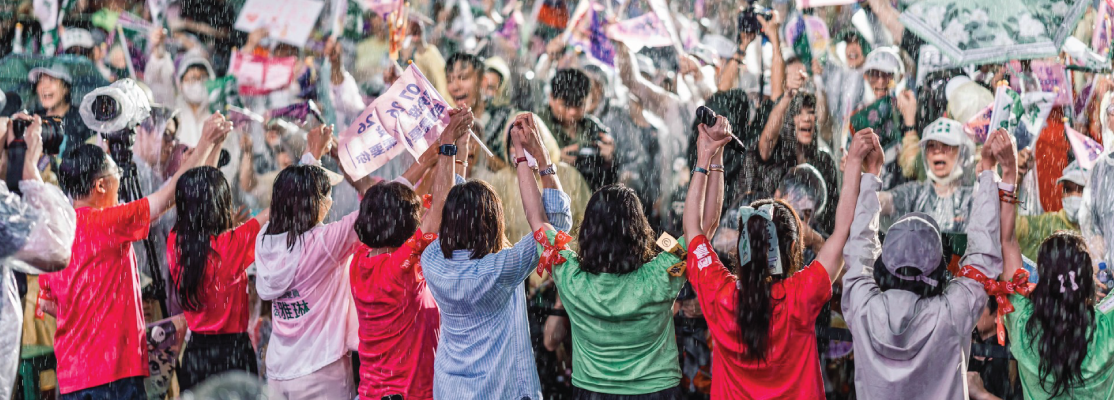
Negative tit-for-tat dynamics commenced almost immediately. Amongst the KMT-majority parliament’s first acts were passing measures to enhance its own authority, including to subpoena and investigate administration officials. While KMT leaders framed such measures as “return[ing] power to the people,” the DPP and many citizens saw unconstitutional overreach with malign Chinese influence. Widespread protests erupted in what came to be known as the “Bluebird Movement,” the largest since the Sunflower Movement in 2014.
In polarized Taiwan, protests were not limited to supporters aligned with the DPP. In August 2024, third-party TPP presidential candidate and former Taipei mayor Ko Wen-je was arrested on charges of corruption. Many Ko supporters perceived his arrest as political reprisal for drawing votes away from the DPP in the 2024 election (which Lai won with 40 percent of the vote), and thousands demonstrated for his release. Then, in October, Taiwan’s constitutional court ruled parliament’s power-enhancing legislation unconstitutional, to which the parliament responded by passing an amendment barring the court from declaring any laws unconstitutional and refusing to confirm eight new vacancies on the fifteen-member court. The year 2024 closed with protests, counter-protests, and Taiwan’s three main branches of government engaged in war by paralysis.
In this context, nationwide recall efforts began in January 2025. Taiwanese semiconductor tycoon Robert Tsao helped organize the effort via a new “Safeguard Taiwan, Anti-Communist Volunteers League.” Tsao accused the KMT and TPP of “dismantling our democracy.” During KMT counter-recall demonstrations, KMT Legislative Speaker Han Kuo-yu claimed it was the DPP who were “murdering our democracy.” Throughout the campaign a vote to recall KMT lawmakers was consistently framed as “opposing communism to protect Taiwan,” while the KMT consistently accused the DPP of authoritarianism. KMT Chairman Eric Chu even compared President Lai to Adolf Hitler.
With the election outcome now clear and the threat from China growing increasingly urgent, it is critical that Taiwan’s leaders break from negative tit-for-tat dynamics and focus on the challenges that unite them. Doing so will require both compromise and acknowledgment of legitimate grievances.
Green and Blue Grievances
While each camp castigates the other, both have legitimate cause for concern. When former President Ma Ying-jeou (KMT) remarks that Taiwan must “trust” Xi Jinping on the eve of the 2024 election, or when KMT whip Fu Kun-chi begins a new legislative session by leading a delegation to meet with Chinese leader Wang Huning in Beijing, the DPP and Taiwanese citizens are rightfully alarmed. After all, concern about Chinese influence is not paranoia. Rather, it is a rational response to being the coveted territory of the world’s second-largest economy that has a demonstrable record of waging sophisticated influence operations.
The DPP is likewise right to be concerned about the KMT-led legislature’s 6.6 percent reduction of the 2025 executive budget. Most alarmingly, this included a 3 percent cut on military equipment and a freeze of about $3 billion in other defense spending. The implications of this are truly far-reaching, as critical US defense support requires Taiwan to take its own defense efforts seriously. US Senator Dan Sullivan (R–AK) made it as clear when he addressed the KMT directly in March, stating, “They are playing a dangerous game on their defense budget. And if anyone from Taiwan is watching this hearing, they need to realize they are playing a dangerous game.”
The KMT and KMT-aligned TPP also have legitimate grievances. The DPP and KMT are at odds on a number of substantive issues, ranging from energy and environmental policy to support for LGBT rights to the composition of the constitutional court. The KMT is likewise much more skeptical of the DPP’s use of the executive to promote a Taiwan-centric identity. One recent example involves the replacement of the 96.4 percent of “Han Chinese” with the category of “other” on an executive website. KMT representatives, who tend to be more affirmative of Chinese ethnic identity as the founders of the Republic of China, described the change as a “denial of history” and “de-Sinicization.”
Because the DPP controlled both the presidency and the legislature from 2016 until 2024, the KMT feels its voice on such issues has not been duly considered. Worse, the KMT is aggrieved that its policy preferences are often framed as a result of malign Chinese influence rather than legitimate policy disagreement. Now, with a divided government, compromise and civil dialogue over such issues are essential.
The Way Forward
The obstacle to civility that Taiwan’s parties face is no different than parties in other highly polarized societies. Simply put, demonizing the enemy can pay electoral dividends. As political scientist Robert Axelrod and common sense illustrate, in such uncooperative environments, the worst outcomes often occur when good-faith efforts to cooperate go unreciprocated. No one wants to earn what game theory calls the “sucker’s payoff.”
Indeed, given the incentives to jealously guard individual or group self-interest, cooperative dynamics can be difficult to implement. Yet, in addition to repeat interactions where trust (or distrust) can be established, the DPP and KMT possess a key condition for establishing cooperative dynamics: namely, a common interest, in this case, survival in the face of the threat from the People’s Republic of China.
As great as this threat is, its uncertain and perhaps distant future may weigh less than the much more immediate and tangible benefits of winning the next election. That is why this recall outcome represents such a significant opportunity, as it appears to signal diminishing returns to polarizing strategies. As Lev Nachman points out, the results illustrate that “accusing everyone of being a Communist party agent is not a winning strategy.”
If the electoral incentives for portraying the opposition party as Chinese Communist Party (CCP) agents diminish, then a new, more civil landscape for competitive democratic politics in Taiwan may emerge. The KMT can help foster this changed dynamic by doing a better job of allaying legitimate concerns about the nature of its cross-strait engagement. Howard Shen, former spokesperson for the KMT’s 2024 presidential candidate, rightfully emphasizes the need for greater transparency, including “how [the KMT] will avoid being taken advantage of by the CCP’s United Front work, and what red lines it will not cross.” Greater transparency, judgment, and self-policing by the KMT can further encourage DPP restraint against recklessly wielding the charge of “CCP agent” as a political cudgel– or at least further reduce this strategy’s electoral payoffs.
Threading the needle between legitimate concern and counterproductive political fearmongering will not be easy. One possible solution is to establish a bipartisan Taiwanese task force jointly focused on combatting CCP influence operations. Such a task force could not only work to establish mutual trust; it would also align with new and necessary “whole of society defense resilience” efforts, particularly around information security.
Conclusion
China’s goal of annexing Taiwan has not changed. Yet, as one Chinese scholar likely affiliated with China’s United Front Department recently put it, “Peaceful unification appears increasingly unlikely, and the cost of military unification is too high.” Given this situation, Beijing seeks to foster polarization to psychologically demoralize Taiwan’s society and make it more vulnerable to various fait accompli scenarios.
Taiwan’s leaders understand this. Yet, the incentives to demonize the political opposition to secure an advantage in each election cycle have often proved too enticing to resist. Now, Taiwan’s voters may have given KMT and DPP leaders a way out. Voters are sufficiently skeptical of the KMT’s cross-strait engagement strategy to subject them to recall, and sufficiently skeptical of collusion accusations to vote for every KMT legislator to keep their seat.
In February 2025, President Lai gathered leaders from all branches of Taiwan’s government, urging that “Taiwan must unite.” At that time, however, the impending recall election presented an obstacle to compromise. Whether direct dialogue between DPP and KMT leaders could be held, as a precursor or in addition to executive-legislative dialogue, would, Presidential Office Secretary General Pan Men-an suggested, depend on future events.
That future has arrived, and the incentives for such inter-party dialogue are perhaps better than ever. Unfortunately, that is a low bar to clear. Whether the KMT and DPP can take advantage of this opportunity will depend on leadership from both sides. As Senator Sullivan’s remarks make clear, Taiwan’s American partners are also watching, and presumably are ready to lend their full support.
Image: Facebook |護國大遶境