 A Nation Must Think Before it Acts
How the Russian Orthodox Church Became a Weapon of Political Warfare
A Nation Must Think Before it Acts
How the Russian Orthodox Church Became a Weapon of Political Warfare

A nation must think before it acts.
How the Russian Orthodox Church Became a Weapon of Political Warfare
Bottom Line
The Russian Orthodox Church (ROC) has become a central pillar of the Kremlin’s political and informational warfare strategy, which shapes narratives by fusing spirituality with nationalism. Through doctrines like the “Russian World” (Russkiy Mir) and appeals to shared Orthodox identity, Moscow weaponizes faith to justify aggression and extend its ideological reach. These narratives have influenced attitudes in Ukraine, Georgia, Moldova, and across parts of Africa and Europe—undermining Western integration, sowing local skepticism toward NATO and the EU, and reinforcing pro-Kremlin movements through cultural affinity and religious symbolism.
The infrastructure that sustains this spiritual-political influence is an interconnected ecosystem of state, church, and media. The ROC hierarchy operates in tandem with state-controlled broadcasters, diplomatic missions, private “patriotic” NGOs, and digital platforms such as Telegram and YouTube channels linked to the Moscow Patriarchate. Financially, the system is underpinned by Kremlin-aligned oligarchs, state enterprises, and tax-exempt church assets, while its logistical reach relies on global dioceses, cultural centers, and ecclesiastical missions that double as nodes of soft power. This coordination allows Moscow to adapt its messaging to local contexts—presenting itself alternately as a defender of faith, a peace broker, or a bulwark against Western “moral decay.”
Countering this form of religiously cloaked disinformation requires targeting both the financial and institutional lifelines that enable it. Transparency over church-state funding flows, regulation of foreign-linked religious structures, and exposure of clerical actors engaged in political propaganda are essential to curbing the Kremlin’s influence. Cases like the Ukrainian autocephaly movement in 2019—when the spiritual head of the Orthodox Church, the Ecumenical Patriarch Bartholomew I of Constantinople, granted the Orthodox Church of Ukraine (OCU) independence from the ROC—and proactive oversight in states such as Moldova show the importance of dismantling hybrid religious-political networks. Complementary measures—strengthening independent Orthodox institutions, enhancing media literacy, and deepening international cooperation—are vital to defending democratic resilience against this evolving form of ideological warfare.
Introduction
Between faith and manipulation lies a blurred frontier. For millions of believers, the ROC is a pillar of tradition and spirituality, a continuation of centuries-old liturgy and culture. Yet behind the sacred façade, the church’s hierarchy has for decades been intertwined with the Soviet and Russian state security apparatus. What began as a project of survival under Bolshevik persecution evolved into systematic subordination to the KGB—and now, to the FSB and Patriarch Kirill— and into a global network of political influence.
This is not an indictment of Orthodoxy or its faithful. It is an examination of how the Kremlin has hijacked the ROC’s institutional structure, transforming it from a spiritual community into an instrument of Kremlin statecraft and soft power. Understanding this evolution—its Soviet origins, its post-Soviet continuity, and its expansion across Ukraine, Africa, and the West—reveals how the ROC has become a “transmission belt” of Russian power, to borrow Vladimir Lenin’s own term for ideological front organizations.
From Subjugation to Collaboration: Soviet Origins
The subjugation of the ROC to state power began long before the Bolsheviks. In the early 18th century, Peter the Great abolished the Patriarchate and replaced it with the Holy Governing Synod in 1721, effectively turning the church into a department of the imperial bureaucracy. Bishops became state officials, sermons were monitored for loyalty, and the clergy were obliged to report politically suspect behavior among their parishioners. This transformation marked the beginning of the church’s long entanglement with the state—a system of spiritual servitude masked as “symphony” between altar and throne.
Resistance emerged almost immediately. The Old Believers, who rejected Peter’s and Patriarch Nikon’s earlier liturgical reforms, became symbols of defiance against both religious standardization and state coercion. Brutally persecuted and driven underground, they preserved an alternative model of faith rooted in autonomy and conscience. Yet their marginalization reinforced the dominance of a church hierarchy dependent on imperial favor—setting a precedent for later regimes to exploit its structures for political ends.
The story then continues with the Bolshevik revolution and Soviet repression. The All-Russian Local Council of 1917–1918 sought to restore the church’s self-governance after centuries of imperial control, but its brief renewal was crushed under the Bolshevik state. Lenin’s Decree on Land and subsequent anti-religious campaigns stripped the church of property, outlawed religious education, and executed or imprisoned tens of thousands of clergymen and women. Yet the Soviet approach was not only about destruction—it was also about infiltration.
By the late 1920s, the OGPU, the Soviet secret police, had adopted a dual strategy of terror and co-optation. Thousands of bishops, priests, and monastics were purged, while others were recruited as informants or installed as loyal agents. In 1927, under pressure from OGPU officer Yevgeny Tuchkov, Metropolitan Sergius issued his notorious Declaration of Loyalty to the Soviet Union, pledging that “the joys and successes of our Soviet homeland are our joys and successes, and its misfortunes are our misfortunes.” With that act, the ROC’s institutional independence was extinguished. A regime-approved synod replaced genuine leadership, and the principle of Sergianism, submission to state power, became the defining doctrine of Soviet ecclesiastical life.
After World War II, the church was revived not as a free institution but as a controlled one. The Council for Religious Affairs and the KGB vetted every bishop and seminary rector. After 1943, the Soviet authorities not only “allowed” the revival of the ROC but placed it entirely under the control of the OGPU’s successor, the NKVD, and later the KGB. The church’s leadership, especially at the episcopal level, largely consisted almost entirely of agents or collaborators of the state security services. Abroad, ROC missions operated as instruments of Soviet diplomacy and intelligence. Among their representatives was a young cleric named Vladimir Gundyaev, today Patriarch Kirill, who, according to Swiss archival evidence, served as a KGB officer under the codename “Mikhailov” while stationed in Geneva in the 1970s. His assignment at the World Council of Churches illustrates how Soviet religious diplomacy doubled as espionage and propaganda.
Continuity under Kirill: The Post-Soviet Church of Power
The collapse of the Soviet Union did not sever these ties—it institutionalized them. When Kirill became Patriarch in 2009, the Church’s mission was recast within the ideological framework of the Russkiy Mir (“Russian World”), a doctrine fusing Orthodoxy, patriotism, and empire. The ROC emerged as a key partner in the Kremlin’s soft-power strategy, sanctifying Russian geopolitical ambitions as a civilizational mission.
Kirill’s public statements have consistently aligned with Kremlin narratives. His 2022 sermons depicted the invasion of Ukraine as a “holy struggle” against a morally corrupt West. In January 2025, he blessed crosses engraved with President Vladimir Putin’s initials to be distributed to “war heroes.” These symbolic acts illustrate a deeper continuity: the church not merely as a moral authority, but as a legitimizing arm of state power.
Global Missions of Influence
Today, the ROC’s foreign reach extends far beyond its traditional sphere. In Africa, Moscow has built a new Patriarchal Exarchate since 2021, establishing over 350 parishes across 32 countries. The official purpose is to serve Orthodox believers who allegedly felt “abandoned” by the Patriarchate of Alexandria after it recognized the independence of the OCU. Yet Ukrainian intelligence reports describe the project as a hybrid influence operation, blending religious diplomacy, propaganda, and soft-power projection under the guise of pastoral care.
ROC emissaries in Africa meet with local officials, cultivate political contacts, and promote narratives of Russian moral leadership. These efforts mirror Soviet-era tactics, replacing Marxism with Orthodoxy as the ideological export. The Kremlin’s objective remains the same: to undermine Western influence and expand Russian presence across strategic regions.
Similar operations occur closer to home. In Georgia and Moldova, ROC-linked clergy propagate anti-Western messages, framing NATO and the EU as threats to traditional Christian values. In the United States and Western Europe, ROC parishes within the Moscow Patriarchate have served as platforms for pro-Kremlin messaging—often cloaked in appeals to “family values” or “spiritual resistance to globalism.” What appears as religious conservatism frequently doubles as information warfare.
Ukrainian Autocephaly and the Post-2022 Contest Over Faith and Influence
The January 2019 decision by the Ecumenical Patriarchate to grant autocephaly to the OCU marked a historic rupture. It ended Moscow’s centuries-old claim over Ukrainian Orthodoxy and struck at one of the Kremlin’s key channels of soft power. Yet it was only after Russia’s full-scale invasion in 2022 that the conflict over ecclesiastical allegiance transformed into an open struggle between a sovereign Ukraine and a weaponized church hierarchy.
For Patriarch Kirill, the war in Ukraine became a sacred mission. Through televised liturgies, state-sponsored processions, and martial blessings, he recast Russian aggression as a crusade against Western decadence and moral relativism. The blessing of crosses engraved with Putin’s initials symbolized this fusion of faith and war. Such ceremonies reinforce the idea that Russia’s campaign is not merely political but spiritual—defending “Holy Rus” from a hostile world.
In Ukraine, however, the OCU’s independence has enabled the state to reassert control over its religious sphere. Since 2022, the Security Service of Ukraine (SBU) has opened at least 174 criminal proceedings against clergy of the Moscow-affiliated Ukrainian Orthodox Church (UOC-MP), with 122 priests formally charged and 31 convicted for collaboration or propaganda in support of the aggressor state. Investigations uncovered priests spreading anti-Ukrainian propaganda, coordinating with Russian operatives, or even stockpiling weapons left by retreating Russian troops. One Kherson-based priest was arrested for attempting to sell Igla missiles and explosives hidden beneath a church under construction.
Other cases reveal more subtle forms of collaboration. A seminary rector in Pochaiv was accused of spreading Russian narratives online, while in Kirovohrad, a UOC-MP bishop allegedly distributed pro-Kremlin leaflets and justified the occupation of Crimea. The Ukrainian parliament has since advanced legislation restricting religious organizations with direct administrative ties to Russia, arguing that such structures represent a threat to national security.
Moscow’s response has been predictably fierce. The ROC accuses the OCU and Constantinople of “schism,” portraying Ukraine’s religious independence as a Western-engineered plot to divide the Orthodox world. These narratives are amplified through Russian media and church channels abroad, turning theology into geopolitics. What began as an ecclesiastical dispute has thus become a front line of hybrid warfare, where sermons, icons, and canonical decrees serve as tools of statecraft.
For Kyiv, confronting this challenge means balancing national security with religious freedom—rooting out subversive networks while safeguarding the faith of millions who worship sincerely. The autocephaly of the OCU has provided a moral and legal framework for such efforts, allowing Ukraine to reclaim its religious sovereignty from a hierarchy that long served Moscow’s interests.
Conclusion
The tragedy of the Russian Orthodox Church lies not in its faith, but in its capture. What began as persecution under Lenin evolved into co-optation under Josef Stalin and institutional servitude to the KGB. Under Putin, this system endures: the Church remains a pillar of Kremlin ideology and a vehicle of political influence from Kyiv to Nairobi.
For policymakers, the lesson is clear. Religious institutions, when intertwined with authoritarian power, can become instruments of disinformation and espionage. Western governments should enhance transparency over foreign-linked religious networks, support independent Orthodox institutions, and include ecclesiastical influence mapping in broader analyses of hybrid warfare. Protecting the autonomy of faith communities is not only a matter of religious liberty—it is a matter of national security.
The Kremlin’s political warfare now wears vestments. Understanding how the Russian Orthodox Church became both a soft-power shield and sword for the state is essential to countering its reach—and to ensuring that faith remains the domain of the faithful, not of the powerful.
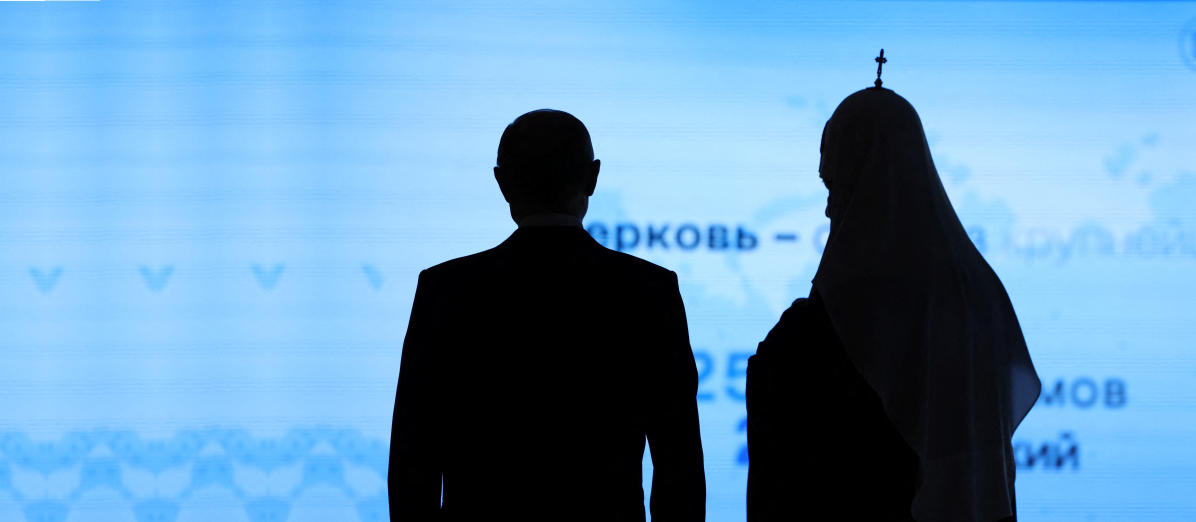
Image credit: Russian President Vladimir Putin and Patriarch Kirill of Moscow and all Russia visit the exhibition Orthodox Rus’ dedicated to the National Unity Day in Moscow, Russia November 4, 2024. Sputnik/Vyacheslav Prokofye via REUTERS