 A Nation Must Think Before it Acts
Political Stability Must Top Japan’s Leadership Agenda
A Nation Must Think Before it Acts
Political Stability Must Top Japan’s Leadership Agenda

A nation must think before it acts.

Political Stability Must Top Japan’s Leadership Agenda
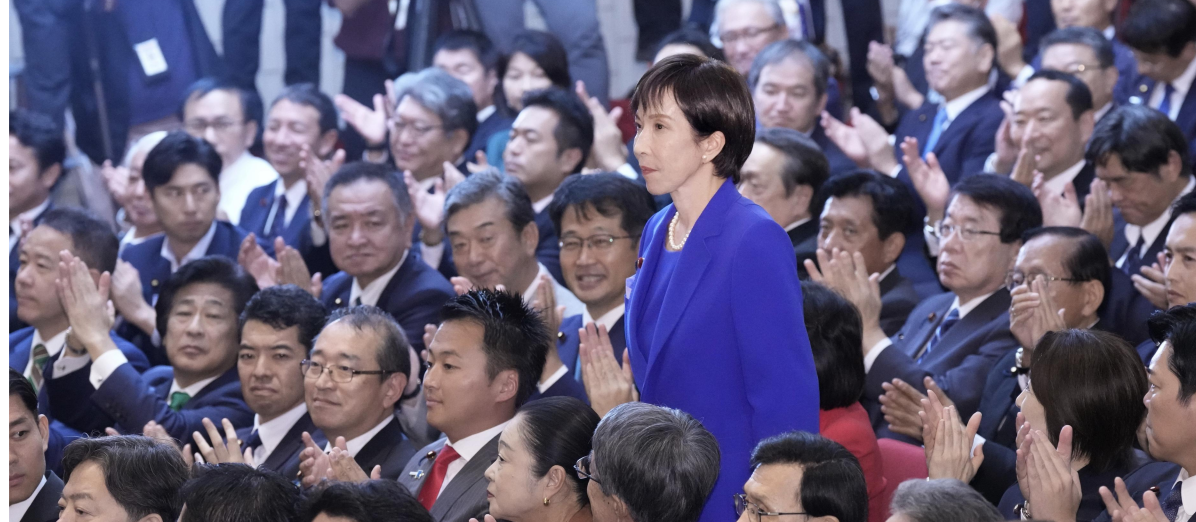
Having won the ruling Liberal Democratic Party’s leadership election on October 4, Sanae Takaichi is set to be Japan’s fifth prime minister in as many years. As the first female leader of the party that has dominated Japanese politics since its founding in 1955, the fact that Japan will have a woman as prime minister is noteworthy. But Takaichi’s success will ultimately be defined by her ability to survive politically and restore stability in the country’s leadership.
Takaichi takes the helm at a critical juncture for the Liberal Democratic Party (LDP). Having suffered decisive defeats in both the Lower and Upper Houses of the Diet over the past year under former Prime Minister Shigeru Ishiba’s watch, the LDP remains the country’s single largest party but it has been weakened significantly. It will need to form a coalition government with at least one other party, and most likely two, which will invariably require greater consensus-building from within. But Takaichi, who has publicly declared repeatedly that she looks to Margaret Thatcher as a role model, is not known for her consensus-building skills. She is, however, known to be a protege of the late Prime Minister Shinzo Abe, who came to define some of Japan’s signature foreign policy directives including a vision for a Free and Open Indo-Pacific and advancing the Comprehensive and Progressive Agreement for Trans-Pacific Partnership (CPTPP) multilateral trade framework.
For the LDP, embracing Takaichi’s more conservative political leanings, such as calling for a more stringent approach to immigration and bolstering national pride by promoting national identity, is seen as a way to restore public support for the party. But as she looks to political allies both within and outside of the LDP for support, Takaichi will also need to address some of Japan’s biggest foreign policy challenges immediately. She is expected to be confirmed as prime minister by mid-October, and one of her first high-stakes tasks will be to meet with President Donald Trump, who is scheduled to meet with the new leader in Tokyo before heading to the APEC summit meeting in Seoul on October 31. Following up on the bilateral trade agreement signed in September will be a priority for Tokyo, but the biggest challenge will be whether or not a personal rapport between Takaichi and Trump can be reached.
Japan remains the most steadfast US ally in the Indo-Pacific, which continues to be the most dynamic and populous region in the world. China, however, is now firmly established as the regional economic as well as military hegemon. As Washington’s China strategy remains unclear, Japan can play a pivotal role in shaping the Trump administration’s perspective and its longer-term relations with Beijing. But that will require the Japanese leader to have the ear, and ultimately the trust, of the US president.
Building trust is no easy task, and it certainly requires time and constant tending. Having the United States remain committed as an Indo-Pacific power is critical for regional stability as China and Russia continue to press ahead with a so-called no limits partnership. Expectations are now high for Takaichi to develop strong personal ties with Trump and to share a vision for security in the Indo-Pacific that could counterbalance the growing quasi-alliance between Beijing and Moscow. For that to be a possibility, though, Takaichi will first and foremost have to establish herself as a leader who will remain in power for the foreseeable future, rather than yet another prime minister who is in office for about a year.
Image Credit: Kyodo/Reuters