 A Nation Must Think Before it Acts
American Missiles and Russian Dachas: Tomahawk and the Future of Stability and Deterrence in Europe
A Nation Must Think Before it Acts
American Missiles and Russian Dachas: Tomahawk and the Future of Stability and Deterrence in Europe

A nation must think before it acts.

American Missiles and Russian Dachas: Tomahawk and the Future of Stability and Deterrence in Europe
The Tomahawk cruise missile is a near perfect machine. Its development followed advances in guidance and turbofan engine technology in the 1970s. It has been tested for decades. And it has been upgraded and augmented for the same amount of time. The missile’s accuracy has always been a source of concern in Moscow, where its deployment in Europe in a ground-launched variant in the 1980s helped spur agreement on the elimination of this class of weapons, only for the erosion of arms control to once again be deployed within ground launch range of Russian targets.
A former Soviet Premier put it best in the days before the Cuban Missile Crisis. In response to the deployment of Jupiter missiles in Turkey, Nikita Khrushchev complained on a trip to the Black Sea that “[He] could see US missiles in Turkey aimed at [his] dacha.”
Soviet and then Russian fears about American encirclement are as old as the missile age. The major concern, as Khrushchev so elegantly put it, is that the United States can put a missile through the window of a Russian dacha in 10 minutes or less. These concerns were first centered on fears of a nuclear first strike, but with changes to both US doctrine and technology over the past 40-years, are now centered on American conventional overmatch: the idea that a US first strike could be aimed at the Russian leadership and, with continued advances in missile defense and precision strike, could eventually be used to negate Russia’s nuclear deterrent.
President Vladimir Putin cautioned against such missile deployments before his invasion of Ukraine in 2022. In November 2021, he warned “If some kind of strike systems appear on the territory of Ukraine, the flight time to Moscow will be 7-10 minutes …” If this sounds familiar, it is because it is the same argument Khrushchev made more than four decades ago. And it is the same argument Russian leaders are now making about the potential introduction of Tomahawk cruise missiles into Ukraine.
There are ample reasons for the United States to provide Ukraine with longer-range weapons. Russia is using its advantage in these longer-range systems to punish Kyiv and Ukrainian infrastructure. Ukraine is not winning the war. It is in a defensive position along the front and, therefore, lacks leverage over Moscow in any future negotiation for a favorable ceasefire. However, it would be unwise to summarily dismiss Russian concerns about Tomahawk or to assume, as President Donald Trump has suggested, that Moscow is a “paper tiger.”
It is not. The Russian leadership has probed NATO’s eastern defenses with drones to some tactical success. It has the capability to strike targets anywhere in Europe. It has chosen not to because it has been deterred. Regardless, it is worth taking Russian leaders at their word about concerns over decapitation strikes. We think they really are afraid. While the risk of conflict spilling over the border remains low, any such move that crosses a stated Russian red line requires some deliberation. It also requires thinking how Moscow may react, and then doing things proactively to defend NATO’s exposed and porous eastern front from an inevitable Russian reaction to the introduction of Tomahawk.
A good way to think about this is to revisit the 1980s. There was a time when the United States had Tomahawk in Europe, and used the deployment of this weapon and others to reach agreement with the Soviet Union on their elimination.
Revisiting Euromissiles and Ground Launched Missiles in Europe
Russian opposition to the deployment of ground-launched Tomahawk missiles in Europe has deep roots, grounded in the fear of decapitation strikes against leadership. During the Euromissile crisis of the late 1970s and early 1980s, the deployment of nuclear-armed American Pershing-II ballistic missile and the Gryphon ground-launched variant of the Tomahawk caused profound consternation among Soviet leadership who worried about the short flight times in the European theater. The Pershing-II was a particular problem. It could reach Moscow in a handful of minutes. Soviet strategists also were concerned by the Gryphon’s mobility, difficulty of detection, and accuracy—a combination that made it ideal for a first strike weapon. While the Tomahawk was removed from the continent by the 1987 Intermediate-Range Nuclear Forces (INF) Treaty, the missile continued to generate fear and uncertainty for Russian leaders. It can be launched from submarines and aircraft, preserving a key American advantage in fires that Moscow never really liked.
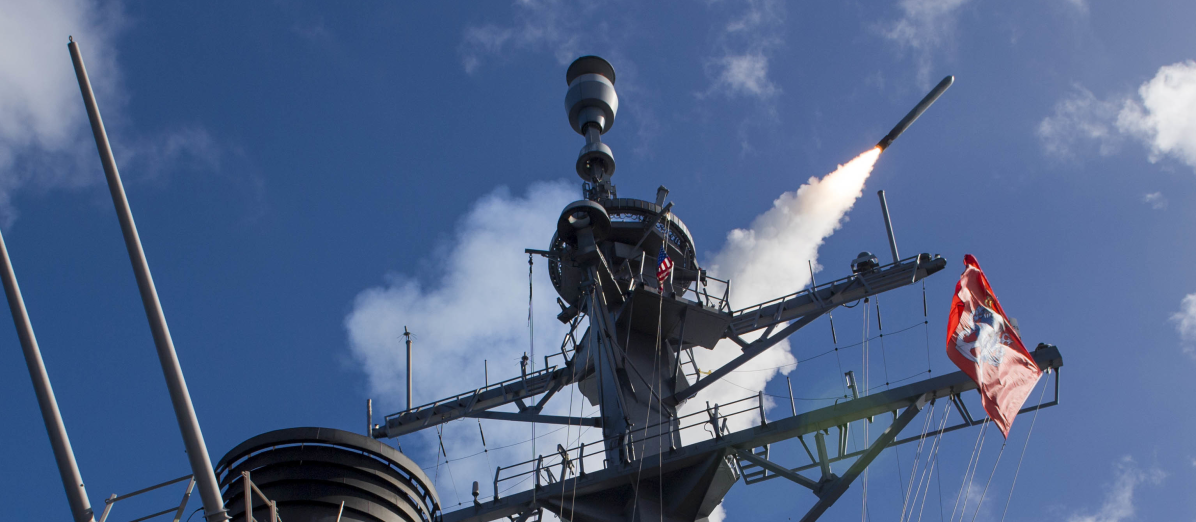
The issue of ground-launched Tomahawks reemerged during the Obama administration. It was part of the controversy over the European Phased Adaptive Approach (EPAA), a missile defense concept designed to defend European allies from a future long-range Iranian missile threat, beginning with deployments of Aegis guided-missile destroyers in the Mediterranean and culminating with the construction of Aegis Ashore missile defense sites in Romania and Poland. The MK-41 launch system is designed for multiple different missiles, including the Tomahawk. This makes perfect sense. The space on ships is limited. Therefore, you want a one size-fits-all approach to launching weapons. The EPAA simply moved much of that system ashore, MK-41 launcher and all.
Perhaps in an act of projection, Russian leaders have repeatedly suggested the United States could covertly redeploy long-range cruise missiles to Europe by arming the Aegis Ashore sites with Tomahawks. The MK-41 vertical launch system that the Aegis Ashore site would use to store and launch SM-3 interceptors could theoretically house Tomahawks, as both the SM-3 and the Tomahawk are launched out of the strike variant of the VLS launcher. However, the Aegis Ashore system lacks the requisite software, fire control hardware, and support equipment to plan and launch Tomahawk strikes. In 2022 the United States reportedly offered to allow Russia the opportunity to inspect Aegis Ashore sites to verify the absence of Tomahawks in the launchers.
Russia has always had an issue with the range restrictions in the INF Treaty. The agreement eliminated the missiles Moscow had once allotted to strike targets in Europe. Russia, in turn, sought ways to—at first—circumvent the agreement by testing the RS-26 to a range to comply with both the INF and New START treaties. It did so with a light payload. After declaring the road-mobile missile as New START compliant, Moscow swapped out the payload, decreasing the range, and giving its leaders the option to deploy what was (and is) a medium-range missile for targets in Europe. It is now using this missile, rechristened as Oreshnik, to strike Ukraine and to signal to Europe that it can use it to strike anywhere on the continent with either nuclear or conventional payloads.
The Russian military also just simply violated the INF treaty. They developed the SSC-8 Screwdriver/9M729 for the Iskander system. This is a ground-launched cruise missile, most probably modelled on the Kalibr missiles they deploy on both naval and long-range aviation platforms. Throughout this period, however, the Russian leadership remained preoccupied with the Aegis Ashore sites in Europe. Indeed, the ideal weapons to strike these sites in Europe is a medium-range missile.
The tensions over these missiles reached a crescendo in 2019. After years of hints and leaked reports about Russian INF violation, the United States began indicating it would withdraw from the INF treaty. In response, Putin gave a speech in which he stated the Aegis Ashore sites were “fit” for deploying Tomahawks that could reach Moscow in 10-12 minutes. Deputy Foreign Minister Sergei Ryabkov echoed those concerns about short flight times of INF-range cruise missiles in an interview. While the stationary Aegis Ashore sites mean such a capability wouldn’t be mobile, these comments indicate Russian leadership now saw the shorter flight times of cruise missiles launched from eastern Europe as an issue, exacerbating the longstanding Russian and Soviet concerns about the Tomahawk’s accuracy and ability to evade detection.
Moscow has sought to obscure their part in the INF treaty’s collapse. They intermittently offer to enter again into negotiations for a deployment moratorium, albeit without ever acknowledging that it was their decision-making that killed the agreement. This is a decision that they may come to regret. And it also raises a serious set of broader questions about strategic stability in Europe, which may become more salient if the Trump administration does indeed export Tomahawk to Ukraine and deploys similar systems in Europe (and in Asia with ranges that can hold targets in Russia at risk).
Russian Regret
Since the Russian invasion of Ukraine in February 2022, the specter of the Gryphon has returned for the Russian strategic planners. It has come in two forms, both carrying conventional warheads—a key difference from the Cold War.
The first is the US Army’s Typhon missile system. When the United States finally decided to abrogate the INF treaty in August of 2019, they did so by launching a Tomahawk from a MK-41 VLS cell on a trailer. This launcher was not originally a rigorously developed weapon system. The duct tape used to help strap the launcher on the trailer for the first test launch was clearly visible in photos released by the Department of Defense. Despite its rugged beginnings, the Army has built on the concept and produced Typhon—four MK-41 vertical launch cells carried in a 40-foot ISO container that launch the Tomahawk and the SM-6 ballistic missile. The mobile Typhon is also called the Mid-Range Capability and has been deployed for training exercises with American allies in the Philippines and Australia. The United States has decided to station an Army Multi-Domain Task Force in Wiesbaden, Germany. Starting in 2026, this will feature periodic deployments of a long-range fires capability, such as the Typhon system. Second, Ukrainian President Volodymyr Zelenskyy has asked the United States for transfers of Tomahawk missiles to help repel the Russian invasion, a decision Trump is considering, according to Vice President J.D. Vance.
While the precise range of the Tomahawk depends on the variant and the flight path, such a transfer would give the Ukrainians a long-range precision strike option with enough range to target Moscow and much of the rest of European Russia. Keith Kellogg, the US special envoy to Ukraine, suggested that with the Tomahawk’s ability to hit deep into Russia, “There are no such things as sanctuaries,” hinting they could threaten leadership. Beyond the deployment of “destabilizing missile capabilities” which pose a “strategic threat” to their backyard, it is clear the Russians continue to worry INF range systems, including Tomahawks, could be used for decapitating strikes.
The Russian leadership may even see the conventional nature of the missiles being deployed to Germany and potentially Ukraine as lowering the threshold for such strikes. Nevertheless, it seems ground-launched Tomahawks are returning to Europe, carrying with them a host of dangers for the Russians. The deployment of US-operated missiles in Germany and, potentially, a different Tomahawk ground launcher in Ukraine is deeply ironic. Russia violated the INF treaty to gain advantages for prosecuting a hypothetical war in Europe. Those violations, however, eventually prompted a withdrawal and ushered in this new reality for the leadership in Moscow. The implications for strategic stability are a bit more difficult to discern. In some respects, the United States and NATO are simply matching a capability Moscow has developed and deployed. Yet, the potential to push that capability to the Russian border would be an outcome Moscow has sought to stop and dissuade for the duration of the war.
How might Russia respond? Various Russian officials have suggested a myriad of responses, ranging from increased hybrid attacks to striking the Polish airport where arms deliveries to Ukraine are collected for distribution. For much of the war, Russian threats have been empty. However, this red line may be one step too far. A direct attack on NATO is unlikely. Russia does not appear to have the appetite for conflict with a more powerful foe. The reality, of course, is that European NATO members—and the United States—have no appetite for war either. This is why Russia’s so-called “hybrid war” tactics can be so effective. They are provocative, yes, but not that provocative. They can prompt concern and anxiety in Europe. And Russia could then try and leverage fear to extract concessions, or split consensus about the future of Ukraine in Europe and North America.
It would be prudent to pair any such deployment with increased vigilance on NATO’s eastern front, perhaps increasing the capabilities of air and naval assets deployed as part of Baltic Sentry. Thinking beyond tactics, the return of missiles is certain to prompt anxiety in Russia. Deterrence has worked thus far in the conflict and is probably going to prevent direct confrontation between the world’s largest nuclear power and the world’s only nuclear-armed alliance. However, Tomahawk and missiles on Russian borders have always been a major irritant for the leadership in Moscow, so there are ample reasons to believe that any such deployment will ignite the Russian leadership’s anxiety about dying, prompting moves to make Europe pay a price for making Moscow’s elite uncomfortable.
Image credit: US Navy