 A Nation Must Think Before it Acts
Collective Seapower: NATO’s New Maritime Strategy
A Nation Must Think Before it Acts
Collective Seapower: NATO’s New Maritime Strategy

A nation must think before it acts.

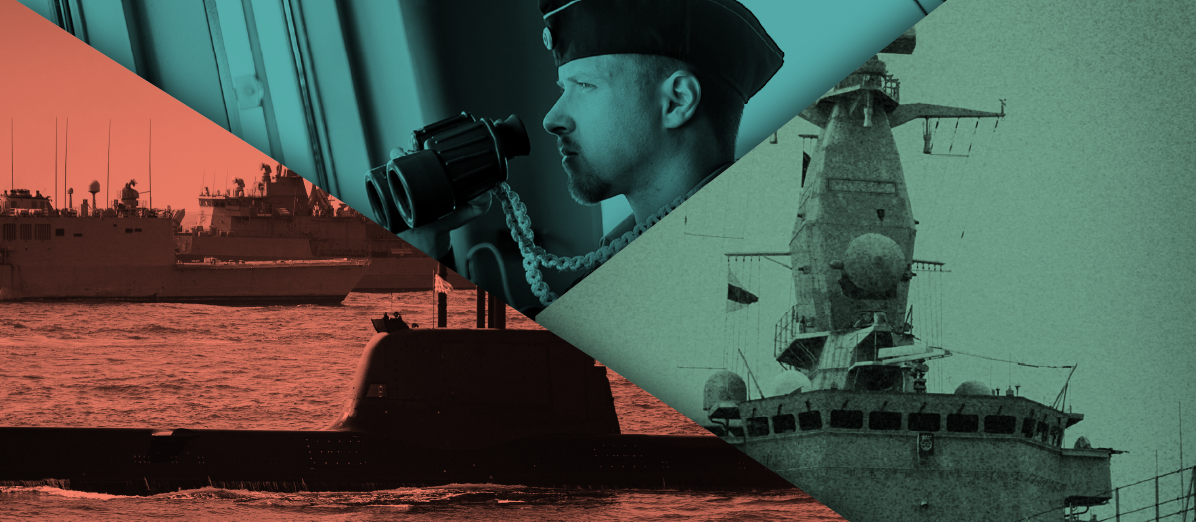
Collective Seapower: NATO’s New Maritime Strategy
NATO has finally unveiled its new Alliance Maritime Strategy, refreshing a document that had not been publicly updated since 2011. While high-level strategy texts of this kind tend not to be riveting reads, the new strategy stands out in its sense of renewed urgency. It not only frames the maritime domain as a decisive front in our era of revived great-power competition but also centers maritime power as the backbone of NATO’s ability to “fight tonight” and “fight tomorrow.”
At its core, the strategy acknowledges that the oceans are the global commons of competition. Sea lanes, undersea cables, pipelines, and ports no longer serve merely as trade and communications arteries—they are strategic pressure points. NATO’s vision is to bind its maritime posture into a coherent whole, integrating naval forces, industrial bases, and emerging technologies into a system capable of deterrence, resilience, and warfighting at scale. It’s a maritime strategy built not for the expeditionary policing of 2011 but for high-end, sustained combat in defense of allied territory.
The strategy’s vision is crisp yet expansive—credible maritime power is indispensable to collective defense. This power is based on four pillars: readiness, advanced technology, the protection of sea lines of communication, and the ability to prevail in conflict. NATO’s navies must be able to surge and sustain operations at a moment’s notice, supported by ships and systems that are not only numerous but networked, fueled by emerging technologies like artificial intelligence, autonomy, and uncrewed systems. The strategy’s repeated emphasis that the alliance must be able to “prevail” signals a shift from deterrence as posture to deterrence through capability. It is a vision grounded in the realism of a more dangerous world—a world where Western maritime dominance is no longer assured but must be continually earned.
Mapping the Strategic Seascape
The strategy begins with a blunt assessment of threats. Russia is correctly defined as the most direct and persistent danger to allied security, with its naval modernization and hybrid activities spanning the Atlantic, Baltic, Black, Mediterranean, and Arctic seas. Moscow’s use of “shadow fleets,” advanced submarine operations, and coercive maritime behavior form a pattern of aggression that NATO intends to confront.
Terrorism also remains a core concern—the strategy highlights that piracy, trafficking, and attacks on shipping or critical offshore infrastructure can threaten the stability of maritime trade and regional security. Alongside these direct threats, the document identifies China as a systemic challenger—its naval expansion, dual-use ports, and “no-limits partnership” with Russia complicating the global maritime balance. Other actors, from Iran to various proxy networks, are also cited for their destabilizing influence.
Climate change and emerging technologies are also treated as strategic forces in their own right. Melting Arctic sea ice opens new routes and new rivalries; rising seas and extreme weather test naval infrastructure. Meanwhile, rapid technological shifts—from artificial intelligence to hypersonic missiles—are redefining the pace and character of surface and subsurface warfare. The result is a portrait of the maritime domain not just as a military theater but as an ecosystem where economic, environmental, and digital challenges converge.
NATO’s Core Maritime Tasks
Within NATO’s enduring mission framework—deterrence and defense, crisis management, and cooperative security—the strategy assigns maritime forces an elevated role.
For deterrence and defense, the emphasis is unmistakably on hard power. NATO commits to defending every inch of allied territory through a blend of nuclear, conventional, and cyber capabilities, with maritime forces as the connective tissue. The sea-based leg of the nuclear triad, the ability to control or deny maritime spaces, and the protection of undersea infrastructure all feature prominently. The strategy’s “Digital Ocean Vision” captures its ambition to achieve real-time situational awareness throughout the maritime domain.
In crisis prevention and management, the strategy preserves the traditional versatility of naval power. From humanitarian assistance and disaster relief to amphibious entry operations and counter-piracy missions, maritime forces remain the alliance’s most agile instruments for operating throughout the spectrum between peace and conflict.
Finally, in the realm of cooperative security, NATO reaffirms the diplomatic dimension of seapower. Maritime partnerships, capacity-building with non-member states, and collaboration with institutions like the European Union and United Nations are cast as pillars of a rules-based maritime order. The strategy balances its sharper warfighting edge with a recognition that legitimacy and stability also depend on dialogue and shared governance of the global commons.
From Vision to Action
The strategy does not just list what should be done— it also lays out a demanding implementation agenda. Readiness is its watchword. Member states are urged to raise force availability, modernize fleets, and ensure that maintenance, logistics, and industrial production can support rapid surges in wartime. NATO’s Standing Naval Forces—the alliance’s visible deterrent at sea—are to be fully resourced and flexible, serving both as operational assets and as testbeds for innovation.
The strategy’s focus on protecting undersea infrastructure is particularly significant. Following a spate of incidents over the past few years in the Baltic and North Seas, NATO acknowledges that pipelines and cables are now front-line targets. The plan calls for enhanced information-sharing and cooperation with private industry—a step toward a more integrated, public-private approach to maritime security.
Digital transformation runs through the entire document. The “Digital Ocean Vision” functions as both an operational tool and a representation of NATO’s intent: a networked ocean where data, sensors, and platforms are fused to create decision-making superiority. Training, too, will shift from routine patrols to realistic, high-intensity exercises testing multi-domain coordination, logistics under threat, and industrial endurance.
Behind all of this lies a sober understanding that maritime readiness is inseparable from industrial readiness. The strategy urges greater transatlantic cooperation on defense production, common funding mechanisms, and the removal of trade barriers. It calls for stockpiles of decisive munitions and resilient supply chains—recognizing that deterrence is only credible if capabilities can be sustained beyond the first salvo.
Strengths and Strains
The new Alliance Maritime Strategy stands out as NATO’s most comprehensive and combat-oriented maritime strategy since the end of the Cold War. It builds on the 2011 Maritime Strategy but transforms its tone from cooperative reassurance to strategic confrontation. Where its predecessor dealt largely with piracy and instability, the new document is unapologetically focused on peer adversaries, deterrence, and industrial mobilization.
Its strengths are many. It provides a clear threat hierarchy, naming Russia as the immediate danger while acknowledging China’s systemic challenge and the lingering threat of terrorism. It integrates emerging technologies not as accessories but as foundations of future warfare. Its attention to undersea infrastructure protection and industrial mobilization marks a major conceptual advance, blending economic and security resilience into the same strategic framework. And, despite its hardened tone, it retains space for maritime diplomacy—an acknowledgment that cooperation, too, is a form of strength, and one that NATO does well.
As always, the strategy’s success will depend on resources, coordination, and political will. Not all allies have the industrial or fiscal capacity to meet the demand for mass or technological parity. Cooperation with the private sector—vital for protecting infrastructure—remains aspirational without clearer mechanisms. Balancing high-end combat readiness with day-to-day maritime security tasks could prove difficult, especially for allies focused on southern threats like migration and piracy. And the elephant in the room remains of how committed the United States under the current administration would be to NATO should the conflict with Russia heat up.
The Seas Ahead
Ultimately, NATO’s new Alliance Maritime Strategy is both a return to fundamentals and a leap into the future. It re-centers maritime hard power within collective defense, integrates digital transformation and industrial strength, and reframes the oceans as the decisive arena of strategic competition. Its ambition is to ensure that NATO’s navies are credible, connected, and combat-ready in an age of global turbulence. It is a call not just to readiness, but to resilience—to an alliance that understands the seas will shape the decades ahead and that its security, prosperity, and credibility all flow through them.
Whether that vision becomes reality will depend not on declarations but on delivery—on allies’ willingness to synchronize acquisitions, sustain industrial output, and train for high-end warfare while maintaining the daily business of maritime security. Only they can make the strategy’s closing line into reality: “NATO’s maritime forces will remain on watch, ready to fight.”
Image: NATO/Natalia Kopytnik/FPRI
This analysis is part of FPRI’s Behind the Front project. Explore more here.