 A Nation Must Think Before it Acts
Central Asia Has a Drug Problem, and It Is Growing Worse
A Nation Must Think Before it Acts
Central Asia Has a Drug Problem, and It Is Growing Worse

A nation must think before it acts.
Central Asia Has a Drug Problem, and It Is Growing Worse
Not long after late 1991, when the Soviet Union collapsed and Kazakhstan, Kyrgyzstan, Tajikistan, Turkmenistan, and Uzbekistan became independent, illegal narcotics trafficking started through the region, mainly coming from drug-producing countries in South Asia, particularly Afghanistan, and being smuggled through Central Asian territory to Russia and from there to Europe. For the most part, Central Asia was simply a transit area for narcotics trafficking but that is changing. Drug smuggling continues but now newer illegal narcotics also are being produced in Central Asia for a growing domestic market. After more than 30 years of developing counter-narcotics agencies, officials in the countries are faced with rapidly evolving situation that makes drug interdiction more difficult and distribution much easier.
The Problem
On November 13, the website of Kazakhstan’s Interior Ministry posted the results of the 10-day “Law and Order” counter-narcotics operation that had just concluded. They detained 27 people and seized some 80 kilograms of narcotics, mostly mephedrone and Alfa-PVP, so-called synthetic drugs. One of the raids was on a laboratory in the city of Karaganda, about 140 miles south of the capital Astana, that produced Alfa-PVP. Police seized two tons of precursor substances at the laboratory.
At the start of November, Uzbek President Shavkat Mirziyoyoev approved the 2025-2026 national program for combating drug-related crimes. According to information posted on the Uzbek president’s website, there were more than 11,000 drug-related crimes and some 2.5 tons of narcotics seized in Uzbekistan since the start of 2025. In July, Uzbekistan’s chief narcologist Zarifjon Ashurov noted drug use among youth is increasing. Ashurov said there are 5,000 registered cases of minors who are drug-dependent and the youngest is 10 years old. Some of that is attributed to misuse of prescription drugs, but Tashkent Deputy Mayor Durdona Rahimova said in November 2024 there is an increase in the number of students at schools in the Uzbek capital who are using synthetic drugs.
In Kyrgyzstan on October 30, the head of the country’s counter-narcotics department Kanybek Usenov said in the first nine months of 2025, Kyrgyz law enforcement seized 4.725 tons of illegal drugs and precursors. Usenov pointed out that of narcotics confiscated, 798 kilograms was synthetic drugs, compared to 34 kilograms seized in all of 2024. Usenov added that five laboratories for producing synthetic drugs were uncovered in Kyrgyzstan in 2025, but he said use of these drugs is growing mainly because of shipments arriving from Kazakhstan and Russia.
In January 2025, the regional representative of the UN Office on Drugs and Crime in Central Asia, Ashita Mittal, said in the last few years Kazakh authorities had found and destroyed 87 drug labs and Kyrgyzstan had destroyed “11 or 12.”
Tajikistan’s media rarely reports on the problem of domestic drug use, but regularly reports on successes in battling drug trafficking. In February 2025, the head of Tajikistan’s Agency for Narcotics Control, Zafar Samad, said some 4.381 tons of illegal narcotics were seized in 2024, down from 5.282 tons taken in 2023. However, 110 kilograms of the drugs confiscated in 2024 were synthetic drugs, compared to only 41 kilograms in 2023. In February 2025, Narcotics Control Agency reported finding 121 kilograms of methamphetamine in a truck carrying precious stones from Afghanistan through Tajikistan to China. In late July 2025, Samad said Tajik law enforcement and security bodies had seized 3.1 tons of narcotics in the first six months of the year, more than half of that in the area along the Afghan border.
Turkmenistan’s government and state media do not talk about drug use or interdiction efforts. Officially, the state practices a zero-tolerance policy on illegal narcotics and while it is often difficult to obtain information from inside the secretive country, there is no evidence to suggest there is a significant domestic drug use problem. However, Turkmenistan was at center of what is among the Central Asian countries, arguably, the biggest drug scandal of 2025. The head of Turkmenistan’s state railway company, Hydyr Rahmanov, and his female companion were caught with LSD in their carry-on baggage when they arrived at Moscow’s Domodedyevo Airport on October 4. Rahmanov was ordered held in custody in Russia until December 3.
The Usual Seizures
Until recently, the sorts of drugs Central Asian counter-narcotics services were accustomed to seeing were marijuana, hashish, opium, and heroin. Reports from 2025 make clear these drugs are still being used.
In one week in mid-October, Kazakh police detained two men with 66 kilograms of marijuana in the southern Zhambyl Province, and another man in the western Mangystau Province who had more than 60 kilograms of marijuana in his possession. In August, police and security forces raided a cornfield in the southeastern Almaty Province that shielded a marijuana plantation in the center of the field. Police confiscated 233 plants that weighed some 49 kilograms. The 36-year-old farmer was arrested.
In late October, Uzbekistan’s traffic police stopped and searched a vehicle in Tashkent Province and found nearly five kilograms of hashish on a passenger, a 54-year-old man from Osh, Kyrgyzstan. Police investigated the Kyrgyz citizen and discovered he had 45 more kilograms of hashish stashed in Bukhara Province. Uzbek authorities said the hashish came from Afghanistan. Earlier in the month, police in Kyrgyzstan’s northern Chuy Province pulled over a 46-year-old driver at 4am and found a “large amount” of hashish in the car. One month earlier, Uzbekistan’s security service detained six residents of the eastern Uzbek city of Andijan, all between 34 and 41 years of age, who were accused of smuggling almost two kilograms of hashish from Kyrgyzstan into Uzbekistan. In the Kyrgyz capital Bishkek, police arrested a 27-year-old man in April who had nearly seven kilograms of hashish and almost 19 million Kyrgyz som (about $217,000) when police apprehended him.
In Kazakhstan, in February, two women, one a former employee of Kazakhstan’s Interior Ministry, were detained with 3.5 kilograms of hashish and mephedrone in their possession in Almaty, and a 27-year-old border guard from the Kazakh capital Astana was detained with 520 grams of Alfa-PVP and mephedrone, and 10 grams of hashish.
And in September, in Uzbekistan’s Samarkand Province, security forces raided the home of a 33-year-old resident of the town of Urgut, seizing 960 grams of opium allegedly brought from Tajikistan, and in a separate raid in the town of Pastdargom, detained a 54-year-old man with 25.5 kilograms of marijuana. A 59-year-old man was arrested in Urgut in November when he tried to sell nearly one kilogram of opium to an undercover policeman for $15,000.
Tajikistan staged its Kuknor (Poppy)-2024 counter-narcotics operation at the end of last year and the Agency for Narcotics Control said it destroyed some 1.2 million “bushes of narcotic plants growing in the wild.” The agency did not specify which sort of plants were destroyed.
The New Problem
Synthetic drugs are rapidly becoming a concern in Central Asia. In July 2024, Batma Estebesova, director of Kyrgyzstan’s Sotsium drug rehabilitation center, expressed the frustration many in Central Asian counter-narcotics services must be experiencing. “We can’t keep up with all the new drugs to add them to the list of prohibited substances,” Estebesova said. One month earlier, Ulanbek Sultanov of Kyrgyzstan’s Department for Combating Drug Crime said counter-narcotics agencies in the country do not have the equipment necessary to test many synthetic drugs to find out exactly what they are.
In November 2025, a UN report said only 10,200 hectares of land in Afghanistan was under opium cultivation in 2025, down from 232,000 hectares before the Taliban returned to power in August 2021 and banned growing opium poppies, but the report added, “synthetic drugs and shifting trafficking routes are posing new challenges.”
Many of the precursor chemicals seem to come into Central Asia from Afghanistan to supply a growing number of laboratories inside Central Asia that are producing synthetic drugs.
Uzbek police searched a flat in the capital Tashkent in October 2024 and found drug-making equipment. The owner was detained, and it was discovered he also had another flat he turned into a drug-making laboratory. In total, police seized nearly 15 kilograms of synthetic narcotics. In October 2025, Uzbekistan’s State Security Service (SGB) detained a police inspector from Tashkent’s Almazar district and found a drug lab in his home. SGB agents found 10.5 kilograms of Alfa-PVP.
In early July 2025, Kazakh police raided a flat in Almaty Province that was described as the biggest laboratory producing illegal narcotics ever found in Kazakhstan. Police found 350,000 doses of mephedrone and “20 liters and 115 kg of psychotropic substances and more than two tons of precursors were seized … (enough) to produce 120 kg of synthetic drugs.” Two “citizens of a neighboring country” were taken into custody.
Police and security forces uncovered a lab making precursors in Almaty Province in January and arrested 10 people, and raided another lab producing Alfa-PVP in February and arrested one man.
Kazakh authorities did not give the ages of the people detained in the raids on drug-producing laboratories, but in November 2024, Kazakhstan’s Health Ministry said that in 2017 most people caught for drug possession were 25-30 years old, but after 2019 it is increasingly teenagers, “particularly girls of about 16 years of age,” who are using synthetic narcotics. Reports from other countries also show that these synthetic drugs are increasingly popular with young people.
In Kyrgyzstan, an 18-year-old drug dealer was caught in Bishkek with packets of unspecified synthetic narcotics in February, the next month another 18-year-old university student with 110 packets of narcotics was apprehended in Bishkek, and a third man, this time 34 years old, with nearly five kilograms of synthetic drugs was arrested at the end of March. Three men, all in their 20s, were caught for trying to sell 1.1 kilograms of ecstasy pills in June.
When Kazakh police reported on the results of their “Law and Order” counter-narcotics operation in November 2025, they specifically noted that among the 27 people arrested during the operation were a 20-year-old in Petropavlovsk with 290 grams of synthetic drugs, a 25-year-old in Karaganda with 400 grams of Alfa-PVP, and a 27-year-old in Shymkent with 500 grams of mephedrone.
In Uzbekistan the same month, a 31-year-old taxi driver was delivering what he thought were two gearboxes given to him by people in Russia for two men in Uzbekistan. When Uzbek customs officials inspected the two gearboxes, they found five kilograms of the synthetic drug Clephedrone inside.
These new illegal drugs appeared in Central Asia less than 10 years ago and as authorities are trying to find ways to combat this new problem, they are further confounded by the ability of dealers to use the internet, particularly the Telegram social media site, to sell their narcotics. In 2023, Alzhan Nurbekov, an official in Kazakhstan’s prosecutor general’s office, warned that “any 12-year-old school kid can buy drugs through a Telegram channel and have them delivered quicker than a pizza.”
Police in Astana arrested a 36-year-old man in February 2025 who was bringing packages of marijuana and hashish to drop-off points in the area. Under questioning, the man said he was recruited as a drug courier by someone on Telegram. That same month, police in North Kazakhstan Province arrested a 27-year-old man who was working a courier for drug traffickers. The man turned out to be a border guard and said he was looking to make some extra money and responded to an advertisement on Telegram for couriers in September 2024.
In April 2025, Kyrgyzstan’s security service detained a 25-year-old Uzbek citizen in Bishkek who was helping to run a synthetic drug business using the internet. His group was active in Kazakhstan, Russia, and Uzbekistan and, according to police, was taking in up to $50,000 daily, then legalizing the profits through the Woody Exchange crypto business.
Kuandyk Alzhanov, the deputy chairman of counter-narcotics committee of Kazakhstan’s Interior Ministry, told a Sept. 5, 2025 briefing for the Central Communications Service, “We have a big problem specifically with Telegram.” Alzhanov explained however that “Telegram is formally classified as a mass media outlet, and Kazakhstan is an open state, so the (committee) has no mechanism for direct blocking (of Telegram).” He said Kazakh authorities are in contact with the Telegram owner and are consulting with legal experts about how to identify and track or block drug traffickers who use the social network for illegal business.
A New Battle
Authorities are moving to clamp down on the rise in drug trafficking and use.
Kyrgyz President Sadyr Japarov signed a law in March 2025 that toughens punishment for selling drugs to minors, and for producing or possession illegal narcotics.
In October 2025, the deputy chief of Kazakhstan’s Department for Combating Drug Crime, Bakhytzhan Amirkhanov, denied rumors that authorities were planning on lowering the age of criminal liability for drug-related offense from 16 to 13. Amirkhanov made clear though that if a 16-year-old is caught for drug trafficking, they will face the full punishment of the law. At the start of December, a court in the northern city of Semey (formerly Semipalatinsk) sentenced a “teenager” who was a university student to five years in a juvenile prison for acting as courier taking synthetic drugs to drop-off points in the area. Kazakh President Kassym-Zhomart Tokayev signed a law at the start of 2025 that adds an extra five years to prison sentences for those convicted of manufacturing illegal narcotics, and includes the possibility of a life sentence in prison.
Central Asian authorities are working with other governments to break up transnational narcotics trafficking groups. Law enforcement agencies in Kazakhstan, Kyrgyzstan, and Russia conducted a counter-narcotics operation in May 2025 that led to the confiscation of some 20 kilograms of synthetic drugs
The battle against illegal narcotics today is different than it was during the first three decades after the Central Asian countries became independent. Until recently, drug enforcement agencies were looking for large packages of narcotics that were passing through Central Asia. Now, the drugs entering Central Asia are not so bulky, often it is only precursor chemicals, and many of these illegal shipments remain in Central Asia.
Just a few years ago, reports in Central Asian media about drug busts or drug use among the population were rare, but now it happens almost every week in some of the countries. Officials admit they are having a hard time dealing with this growing problem and there appears to be little they can do to keep drug use from becoming a major social problem in Central Asia.
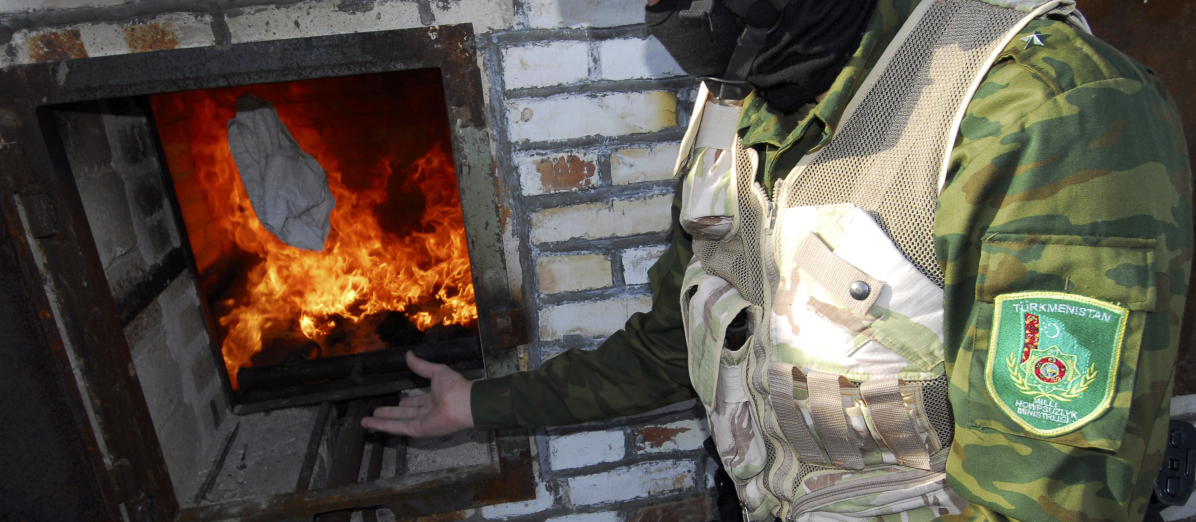
Image: A Turkmen drugs control officer throws a bag of opium into a furnace at Manysh, some 20 km (12 miles) from the capital Ashgabat, February 7, 2007. (Reuters)