 A Nation Must Think Before it Acts
Czech Elections: Back to the Future as Andrej Babiš Sweeps to Victory
A Nation Must Think Before it Acts
Czech Elections: Back to the Future as Andrej Babiš Sweeps to Victory

A nation must think before it acts.
Czech Elections: Back to the Future as Andrej Babiš Sweeps to Victory
The Czech Republic, in a widely predicted result, returned former Prime Minister Andrej Babiš and his ANO movement to power in parliamentary elections held in early October of 2025. While the outcome of the polls was clear, several key questions remain surrounding the causes and ramifications of Babiš’ political resurgence:
- What went wrong for the coalition government of outgoing Prime Minister Petr Fiala;
- How will Babiš and his party rule in a coalition with two right-wing parties;
- What role will President Petr Pavel play in potentially mitigating more extreme policy proposals of the new government, and;
- What does an ANO-led regime in Prague mean for relations with its neighbors, Brussels, and Washington?
The goal of this analysis is to provide answers to these questions.
In order to set the stage for the current political developments in the Bohemian heartland, it is instructive to remind readers that the Czechs have travelled this populist road before. From 2017–2021, Babiš served as prime minister in a government led by the ANO (“action of dissatisfied citizens” in Czech, and also means “yes”) movement. Concurrently, the Czech president was Miloš Zeman, a eurosceptic Russophile. The political landscape in the country changed dramatically in 2021 as a center-right coalition government led by the SPOLU (“together”) group of parties, swept to power in parliamentary elections. The populist retreat continued in early 2023 as Babiš’ bid for the Czech presidency fell woefully short, resulting in the election of Pavel, a former army general and staunch supporter of the European Union (EU) and the North Atlantic Treaty Organization (NATO).
At the time, many—including this analyst—believed that the Czechs had successfully navigated the growing populist wave that was enveloping the political sands of much of Central Europe, specifically the Czech Republic’s neighbors in Poland, Slovakia, and Hungary. The centrist resurgence proved to be short-lived, however, as the SPOLU coalition, for a variety of reasons highlighted below, gradually but irrevocably lost support to the ANO-led opposition.
Governing Is Hard, Opposition Is Easy
Determining causality in the outcome of elections is often speculative at best but, in the recent Czech polls, specific issues unquestionably played a role in SPOLU’s defeat. Fiala took office in December of 2021 as the leader of a coalition that included his Civic Democratic Party (ODS), the Christian and Democratic Union, Czechoslovak People’s Party (KDU-ČSL), TOP-09, Mayors and Independents (STAN), and the Czech Pirate Party (Pirates). As is the case with most broad-based political partnerships, the Fiala regime met its fair share of challenges that stretched the cohesive soft tissue of the government.
The Czech Republic, like much of the globe, suffered from high inflation rates in 2022 (15.1 percent) and 2023 (10.66 percent), the initial two years of Fiala’s premiership. The inflationary spiral, caused primarily by pandemic supply chain ruptures and an energy crisis precipitated by Moscow’s invasion of Ukraine in early 2022, eased considerably in 2024. However, by that time, the Fiala government was associated, rightly or wrongly, with higher prices by a growing portion of the Czech population.
Many scholars of present-day Europe would argue that since the start of the Ukraine war, the Czech Republic has been a model supporter of Kyiv, particularly in comparison with two of Prague’s erstwhile Visegrád-4 allies, Hungary and Slovakia. That faithful succor to Ukraine came with a domestic political price for Fiala. Despite a consistently high level of sympathy for Ukraine among the Czech populace, as the ramifications—upwards of 400,000 Ukrainian refugees in the country, high inflation, and energy woes—of the conflict compounded, the Czech willingness to sacrifice for their Slavic brethren waned. According to a January 2025 study by the Czech STEM Institute for Empirical Research, support for the war was gradually losing ground across the country. In fact, the study reported that roughly half of the population believed that Prague was providing too much military assistance to Kyiv. Consequently, while Fiala may have been the Central European darling of the EU and NATO with respect to Ukraine, it likely cost him at home.
Fiala’s government suffered another blow in September of 2024 when the Pirate Party withdrew from the governing coalition following the prime minister’s dismissal of the Deputy Prime Minister for Digitalization, Ivan Bartoš, for perceived mismanagement of a long running project to digitize building permits. The decision by the Pirate Party to join the opposition diminished the coalition’s parliamentary margin to a mere four votes and, more importantly, raised serious questions about the government’s competence.
As the election season heated up in May of 2025, the governing alliance was rocked with another scandal that likely represented the proverbial nail in the coffin for the Fiala administration. Czech media uncovered a bizarre tale in which the Ministry of Justice accepted payment of approximately one billion Czech crowns ($45 million) in bitcoin from a former convicted drug dealer. Pavel Blažek, the Minister of Justice from Fiala’s ODS, resigned over the case, which the Babiš-led opposition skillfully used to impugn the integrity of the coalition during the remainder of the campaign.
Less quantifiable, but possibly a no less important cause for the end of the Fiala government, was the growing perception within the country of an over-reaching EU bureaucracy in Brussels. As early as September of 2022, polling indicated that approximately half of the Czech populace was apprehensive about the economic hardships that compliance with EU green deal policies would entail. Furthermore, Czech farmers led noisy and disruptive demonstrations across the country in February of 2025, protesting against the EU-Mercosur trade agreement, duty-free grain imports from Ukraine, and the onerous bureaucratic red tape emanating from Brussels.
It is not surprising that similar sentiments were expressed across many of the nascent democracies of post-Cold War Central Europe. While populations throughout the region remain generally favorable to the idea of EU and NATO membership, their shared experience of taking orders from Moscow for over 40 years has instilled a strong resistance in their collective political DNA to even the perception of foreign control, however benign that external influence might be.
Nonetheless, the aggregate effect of the aforementioned issues severely thwarted the SPOLU coalition’s re-election chances, in the process opening the door for Babiš’ Trumpian political resurgence.
By the Numbers
The fundamental outcome of the recent elections was not a surprise. For over a year ANO had been polling as the predominant favorite among a significant portion of Czech voters. In an early January 2025 survey by Czech STEM Institute for Empirical Research, the ANO movement registered just over 30 percent support, in June 28.5 percent, and 30.5 percent at the end of August. Their share of the final vote topped out at 34.5 percent, likely due to undecided voters jumping on the bandwagon as it became clear that ANO would form the core of any new coalition government.
What was a surprise, however, was the respective success and failure of some of the country’s secondary political forces. Example number one in this category was the dismal showing of the Stačilo! (Enough!) alliance of social democrats and former communists. The alliance, which was openly pro-Russian, called for a referendum on Czech membership in NATO and the EU. However, the group did not meet the 5 percent threshold and will not be represented in the new parliament.
On the positive side of the ledger, the nascent Motoristé sobě (Motorists for Themselves) party received almost 7 percent of the vote and look to be an important member of the ANO-led governing coalition. The party, which campaigned on an anti-environmentalism platform, will head the Ministry of Environment as a likely quid-pro-quo for supporting the presumptive Babiš regime.
Equally impressive were the results of two parties allied with the SPOLU coalition, STAN and the Pirates. Both of these political movements rebounded from lamentable polling numbers early in 2025 to perform strongly—STAN at 11.23 percent and the Pirates at 8.97 percent—in the October plebiscite. Accordingly, they will join a strong opposition front led by SPOLU (23.36 percent), comprising 92 of the 200 seats in the parliament.
One last statistic from the recent Czech elections that is worth highlighting. Nearly 69 percent of registered voters cast a ballot, 3.5 percentage points more than turnout in the 2021 parliamentary elections and just below the level in the critical 2023 Czech presidential polls. Thus, while many in “old Europe” may bemoan the results of the vote, there is no question that the majority of the Czech citizenry has spoken. The voter participation numbers do not lie.
Building a Coalition
In an early 2024 television interview with Czech commentator Václav Moravec, senior ANO official and soon to be Minister of Finance Alena Schillerová stated: “I can’t imagine that ANO, as a clear pro-Western movement, would form a government with SPD [Freedom and Direct Democracy].” She added that “personally I would definitely not join a government with a party that wanted to withdraw from the EU.” Not only is SPD part of ANO’s emerging coalition, but the party also looks to fill several important positions, to include the Minister of Defense and the speaker of the Czech Parliament. Tomio Okamura, SPD’s controversial leader, already occupies the latter role, confirmed in a “secret ballot” with 107 votes in the country’s 200-member lower house on Nov. 5, 2025.
The political dance with SPD is emblematic of the coalition complications that face Babiš, who stated repeatedly during the election campaign that his goal was for ANO to rule alone. The numbers require either a coalition or a minority government. The ANO leader has chosen the former option, joining forces with the only elected parties—SPD and the Motorists—willing to govern with his movement.
The risks for Babiš in this arrangement are significant. With respect to SPD, they are generally considered an extremist, alt-right party and are currently proud members of the European Parliament’s Europe of Sovereign Nations political group, which is dominated by Germany’s Alternative for Deutschland. Okamura and his party have already caused ANO headaches as they were initially set to receive the powerful Ministry of the Interior portfolio in the new government. Babiš, however, had to cancel that plan as Okamura, soon after the election, threatened to use the position to fire the country’s police president as retribution for a recent policy investigation into the SPD leader for inciting hatred during the campaign.
Losing the Ministry of the Interior is a blow to SPD but they are, as of this writing, slated to lead the Ministry of Defense. How ANO manages to assuage understandable concern in the EU and NATO over an avowedly anti-NATO party leading the Czech defense establishment at a critical phase of the Russia-Ukraine war remains to be seen. Furthermore, Okamura’s election as the speaker of the lower house potentially jeopardizes the non-partisan nature of the position. As Czech political analyst Jiří Pehe commented on Nov. 5, “Tomio Okamura will need to clarify what role he wants to play. Does he want to be a non-partisan speaker or will he attempt to be a partisan leader?”
While the SPD is unquestionably the more extreme of the two junior parties in the budding coalition, the third member of the team, the Motorists for Themselves, comes with some serious political baggage as well. Petr Macinka, the party leader and the new coalition’s nominee for foreign minister, was initially projected to assume the Minister of Environment job in the new government. Macinka caused a political ruckus early in the campaign with controversial comments about his party’s intentions. Specifically, in June of 2025 he suggested that should Motorists for Themselves become part of a future cabinet, “green blood” would flow at the Ministry of the Environment. Not surprisingly, since the elections environmental groups have protested against the purported plans for the Motorists to lead the country’s environmental efforts.
Even more contentious is the possibility that the honorary president of the Motorists, Filip Turek, will become part of the incoming government. No sooner had the election dust settled than a Slovak news organization, Dennik N, published numerous social media posts by Turek that were openly racist, sexist, homophobic, and/or pro-Nazi. Though the Motorists seem determined to insist on Turek as one of their ministerial candidates, Pavel, who cares deeply about the country’s image abroad, will likely press Babiš to select a different candidate. When the names of the projected cabinet members were announced on Nov. 26, Turek was pegged to take the Ministry of Environment, keeping alive Macinka’s boast about potentially eviscerating the department. Nonetheless, the mere fact that such a controversial figure as Turek is the candidate to lead a ministry indicates the strength that the two junior parties in the coalition avow.
The Buck Stops at Pavel
Notwithstanding Babiš’ impressive election victory, Pavel consistently polls as the nation’s most popular and respected political figure. Pavel is using that public favor, as well as his constitutional authorities, to ensure that the incoming government does not substantively damage the country’s relationships with NATO and the EU. Starting well before the election campaign, the president repeatedly underscored the criticality of membership in Western security and political structures for the future of the Czech Republic. In his 2025 New Year’s address to the nation, Pavel stressed the Czechs’ good fortune in having their security guaranteed by NATO and other international commitments. These, and other statements, were meant as a direct warning to any future cabinet to toe the line on the country’s Western orientation.
The Ukraine conflict is front and center of Pavel’s concerns, as some members of the incipient coalition—most prominently from SPD—have openly questioned Prague’s previous support to Kyiv. Pavel reinforced his and Czech support for Ukraine during a meeting on Nov. 24 with his Polish counterpart, Karol Nawrocki. Both leaders, from very different political backgrounds, found common ground in equating the security of Ukraine with the security of their respective countries.
Pavel is not limiting his pressure on the incoming government to only the foreign and security realms. Since the October polls he has consistently called on Babiš to publicly explain to the Czech populace how he will resolve his purported conflict of interest in owning Agrofert, one of the Czech Republic’s largest conglomerates that has, in the past, accepted significant EU agricultural subsidies. For his part, Babiš has promised to come clean on the conflict of interest question once he becomes prime minister, citing a constitutional obligation to divest within 30 days of taking office.
Although Pavel and Babiš have privately discussed the issue in the aftermath of the elections, it remained unresolved as of early December 2025. In fact, Pavel, in a radio interview on Nov. 17, the anniversary of the 1989 student demonstrations in Prague that precipitated the fall of the communist regime, stated bluntly that absent a satisfactory resolution of the conflict of interest issue, ANO should propose a new candidate for the position of prime minister.
It is worth reminding the reader that Pavel and Babiš have a history, having bitterly contested the Czech presidency in early 2023 elections. While Pavel enjoyed a resounding victory in a second round runoff, there appears to be no love lost between the two. Their respective memories of that contest, as well as their divergent views on the appropriate level of Czech support to Ukraine, are unquestionably contributing to the public sparring as the ANO leader endeavors to form a working coalition.
The Road Ahead for the New Government
As 2025 enters its final month, the proposed new governing coalition in Prague is taking shape with ministerial nominations presented to Pavel by Babiš during the last week of November. Babiš has stated frequently since the elections that he intends to represent the Czech Republic at the final European Council leadership meeting of the year, scheduled for Brussels in late December. The more salient and long-term questions to be considered, however, are what impacts the return to power of the ANO movement will have on the Czechs, Central Europe writ large, and Prague’s relations with the EU and Washington.
Starting with the security realm, while the new government in Prague is unlikely to join Budapest and Bratislava in a tripartite anti-Kyiv group, the days of resolute Czech support to Ukraine are seemingly over. Despite recent favorable comments by Russian Foreign Minister Sergei Lavrov about Babiš, the ANO leader will likely try and steer a middle course between the vitriolic anti-Ukraine rhetoric of his SPD coalition partners—symbolized by Okamura’s first decision as speaker of the lower house to unceremoniously remove the Ukrainian flag from the Czech parliament building—and the openly pro-Kyiv policies of both the departing Fiala cabinet and Pavel. How Babiš manages this political conundrum will manifest soon enough as ongoing, vituperative negotiations on the country’s 2026 budget will undoubtedly include difficult choices on Prague’s commitment to allocating 5 percent of GDP to defense by 2035.
Further evidence of the new regime’s intentions on the security front will be their stance regarding the Czech munitions initiative for Ukraine. Babiš is not a fan of the program, preferring instead its transfer to NATO. Moreover, although the incoming administration has not recently cast doubt on the decision of the previous cabinet to purchase American F-35 fighter aircraft, pre-election statements by senior ANO defense expert, Robert Králíček, may be a harbinger of a future reappraisal of the deal. Such an eventuality, as well as potential backpeddling on the 5 percent obligation, would represent a major blow to Prague’s image in both Washington and Brussels.
Less speculative is the prospect that the incoming Czech leadership will openly clash with the EU on a number of issues. First and foremost, the inclusion of the Motorists in the new government and their assumption of the Ministry of the Environment portfolio effectively guarantees that Prague will be a thorn in Brussels’ side—along with the rest of the erstwhile united Visegrad-4 countries—on green issues. This trend is not new, as the outgoing government also rejected recent EU environmental proposals as overly disadvantageous to the Czech economy. The friction between Brussels and Prague on the environment will undoubtedly spike, however.
It remains to be seen whether Prague will also join Bratislava, Budapest, and Warsaw in pushing back on perceived EU micromanagement of cultural and civil society issues such as same sex marriage, LGBTQ+ rights, support to public media, and the independence of non-governmental organizations (NGOs). On the latter two subjects, the incoming coalition has sent mixed signals. Both SPD and the Motorists have proposed a cessation of government funding for public media while the new regime’s published program puts forward modest limits on the autonomy of NGOs operating the country.
ANO’s return to power after four years in political opposition makes for a legitimate basis for the growing comparisons between Babiš and American President Donald Trump. Both are seemingly driven by power and the quest for financial gain. Despite using some of the same political symbolism of his American counterpart to include sporting a red baseball cap emblazoned with “Strong Czechia,” Babiš is less ideological than Trump. The incoming Czech leader does not want to change the world, but rather to ensure that his country and himself profit from it. He understands that the best way to accomplish that goal is through continued membership in the EU and NATO, not in reorienting Prague’s policies towards Moscow.
In April of 2023 this analyst argued on this platform that the election of Pavel as Czech president offered the country an opportunity to make a clean break from its Babiš and Zeman-driven populist past. Despite the Czechs enjoying a relatively strong economy and a generally well-respected government across the EU and NATO, the accomplishments of the Fiala regime proved insufficient at the ballot box. Consequently, Babiš and his ANO-led rightist coalition are set, once again, to take power in the center of Europe, ensuring substantive repercussions for Prague’s place in the region, as well as its relations with Kyiv, Brussels, and Washington.
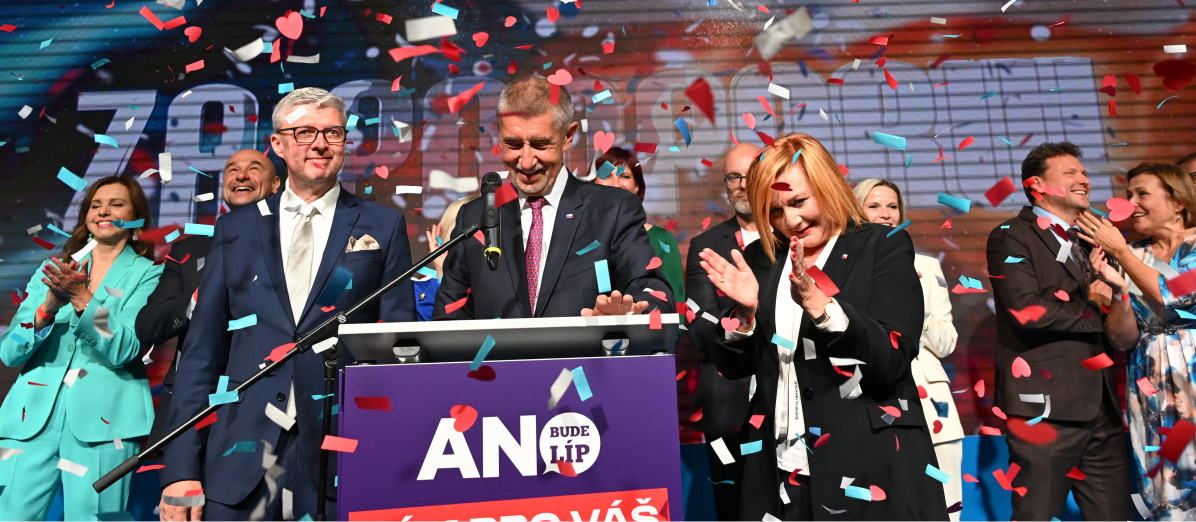
Image credit: Andrej Babis (middle), former Czech prime minister and leader of ANO party, Karel Havlicek (left) and Alena Schillerova (right) seen during a press conference at the election headquarter of ANO party after the Czech parliament elections. (Tomas Tkacik / SOPA Images via Reuters)