 A Nation Must Think Before it Acts
Leveraging the Kurdish National Council and Roj Peshmerga to Break the Deadlock in Syria
A Nation Must Think Before it Acts
Leveraging the Kurdish National Council and Roj Peshmerga to Break the Deadlock in Syria

A nation must think before it acts.
Leveraging the Kurdish National Council and Roj Peshmerga to Break the Deadlock in Syria
Bottom Line
-
Extend the ceasefire and ensure that both the Damascus government and the Syrian Democratic Forces (SDF) fully abide by it.
-
Pave the way for the entry of the Roj Peshmerga from Iraqi Kurdistan into Hasakah province and the Kobani region in Aleppo province, where the Roj Peshmerga can help reduce tensions with Damascus and local Sunni Arab communities.
-
Use America’s leverage to ensure a new political deal is reached between the Kurds and Damascus, with the Syrian Kurdish National Council (KNC) playing an important balancing role within the Kurdish political landscape alongside the SDF and its political affiliates.
State of Play
Northeast Syria, for long the most stable corner of the country, has been plunged into turmoil following a military campaign by the government of President Ahmed al-Sharaa. Following days of fighting, the Syrian Democratic Forces (SDF) have now retreated to the Kurdish-majority portions of northeast Syria in Hasakah province and Kobani, in Aleppo province.
The territorial advances by the government have been portrayed as shocking by some, but they were to be expected. The SDF, although built on a Kurdish nucleus force, the People’s Protection Forces (YPG), were majority Arab in recent years. This was the case because the United States encouraged the YPG to grow into a larger military force to combat the Islamic State (or ISIS) in eastern Syria. As a result, the YPG grew into the SDF and came to be predominantly Arab because the bulk of the areas in northern and eastern Syria under the force’s control were populated by Sunni Arabs. What happened in recent days was a campaign orchestrated by Damascus, to peel off the Arab units from the SDF. As these units split from the SDF, so did the areas where they were operating, largely autonomously.
At the moment, the official military forces of the Syrian government and the former SDF Arab units—essentially turned into tribal militias at this point and allied with Damascus—have encircled the Kurdish-majority areas in the northeast corner of Hasakah and Kobani. However, the manner in which this campaign has been conducted and handled by Sharaa’s forces has been highly problematic and threatens to turn into a security and humanitarian disaster, and by extension a political one too.
On the security domain, government forces and allied tribes have recklessly stormed prisons holding ISIS detainees, leading to the escape of ISIS prisoners and family members in camps amid chaos and SDF withdrawals. This behavior echoes the conditions that enabled ISIS’s rise in 2013–2014 and should be understood as potentially posing grave regional and global risks. Indeed, so deep the concerns about the government’s ability to handle the security situation seem to be that the United States is now airlifting 7,000 ISIS prisoners from the northeast to neighboring Iraq, not to prisons in other stable parts of Syria.
Meanwhile, an escalating humanitarian crisis is unfolding, as up to 100,000 Kurdish civilians have fled advancing government forces. Renewed fighting could trigger a large refugee influx into Iraqi Kurdistan, further straining an already fragile and financially stressed region. The government has also placed Kobani—the town that became a global symbol of resistance against ISIS in 2014—under siege.
Kurdish civilians fear a repeat of massacres seen in Alawite and Druze areas that occurred last year. Videos of atrocities by government forces against Kurdish civilians, including the killing of six members of a family and incendiary, dehumanizing rhetoric against Kurds—now normalized even among public figures, to the point that a Syrian winner of Sakharov Prize feels fine contributing to it—signal risks of mass violence and ethnic cleansing if left unchecked.
While dominant rhetoric from some circles in Damascus tends to downplay Kurdish particularism and demands for cultural and political rights, it is important to recognize that Kurdish claims have deep historical roots. They stem from decades of systematic persecution and sustained deprivation of rights under the Syrian state since independence in the 1940s. This reality must be acknowledged and addressed accordingly.
What follows is a proposal aimed at breaking the current deadlock and laying the groundwork for a durable, long-term solution. The US administration, in particular, has a strong interest in maintaining peace and stability in Syria. This objective can be advanced by pursuing solutions that bring America’s two key partners on the ground—Damascus and the Kurds—together. This policy proposal seeks to contribute to that end.
To give such an initiative a chance, it is essential that the current ceasefire—with 10 days remaining—be maintained and extended to create space for meaningful, productive diplomatic and political initiatives. International support for the ceasefire, as evidenced by a recent statement from the United States, the U.K., Germany, and France, is important.
A Path Forward
Amid the stalling of negotiations between the SDF and Damascus—and the growing risk of a bloody conflict—the situation in Syria today resembles a tightly tangled knot, in which local grievances, regional rivalries, and international interests are deeply intertwined. Yet this should not be read as a moment of fatalism or inevitability. The knot can still be loosened with the right political tools and sequencing.
One such tool, long overlooked but potentially pivotal, is the Syrian Kurdish National Council (KNC) and its military wing, the Roj Peshmerga, based in Iraqi Kurdistan. Properly leveraged, the KNC/Roj Peshmerga card offers a realistic mechanism to defuse current tensions, bridge political gaps, and help chart a new, more sustainable path forward.
The KNC is an umbrella group of 18 Syrian Kurdish groups and figures, some of them with decades of experience in Syrian and Kurdish politics in the country. It was part of the Syrian National Council, the main opposition umbrella group established right after the Syrian uprising in 2011 and that was in existence until its dissolution in February 2025 following the Assad regime’s collapse. The KNC’s Roj Peshmerga is a several-thousand-strong force (estimated at around 7,000) and gained experience fighting ISIS in Iraq.
There are several advantages to bringing the KNC and its Roj Peshmerga into the equation. First, the KNC has been politically aligned with the Kurdistan Democratic Party (KDP) in neighboring Iraqi Kurdistan. The KDP is led by the veteran Kurdish leader Masoud Barzani and is the major governing party within the Kurdistan Regional Government (KRG) in Iraq. The KDP, in turn, has strong relations with the United States as well, both on its own and through the KRG in Iraq.
More importantly for the current situation in Syria, the KDP enjoys warm relations with Ankara, one of the central stakeholders shaping both the immediate crisis and Syria’s broader political and security landscape. The KDP also enjoys good relations with Damascus, as attested by several contacts by the leadership on both sides. The Ankara connection certainly helps lubricate the relationship between the KDP/KNC with Damascus as well. For its part, the Syrian KNC has also had relations and open channels of contact with Ankara for well over a decade. In fact, Turkey contributed to training the Roj Peshmerga at some point as Iraqi Kurdistan scrambled to counter the ISIS campaign in the mid-2010s.
The Syrian conflict has repeatedly demonstrated a basic truth: Military arrangements that lack political legitimacy do not hold. Northeastern Syria is no exception, and Damascus should not think that outright military control will bring it legitimacy among Kurds. This is where the Syrian KNC matters. Unlike the SDF and its political core, the Democratic Union Party (PYD), which Ankara and Damascus have difficulty accepting because of its alleged connections with the Kurdistan Workers’ Party (PKK) of Turkey, the KNC is a political actor with roots and membership in Syria and within the former Syrian opposition. It has longstanding ties to Kurdish society inside Syria and an explicit historical commitment to advancing Kurdish rights within a Syrian national framework.
That pedigree matters. It allows the KNC to operate politically in spaces where the SDF might be viewed with suspicion, fairly or unfairly. Additionally, through its leadership’s historical social ties with the Arab tribes in the areas cohabited by Kurds and Arabs, and the fact that there are strong ties between the Iraqi KDP and Sunni Arab tribes on both sides of the Syrian-Iraqi border, the KNC can play an important role in bridging differences with local Arab tribes, helping win their trust (even if gradually) and preventing a total collapse of the security situation and, equally important, social peace in the northeast.
The KNC/Roj Peshmerga figures should be represented in any future Kurdish delegations negotiating with Damascus on civilian, administrative, and security-military matters. This would help reduce tension in the meeting spaces and usher in confidence building measures. But the KNC or the SDF should refrain from negotiation with Damascus separately as this would undermine the Kurdish front. The SDF is currently under tremendous pressure due to the retreat of its forces and the current state of play. It can be convinced to accept the entry of the KNC/Roj Peshmerga into the equation and to share power with them locally, given the grave risks otherwise facing the Kurdish population in northern Syria.
Practical Steps
The advantage that Roj Peshmerga has is that it is not perceived as an extension of a transnational revolutionary armed actor such as the PKK. Its institutional lineage—shaped by the KNC and earlier sponsorship by the Iraqi KDP—gives it a distinct profile and should make it palatable to officials in Ankara and, with some effort, to those in Damascus as well.
A key first practical step to take is to deploy the Roj Peshmerga units at points of contact between the Kurdish-majority areas under the SDF’s control and other Syrian armed groups, particularly in sensitive areas where miscalculation risks escalation. This would practically position them to act as both mediators and buffers.
While deployed on the ground, the KNC and Roj Peshmerga ties to the Iraqi KDP, and by extension their channels—formal and informal—with Ankara and Damascus, create space for further political/diplomatic efforts to address the ongoing crisis and produce a solution. It should also help alleviate the concerns in Damascus and Ankara about the dominance of Kurdish areas by the SDF and its links to the PKK, real or perceived. Hence, this introduction of the KNC/Roj Peshmerga factor into the equation should not be seen as cosmetic; it can be strategically consequential.
Meanwhile, it is important for both Damascus and Ankara to tone down their anti-SDF rhetoric and the framing of their conflict with the SDF as being about fighting the PKK. Decoupling the Kurdish question in Syria from a singular SDF-PKK framing would help reduce tensions and open diplomatic space for compromise. If Ankara’s and Damascus’s core concern is about the PKK, as they claim, and not Kurdish rights per se, the introduction of the KNC and Roj Peshmerga acts as a strategic actor/card to help reduce tensions and eventually lay the foundation for a lasting solution to the Kurds’ status inside Syria. It is, however, important to note that any attempts to use the Roj Peshmerga or the KNC as an alternative to the SDF and its political affiliates would likely fail and only further undermine the already low level of trust between Damascus and Syria’s Kurds.
Administration of Kurdish-Majority Areas
Current Damascus proposals allowing Kurds to nominate a governor for Hasakah province and candidates for ministerial and sub-ministerial posts are positive and encouraging, but they are not sufficient to durably defuse tensions or to build a peaceful, stable, and productive long-term relationship between Kurds and Damascus.
Establishing such a relationship is key to enduring stability in northeast Syria. The entry of the KNC and Roj Peshmerga should be used as an opportunity for a new administrative and security arrangement that could take the following shape:
In terms of civilian administration of the area, a new administration should be established in Hasakah with balanced participation of SDF-aligned and KNC-aligned individuals, of course in partnership with local Arabs and Christians proportionate to the population size in each of the administrative districts and sub-districts of Hasakah. This should help convince Damascus to accept such an arrangement, as it would not be solely dominated by SDF allies on the Kurdish side.
Language policy is equally central. Kurdish should be recognized, alongside Arabic, as a language of administration and education in Kurdish-majority regions. The current Syrian government decision to limit Kurdish to an elective class in Kurdish areas does not constitute meaningful reform. It reduces Kurdish to a status even lower than English, which is taught as a foreign language in the Syrian educational system. The specifics of implementation can be negotiated, including how Kurdish is integrated across public and private schools. Private schools could be granted greater flexibility to adopt Kurdish as a primary or co-equal language, supported through state subsidies. In any case, given Syria’s demographic composition, Kurdish students must receive a robust Arabic education.
The same formula should be followed in the Kobani and Afrin areas. In Afrin, which is already under Syrian government control, the KNC should be invited to join the local administration, playing a meaningful role in ensuring Kurdish representation, thus also bringing legitimacy to the new government in the eyes of the Kurdish population there.
Security Arrangements
At the level of the Syrian Ministry of Interior, new local security units should be assembled in the Kurdish-majority areas of Hasakah and Kobani, with KNC- and SDF-allied/aligned individuals making up the bulk of the local security forces, in addition to proportionate representation for local Arabs and Christians according to their population size in each district or subdistrict of Hasakah and Kobani. These security forces should run local policing and security tasks in their districts and will be affiliated with the Damascus Ministry of Interior.
At the level of the Ministry of Defense in Syria, one or two army divisions can be established in the Kurdish-majority parts of Hasakah province. The forces in the Kurdish majority areas should be predominantly Kurdish and comprised of current SDF, Roj Peshmerga, and local Arabs and Christians under Kurdish command but connected to the Syrian government. These army divisions should remain within their garrisons and not interfere in local policing and security matters, only dealing with major challenges such as jihadi assaults or cross-border threats. Syrian military units from outside the area should have the right to enter these areas in the event of contingencies that would require their presence to execute their tasks in coordination with local police, security, and military forces already based there. In other Arab-majority parts of Hasakah, new divisions should also reflect the demographic make-up and while being Arab majority, include non-Arab proportionally as well. A Border Protection Force should also reflect a similar demographic balance, under Damascus’ supervision.
It is important to note that given the track record of the current Syrian military forces in Alawite and Druze areas and the atrocities currently committed by them against Kurdish civilians and captured combatants, the notion of deploying these units to Kurdish areas would plant the seeds of long-term instability and a problematic relationship between Kurds and the state. This needs to be avoided with foresight and open-mindedness.
The same formula should be replicated in Kobani. In the case of Afrin, meaningful participation by local Kurds within the security and military forces should also be ensured, as this is essential to securing local buy-in and legitimacy from the Kurdish community there.
Implementing these steps in both the administrative and security domains would allow for the restoration of Syrian state authority in Kurdish-majority regions while respecting local realities. The resulting arrangement would amount to a form of decentralization that falls short of the SDF’s earlier demands for federalism or full territorial autonomy, yet goes beyond what the Syrian government has so far been willing to offer.
This formula requires compromise from all sides. It offers a pragmatic, middle-ground path that could avert further unnecessary bloodshed and contribute to Syria’s stabilization. If successful, it could also serve as a workable model for other minority-populated areas, including Suwayda and the Alawite coast.
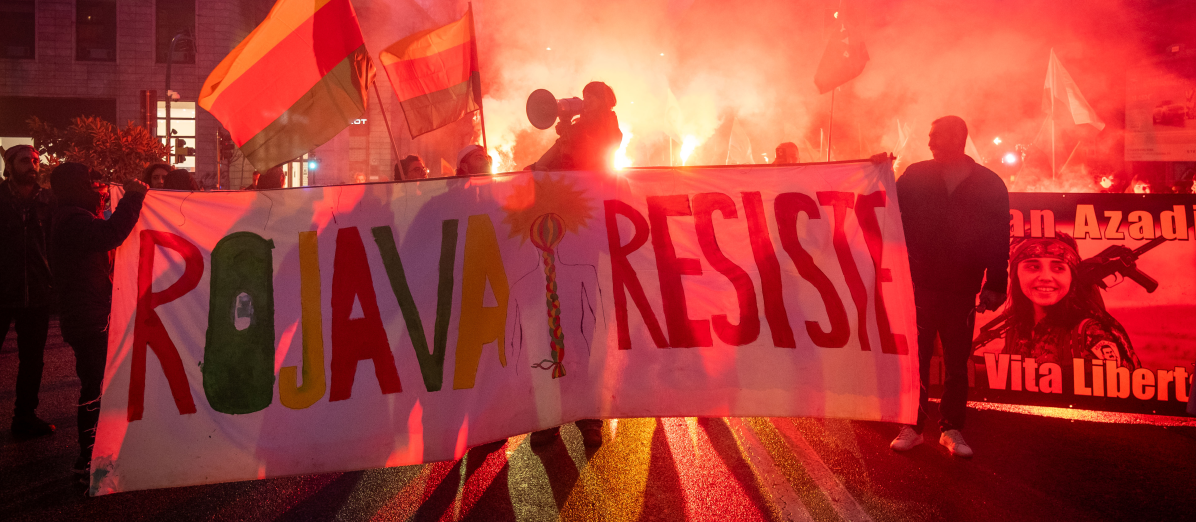
Image credit: January 24, 2026, Rome, Italy: Hundreds of activists, members of the Kurdish community and citizens join a march in solidarity with the Kurdish people to raise awareness of the new offensive against Rojava by Turkish-backed Syrian forces. (ZUMA Press Wire via Reuters Connect)