 A Nation Must Think Before it Acts
The Origin of the US-UK Intelligence “Special Relationship”
A Nation Must Think Before it Acts
The Origin of the US-UK Intelligence “Special Relationship”

A nation must think before it acts.
The Origin of the US-UK Intelligence “Special Relationship”
Introduction
From the beginning of World War II in Europe in 1939, a formal, albeit limited, liaison relationship existed between the intelligence and security services of the United Kingdom and their American counterparts—the Army and Navy intelligence staffs and the Federal Bureau of Investigation (FBI). Like many modern liaison relationships, the US-UK relationship at the time was problematic, limited by suspicion and, at times, outright hostility. This changed in the 1940 when US presidential envoy William J. Donovan travelled to the United Kingdom with instructions to report back to President Franklin Roosevelt on the likelihood of its survival. The president’s decision to go outside normal bureaucratic channels and send a civilian to answer his questions would change the nature of the intelligence relationship between the United States and the United Kingdom forever.
In the spring of 1941, the British had been at war for nearly two years. Their intelligence services had matured under the pressure of an effective German counterespionage program inside occupied Europe run by an aggressive military intelligence service (the Abwehr), and the Nazi party intelligence and security services—the Geheimstatspolizei (Gestapo) and the Sicherheitdienst (SD). When Donovan arrived in London, the British Secret Intelligence Service (SIS) leadership saw little benefit in providing their US counterparts with anything other than leads to counterespionage investigations that would prevent Nazi sabotage at US ports.
The British Army and the Royal Navy had little time for partnership with their US counterparts, who were not yet in the war and, in their estimation, woefully unprepared for a world war. The British Security Service (BSS) was far more open to a liaison relationship with the FBI, but at that time, the BSS could see no real benefit in sharing its sophisticated capabilities with the FBI as its director, J. Edgar Hoover, emphasized in formal and informal meetings that his organization must follow the neutrality acts passed by the US Congress.[1]
The first steps toward a coordinated effort in information sharing began with exchanges between the Royal Navy and the US Navy, culminating in the US Navy Atlantic Squadron conducting coordinated convoy duty with the Royal Navy, officially “neutrality patrols,” over the winter of 1940–1941. The Admiralty shared basic information on the German U-boat threat without any real involvement between the intelligence staffs of either navy. At the same time, Prime Minister Winston Churchill approved the creation of the office of British Security Coordination (BSC) based in New York under the control of the Canadian World War I hero, William Stephenson.
Officially, the BSC mission was to prevent German sabotage in American ports. In fact, the BSC was designed to serve as the UK focal point in the western hemisphere for the SIS, BSS, and the Special Operations Executive (SOE). Churchill and SIS tasked Stephenson to promote UK foreign and military policies to American colleagues, curb Nazi and fascist movements in the United States, and collect intelligence in the western hemisphere. Stephenson was also tasked with delicate propaganda missions: convince the American public to support the British against the Nazis and undermine American politicians and American media that were supporting neutrality and distributing Nazi propaganda.
Stephenson reported to SIS headquarters in London that both US Army intelligence (G-2) and the US Navy’s Office of Naval Intelligence (ONI) would not meet him officially for fear of violating neutrality laws. Hoover initially met Stephenson in private but eventually pushed Roosevelt for specific direction to authorize coordination with Stephenson.[2]
While Stephenson made some headway initially in information sharing with Hoover, he had little luck with either G-2 or ONI. This was a challenge facing the Roosevelt administration in 1940. The administration had to cope with a strong isolationist spirit in Congress and the fragmented nature of the US military and civilian security and intelligence communities.[3] Furthermore, Roosevelt’s own ambassador to the United Kingdom, Joseph Kennedy, regularly expressed in official and sometimes in public forums that he thought the United Kingdom could not withstand for long the power of the German juggernaut.[4]
Therefore, Secretary of the Navy Frank Knox recommended to Roosevelt that he send Donovan to the United Kingdom. Donovan was a well-known Republican, Irish-Catholic, and Medal of Honor winner from World War I, and was an internationalist of the first order. If anyone could convince the public that the United Kingdom had a chance, Knox thought it would be Donovan. Roosevelt agreed and sent Donovan to the United Kingdom in July 1940. Roosevelt saw in Donovan an unimpeachable source to counter Kennedy’s dire reporting.[5]
Not surprisingly, Churchill provided Donovan with a full schedule of meetings with UK military and intelligence seniors as well as an audience with King George VI at Buckingham Palace. Donovan returned with a positive, but also realistic, view of Britain’s position—Britain needed US material support to survive. He also returned with an understanding of how intelligence and special operations were playing a key role in the conflict.
Roosevelt dispatched Donovan for a longer trip in the fall and winter of 1940–1941. On this trip, Donovan traveled to the Mediterranean theater of operations and then with Stephenson to various British intelligence and special operations operational and training facilities. Upon returning from his second trip, Donovan made it clear to the president that the impending US involvement in the world war was going to require more than conventional military operations.
One of Donovan’s early memoranda to the president argued for creating an organization that would be involved in what Donovan called a critical piece of modern warfare—psychological warfare, which included propaganda, subversion, and irregular warfare. Donovan stressed that, “the Germans were exploiting the psychological and political elements. They were making the fullest use of threats and promises, of subversion and sabotage, and of special intelligence. They sowed dissension, confusion and despair among their victims and aggravated any lack of faith and hope.” Yet, Donovan reported, “neither America nor Britain was fighting this new and important type of war on more than the smallest scale… Preparation in the field of irregular and unorthodox warfare was as important as orthodox military preparedness.”[6]
The Coordinator of Information
While he could provide the president with memos on his plan, Donovan had no authority to action that plan. This changed radically when, in June 1941, Roosevelt offered Donovan the job of the Coordinator of Information (COI) and formally created COI with a Presidential Memorandum the next month on July 11. While the COI title offered a simple job description, in fact Roosevelt acknowledged the need for more than a clearing house for intelligence reporting. He expected Donovan to follow through on plans outlined earlier in the summer in yet another of Donovan’s many letters to the president and do far more than just coordinate information from G-2, ONI, and FBI.[7] In the text of Roosevelt’s directive, he provided guidance on how he wanted Donovan to proceed. In a classic vague construction familiar to any student of intelligence history, the president expected Donovan “to carry out, when requested by the President, such supplementary activities as may facilitate the securing of information important for national security not now available to the Government.”[8]
Many books discussing the creation of COI and Donovan’s appointment as director attribute the selection to lobbying by Stephenson. It is certainly true that Stephenson was frustrated with his nascent liaison relationships with the FBI and US military intelligence and understood the value of Donovan as an ally to the United Kingdom. He saw in Donovan another individual who was willing to expand intelligence and special operations charters to address the challenges of total war. There is also no doubt he used his contacts to reinforce that viewpoint. However, historian Thomas Troy argues that Knox was the man who recommended Donovan to the president. Troy used extensive archival material to build a timeline that shows an American vice British origin for the entire enterprise. There is little documentary evidence supporting Stephenson as the source of Donovan’s selection other than Stephenson’s claim after Donovan’s death.[9] Regardless of who might claim to have designed COI, after months of frustration with the fragmented US intelligence enterprise, Stephenson finally had a focal point that he could use to deepen a US-UK intelligence relationship. Another benefit of having Donovan in charge of COI was that Stephenson could enhance Donovan’s (and by extension, the president’s) understanding of British irregular warfare including the activities of the SOE and the Political Warfare Executive (PWE).
For all his flaws, Donovan was always ready to take the initiative. Even before the president made the formal announcement to the Joint Chiefs of Staff, the Attorney General, and Hoover, Donovan started to build a staff of trusted confidants. By the end of August 1941, there were 13 staff members on the COI payroll. The key members were Robert Sherwood, G. Edward Buxton, and William D. Whitney. Sherwood had been a playwriter as well as speechwriter for Roosevelt. Donovan recruited him to design and implement a COI propaganda arm, the Foreign Information Service (FIS). In Donovan’s view, propaganda was a key weapon, perhaps the most important weapon, in the new world war. Sherwood agreed and pressed for both “white” (US-attributed) and “black” (covert) propaganda to remain in the hands of civilians in the COI rather than under the control of the military.
Buxton knew Donovan as a fellow battalion commander in American Expeditionary Force in France in World War I and from their post-war work founding the American Legion. He was a senior business executive in New York when Donovan reached out to him to serve initially as the officer in charge of the first COI field office in New York. Along with other responsibilities, this meant Buxton would be the primary liaison contact for Stephenson’s BSC headquarters in New York City. Buxton would eventually leave New York with the creation of the Office of Strategic Services (OSS) in June 1942 to become Donovan’s deputy.
Whitney was a Rhodes Scholar, a lawyer with a New York firm focused on international law, and a former volunteer in the British armed forces. When Donovan reached him, he was the assistant to W. A. Harriman, the London-based representative of the Lend-Lease program. Whitney was there using his extensive legal experience in the complex legal processes that allowed the United States to remain neutral but still provide the British government with American weapons. His work centered in part in negotiations with the UK Ministry of Economic Warfare. Not coincidently, the Ministry of Economic Warfare was both the focal point for the Lend-Lease program and the administrative home of the SOE. Donovan tasked Whitney to establish the COI London office and begin direct liaison with the British intelligence and security services. Whitney would coordinate COI operations with the British from London while Buxton did the same with Stephenson in New York.
In September 1941, Donovan hosted both Stephenson and a senior SOE representative, Col. F. T. Davies, for discussions on irregular warfare. These discussions included an SOE request for US funding to build a special training school, later known as Camp X, in Canada. In exchange, Stephenson and Davies offered for COI personnel to attend the school.[10] That same month, Donovan dispatched Sherwood to meet with the head of Britain’s PWE, Bruce Lockhart, and SOE senior leadership. During a weeklong discussion, Sherwood gained insight into the workings of PWE including their clandestine broadcast stations and message design. He promised PWE seniors that COI would assist in “market research” from American travelers to the continent as well as equipment. When Whitney arrived in London in November 1941, his team included Edmund Taylor, considered by Sherwood as COI’s expert in political warfare and Percy Winner as the primary focal points for PWE.[11] Whitney focused on working with SOE while Winner focused on PWE. Based on Donovan’s memoranda to the president, Whitney also engaged with the intelligence services of the Free French and Polish governments-in exile to acquire intelligence from occupied Europe.
However, unlike the well-established SIS, SOE and PWE were new organizations, created during the darkest days of 1940, and favorites of Churchill. Both SOE and PWE were regularly in conflict with SIS. This placed the COI London office in the middle of a pair of bureaucratic arguments between the British intelligence and special operations establishments with special operations looking for an ally. COI was precisely that ally.
SIS was hostile to SOE sabotage and subversion efforts on the continent, believing those activities threatened its agent networks. The British Ministry of Information (MOI) saw PWE as a threat to its efforts to craft the British government’s public face of always presenting the truth—both good news and bad. It is easy to imagine that both SOE and PWE leadership would have been looking for an American ally in these bureaucratic fights. That would certainly explain in part why the first set of negotiations focused on these organizations. It is also true that these two organizations were conducting the precise set of missions that Donovan, as far back as the spring of 1941, thought essential to winning modern war.
Shortly after the Japanese attack on Pearl Harbor, Donovan began to press for a more aggressive operational posture for COI. On Dec. 22, 1941, he sent a memo to the president outlining his plans for organizing “guerrilla warfare.” Donovan’s memo argued there should be two types of guerrilla warfare conducted. First, setting up of small groups working as bands under definite leaders. Second, creating organized units that could carry out combat operations against transportation and supply networks.[12] The next day, the president instructed Donovan to reach out to Churchill to accomplish this mission.[13] While there is no record in the British archives of any direct discussion between Donovan and Churchill on this topic, it seems clear that it was raised when Churchill spent the Christmas holidays of 1941 at the White House. In January 1942, Donovan sent some of his officers to Camp X to follow through on his irregular warfare plans outlined in the summer of 1941.
Negotiations: Spring 1942
In January 1942, Donovan expanded the COI staff to include two new sections. Special Activities/Bruce (SA/B), led by US Army Maj. David Bruce, was responsible for clandestine intelligence collection. In the organizational chart of the future OSS, this would become OSS/Secret Intelligence. Special Activities/Goodfellow (SA/G), led by US Army Lt. Col. M. Preston Goodfellow, was responsible for irregular warfare. In the OSS, this would become OSS/Special Operations. Bruce and Goodfellow would remain important COI and then OSS seniors until the end of the war. Donovan also began to deliver weekly memoranda to the president based on COI’s nascent collection effort from debriefings of foreign nationals arriving in the United States, SIS and SOE liaison intelligence reports, and PWE analysis of Axis propaganda broadcasts. BSC liaison partners provided these last two sets of reports. Donovan also reported that PWE radio transmissions into occupied Europe included translations of Roosevelt’s foreign policy speeches.
The next steps to build a COI irregular warfare portfolio were taken in London. The early 1941 openness to US-UK collaboration, expressed to Donovan by then SOE chief of operations (and soon to be SOE head) Brig. Colin Gubbins, developed further after Pearl Harbor. Gubbins understood that American resources would significantly increase SOE’s capabilities. Specifically, he knew America’s industry could produce anything the European resistance needed including weapons, clothing, and communications. He also knew a partnership with the Americans might eventually break the logjam that he had in delivering SOE agents and supplies into Europe.
The Royal Air Force (RAF) bomber command and the Royal Navy surface and submarine fleets were busy conducting their own operations against the Nazi and the Italian forces in Europe. The strapped RAF and Royal Navy were simply not willing to deliver agents even if they might be able to help. The arrival of US Army Air Corps aircraft and US Navy ships could solve Gubbins’ problem, but only if he already had a working relationship with an American unit. As reported in William Mackenzie’s book, The Secret History of the SOE, “there was plenty of exchange of ideas between OSS and SOE about weapons and equipment. The Americans were richer than the British and could, and did, spend more on fitting out their teams; on the other hand, the British had had longer experience and were prepared to share it.”[14] However, Claude Dansey, the SIS deputy at the time, saw no utility in being more than polite. He neatly bracketed the two “Bills” together with his underlying antipathy to special operations, complaining in April 1942 that “there was not much in Donovan for the SIS. He was completely sold on publicity and this he can find in SOE operations.”[15]
While Dansey’s comment regarding Donovan’s interest in publicity might have been unfair, it was true that Donovan was mostly interested in irregular warfare operations to support the American war effort, like sabotage and subversion. In the first months of the war, he showed less interest in conventional, long-term espionage operations. It is also true that the American intelligence community in 1941–42 had little to share with regards to clandestine human intelligence collection. As noted in Nicholas Reynolds’ recent book, the real intelligence benefit for the British early in the war would come from the US military signals intelligence community.[16]
One frustration for Donovan in 1942 was the unsuccessful negotiations with PWE. Winner, Donovan’s FIS representative in London, recognized that there were serious obstacles that had to be overcome between Britain’s PWE and MOI if COI was every going to make any progress with PWE. In multiple memos to Donovan, Winner warned that the fight between the MOI and PWE grew worse the harder he worked to create a partnership. By the spring of 1942, Roosevelt and his inner circle were not convinced that Donovan’s FIS should blend strategic communications, which were based on the power and value of American truthfulness, with black propaganda operations designed to destroy enemy morale. By early June 1942, the same month COI transitioned to OSS, the president stripped FIS from Donovan’s command and created a new organization, the Office of War Information (OWI). OWI became the lead organization in offering the US perspective into occupied Europe. Unattributed and disruptive “black propaganda” was left inside the new OSS under a unit named Morale Operations.
Final Negotiations with the British
Whitney was the focal point for the COI-SOE negotiations until he left London in April 1942 over a difference of views with Donovan related to collaboration with SOE. According to the War Report of the OSS, Whitney argued for a more complete partnership with the SOE while Donovan wanted to maintain the independence of US special operations forces. Based on the available archival material, the profound tactical advances that Whitney made with SOE such as shared intelligence, knowledge, and training facilities was not enough for Donovan. Whitney returned to Washington to assume a senior role in OWI. Compared to Whitney, Donovan had a more strategic vision of the partnership between the US and the UK in special operations. In North Africa, he already had an example of what an independent American intelligence organization could do on its own. The successes of Col. William Eddy and Carleton Coon in Tangiers showed Donovan that there was a place for unilateral clandestine intelligence and irregular warfare operations when he had the right Americans in the right place.
In June 1942, Donovan traveled to London with both Bruce and Goodfellow. Bruce would eventually stay in London as the senior OSS representative. When negotiations were completed on June 22, 1942, and then certified by the US Joint Chiefs of Staff and senior UK military officers that July, the OSS and SOE had carved up the world into areas of responsibility. The 12-page document focused both on field operations and strategic coordination. Titled “Summary of Agreement between British S.O.E. and American S.O.,” the document reads less like an operational plan against the Axis and more like a merger or acquisition agreement between two international companies.[17] This is no surprise considering the pre-war legal experiences of Whitney, Buxton, and, of course, Donovan.
The document opens with a discussion of principles including a commitment to cooperation at headquarters in London and Washington on how to resolve conflicts to prevent dangerous competition between irregular military forces in the field. It proceeds into a legalistic discussion of what each party will deliver in the agreement. This discussion includes the structure of both central and field headquarters as well as the roles and responsibilities of those offices. The principles section concludes with an acceptance that there will be differences generated in the field that will need to be addressed by London and Washington.
The next section focuses on areas of responsibility. The specific designations of areas of responsibility outlined in the memorandum of agreement include a back and forth set of country specific designations. India is a British area. China is an American area. Australia is considered an area where the United States had to negotiate with the Australian service. Burma is identified as a British area. Siam, Indochina, Malay, and Sumatra are all considered open to both US and UK special operations in coordination with the Australians. East Africa is a British area. North Africa is considered an American area of responsibility and West Africa was not clearly identified as either a US or UK area. The document identified the UK colonial responsibilities in both East and West Africa as paramount, but with the understanding that if any military operation eventually happened in West Africa, the United States would be the lead special operations element. The Atlantic Islands and Finland were considered an American area while neither SOE nor OSS had any interest in responsibility for operations in the Soviet Union.
The longest and most legalistic discussion of the agreement focused on the Balkans and the Middle East. It required a full two and a half pages of the 12-page document. The discussion focused primarily on the fact that SOE had bases and operations in these areas and an established headquarters in Cairo but acknowledged interest on the part of the United States to participate in the region. The discussion focused on command, control, authorities, supplies and contact with the local population at a level of detail that was not displayed in any of the rest of the document.
Another two pages of the agreement identified the roles and responsibilities of special operations in the occupied countries of Western Europe. The document stated that SOE is the established entity in occupied Europe and OSS would begin operations by supporting established SOE operations with personnel, equipment, and finances. When the Allied forces landed in Europe, the special operations command and control responsibilities would be delegated based on the Allied commands in the various front lines.
Finally, in the case of Poland, Czechoslovakia, Germany, and Italy, US operations would be managed by OSS London coordinating with SOE headquarters. Both neutral Sweden and neutral Switzerland were areas where OSS would have representatives assigned to the US mission. In the case of Sweden, the OSS special operations element would work with the established SOE mission. In the case of Switzerland, the OSS element would be under instruction from OSS/London. In the Iberian Peninsula, SOE operations had been prohibited by the British Foreign Office. Therefore, OSS was expected to take the lead in the region. In parallel to the SOE negotiations, Bruce established his own plan for intelligence collection operations based out of London. On June 26, 1942, he forwarded a memo to Donovan detailing OSS/SI operations in London. The memo described expanded intelligence collection through liaison with the intelligence officers of the Ministry of Economic Warfare, SIS, and the intelligence services of the exiled governments of Poland, Czechoslovakia, Norway, and the Netherlands. Bruce planned to engage the Belgian, Free French, Yugoslav, and Greek contacts based in the United Kingdom in a hunt for sources inside Europe. These operations would be independent of any negotiations between OSS and SOE and apparently independent of any established agreement with SIS.[18]
The American Joint Chiefs of Staff agreed to the memorandum in July. However, final negotiations inside the UK government among the SOE leadership, the British military leadership, and the Foreign Office (and by extension, SIS), lasted until September 1942. British
archives show the primary sticking point was that SIS did not want any formal agreement with OSS. In fact, there are marginal notes in several of the subsequent letters between the Foreign Office and the Ministry of Economic Warfare that state clearly that SIS did not support the stated plan but accepted that it was too late to stop the agreement. After months of wrangling in London, the memorandum was signed by both the SOE chief, Charles Hambro, and Donovan in mid-September 1942.[19]
Conclusion
Donovan and his team were certainly far less experienced in intelligence and special operations than their British counterparts. What Donovan, Buxton, and Whitney brought to the table was their collective skills in both corporate and international business negotiations. They understood successful contract negotiations required clear and aggressive positions as well as a willingness to compromise. COI London initiated these negotiations in the beginning of 1942, well before there were any US teams in training, much less on the ground in combat.
There were several other key features the COI negotiators had in their favor. There was an established and productive relationship between Stephenson and Donovan. Donovan had regular, direct links to the president. Probably most important, Donovan had a personal vision of an independent American irregular warfare organization linked with a clandestine intelligence organization and a research and development organization that appealed to the president. This centralized intelligence apparatus would quickly rival and eventually surpass the capabilities of the British.
Whether it was a successful bluff or Donovan’s understanding of techniques of closing a deal, by the time the OSS was officially acknowledged by the US Joint Chiefs of Staff in June 1942, the OSS and the SOE had a road map where they had carved up the world into areas of responsibility including detailed roles for both paramilitary organizations. Once negotiated and signed by all parties, the UK Foreign Office, where SIS officially resides, begrudgingly accepted the results.
Over time, OSS and SOE field units would regularly violate the agreement based on local assessments of the situation or because of local personalities. However, at the strategic level, both organizations would live up to the bargain and both organizations were stronger because of the negotiations in the spring of 1942. The blending of OSS resources (including manpower, equipment, and authorities based on the OSS relationship with the US Joint Chiefs of Staff) with the experience of the SOE in occupied Europe resulted in real tactical and operational successes in both the European theater and the China-Burma-India theater. It also laid the groundwork for a post-war relationship between the US and the UK intelligence and special operations communities.
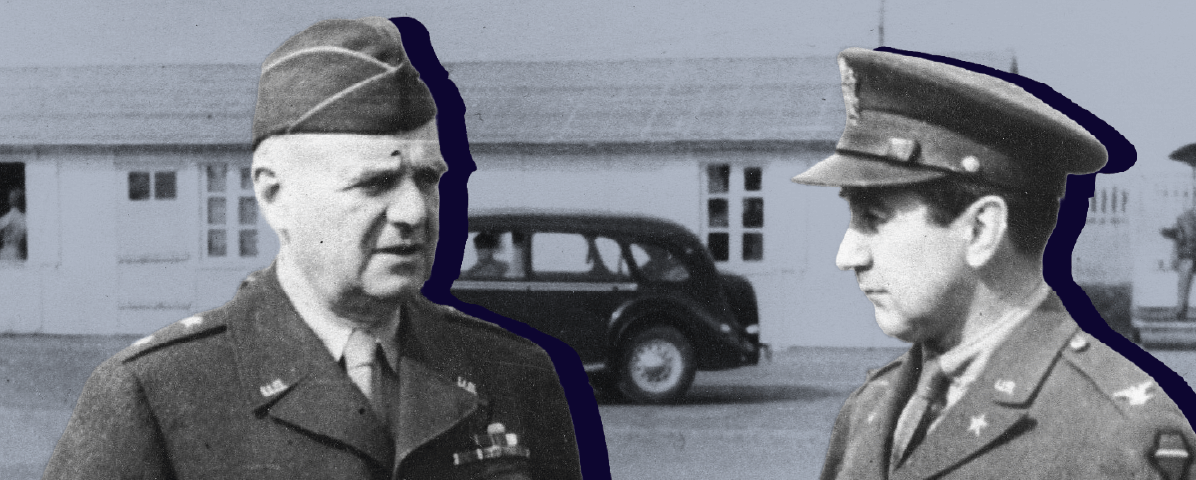
Image credit: Maj Gen William J ‘Wild Bill’ Donovan, Director, OSS and Colonel William Harding Jackson April, 1945. (Wikimedia/US Army)
[1] For additional details on the FBI and specifically J. Edgar Hoover’s positions on operations before Pearl Harbor, see Raymond J. Batvinis, The Origins of FBI Counterintelligence (University of Kansas Press, 2007) and Raymond J. Batvinis, Hoover’s Secret War against Axis Spies (University of Kansas Press, 2014).
[2] M. R. D. Foot, SOE: An Outline History of the Special Operations Executive, 1940-1946 (BBC Press, 1984), 173– 74.
[3] The most detailed description of the role of the BSC both before and after the United States entered World War II is its official history, published as The Secret History of British Intelligence in the Americas, 1940-1945 (St. Ermin’s Press, 1999). Other books focused on the BSC include H. Montgomery Hyde, The Quiet Canadian (Hamish Hamilton, 1962), William Stevenson, A Man Called Intrepid (Ballantine Books, 2009), and Thomas Troy, Wild Bill and Intrepid: Donovan, Stephenson, and the Origin of the CIA (Yale University Press, 1996). For a less positive perspective on the BSC and Stephenson, see Thomas Mahl, Desperate Deception: British Covert Operations in the United States 1939-1945 (Brassey Publications, 1998).
[4] Nicholas Reynolds, Need to Know: World War II and the Rise of American Intelligence (Mariner Books, 2022).
[5] Strategic Services Unit, Office of the Assistant Secretary of War, War Report of the O.S.S. (Office of Strategic Services) (1947, declassified in 1975, published Walker and Company, 1976); Troy, Wild Bill and Intrepid ; Joseph Persico, Roosevelt’s Secret War: FDR and World War II Espionage (Random House, 2001), 63-70.
[6] Strategic Services Unit, War Report of the O.S.S., 6-7.
[7] Roosevelt may not have expected quite the level of response from Donovan as the COI. Between July 1941 and June 1942, Donovan forwarded over 600 memos directly to the president. These memos included intelligence reports acquired both from the British and from COI collectors, regular reporting from the British on Nazi
propaganda as well as the UK response to the same, dozens of intercepted cables from various Vichy officials, and
Donovan’s own recommendations for how to conduct irregular warfare.
[8] Central Intelligence Agency, “Historical Intelligence Documents: from COI to CIG” in Studies in Intelligence, 37, No. 4, 111-113.
[9] Troy, Wild Bill and Intrepid.
[10] William Mackenzie, The Secret History of SOE. The Special Operations Executive 1940-1945 (St.
Ermin’s Press, 2000), 390.
[11] David Garnett, The Secret History of PWE: The Political Warfare Executive 1939-1945 (St. Ermin’s
Press, 2002), 118-119.
[12] “Memorandum to the President No. 94,” December 22, 1941 (NARA, OSS files Box 147, Folder 3).
[13] “Memorandum for Bill Donovan,” December 23, 1941 (NARA, OSS Files, Box 147, Folder 3).
[14] Foot, SOE, 151.
[15] Keith Jeffery, The Secret History of MI6: 1909-1949 (Penguin Press, 2010), 449.
[16] Nicholas Reynolds, Need to Know.
[17] “Summary of Agreement between British S.O.E. and American S.O.,” (Copy no 30. File: SOE America 19/B, HS
8/10, British Archives, Kew).
[18] “Untitled Memorandum for Colonel Donovan from Major Bruce,” June 28, 1942 (CIA reading room, CIA- RDP13X00001R000100470001-2).
[19] Multiple letters between the British Foreign Office, the Ministry of Economic Warfare and SOE headquarters, June-September 1942 (File: SOE America 19/B, HS 8/10, British Archives, Kew).