 A Nation Must Think Before it Acts
The US AI Acceleration Plan vs China’s Diffusion Model
A Nation Must Think Before it Acts
The US AI Acceleration Plan vs China’s Diffusion Model

A nation must think before it acts.

The US AI Acceleration Plan vs China’s Diffusion Model
The latest US Artificial Intelligence Strategy is a meaningful policy shift and should not be treated as just another vision document. It is an attempt to rewire how the Department of War builds, plans, tests, accredits, and scales capability around a single premise: in the AI era, the side that learns and fields the fastest wins.
From the perspective of US-China competition, the significance is not simply that Washington wants more AI. It is that the department is now treating AI adoption as an operational race in which the decisive variable is diffusion—how quickly a promising capability moves from experiment to trusted, fielded use across the services, commands, and enabling enterprise that actually fights.
China’s Race to Adopt Technology
China’s military AI progress is often framed as a technology contest. It is better understood as an adoption contest. Over the past decade, People’s Liberation Army (PLA) modernization has evolved through overlapping phases—mechanization (机械化), informatization (信息化), and what Chinese military writing describes as “intelligentization” (智能化)—with decision advantage, cognitive leverage, and faster kill-chain execution as the defining features of future conflict.
Beijing then works to reduce the friction that normally separates civilian innovation from military demand through military-civil fusion (MCF). MCF is not a slogan so much as an ecosystem design driven from the top (Xi Jinping) down: state-guided, system-wide aligned universities and labs, and a steadily expanding web of dual-use vendors (民参军/军转民) that can be mobilized for defense priorities while breaking down contracting barriers.
The result is a whole-of-nation diffusion model. China can take a capability that begins as a commercial technique (e.g., autonomy systems, large language models, edge computing) and route it through procurement into military applications, then scale those applications through follow-on contracting, organizational learning, and doctrinal experimentation. A Georgetown Center for Security and Emerging Technology (CSET) study drawing on 2,857 PLA AI-related contract award notices from January 2023 through December 2024 offers a rare empirical view into this ecosystem, showing a defense industrial base anchored by state-owned enterprises and defense-affiliated research institutions, but increasingly complemented by a long tail of nontraditional vendors that still find pathways into PLA demand.
The United States cannot and should not attempt to replicate China’s political model. But it must compete on the dimension China exploits well: scale. This strategy is notable because it aims directly at the US Achilles’ heel—bureaucratic friction that prevents diffusion, even when the underlying technology exists, and the private sector is moving at speed.
AI as a Warfighting Force
The strategy directs the department to become an “AI-first” warfighting force and lays out four lines of effort: unleash experimentation with leading American models; eliminate legacy bureaucratic blockers; focus investment on US asymmetric advantages (compute, entrepreneurial dynamism, capital markets, and combat-proven operational data); and execute a set of pace-setting projects (PSPs) designed to set the tempo for the rest of the institution.
The PSP construct is the centerpiece. Seven initial PSPs are named across three mission areas: warfighting, intelligence, and enterprise. In warfighting, Swarm Forge is framed as a competitive mechanism pairing elite units with elite innovators; Agent Network aims to drive AI agents into battle management and decision support from campaign planning to execution; and Ender’s Foundry focuses on AI-enabled simulation and rapid feedback loops. In intelligence, Open Arsenal is designed to compress the “techint-to-capability” pipeline, while Project Grant seeks to shift deterrence from static posture to dynamic pressure with interpretable results. In the enterprise arena, GenAI.mil and Enterprise Agents are positioned to democratize experimentation across the workforce and establish secure patterns for deploying AI agents into core workflows.
The discipline is not only in naming projects, but in enforcing diffusion. The strategy requires every military department, combatant command, and defense agency or field activity to identify within thirty days at least three projects to fast-follow the PSPs. It also creates a senior demonstration cadence and directs leadership to rank efforts by speed and impact. The combination of pace-setters plus forced replication turns PSPs from a portfolio of pilots into an enterprise-wide diffusion mechanism.
The strategy’s next move is to remove the institutional excuses that typically slow modernization, and especially AI adoption, down: access to models and data, and the ability to deploy quickly. While this comes with the inherent risk of safety, the strategy emphasizes that protracted timelines are not acceptable.
This matters because the department’s historical failure mode is not invention; it is adoption. The strategy is trying to solve for scale by making replication the default, then clearing the practical blockers that normally prevent replication from happening.
The Case for Prioritizing Speed
The strategy targets the choke points that have historically prevented AI from scaling. First, it aims to break data hoarding by forcing enterprise visibility into what data exists, where it lives, and how it can be accessed—backed by escalation when components refuse. Second, it treats commercial model release cycles as the relevant clock speed, pushing for integration pathways that can absorb new models quickly instead of fielding stale capability. But the decisive move is the third lever: accreditation speed.
The strategy calls for a “wartime approach” to eliminating blockers across authorizations to operate (ATOs), test and evaluation (T&E), certification, contracting, and hiring. It specifically targets rapid ATO reciprocity and creates a monthly “barrier removal board” empowered to waive non-statutory requirements and escalate the rest. The signal is clear: compliance can no longer function as a veto over operational learning and fielding timelines.
While China has similarly ambitious AI diffusion mechanisms, open sources do not point to a single named corollary to the department’s PSP construct. China does, however, have functional analogs enabled by MCF. State-directed special projects, competitions, and procurement pipelines create repeatable pathways that translate civilian AI progress into military capability and then scale adoption through contracts and doctrine-driven experimentation.
The department’s PSP approach is aimed at a different problem: how to force diffusion across a federated US defense enterprise without centralized political control. If it works, PSPs become a governance weapon: a handful of demonstrators that harden the enabling stack (data access, accreditation reciprocity, modular interfaces, and vendor integration cadence) and then compel replication through fast-follow projects. That is a plausible path to leapfrog China: not by matching mobilization, but by out-cycling it through faster learning, faster integration, and faster replacement of what does not work.
Looming Implementation Risks
The US strategy could fail for three plausible reasons due to implementation mandates in the AI strategy. First, forced data sharing expands the attack surface while increasing counterintelligence risk. Diffusion is a force multiplier not only for capability, but also for compromise, especially if security engineering does not keep pace with the drive to share data broadly.
Second, “model parity in thirty days” can deepen reliance on a small number of frontier vendors and procurement channels. That may be acceptable in a sprint, but it creates resilience and governance questions over time when models are updated continuously and integrated across mission systems.
The third and hardest problem is enforcement. The difference between a memo and a movement is whether programs actually share, accrediting authorities actually reciprocate, and fast-follow projects actually ship. If the department cannot compel compliance when it clashes with incumbent incentives, the strategy will produce pockets of excellence rather than department-wide advantage.
The Way Ahead
Four steps would increase the odds that this strategy produces an enduring advantage.
1) Treat diffusion as a named capability. Track adoption rates, time-to-first-operational-use, time-to-update, rollback time, and cross-component replication. The strategy already directs leadership to rank efforts by speed and impact; diffusion metrics should be part of that scorecard and tied to resourcing decisions.
2) Require every PSP to ship reusable artifacts. Each PSP should deliver reference architectures, interface standards, data access patterns, and ATO reciprocity packages that fast-follow projects can be reused with minimal friction. Otherwise, PSPs become impressive demonstrations but do not scale.
3) Build “safe speed” into the barrier removal board. Waivers should be paired with continuous evaluation, provenance, and auditability so acceleration does not accumulate hidden compliance debt that later collapses programs at the moment they matter most.
4) Translate PSPs into coalition advantage. The strategy explicitly references leveraging allies and partners. PSP outputs should be designed for releasability and combined operations from the start, because the US advantage is amplified through alliances rather than being trapped inside US silos.
China’s military AI momentum is dangerous because it is built for diffusion: doctrine, procurement, fusion, and mobilization push capability into the force at scale. The Department of War’s AI strategy is a serious attempt to compete on that same footing by forcing data sharing, accelerating ATO and T&E pathways, demanding a commercial-tempo model refresh, and using Pace-Setting projects as an institutional flywheel. If data actually moves, accreditation actually reciprocates, and fast-follow projects actually ship, the department has a credible path to leapfrog—by out-diffusing China rather than imitating it.
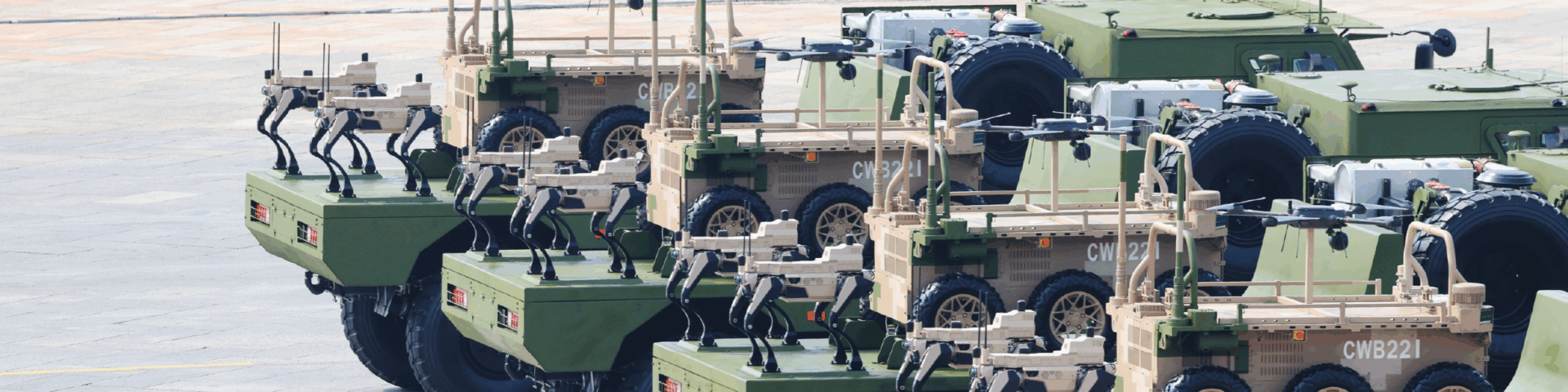
Image: The unmanned land-based formation, including the robotic wolves, attends V-Day military parade to commemorate the 80th anniversary of the victory in the Chinese People’s War of Resistance against Japanese Aggression and the World Anti-Fascist War on September 3, 2025 in Beijing, China. (Sheng Jiapeng/China News Service/VCG via Reuters Connect)