 A Nation Must Think Before it Acts
FPRI Experts React | Renewed Conflict in Iran
A Nation Must Think Before it Acts
FPRI Experts React | Renewed Conflict in Iran

A nation must think before it acts.
FPRI Experts React | Renewed Conflict in Iran
Aaron Stein, President
After declaring Iran’s nuclear program obliterated after Operation Midnight Hammer, the US has returned to finish the job. The backdrop for this renewed air campaign is complicated, but worth fleshing out to understand the implications for US forces. The USS Ford participated in the Maduro operation and has had its deployment extended, taxing everything from sailor morale to on-board plumbing. US missile defenses remain stretched, but are now stacked up in Saudi Arabia and Jordan — and perhaps elsewhere. The Air Force has deployed two-thirds of its available F-15Es, an aging airframe in constant demand. And the F-35 inventory was already under strain, stemming from spare part shortages linked to their diversion to help Israel after the 12-day war.
And despite these challenges, the tactical execution thus far has been excellent. Iran appears overwhelmed with near constant US presence overhead, suppressing ballistic missile launch, and an Israeli-led effort to kill the Iranian leadership.
Where is this going? I think it’s safe to say we don’t know. Iran is on the back foot. But even if Khamenei is dead — and I think he is — the IRGC has that place wired. It is the muscle and money behind the Islamic Republic. They won’t go quietly, or will cut a deal to keep them in power in ways that don’t comport with the idealism often associated with liberal regime change.
Looking internally, for any future claim about a clean military victory, the second-order effects will be visible. The Ford will need maintenance — and a lot of it. Flight hours for the F-35 may decrease with shortages. And the aging 4th generation backbone of the Air Force will be further taxed. Munition stockpiles remain low and need to be replenished faster. This is the time to truly commit to sound industrial policy back home to match the intensity of Trump’s adventurism abroad. These systemic readiness and production issues can’t be kicked down the road any longer. Iran isn’t the main factor in resisting the US attack. It’s our own inability to buy and build things that will slow this thing down if it continues for more than a few weeks.
Afshon Ostovar, Senior Fellow
What we are witnessing today is not simply a military campaign — it is an attempt to resolve by force a geopolitical problem that four decades of diplomacy, sanctions, and limited strikes failed to solve. The question is whether it will work, and the honest answer is: we don’t know.
What is clear is that Iranian politics will change. Should the regime emerge from this, it will have lost at least another layer of its senior leadership. Its military will be dramatically weaker than it already is. Its missile and drone programs will be further degraded. Its naval power will be blunted. And its hopes for restoring nuclear enrichment will be over—at least for now.
In some ways, the Islamic Republic was built to absorb exactly this kind of blow. Decapitation may wound the regime, but the institution that sustains it—the Islamic Revolutionary Guards Corps—runs far deeper than any individual, even Khamenei himself. The IRGC is not merely a military force — it is an economic empire, a political machine, and a survival mechanism fused into one.
And while regime change could bring the prospect of a new Iran—a country free from the fetters of the regime’s recalcitrant and poisoning ideology, one that can restore prominence and pride to the Iranian people—such change is unlikely to result from an air campaign alone.
So, while the situation is still fluid, I’ll be watching first and foremost to see signs of the ultimate goal of this campaign. If it is indeed aimed at regime change, then it’ll likely require a sustained air campaign—think drones and bombers persistently hitting formations of regime forces as they assemble for counterprotest operations—and some element of ground involvement. This could come by way of special force units inserted to accomplish specific and discrete tasks such as kill-or-capture missions, seizing government buildings and telecommunications, or sabotage.
Where this goes is unclear. But the two most likely outcomes are these: it could end with a paralyzed regime or an entirely new government entity whose first job will be trying to keep the country together.
Emily Holland, Eurasia Program Director
Like the January US intervention in Venezuela, today’s strikes on Iran won’t have a major effect on Russia’s primary foreign policy goal: ending the war in Ukraine on its terms. The Russian Foreign Ministry was quick to condemn the strikes as “an unprovoked act of armed aggression against a sovereign and independent UN member state,” calling for an immediate cessation of military activity.
If anything, a war in the Middle East, and especially a protracted one, will certainly divert Washington’s attention from potential Russia-Ukraine peace talks, allowing Moscow to continue its war of attrition in Ukraine. Any longer-term hostilities in the Middle East will also drain stockpiles of key munitions, particularly the Patriot interceptors that Ukraine desperately needs.
Today’s strikes have already rattled energy markets. In the event of a full or even partial closure of the Strait of Hormuz, oil and gas exports from Saudi Arabia and the United Arab Emirates to premium Asian markets could be slowed. It is likely that when oil markets open on Monday, they will rise steeply, which could advantage Russia by punishing the very G7 member states that imposed a price cap on Russian oil.
In terms of its regional interests, after the fall of Assad in Syria, Moscow’s strategy towards the Middle East was based on leveraging its ties with Iran to gain leverage against the Gulf states. Although it is too early to say what comes after the dust settles, Moscow is certainly concerned about the possibility of losing this role. However, like in Venezuela and Syria, Moscow has not deemed saving its partners worthy of intervention (nor has it been able to), because in the context of the war in Ukraine, regional interests are not core security priorities.
Mohammed A. Salih, Senior Fellow
As a US-Israeli military campaign against the Islamic Republic regime continues, a key question on the minds of many inside and outside the country is what comes the day after, assuming that the US and Israel continue the campaign until the current regime collapses or capitulates.
In the case of capitulation, the core nucleus of power within the regime will likely survive and continue to run the country. This outcome is mostly preferable to the US, as Washington would likely view behavioral change as a success, but for Israel, regime change might be the more preferable outcome.
If the Islamic Republic regime indeed collapses— as a result of a combination of military campaign and popular uprising—the day after would present a more chaotic scenario. In the event of regime change, the current regime’s security forces might not have the capabilities or popular legitimacy to continue governing. That would open the door to a role for Iranian opposition parties based in exile. Currently, the former crown prince of Iran, Reza Pahlavi, and the Mojaheddin-e-Khalq (MEK) are the top contenders for power in the event of regime change. Pahlavi does not have a strong organization inside Iran, and his best chance of gaining power in Tehran would rely on partnering with some of the core elements of the Iranian security establishment. The MEK, on the other hand, has a strong organization and is capable of mobilizing its members for armed action, as the group reportedly did on February 24 against Supreme Leader Ali Khamenei’s residence. However, while Pahlavi appears to enjoy growing public support in the mainstream of Iranian politics, the MEK does not have such support. Ultimately, without Washington’s and Jerusalem’s support, it is unlikely that anyone could gain power in Tehran, whether the current regime falls or transforms internally.
Sam Lair, Fellow
Iranian air defenses are likely to struggle as much, if not more, during this conflict against the US and Israel than they did during the 12-Day War last summer. Many Iranian air defenses were destroyed during the last war, along with the all-important radars to manage and cue SAM systems. One interesting recent development is that I saw some of Iran’s Russian-made S-300 launchers reappear at Iranian air defense sites in satellite images from our partners at Planet Labs and Airbus. While the reappearance of these higher-quality SAMs is interesting, their radars were absent. Many of those radars were destroyed by the Israelis during the retaliatory strikes for True Promise I and II and the 12-Day War. Those radars are essential to make the S-300s work. Perhaps the Iranians have managed to network the Russian SAMs with their domestically produced radars, but that would bring severe limitations. Not only are they not designed to work together, and would therefore suffer performance limitations, but Iranian radar networks are very brittle and inflexible. Jeffrey Lewis and I discovered this last year in our analysis of a snippet of footage from an air defense command center near Natanz. In sum, my prediction is Iran’s air defenses won’t pose much of a threat to the US Air Force and Navy, but as Operation Rough Rider demonstrated, there is always the potential for something to go wrong.
Shihoko Goto, Vice President of Programs, Asia Program Director
The attack on Iran has raised alarm across the Indo-Pacific, from US treaty allies to strategic rivals alike. While the White House has declared the end goal to be nothing short of regime change as well as the dismantling of Iran’s nuclear program, the lack of consultation and coordination with allies, with no clear roadmap to achieve its objectives, is seen as troubling even amongst Washington’s staunchest allies.
Fears of a prolonged war and expectations for treaty allies, including Japan, Korea, Australia, and the Philippines, to support US efforts are on the rise, while wariness about the unsettling track record of the United States to reach decisive wins in Afghanistan as well as Iraq weighs heavily. The prospect of escalating tensions across the Middle East will undoubtedly impact global energy prices. For countries across the Indo-Pacific that remain dependent on imports from the Middle East, the likelihood of higher energy prices is yet another factor to increase wariness about the US decision to attack Iran.
As for China, it has been swift to condemn US actions for violating international laws and the UN Charter. Beijing is expected to continue its message of restraint and dialogue with Tehran; it is unlikely to provide military support to Iran.
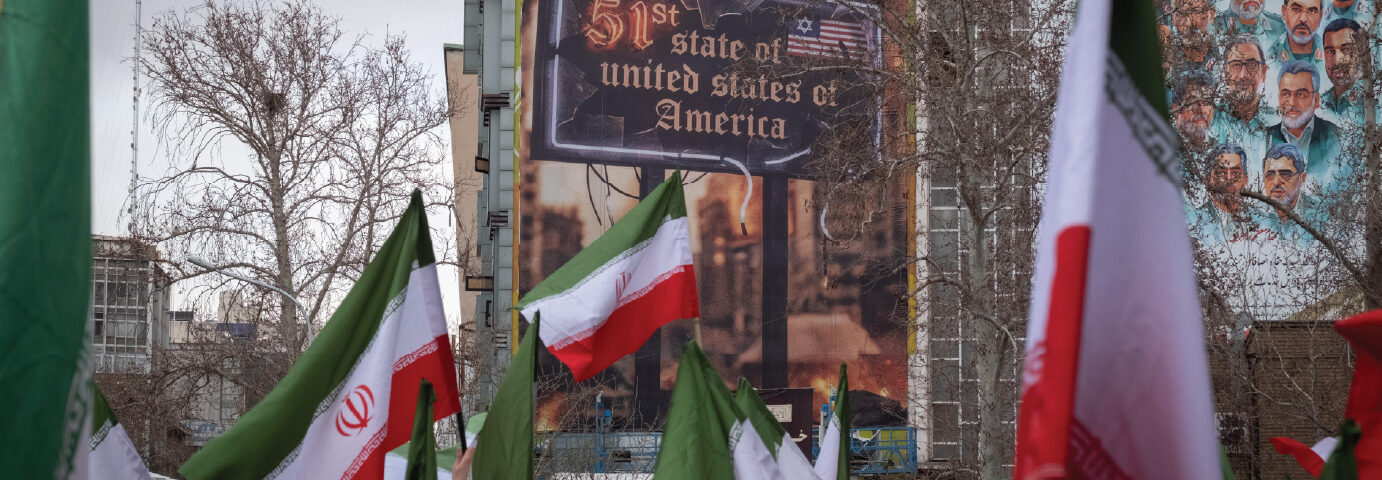
Image: Iranian pro-government protesters wave national flags in front of an anti-US and Israeli billboard while participating in an anti-war protest gathering against the US and Israeli military attacks in Iran, at a Palestine square in Tehran, Iran, on February 28, 2026. (Photo by Morteza Nikoubazl/NurPhoto)