 A Nation Must Think Before it Acts
FPRI Experts React | Understanding the Third Gulf War
A Nation Must Think Before it Acts
FPRI Experts React | Understanding the Third Gulf War

A nation must think before it acts.

FPRI Experts React | Understanding the Third Gulf War
The third Gulf War began with an assassination on February 28, 2026, in broad daylight in central Iran. The war has engulfed the region in conflict, extending from neighboring Gulf Arab countries to the waters just off Sri Lanka. The end date of the air campaign remains uncertain, with estimates ranging from weeks to months, and the war has spilled over into the Gulf Arab States and into the Eastern Mediterranean.
The Foreign Policy Research Institute (FPRI) gathered a group of experts to answer questions about Israeli and American air operations, the progress made towards degrading Iranian missile and drone capabilities, the surprising role of submarine warfare in the conflict, and allied naval commitments to defend the region from drone attack.
Aaron Stein, President
The air war’s intensity is unprecedented. The focus has rightly been on the success of regional air defense, the effects of the Israeli and American strikes on Iranian missile launchers and infrastructure. However, as I wrote about previously in a report for FPRI about the drone defense during the United States Air Force (USAF) led Operation True Promise drone defense, an often overlooked issue is deconfliction. Put simply: there is a lot of metal flying in the air, the US and Israel fly the same airframes, and that can lead to unintended outcomes. The most obvious example was the Kuwait F/A-18 shootdown of three F-15Es.
The second issue I am watching is crew rest. The strikes on the USAF side are very intense. The bases are being targeted with missiles and drones every night. This means that crews returning from strikes are probably not sleeping well, if at all. This opens the door to mistakes or broader issues about a pilot-to-plane ratio. I suspect the USAF may need more pilots, perhaps not aircraft, and so increases in US forces will take place to give the operating crews a break.
The third issue is magazine depth – and I am not talking here about the much written about stockpiles of Patriot and THAAD interceptors. That is well covered. I’m talking here about AIM-9X and AGR-20 APKWS, the workhorse missile and rocket system for airborne Shahed defense. The drone launches are unprecedented, as well, meaning that the USAF is certainly using far more air-to-air missiles than planned or budgeted for, and stockpiles will dwindle. Magazine depth – and not the cost exchange ratio – is the industrial challenge that the US will have to address urgently now and when this war ends.
Emma Salisbury, Senior Fellow
The Royal Navy is sending assets to help protect RAF Akrotiri on Cyprus, after several drone attacks causing minor damage. HMS Dragon, one of the Royal Navy’s six Type 45 destroyers, is currently being loaded up with munitions in Portsmouth before sailing to the Mediterranean. The Type 45s are air defense specialists, with 48 VLS cells, various naval guns, Phalanx CIWS, and other advanced electronic warfare capabilities.
In advance of HMS Dragon’s arrival, the Royal Navy is sending two of its Wildcat helicopters, equipped with Martlet missiles designed to take down drones. These will reinforce the RAF’s Typhoons, F-35Bs, and ground defenses at the base, as will military assets from France and Greece.
The UK government has been criticized from all sides during the few days of this war – at home for not sending reinforcements sooner, from the Cypriot government for not doing more to protect communities near the base, and from President Donald Trump for only permitting the use of British bases (likely Diego Garcia and RAF Fairford) for “defensive” strikes.
Sam Lair, Fellow
The air campaign the US and Israel have conducted against Israel has proceeded in three phases, and has been fairly effective.
The first phase was brief and targeted against the Iranian leadership. The Israeli air force used Sparrow air-launched ballistic missiles to kill Supreme Leader Ali Khamenei, and the US struck a number of targets with Tomahawks.
The second phase has been directed against Iranian air defenses and offensive striking capabilities. A number of air defense sites I examined in mid-February have been targeted, and many Iranian radars and SAM systems have been destroyed. Iranian naval and Air bases have also sustained extensive damage.
One major focus of the second phase has been Iran’s missile bases. At this point, nearly every major Iranian missile base has been struck. Based on analysis of satellite imagery, a pattern has emerged in the attacks. Some of the bases which house the regional-range missiles used to strike Israel have been hit with bunker buster munitions, like Tabriz North and Imam Ali outside of Khorramabad. However, very little damage has been done to infrastructure at other bases. Missile checkout buildings have been hit at Isfahan North and Khorgu, but at the shorter-range bases focused on the Persian Gulf and other regional-range Iranian bases in the interior, it seems the focus has been on targeting missile launchers instead.
The US and Israel have seen pretty serious success on that front. The lack of Iranian air defense and the Iranian failure to disperse their TELs in advance of the conflict means that long-endurance drones or other reconnaissance assets can monitor Iranian missile cities, track the launchers as they emerge, and either strike the launchers themselves or cue up long-range precision strike assets in the region to destroy the launchers before they can fire. There has also been evidence of successful launcher destruction at regional-range bases like Isfahan North and Garmdareh as well.
It seems likely to me that as the war progresses, more bases will be attacked with bunker busters to seal tunnels and damage underground infrastructure, but the regional-range missile bases seem to be the priority for those munitions. However, as the war progresses and more of those Iranian bases come under more concerted attack, I anticipate the volume of Iranian missile strikes against the Gulf states will continue to decline.
The third phase appears to have just started in the last day or so and involves strikes against the Iranian defense industry. The Shahid Hemmat Industrial Group complex at Khojir was hit, including Shahid Cheragi Industries which makes oxidizer for Iranian liquid propellant missiles. The Iran Aircraft Manufacturing Industrial Company (HESA) complex near Isfahan was targeted as well. I expect this third phase will be prolonged as there are many defense-industrial sites in Iran, and their domestic missile capabilities were a significant part of the justification for the war on both the US and Israeli side.
Michael Petersen, Senior Fellow
On March 4, a US attack submarine (SSN) sank the frigate IRIS Dena about 40 nautical miles off of Sri Lanka. This attack raised even more public concern about the legality of US operations against Iran. These debates are important and welcome. But they must also be informed by a proper understanding of fact, context, and feasibility.
Consider: The Dena, one of the Iranian Navy’s most advanced ships, was headed west toward an area of active US Navy combat operations. The submarine’s commanding officer almost certainly would have received orders that Iranian military assets worldwide were to be considered hostile.
The Iranian warship was transiting toward US aircraft carriers, the most expensive, powerful, and heavily crew-laden vessels in the Navy. Whether the frigate intended to attack US forces or not, the submarine commander would have committed professional malpractice and endangered thousands had he let it approach within missile range of the carrier strike group. Warning the Dena was out of the question. The moment a submarine reveals itself, it is the most vulnerable warship in the ocean. Submarines are slow. They have no combat capability on the surface. Their protection lies in stealth.
As anyone who has been on a US attack submarine knows, they are also some of the most cramped vessels on Earth. 32 Iranian sailors survived the attack. There is exactly nowhere aboard an SSN to put this many people. Given that the attack was only 40 nautical miles from Sri Lanka, the submarine commander could have a reasonable expectation that the Sri Lankan Navy could rescue the sailors.
In matters of fact, context, and feasibility, it makes little sense to argue the US submarine could do anything else but attack and sink the Dena.
Decker Eveleth, Associate Research Analyst at the CNA Corporation
Iran’s own missile posture continues to be its biggest weakness. Iran’s concentration of the majority of its missile force in fixed underground “missile cities” continues to make its primary deterrent force vulnerable to loitering drones picking off launchers entering and leaving, or earth-penetrating weapons. Iran has also not invested in the capability to rapidly reload in the field or recover broken-down launchers, allowing allied drones to destroy stricken and abandoned launchers or launchers returning to known sites to reload. Even if significant missiles remain inside missile cities, many are either likely entombed, unable to be fired due to lack of launchers, or unable to sally forth from the tunnels due to the continuous presence of allied drones.
As a result, the number of Iranian missiles launched continues to decrease day after day. The number of Iranian drone attacks remains stable, however. Smaller and easier to set up and launch, Iranian Shahed-type drones will continue to be a nuisance to US and allied forces.
Guy Plopsky, Author of FPRI’s Rising Lion Air Offensive: Aircraft, Weapons, and Operations
On the morning of February 28, 2026, the Israel Defense Forces (IDF) and the United States Armed Forces commenced a combined, high-intensity air offensive against the authoritarian regime of the Islamic Republic of Iran. The IDF’s contribution to the offensive, known as Operation Roaring Lion, opened with air strikes by the Israeli Air Force (IAF) on the regime’s senior political and military leadership in the capital city of Tehran. Some forty high-ranking officials were eliminated within a time span of approximately 40 seconds, among them Iran’s Supreme Leader, Ali Khamenei, who had ruled the country for over 36 years.
In a manner resembling last June’s Operation Rising Lion, the IAF followed its decapitation strikes with extensive air attacks against other target sets, predominantly ground-based air defenses (GBADs) and surface-to-surface missile (SSM) sites in western and central Iran. The attacks, conducted as part of a large-scale offensive counterair (OCA) effort, further degraded Iran’s ability to defend its airspace and launch ballistic missiles at Israel. Crucially, the IAF was able to rapidly attain air superiority/supremacy over relevant parts of western and then central Iran, including Tehran, paving the way for subsequent waves of attacks in the days that followed. These attack waves have focused on various targets, including, inter alia, those associated with the Iranian regime’s security and intelligence apparatuses, and the military dimension of its nuclear program, as well as SSM-related development and production sites.
Operation Roaring Lion has seen the IAF utilize a wide range of assets, among them various combat support platforms, unmanned combat aerial vehicles (UCAVs), and fighter aircraft. The latter includes all major fighter types presently in service with IAF frontline squadrons; from the older (albeit upgraded) F-15 Baz and F-16 Barak to the more modern and capable F-15I Ra’am and F-16I Sufa, to the state-of-the-art, stealthy F-35I Adir. This diverse fighter force has delivered a large quantity of precision-guided ordnance against Iranian targets since the beginning of the air offensive, including, among many others, US-supplied Joint Direct Attack Munitions (JDAMs), and Israeli-developed SPICE glide weapons and RAMPAGE supersonic air-to-surface missiles.
According to figures released by the IDF on March 3, since commencing Operation Roaring Lion the IAF’s fighter force (and presumably also UCAV fleet) have employed a total of some 4,000 munitions over the course of more than 1,600 strike sorties. An IDF press release published less than 24 hours later, on March 4, notes that the figure for total munitions expended had increased to over 5,000. For comparison, the IAF reportedly generated approximately 1,500 sorties and employed roughly 4,300 munitions during the entirety of Operation Rising Lion (a period of 11-12 days). The IDF did not provide a basic breakdown of the sortie figure for Rising Lion (for example, whether it comprises only strike sorties and, if yes, only those conducted by fighter aircraft or also by UCAVs). Nevertheless, the difference with Roaring Lion is marked and further points to a much higher intensity of Israeli air operations this time around.
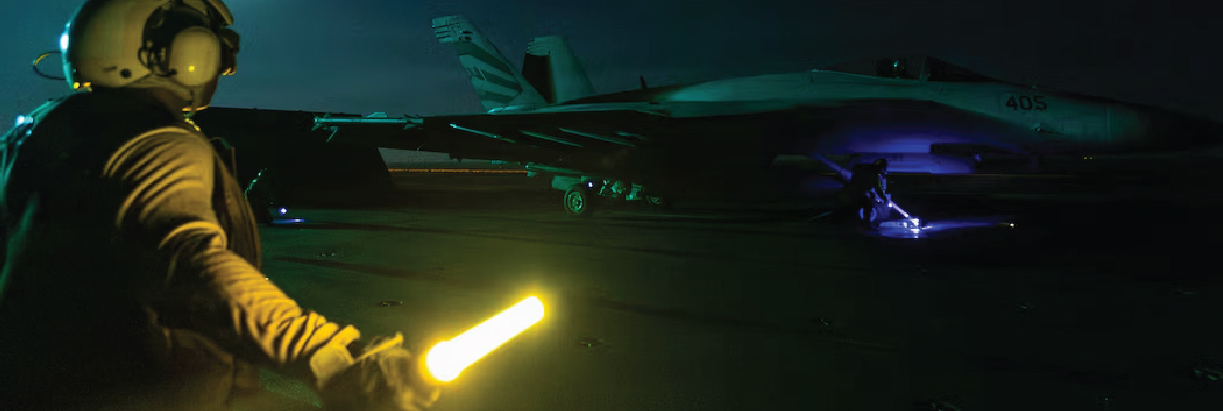
Image: An F/A-18E Super Hornet, attached to Strike Fighter Squadron (VFA) 151, prepares to launch from the flight deck of Nimitz-class aircraft carrier USS Abraham Lincoln (CVN 72) in support of Operation Epic Fury, March 3, 2026. (US Navy photo)