 A Nation Must Think Before it Acts
Militias and Iraq’s Role in a Multifaceted Regional War
A Nation Must Think Before it Acts
Militias and Iraq’s Role in a Multifaceted Regional War

A nation must think before it acts.
Militias and Iraq’s Role in a Multifaceted Regional War
Introduction
Amid the escalating Iran-US-Israel war, Iraq is increasingly becoming one of its central fronts, bringing back into sharp focus a chronic structural dilemma: the role of militias embedded within the state and the consequences of their conduct for Iraqi sovereignty and stability. At the core of this dynamic is a deep contradiction: state-affiliated forces operating in alignment with an external agenda, effectively shaping Iraq’s war and peace decisions beyond the government’s control.
Since late February, more than 500 attacks have reportedly been carried out against targets inside Iraq or launched from Iraqi territory toward regional actors, based on a review of various media estimates. The majority have been attributed to Shia armed factions aligned with Iran, with some operations originating directly from Iranian territory. Targets have included US military and diplomatic facilities in Baghdad and Erbil, Kurdish Peshmerga positions, civilian infrastructure such as oil fields and hotels, Iranian Kurdish opposition groups, European diplomatic and military personnel, and even Iraqi intelligence and counterterrorism units.
The cumulative effect has been to draw Iraq deeper into a confrontation not of its own making. In response, the US-Israeli alliance has conducted an expanding series of airstrikes targeting the infrastructure and leadership of militant groups within the Popular Mobilization Forces (PMF), a legally recognized component of Iraq’s security apparatus. Several prominent PMF leaders are reported to have been killed or wounded in these strikes.
Who Is Launching the Attacks and Why?
Responsibility for the militia attacks has been claimed under the banner of the “Islamic Resistance in Iraq,” an umbrella label used by Iran-aligned militant groups operating across the region. Sub-groups such as Saraya Awliya al-Dam and Ashab al-Kahf frequently issue claims of responsibility. However, these names function largely as branding facades rather than distinct operational entities.
In practice, the attacks are widely understood to be carried out by established PMF factions with significant military capabilities. These include Kata’ib Hezbollah, Kata’ib Sayyid al-Shuhada, Harakat al-Nujaba, and others. These groups are formally integrated into the PMF structure as brigades, receiving state salaries, funding, and legal status. At the same time, they maintain independent command structures and external lines of support, particularly from Iran’s Islamic Revolutionary Guard Corps (IRGC).
The PMF itself is a large and heterogeneous institution, comprising roughly 60 to 70 brigades and approximately 230,000 personnel, with an annual budget estimated at around $3.5 billion. While some units—such as formations affiliated with Shia holy shrines—operate primarily within a national framework, the core leadership and operational capacity of the PMF remain concentrated among pro-Iran factions.
These groups also possess capabilities beyond conventional militia activity. Some maintain indigenous drone and missile production facilities, supported by Iranian expertise, in locations such as Jurf al-Sakhr in southwestern Iraq. Their hybrid status—both state-affiliated and externally aligned—allows them to operate with legitimacy and autonomy, often beyond government control.
Politically, these factions have entrenched themselves within Iraq’s governing institutions. Since the 2018 elections, several militia-linked groups have expanded their presence in parliament and key ministries, consolidating influence over both policy and resource allocation. This dual role—armed actor and political stakeholder—also further complicates efforts to regulate their behavior and minimize their influence.
The current wave of attacks by these groups against a diverse array of targets must be understood within the broader strategic context of the regional confrontation. From the perspective of Tehran and its allied factions, the war is perceived as an existential threat. Participation by Iraqi militias serves multiple purposes: It signals alignment with Iran, imposes costs on US forces with the aim of eventually forcing them to leave Iraq, sows chaos and disruption in Iraq and the broader region, and introduces instability into energy markets, which remain perhaps the central lever in Iran’s strategic calculus in the current war.
However, the operational impact of these attacks has been uneven. While they have succeeded in sustaining pressure and creating uncertainty, the Iraqi armed factions have not fundamentally altered the military balance. Their primary effect has been political—escalating tensions, complicating diplomatic positioning, and deepening Iraq’s entanglement in the conflict.
Why Are Shia Armed Factions Important to Tehran?
Iraqi Shia armed factions occupy a central place in Iran’s regional strategy. Over the past two decades, they have generally evolved from local militias into transnational actors capable of projecting power beyond Iraq’s borders. Their involvement in Syria, where they fought in support of Bashar al-Assad’s government, particularly illustrates this expanded role.
These groups also contribute to Iran’s economic resilience. Through networks involved in sanctions evasion, oil smuggling, and illicit financial transfers, they provide Tehran with alternative channels of revenue and logistical support. At least six PMF-affiliated factions are under US sanctions for activities ranging from terrorism to illicit economic practices.
As other Iranian proxies and partners in the region—such as Hezbollah and Hamas—have faced increasing pressure, the relative strategic importance of Iraqi factions has grown. Their geographic position allows Iran to project influence westward into the Levant and southward toward the Gulf, while also providing a buffer along the bulk of its western borders.
A key distinguishing feature of Iraqi factions is their integration into a state system that finances their operations. Unlike other proxies that depend heavily on Iranian funding, the unruly armed factions within the PMF draw salaries and resources directly from the Iraqi budget. This arrangement has not only reduced Tehran’s financial burden but also created opportunities for revenue generation through illicit activities.
Within this network, there is a division of labor. Some factions focus on military operations, while others prioritize political engagement and institutional influence. Groups such as the Badr Organization and Asa’ib Ahl al-Haq have played prominent roles in shaping government formation and policy direction, particularly since 2022. This combination of armed capability and political access enhances the armed factions’ strategic value and impact.
Iraq and the Dilemma of Shia Armed Factions
The presence of these armed factions presents Iraq with a structural dilemma that has proven resistant to resolution. The PMF, as an institution, emerged as a response to the collapse of the Iraqi military during the fight against the Islamic State. In that context, Shia militias positioned themselves as defenders of the state and the Shia community, drawing legitimacy from both necessity and sacrifice.
However, their continued alignment with Iran introduces a competing set of loyalties that complicates their role within the Iraqi state. Since October 2023, many of these groups have participated in attacks against US forces and other targets as part of a broader Iran-led regional axis. Their activities are often conducted under alternative names, but it is widely understood which groups are actually responsible.
This creates a situation in which the Iraqi government is both host to and, indirectly, a party to actions it does not fully control. Direct confrontation with these groups carries the risk of intra-Shia conflict, a scenario that Baghdad has consistently sought to avoid. At the same time, inaction allows these factions to shape Iraq’s external relations and internal security dynamics and posture. The result is a gradual erosion of sovereignty as, internally, the state’s monopoly on the use of force is compromised and, externally, Iraq’s foreign policy becomes entangled with the agendas of non-state actors beholden to Iran.
Despite years of claims of security sector reform, many PMF factions today constitute something of a security black hole within the Iraqi state, rather than functioning as institutions tasked with enforcing security as their legal and institutional role would require. When these groups launch attacks, they typically claim responsibility under façade names such as the Islamic Resistance in Iraq. However, when they are targeted in response by the United States and others, casualties are claimed under the PMF banner. This serves to foment anti-American sentiment—particularly among Iraq’s Shia population—and to ensure that the families of those killed receive “martyrdom” pensions from the Iraqi government. Former Iraqi Prime Minister Mustafa al-Kadhimi has publicly acknowledged the untenability of this situation and warned of its consequences for Iraq. While government’s difficult balancing act seeks to maintain internal cohesion while avoiding external escalation, it has in practice reinforced contradiction and ambiguity that threatens the state’s own stability.
In the face of mounting volatility and pressure to act, the government of Prime Minister Mohammed Shia al-Sudani has largely limited its response to issuing deeply contradictory statements. It has condemned militias attacks on foreign troops and diplomatic facilities present on Iraqi territory with Baghdad’s approval as “terrorist” in one paragraph—without naming perpetrators or assigning responsibility—while, in another, denouncing the retaliatory “aggression” by U.S.-Israeli alliance in response to those same attacks. Taking matters further, on March 24, Baghdad took the extraordinary step of authorizing the PMF to respond to attacks on its bases. This effectively makes Iraq a belligerent in the current regional war, rendering it responsible for actions carried out by the PMF factions under claims of self-defense.
This outcome reflects the logical culmination of a deeply contradictory arrangement: forces aligned with a foreign power operating within Iraq’s security apparatus for legitimacy and funding. This amounts to the incorporation of militia activity into the framework of state-sanctioned self-defense. In doing so, this blurs the line between state and non-state actors even further. Instead of restraining militias on its payroll, the government is effectively signaling that their actions are justified and authorized. Sudani has also stated that the withdrawal of US and foreign troops by the end of September 2026, under a 2024 agreement between Baghdad and Washington, would make it easier to dismantle pro-Iran armed groups. However, the feasibility of such an outcome following a full US withdrawal remains highly questionable, as the Iraqi government does not appear to possess either the intent or the capacity to undertake such a consequential task on its own.
Additionally, the continued hostility of these armed factions poses a serious challenge for Washington, its relationship with Iran, and the broader regional security order. US frustration appears to be mounting, reflected in an uptick in recent retaliatory strikes. Since October and as recently as early March, Secretary of State Marco Rubio has warned senior Iraqi leaders to protect US personnel and facilities and called for the disarmament of these groups. Washington has also repeatedly opposed any role for these factions in Iraq’s next government, which has yet to be formed more than four months after the latest parliamentary elections. Without sustained US pressure—potentially including military measures and the threat of significant economic sanctions—tangible reforms regarding the status and behavior of the PMF and its belligerent factions are unlikely to materialize.
For now, while Baghdad appears incapable of mounting a full-scale campaign to rein in these militias, it could still take meaningful steps to demonstrate seriousness in holding them accountable and curbing the current state of security disorder—beginning with greater transparency in attributing attacks, cutting or limiting funding, and enforcing stricter over their resources, weaponry, and behavior. The state’s ability, or lack thereof, in curbing these groups will be an important factor in shaping the country’s trajectory in the months and years ahead.
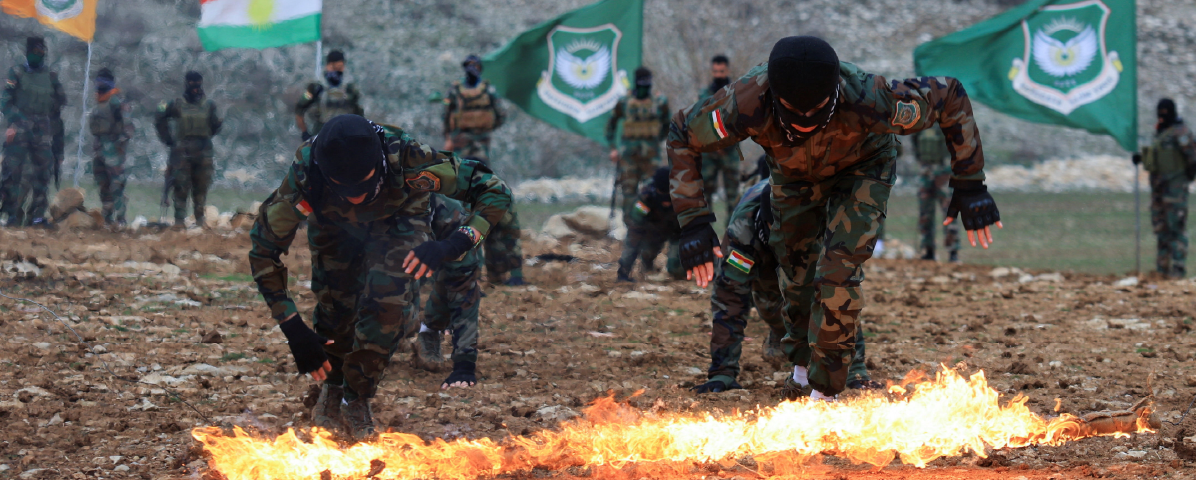
Image credit: Iranian Kurdish fighters from the Kurdistan Freedom Party (PAK) take part in a training session at a base on the outskirts of Erbil, Iraq February 12, 2026. REUTERS/Thaier Al-Sudani