 A Nation Must Think Before it Acts
Over 5,000 Munitions Shot in the First 96 Hours of the Iran War
A Nation Must Think Before it Acts
Over 5,000 Munitions Shot in the First 96 Hours of the Iran War

A nation must think before it acts.

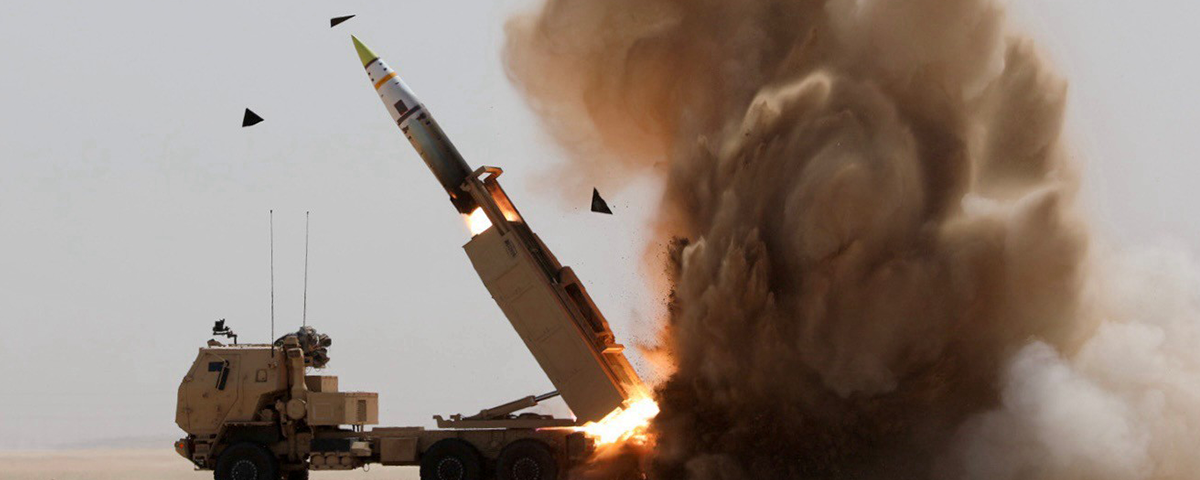
Over 5,000 Munitions Shot in the First 96 Hours of the Iran War
For three decades, American grand strategy has rested on what Barry Posen termed “Command of the Commons”: an unrivaled ability to project power across the globe. The opening 96 hours of Operation Epic Fury against Iran suggest this paradigm has shifted. The decisive factor in modern, high-end conflict has become more than just standoff strikes—it is about the industrial capacity to sustain those strikes and defend against adversarial attacks. The modern foundation of military power has become a problem that we refer to as the “Command of the Reload.” This is the result of industrial physics showing up to war like an unpaid invoice, and the bill is coming due in minerals, manufacturing, and strategic solvency.
Several organizations have published cost estimates for Operation Epic Fury’s opening phase. The Center for Strategic and International Studies (CSIS) places the first 100 hours at $3.7 billion; Anadolu Agency estimates $5.82 billion when asset losses are included; and the Penn Wharton Budget Model projects $40 to $95 billion for a two-month conflict. Those figures obscure a more uncomfortable reality. Our analysis, using a Payne Institute proprietary ledger that fuses open-source event tracking with expert validation (see Methods Box 1), reveals that the true story lies in the composition of the expenditure.
In the first 96 hours, the US-led coalition expended approximately 5,197 munitions across 35 types (see Figure 1). This carries a munitions-only replacement bill of $10–$16 billion in four days. This represents a significant industrial burden for replacing some munitions that cannot be replenished in 4 days, 4 weeks, or even 4 months. Worse, those estimates do not include combat losses of warfighting assets or damage to bases and the high-end air defense enabling architecture. Critical sensing assets that have been lost to Iranian missile strikes and drone attacks, as of March 10, 2026, include the AN/FPS-132 early warning radar in Qatar; multiple AN/TPY-2 THAAD radars across Jordan, Kuwait, Saudi Arabia, United Arab Emirates (UAE); and the AN/TPS-59 tactical radar in Bahrain. The friendly-fire incident in which a Kuwaiti F-18 shot down three US F-15-E Strike Eagles and Iran downing 11 MQ-9 Reaper drones adds further costs. When munitions, sensor losses, and aircraft attrition are combined, the total coalition bill reaches roughly $20 billion—and our calculation does not include munition expenditures after day four and other operational costs such as jet fuel, expeditionary costs (food, lodging, etc.) for forces, and other outsourced support functions.
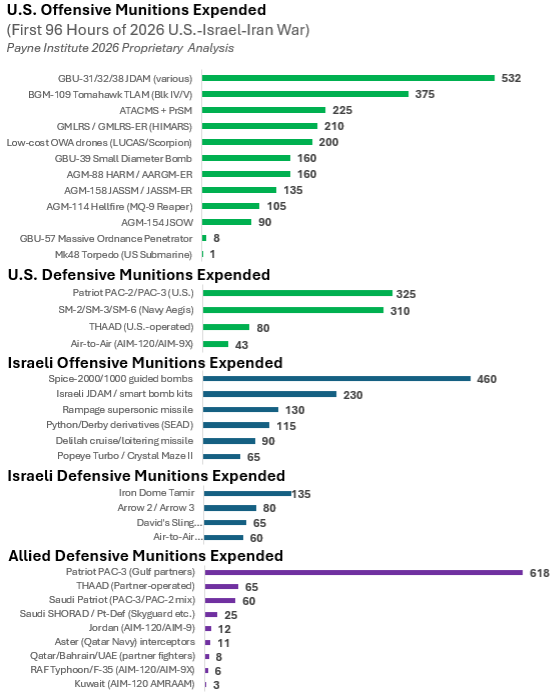
Figure 1: Payne Institute estimate of US, Israel, and allied expenditures in the first 96 hours.
Munition expenditure framing matters because the public debate has split into two camps: panic that America is “running out” or complacency that the West can simply buy its way out. Burn rates matter because it reveals an American industrial resilience gap, especially with the minerals and materials needed to create more munitions and weapon systems. Per our analysis, many high-volume weapons remain healthy. But the war is burning fastest through the categories that cannot be replaced quickly: air-defense interceptors, long-range strike munitions, and the enabling radar and command architecture that turns interceptor missiles into a broader defense network to protect airbases, ports, launchers, and other critical infrastructure. Degradation of the integrated air defense network means reduced fidelity and tracking of Iranian missiles and drones, meaning more “leakers” can sneak through defenses undetected and/or air defense sectors are forced to expend more missiles to increase the likelihood of a successful intercept. Days into the Iran conflict, the Trump administration was already pressing defense firms to quadruple surge output, especially for exquisite weapon systems.
Iran’s strategy is built on this very weakness. To be clear, the four-day burn rate is not the steady-state tempo of the conflict. After the initial phase, Iranian salvos fell sharply, with daily drone attacks down by approximately 83 percent and daily missile attacks down by 90 percent after day five. But that is precisely the point. The first 96 hours capture the peak stress test, revealing what happens when an adversary attempts to saturate defenses before suppression and attrition take hold. Figure 2 benchmarks this opening intensity, illustrating a deliberate Iranian strategy to overwhelm defenses by trading their cheaper, mass-produced munitions for the West’s expensive, finite interceptors. Iran’s approach is necessary because it knows it cannot prevent the coalition from achieving “air supremacy,” as noted by retired US Gen. David Petraeus.
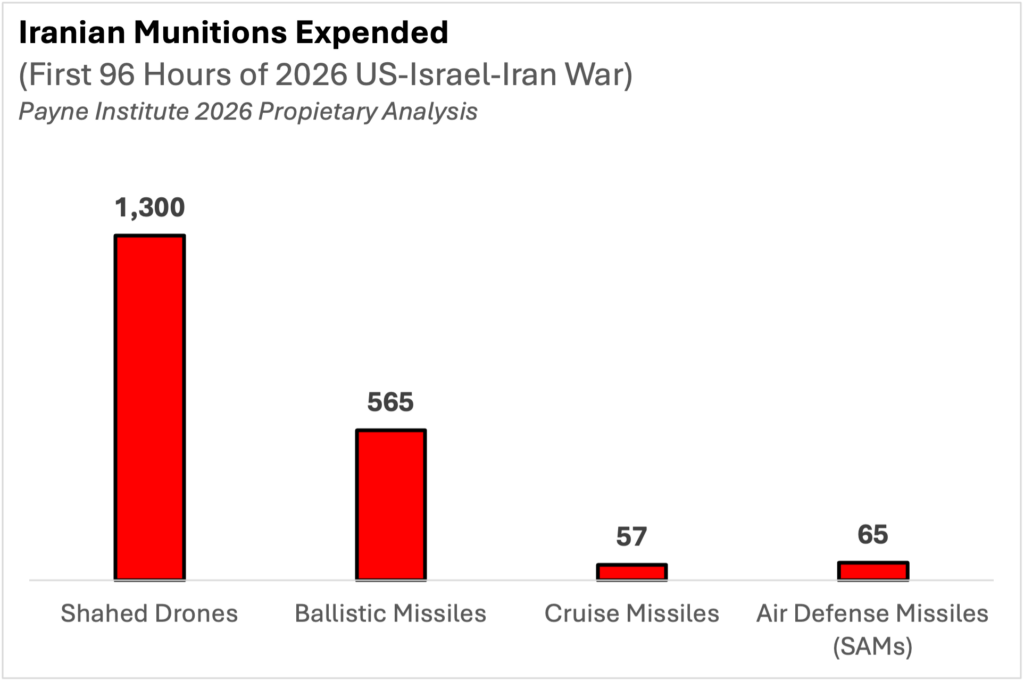
Figure 2: Payne Institute estimate of Iranian munitions used in the first 96 hours.
While access, stealth, and targeting remain critical, the limiting factor in a peer conflict is the ability to keep striking and keep defending after the initial salvos. Already two weeks into the war, the Pentagon is redeploying critical air defense assets from the Indo-Pacific to the Middle East. This shift in assets demonstrates that the American defense industrial base (DIB) cannot comfortably support a two-theater posture, highlighting a strategic dilemma in American warfighting.
“Command of the Reload” is fundamentally an industrial systems problem that undermines military readiness. Decades of institutional neglect have left the Western DIB optimized for peacetime efficiency, not wartime resilience. Even prior to the Iran War beginning, the United States was already pausing some arms sales to Europe. The ability to replenish magazines is not a switch that can be flipped with emergency appropriations or executive orders—it is a long chain that starts with access to minerals, energetics, and sub-tier suppliers and ends in certified production lines that do not surge on command. This industrial capacity is not “support” for deterrence—it is the foundation of it. And the ability to replenish becomes the strategic variable upon which everything else depends. The Iran war is a stark illustration that in a high-end fight, the arsenal you have at the start is nearly all you will have. This is because the limiting factor is not the ability to go on the offensive, but the capacity to reload and defend.
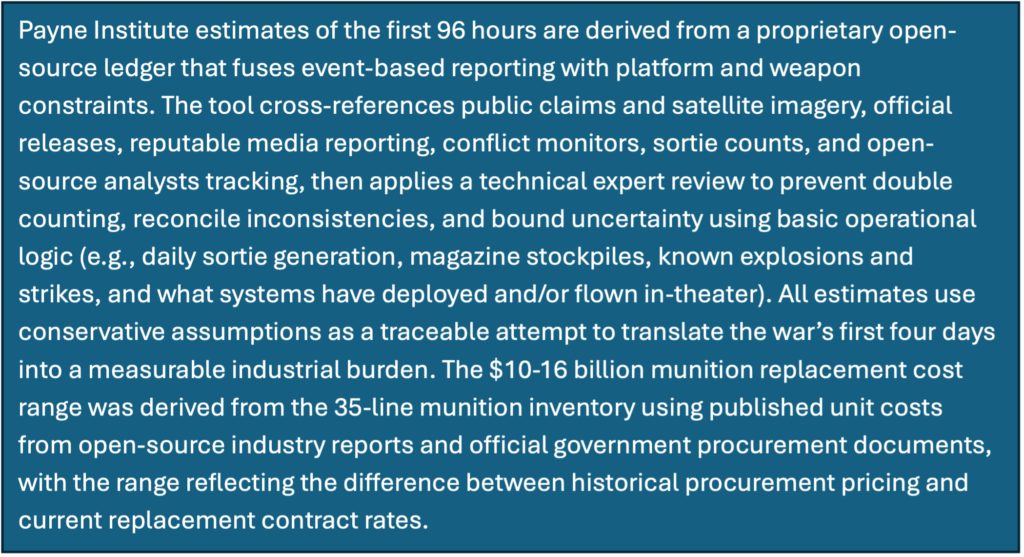
Methods Box 1. Description of Payne Institute methodology.
The Good, the Bad, and the Ugly of the Burn Rate
The headline of 5,197 munitions in 96 hours, now makes Epic Fury the most intensive opening air campaign in modern history, dwarfing the initial three days of the UN-approved “No Fly Zone” intervention in Libya, which saw approximately 735 bombs and missiles used, with about 20,000 munitions expended in total between March and October of 2011. The more important aspect of our Payne Institute analysis is the imbalance in depletion rates. The coalition is not running out of bombs. But it is running out of the high-end systems that enable low-risk, long-range strikes and the systems and munitions needed for regional defense. As Table 1 shows, these are not interchangeable assets.
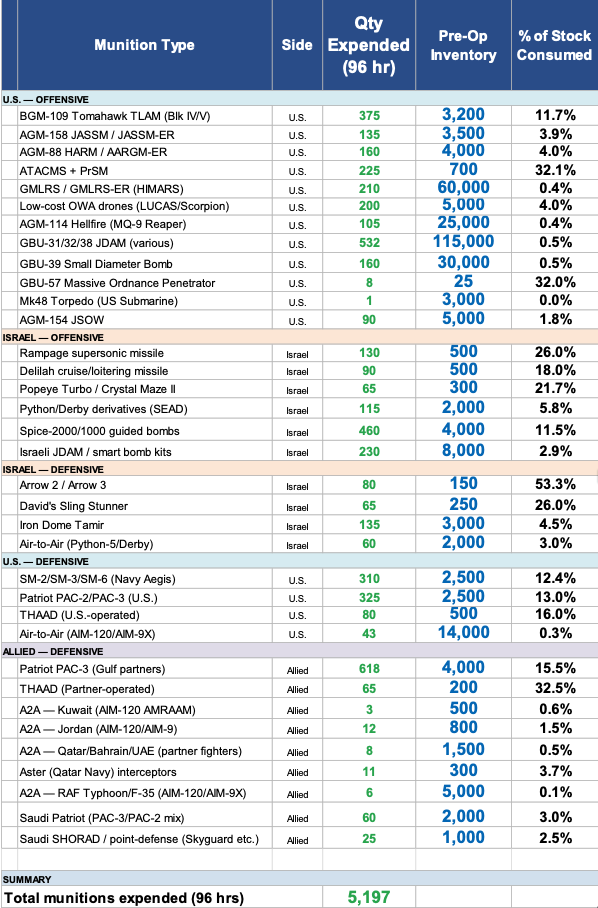
Table 1: Payne Institute tally of munition burn rate relative to known pre-war stockpiles.
Of the 35 munition types we tracked, 21 remain in a healthy condition, with deep inventories and mature production lines. But the war’s true bill is concentrated in the 14 systems now critically strained—they are disproportionately the systems that make modern air defense credible and long-range strike meaningful. Table 2 showcases assumptions of munition expenditures by the US-Israeli coalition. The “ops-to-depletion” metric divides the pre-war inventory of a given system by the quantity expended in the first 96 hours. This “ops-to-depletion” model assumes that if the coalition were to maintain that same level of intensity, it illustrates how many more days the coalition could fight in that way. The metric answers a simple, brutal question: How many more times can the coalition fight and withstand a high-end opening salvo with the arsenal it has right now?
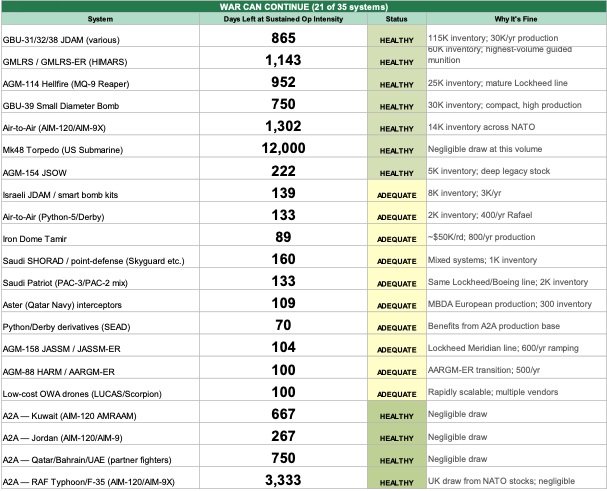
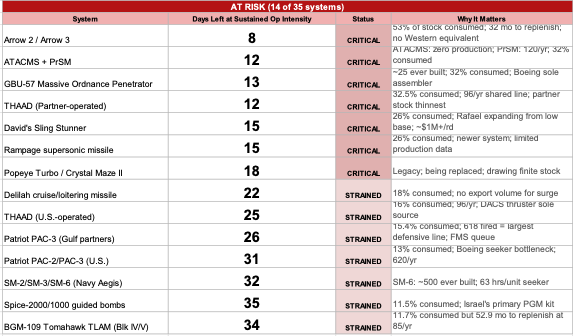
Table 2: Payne Institute analysis of Healthy and Critical munition burn rates.
Consider some of the specifics. Israel’s Arrow interceptor inventory was cut by over half in four days—at current production rates, replacing that expenditure would take an estimated 32 months. US stockpiles of ground-launched ATACMS and the new PrSM ballistic missiles were depleted by a third, with the legacy ATACMS production line now cold. Partner-nation THAAD interceptors, the thinnest-stocked assets, were depleted by over a third. Eight GBU-57 Massive Ordnance Penetrators were used—almost a quarter of the remaining stockpile, which is deliverable only by the 20-aircraft B-2 Spirit fleet. Replenishing just the GBU-57s via Boeing is not expected before 2028.
This is the distinction that public commentary misses. Analysts see ongoing strikes and conclude that stockpile concerns are overblown. This is the wrong inference. The coalition can keep striking because mass is plentiful in the visible parts of the kill chain: the bombs. The strategic constraint sits in the invisible parts: the interceptors that keep bases alive, the long-range weapons that hold enemy launchers at risk, and the sensor architecture that makes missile defense efficient and functional. Plainly speaking, “healthy” munitions let you keep fighting the war you are in. “Critical” munitions decide if you can sustain a high-ops tempo war or afford to fight the next one. This is why the Iran war must be viewed as a stress test for the DIB. Iran is creating a strategic illusion where the tactical bombing campaign continues, but America’s readiness for a larger, second-theater contingency quietly bleeds out with every high-end munition fired. It also gives Chinese leaders a reason to do the “missile math” when it comes to considering how their military might fare in a conflict over Taiwan.
Command of the Reload: The Industrial Limits of American Airpower
Understanding how Operation Epic Fury changes deterrence requires looking beyond the healthy-versus-critical distinction and examining the industrial constraints that govern how fast the coalition can actually reload. Referring back to Table 1 shows the initial constraints of the war, in terms of how much the US-Israeli coalition expended—and what pre-war inventories existed. The days until “ops-to-depletion” (refer back to Table 2), provides a window into how the initial 4-day salvo might have to change for the US-Israeli coalition based on the inability to sustain certain munition expenditure rates. For example, if Israel were to fire Arrow interceptor missiles at the same rate that they did in the first four days of the war, they would only have 8 days remining, meaning they would run out of them around 12 March 2026. Similarly, if Gulf partners were to maintain a constant THAAD expenditure rate, their stocks would be completely depleted within 12 days (or by 16 March 2026). Fortunately, our Payne Institute initial assessment of expenditures after day 4 indicates a much lower intensity of munition usage by the whole coalition.
Understanding how long a military can maintain munition intensity answers a simple, brutal question: How many more times can the coalition fight and withstand a high-end opening salvo with the arsenal it has right now? It also forces the coalition to accept more risk going forward because they no longer have the luxury to expend as many munitions against incoming missile and drone salvos, because they know additional salvos will happen again. Worse, Iranian aerodynamic maneuverable vehicles (AMVs), launched from ballistic missiles, are even more difficult to intercept due to their ability to change course and further complicate interceptor math.
The defensive interceptor arithmetic is the most dangerous finding. Gulf partner and US Patriot batteries combined fired 943 rounds in 96 hours, consuming 18 months of production from a single shared Lockheed Martin/Boeing production line currently running at 620 interceptors per year. Even with Poland’s WZL-1 facility now contributing PAC-3 MSE launch tubes to the global supply chain, the binding constraint remains the Boeing seeker assembly, which limits final production regardless of how many other components are available. The Tomahawk, at 34 days to depletion (assuming high-ops tempo consumption), appears more comfortable until the replenishment timeline is considered: at 85 units per year, replacing an operation expenditure of 375 missiles in 96 hours takes 53 months to regenerate. The Williams International F107 turbofan engine, sole-source for Tomahawk, JASSM, JASSM-ER, and LRASM, is the production bottleneck that no amount of funding can immediately widen.
These numbers also reveal a structural asymmetry in the coalition’s burden-sharing that both draw from the same Lockheed Martin production line for Patriot missiles. Gulf partners fired nearly double the number of Patriot interceptors as US forces, absorbing the heaviest defensive burden. Yet, under the Foreign Military Sales (FMS) process, their replenishment orders sit behind US priorities in the production queue, adding an estimated six to 12 months to their reload timelines. In this system, the allies who bleed the most munitions are the last to be resupplied. This industrial reality has profound implications for alliance credibility and the true foundation of American security guarantees. Compounding matters, there is a scarcity of specialized welders, technicians, and engineers required to operate and expand munition production lines. Decades of a shrinking DIB means a shrinking, aging workforce that cannot be surged by presidential degree, adding another critical layer to the “Command of the Reload” problem.
The reallocation of finite assets, such as air defense systems and missiles from the Indo-Pacific, is the first payment of a “second-theater tax,” where sustaining one conflict directly degrades deterrence in another.
The Mineral Bill Comes Due
Policymakers consistently overlook a fundamental reality of modern war: You do not replenish missiles solely with money. They are replenished via chemistry, machine time, and processed inputs, each with their own chokepoints. Moreover, the mineral bill determines whether the United States and allies can spend the same amount to replace the same amount of munitions. Unfortunately, as shown by US Navy’s 2023–2024 operations in the Red Sea, just because you expend $1 billion in munitions, that does not mean replacement costs are the same. In fact, Former Navy Secretary Carlos Del Toro testified that his service would need more than $2 billion to replace the $1 billion in Red Sea missile expenditures. This implication means that it could take up to $32 billion for the coalition to replenish $16 billion worth of munitions used in 4 days.
Raw materials account for a small fraction of the unit cost of a finished munition, usually no more than 3 percent. A $4.5 million Patriot PAC-3 MSE interceptor contains roughly $5,000 to $15,000 worth of raw minerals at current spot prices. But the dollar value of the minerals is not the point. The constraint is availability. Congress can appropriate $16 billion overnight. It cannot appropriate gallium, neodymium, or ammonium perchlorate into existence. The gap between what the war costs and what the industrial base can deliver is why this is so urgent for the entire Western DIB. This is because it is a chemistry and geology problem. Then add in the supply chain control problem due to China controlling and restricting many of the mineral and material inputs, and now it does not matter if the Western DIB has a “blank check” because there are no minerals that Chinese firms are willing to sell to American and allied defense firms.
Table 3 translates the first 96 hours of combat into this industrial reality, showing the aggregate mineral burden required to replace the expended munitions. The numbers that appear small by weight are the most strategically consequential given the current American annual consumption and import rates per the 2026 US Geological Survey of mineral commodities. China controls 98 percent of global gallium production (banning exports to the United States in December 2024), 90 percent of neodymium processing, and 99 percent of dysprosium. These rare earths and specialty metals are inside every seeker head, guidance system, and radar module in the coalition’s inventory. They cannot be substituted at scale, and alternative supply chains are years away from delivering meaningful volume.


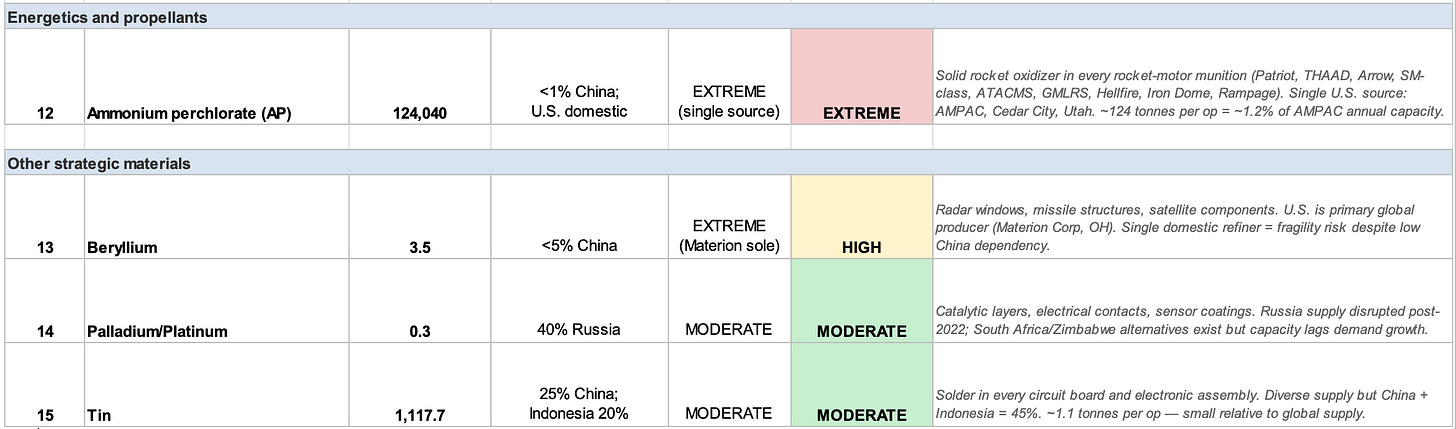
Table 3: Payne Institute estimate for munition mineral replacement burden and exposure.
Replacing the 5,197 munitions expended in 96 hours requires approximately 92 tons of copper, 137 kilograms of neodymium, 18 kilograms of gallium, 37 kilograms of tantalum, 7 kilograms of dysprosium, and 600 tons of ammonium perchlorate. The rare earths and specialty metals look small by weight, but are becoming increasingly difficult to secure in quantities due to Chinese export controls, commercial data center and AI demands, and/or limited producers.
Ammonium perchlorate is the biggest vulnerability. It is the solid rocket oxidizer present in every missile with a solid motor, from Patriot to THAAD to Arrow to ATACMS. The 600 tons required to reload one 96-hour operation represents 6.7 percent of the entire annual production capacity of AMPAC’s facility in Cedar City, Utah, the single domestic source. There is no second supplier. A disruption at that one facility would halt all solid rocket motor production in the United States simultaneously.
The mineral constraint is not the only upstream bottleneck. The high explosives that fill warheads, RDX and HMX, flow through a single facility built during World War II: the Holston Army Ammunition Plant in Kingsport, Tennessee, operated by BAE Systems. There is no second domestic source. A prolonged disruption there would ripple across every missile, torpedo, and precision-guided munition program in the US inventory. This becomes even more troubling given that, as of 12 March 2026, the Holston Army Ammunition Plant has not received any orders to increase production despite the Iran War.
The turbofan engines that power most US cruise missiles come from a single manufacturer: Williams International in Pontiac, Michigan. The Iran war shows that there is more than one DIB chokepoint. There are a series of DIB chokepoints in sequence, each capable of halting production independently. Even when the funding is available, even when the prime contractor is ready, a missing seeker material, an overloaded energetics plant, or a sole-source engine maker can stop the line.
The sensor layer is where the mineral constraint bites hardest. The radars destroyed by Iran are orders of magnitude more mineral-intensive than the munitions they were designed to direct. A single AN/FPS-132 radar contains approximately 75 kilograms of gallium in its phased-array transmit/receive modules, more than four times the gallium needed to replace all 5,197 munitions fired in the first four days of the operation. The two confirmed AN/TPY-2 losses add up to another 50 kilograms of gallium demand. Replacing the sensor losses requires more of the most constrained mineral on earth than replacing the entire munitions expenditure does, and the production timelines for these systems are measured in years, not months.
In essence, replacing 125 kg of gallium is not a simple procurement issue, as it should cost at most $100,000 to procure. However, acquiring it is a strategic challenge that exposes the brittleness of the entire US defense electronics supply chain. The Pentagon would be forced to either cannibalize production from other vital defense programs or circumnavigate a global market where the dominant supplier is a strategic adversary actively using its resource control of this rare earth and other minerals as a tool of statecraft for leverage against the United States and its allies.
This is the distinction that makes the mineral bill more than an accounting problem. Thus, the procurement bottleneck becomes time, not money. Unfortunately, right now, for the materials that matter most, two weeks of war show critical vulnerabilities that could take up to a decade or longer to resolve.
The Second-Theater Tax: The Bill for Victory is Paid in Minerals and Manufacturing
Munition usage thus far has demonstrated formidable US-led firepower, but it is now becoming a sobering audit of Western defense industrial base (DIB) endurance. The expenditure of over 5,000 munitions in the first four days has revealed a new problem of waging modern warfare: the decisive factor is less about the ability to strike, but the DIB capacity to reload. This new paradigm is “Command of the Reload”—and it will be an influential factor in 21st-century great-power competition.
As this analysis has shown, a substantial number of munitions were used, but there was also an alarming depletion rate of the most critical and least replaceable assets. The coalition can keep bombing Iran for years at this rate, but it will risk running out of high-end interceptors, long-range missiles, and sophisticated sensors that protects assets and infrastructure, while enabling decisive military advantages. This vulnerability is a structural crisis rooted in decades of prioritizing peacetime efficiency over wartime resilience. The chokepoints are clear and layered: single-source producers for essential rocket motors and explosives, constrained production lines for critical components, and, most fundamentally, a perilous dependency on a critical mineral supply chain dominated by China.
Resolving all of these DIB issues in the short term is nearly impossible. This is because it requires the United States to have already invested in strategic mineral stockpiles, qualified second-source suppliers for critical components, and the skilled industrial workforce.
Ultimately, the Iran campaign levies a steep “second-theater tax,” consuming the very assets needed to deter conflict in the Indo-Pacific and eroding the credibility of US security guarantees worldwide. The lesson is stark: An arsenal that cannot be replenished is a wasting asset. For policymakers, the key takeaway should be that military supremacy cannot be maintained on a brittle industrial base. “Command of the Reload” is the foundation of deterrence, and the bill for neglecting it is now coming due.