 A Nation Must Think Before it Acts
Hungarian Elections: Ramifications for Central Europe
A Nation Must Think Before it Acts
Hungarian Elections: Ramifications for Central Europe

A nation must think before it acts.

Hungarian Elections: Ramifications for Central Europe
As the dust settles and the euphoria ebbs on the historic mid-April 2026 elections in Hungary, the consequences of Tisza’s resounding victory over Victor Orban’s Fidesz party will start to manifest to the north of Budapest, specifically in Poland, the Czech Republic, and Slovakia, the three other members of the Visegrád Four. While Peter Magyar will undoubtedly reorient his country’s foreign policy with respect to Ukraine, Russia, the North Atlantic Treaty Organization (NATO), and the European Union (EU), Budapest’s relations with Warsaw, Prague, and Bratislava will also evolve, in the process changing the geopolitical dynamic at the center of the continent.
Warsaw Calling
The most consequential change within the Visegrád group is likely to be the expected rapprochement between Budapest and Warsaw. The two countries have been at odds politically over the past several years due to fundamental disagreements over the Ukraine/Russia war, with Poland—viewing Moscow’s aggression as a potentially existential threat—openly criticizing Orban’s unambiguous pro-Moscow stance. Poland’s frustrations with Hungary over the war were highlighted succinctly in February of 2024 when the Polish Prime Minister, Donald Tusk, stated publicly at an EU meeting that “there’s no problem with Ukraine fatigue… we have Orban fatigue here in Brussels.”
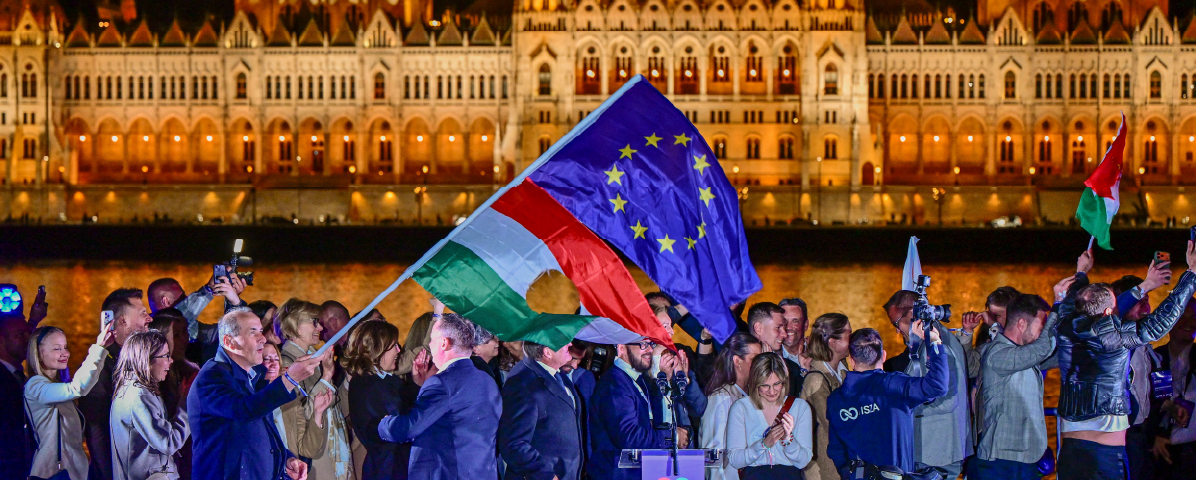
Magyar made it clear in his April 12 victory speech on the west bank of the Danube in Budapest that his first foreign trip would be to Poland. He explained his decision to the rapturous crowd thusly; “We will rebuild, build on strong foundations, and expand cooperation within the Visegrád Group. That is why my first stop is Warsaw.”
Accomplishing those goals will take time and effort, however, as substantive Warsaw-Budapest ties have been essentially frozen since Tusk’s return to power in Poland in late 2023. Magyar and his Polish counterpart, however, share an opportunity to renew historically strong ties between the two countries, based on common views regarding the threats emanating from the east, respect for the rule of law, mutually beneficial relations with the European Union, and the centrality of NATO to their countries’ respective national security posture. Moreover, the sweeping political changes in Budapest provide Warsaw with a likely ally in Central Europe to counter the recalcitrant populism still alive and well in the lands of the former Czechoslovakia.
Prague Prevaricating
Given the results of the Hungarian elections, new Czech Prime Minister Andrej Babiš finds himself in a bit of a political pickle. Immediately before the polls in Hungary, the Czech leader publicly gave his support to Orban and the Fidesz party, praising the Hungarian leader on April 11 for “always defending Hungarian citizens and the country’s national interests.” This was not surprising as Orban’s “in your face” disputes with the European Union have provided convenient cover for the new Czech regime’s growing backpedaling on EU and NATO commitments. With Orban’s political demise, Babiš and his ANO (“action of dissatisfied citizens” in Czech, and also means “yes”) movement will face difficult choices on Prague’s relations with Budapest, Brussels, and their populist besties in Bratislava.
The upcoming policy challenges could create more friction within the nascent coalition as the Czech premier—the quintessential political chameleon, decides whether to swing back to the center on critical issues related to NATO and the European Union, among them increased defense spending, more tangible support to Kyiv, and respect for European standards on freedom of the press and an independent cultural sphere. Should Babiš go this route in response to the Hungarian populist electoral debacle, he risks alienating his two junior coalition partners, both of which represent the radical, far-right wing of the current Czech government.
In the short term, the Babiš team seems quietly resigned to losing its political lodestar in the center of the continent. In the immediate aftermath of the plebiscite, leaders in Prague weighed in with the prime minister sending perfunctory congratulations to Magyar while Czech Foreign Minister Petr Macinka lamented the loss of “an ally in the EU.” Meanwhile, Czech President Petr Pavel, no friend of the Babiš regime, celebrated the results as a “victory for democracy.” The diverse reactions in Prague to Orban’s electoral drubbing accurately reflect the polarized nature of Czech society. Only time will tell what lessons the new Czech coalition will take from Tisza’s landslide and what effect it will have on Prague’s relations with Brussels and the other members of the Visegrád Four.
Sweating Bullets in Bratislava
The leader that stands to suffer the most from the Tisza wave in Hungary, besides Orban himself, is Slovak Prime Minister Robert Fico. The pugnacious pugilist of Bratislava, since returning to power in late 2023, has been the Central European strongman most closely aligned with Orban’s pro-Moscow, anti-Brussels policies. The loss of his Hungarian mentor potentially leaves Fico as an army of one in ongoing battles with the European Union. How alone he becomes depends on what the Babiš coalition decides to do in the aftermath of the consequential Hungarian elections. Nevertheless, at least with respect to latent regional animosity towards Kyiv, Fico will likely be flying solo.
To put it bluntly, the Slovak leader faces an elementary fork in the road with Orban’s defeat. As Central European analyst Radovan Geist opined in the April 12 edition of the Slovak daily Sme, “Fico will no longer be able to hide behind Orban and his behavior. It will now become clear what Fico seriously thinks about relations with the EU.” One option for the Slovak leader, therefore, is to moderate his belligerence towards Brussels, understanding that regardless of Moscow’s tacit support for his troublemaking, fighting the powers of “old Europe” alone likely translates to a losing battle.
Conversely, he could choose to dig in his heels in his seemingly open-ended strife with Brussels on relations with Kyiv, rule of law issues, and democratic backsliding. Just recently, Bratislava raised the ire of the EU bureaucracy by implementing—in response to the Iran war energy crisis—a tiered fuel-pricing system that charges foreign-plated vehicles a considerably higher price. Without strength in numbers (the Czechs possibly, who Fico has recently been courting), however, this policy avenue does not offer much hope of positive results. Furthermore, it can’t be lost on Fico and his coalition partners that Orban’s long-running battles with Brussels and perceived fealty to Moscow contributed to a historic thrashing at the polls.
Political Change the Constant in Central Europe
The winds of political change that swept across the Danubian plain on April 12 represent the latest U-turn in governance over the past several years in the wider Central European region. In Poland, Tusk’s centrist, pro-European Civic Coalition replaced the right-wing, Eurosceptic Law and Justice (PiS) party in 2023. The Polish right regained the momentum in the summer of 2025 with the election of Karol Nawrocki, a PiS-supported candidate who’s since done his utmost to block much of the centrist government’s agenda.
In the Czech Republic, in 2021 a centrist coalition led by Petr Fiala replaced Babiš and his ANO movement, setting the stage for Prague becoming one of Ukraine’s most ardent supporters following the outbreak of war in 2022. The Czechs cemented their pro-European leanings in 2023 by electing Pavel, a former Army chief and senior NATO official, as president. The tables turned again in late 2025, however, as Babiš and a new band of grumpy Czech populists returned to power, leaving the country deeply divided between a pro-western president and a “Make Czechia Great Again” coalition government.
Slovakia has experienced some of the same, seeing a previous Fico-led government collapse in 2018 due to a political crisis only to then, five years later, return the petulant populist back to power. One can assume that the main Slovak opposition party, Progressive Slovakia, has taken copious notes from the Tisza campaign playbook in preparation for their expected attempt to de-Fico Slovakia in that country’s next parliamentary polls.
Accordingly, if recent history offers a glimpse into the future, political upheaval across the Visegrád group is likely to continue, with general elections scheduled for late 2027 in both Slovakia and Poland. How those polls play out will go a long way in determining if Hungary’s overwhelming repudiation of Orban’s illiberal democracy model of governance is a one-off or the beginning of a region-wide turn against populism’s staying power in these troubled lands.
Image credit: The European Union and revolutionary national flags fly after a speech by Peter Magyar, leader of the opposition Tisza party, following the partial results of the parliamentary election, in Budapest, Hungary, April 12, 2026. REUTERS/Marton Monus