 A Nation Must Think Before it Acts
Moscow Considers Deploying Nuclear Weapons in Space

A nation must think before it acts.

Moscow Considers Deploying Nuclear Weapons in Space
Introduction
A joint investigation by Süddeutsche Zeitung (SZ), WDR, and NDR reported that Western intelligence services agree that Russia may deploy a satellite equipped with a nuclear warhead into space later this year (WDR). According to reporting by David Ignatius, which has now been corroborated by the German investigation, the weapon is called Sputnik-S. Sputnik-S is believed to be an operational variant of the Kosmos-2553, which was previously intended to test the effects of radiation on satellites (SZ).
The German investigation suggests an operational Sputnik-S satellite has been designed, built, and stored near Moscow for several years. The Russian embassy in Berlin categorically rejected this claim, responding that it was “part of a propaganda campaign” and that Russian activities in space were for “exclusively peaceful purposes.” In 2024, the US Defense Intelligence Agency publicly assessed that Russia was developing a satellite designed to carry a nuclear weapon, but the assertion of imminent deployment is novel. The German-language reporting was picked up by Reuters and other US outlets but with little information beyond what was contained in the German pieces.
In September of this year, FPRI’s Eurasia Program and Initiative for Deterrence and Arms Control convened a wargame built around a strikingly similar scenario: credible indications that Moscow had placed nuclear weapons in orbit, accompanied by threats against Western commercial satellite networks. The aim of FPRI’s game was not to forecast, but rather to understand how the United States, NATO, and commercial actors might respond to a novel form of Russian coercion in space under conditions of uncertainty. Our most troubling finding was that a crisis in this domain could spiral into conventional war even before any nuclear weapons detonated in space. Our findings were consistent with previous FPRI reports on Russian thinking about escalation and coercion in space.
If the reporting accurately captures the underlying intelligence, America and its European allies have been unsuccessful in deterring Russia from building Sputnik-S. This shifts the priority to deterring the launch of Sputnik-S. Given the consequences of Russia placing a nuclear weapon in orbit, US and allied efforts should be focused on deterring the Russians from doing so, exploring ways to reinforce the Outer Space Treaty, and weakening Russian leverage by increasing Western resilience in space.
The Risk of Nuclear Detonation in Space
The reporting is somewhat ambiguous on whether Russia intends to launch Sputnik-S later this year or is merely capable of doing so. While launch timing is heavily dependent on launch vehicle and facility availability, Russia would benefit from launching during the tenure of the Trump administration. Given his personal relationship with Vladimir Putin, President Donald Trump in particular may be less likely than other US leaders to respond aggressively to a Sputnik-S launch. US allies, including Germany, however are already taking a strong position. A spokesperson from German Cyber and Information Space Command suggested they would attempt to use electronic warfare to block signals going to the satellite or disable it using “offensive cyber means” (offensiven Cybermitteln).
All the reports agree a Sputnik-S satellite has been “fully designed and stored in the greater Moscow area for several years.” If correct, that reporting might imply there were debates or concerns within Russian leadership about whether to deploy the weapon. Alternatively, it might suggest that the plan was to launch Sputnik-S during a crisis.
A nuclear weapon in space is non-discriminatory; it would threaten satellites regardless of who launched, owns, or operates them. There are two ways a weapon like Sputnik-S would destroy or degrade satellites, including commercial constellations. First is through prompt radiation; X-rays released by the nuclear blast. Those would damage satellites within line of sight of the space-based nuclear weapon. Depending on where the weapon is detonated, the prompt effects would be bad but limited. While estimates vary, they suggest the prompt X-rays would destroy or incapacitate 2–5 percent of satellites in a low-earth orbit constellation like Starlink. Other orbital regimes would be somewhat protected by the vast distances involved.
The second, more worrisome, kill mechanism comes from electrons released by the fission products of the nuclear explosion. Those electrons become trapped in the Earth’s magnetic fields in bands known as Van Allen belts, exposing orbiting satellites to repeated doses of damaging radiation. This phenomenon was first observed in the United States in the 1960s. After the 1962 Starfish Prime high-altitude nuclear test, radiation trapped in the magnetic belts killed roughly one third of the satellites in orbit at the time, including Telstar 1, the first commercial communications relay satellite. The consequences of “pumping” the Van Allen belts with radiation would be extreme. A recent paper by researchers at Princeton and the University of Wisconsin-Madison demonstrated that a one-megaton explosion over the south Atlantic would disable 98 percent of satellites in low-earth orbit (LEO) within one week. As more satellites were rendered non-functional by radiation, collisions would increase, casting debris across some of the most desirable orbits.
Given the majority of commercial satellites are in low-earth orbit, such a detonation would be catastrophic for the commercial space industry. Many commercial assets on orbit would be immediately destroyed, and large swaths of LEO would be denied by radiation or debris for some time. This is likely the point. Moscow regards Starlink, a commercial satellite internet and mobile communications service operated by SpaceX, as a dual-use system with specific military applications. Given Ukraine’s success in applying Starlink and other Western satellite constellations against Russian targets in Ukraine, as well as their increasing use by NATO militaries, Moscow has sought means to fight back. Disabling Starlink is very difficult given its large number of satellites and SpaceX’s ability to reconstitute them using mass production and high launch cadence. The ability therefore to destroy satellites en masse and deny future use of orbit is one that would benefit Moscow in its conflict with Ukraine and beyond. The Russians have other, less dramatic and escalatory means available to target and degrade commercial assets supporting Ukraine including co-orbital anti-satellite weapons, as demonstrated by the Kosmos-2612–ICEYE-X36 incident last month. These capabilities can be seen as complementary, providing Russia with different options to target space assets at different levels of escalation.
What FPRI’s Research Says
In FPRI’s wargame, the team playing Russia (Red) initially used the uncertainty around its orbital capabilities to pressure Europe (Green) and the United States (Blue). Ambiguity around the weapon’s readiness and intended use gave the Red team a means of imposing costs and creating political divisions without crossing the threshold of nuclear deployment. Our game also demonstrated how technical uncertainty affected political decision-making. During the crisis simulation, participants debated assessments about potential damage to commercial satellites and acknowledged the potential consequences of radiation belts. Variance in assumptions influenced the urgency assigned to the threat and potential responses.
One of the most consequential outcomes of our wargame occurred not in orbit but on NATO territory. As the scenario developed the Red team interpreted allied responses and changes in American posture as preparation of a possible coordinated attack. While in our simulation no orbital nuclear detonation ultimately occurred, a crisis in space became a conventional nuclear confrontation with a NATO member state. The Red team’s efforts to preserve flexibility through ambiguity made communication more difficult just as the horizon for diplomacy collapsed. While our game does not aim to predict Moscow’s or NATO’s behavior in a real crisis, it does demonstrate a plausible mechanism by which different assumptions, intelligence, uncertainty, and misperception can become mutually enforced.
NATO’s Deterrence Problem
Our exercise revealed the difficulty of forging a common response to a novel threat. Players on the Blue team adopted aggressive countermeasures, while players on the Green team prioritized de-escalation. These differences reflect different strategic vulnerabilities and threat perceptions within the NATO alliance. For European allies, the immediate danger was that any attempt to neutralize Russia’s space threat might provoke Russian military action on NATO territory. The Red team treated Washington as its only meaningful interlocutor, discounting Blue efforts to signal restraint.
NATO’s existing space policy contributed to this misalignment of interests. NATO has previously stated that an attack to, from, or within space would trigger Article 5, with decisions taken on a case-by-case basis. But there is significant ambiguity around what constitutes an attack when the targets are commercially owned satellites serving both civilians and militaries.
Preparing for Crisis Before Launch
There is a serious need for capabilities to verify Article IV of the Outer Space Treaty. These capabilities could be employed on the ground during pre-launch inspections, or on-orbit using a variety of active and passive measures. There is space for commercial operators and civil society to aid in verification measures. Commercial operators can help pioneer norms around pre-launch inspection protocols. Similarly, unclassified or commercial orbital verification would help adjudicate potential treaty violations in a transparent manner.
Beyond essential verification tools, FPRI’s research findings indicate that regardless of current deployment status, Western allies should first focus on achieving three goals. The first priority should be achieving political consensus on responses to the Russian threat. NATO should have a shared assessment of what would constitute unacceptable Russian behavior, and agreement on the objectives of an allied response: deterring launch, deterring detonation, sustaining commercial services, or preventing a wider conflict. These objectives are obviously related but not interchangeable. Our wargame demonstrated the cost of leaving these questions unresolved once a crisis was already underway.
Second, allies need joint procedures for assessing intelligence and coordinating military signals across domains. Preparations intended to reassure vulnerable allies or commercial operators could also be interpreted as preparations for attack. Intelligence about imminent threats, especially in a new domain, should be verified and backchannels should remain open even when public posturing hardens.
Finally, allies should boost commercial space resilience. NATO should plan with commercial operators for degraded satellite services, reconstitution, and on the ground alternatives. A more vibrant international commercial space launch sector would go a long way to addressing some of these concerns. This will require an open channel of communication between commercial space operators, national security actors and militaries. Greater resilience of commercial space operators will weaken Russia’s leverage and threats. Just as critical infrastructure operators on land and at sea are increasingly regarded as integral parts of wider societal resilience, so should commercial operators in space.
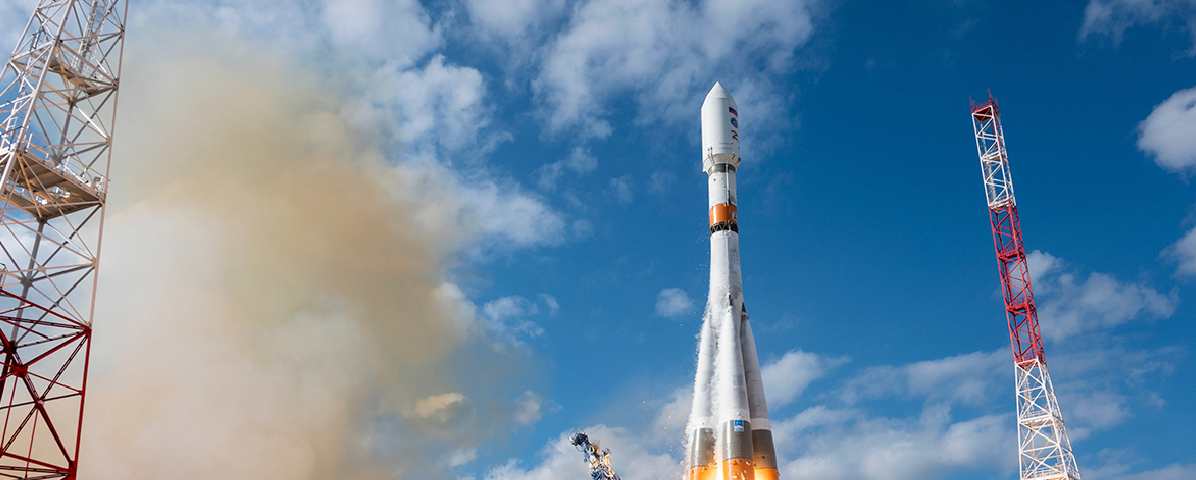
Image: A Soyuz‑2.1b rocket launches carrying a GLONASS-K2 satellite to orbit (mil.ru)