 A Nation Must Think Before it Acts
In Conversation with Anna Fotyga | Poland’s Path From Solidarity to NATO Accession and Beyond
A Nation Must Think Before it Acts
In Conversation with Anna Fotyga | Poland’s Path From Solidarity to NATO Accession and Beyond

A nation must think before it acts.
In Conversation with Anna Fotyga | Poland’s Path From Solidarity to NATO Accession and Beyond
 The following conversation was recorded on October 17, 2025, and has been edited for clarity. You can listen to the conversation here.
Natalia Kopytnik: It’s an honor to welcome Ms. Anna Fotyga to the podcast today. Ms. Fotyga has a long and distinguished career in government service, most notably as Poland’s Foreign Minister and Chair of the Chancellery under the late President Lech Kaczyński. She also served as the deputy mayor of Gdańsk, as well as terms in the Polish Sejm and the European Parliament, where she chaired the Security and Defense Subcommittee.
In 2020, she was appointed by then-Secretary General Jens Stoltenberg as part of NATO’s Reflection Group, a working group of ten high-level experts that worked to create recommendations aimed at strengthening NATO’s political role over the next decade.
Ms. Fotyga, thank you so much for taking the time today and joining us on The Ties That Bind.
Anna Fotyga: Thank you. My pleasure.
NK: I’d like to rewind the clock a little bit because you really got to see the evolution of Poland’s path towards NATO and towards the European Union in the last days of the Cold War. You were part of Solidarność, the Solidarity Union, which was a linchpin in facilitating the end of the Cold War. And you also served, as I understand, as the head of Solidarity’s foreign department in the 1980s.
Could you maybe tell us a little bit about how you got involved with Solidarność to begin with, what your role there entailed, and how this experience really shaped your career over the next decades?
AF: Well, since early childhood, probably because of family discussions and my involvement in literature, I’ve always been a fan of reading, especially history books. I was always opposed to communist rule in Poland. In my early school days, I was a devout scout, and I was lucky because in some places, like my hometown of Gdańsk, clubs and organizations were rather traditional. They were led by people who were really in love with Poland’s heroic achievements in history.
So immediately after the strikes, I got involved in volunteering in Solidarność because at that time I was a student of Gdańsk University. I was first a volunteer, but immediately after completing my studies in April of 1981, I became a full-time employee of the Foreign Department of Solidarność.
And I would say that throughout my career, it was one of my most beloved times of my work, my love, and my life. Even now, being a retired politician, I still try to help all those who fight for freedom. I’m involved in helping nations that try to build their independence and a sovereign life.
I had long-standing links to Crimean Tatars and to the independent Chechen movement. I still support nations like Georgia, and of course, Ukraine. Ukraine, that’s first and foremost, because it is the most important factor in our region and also globally. I deeply believe with my whole history, my whole experience, that the result of this war will shape the future world order. And in my region broadly, in Central and Eastern Europe and our Eastern neighborhood, it will define the future of millions for centuries.
NK: You said defining the future for millions, and I think that moment in time in the 1980s, 1989, went on to define the future not only for Poland, but for all former Warsaw Pact countries. And obviously we still see the countries fighting for that chance to be a part of these institutions.
You became the foreign minister in 2006, arguably also a very formative time for Polish foreign policy and security. Poland joined NATO in 1999, later the European Union in 2004, and it was such a period of transition, that whole decade.
Could you tell us a little bit about Poland within the NATO context during that first decade of the 2000s and how you were thinking about Poland and its goals and its role in the Alliance during this time, and perhaps how you would assess its evolution in this context over almost three decades now?
AF: Many people I used to work with include first and foremost my friend, my boss, the late president of Poland, Lech Kaczyński, who was also known as a prominent person of Poland’s anti-communist opposition—we were absolutely aware since the very beginning of our political life of ongoing threats from first, the Soviet Union, and later the Russian Federation.
These threats were not so visible, after the changes happening in Central and Eastern Europe and then the reunification of Germany, because at that time, the earlier the Soviet Union, then later the Russian Federation, were considerably militarily and politically weaker, I would say, but still playing an important role because of possession of a nuclear arsenal.
But also because of the changes, its position was different. The Chechen wars, what happened to Georgia in the early 1990s, there were many signals of the ongoing neo-imperial posture of the Russian Federation.
Actually, all my public life I used to warn the international community, the collective West, about these threats. And actually, it is tragic that we did not adopt a very firm attitude vis-à-vis these threats much earlier. I think that the war waged by Russia on Georgia in 2008 and the annexation of quite a large part of Georgian territory showed clear creeping borderization happening all the time. I think that in terms of Georgia, the collective West made many mistakes.
Georgian society was trying to move towards the West, trying to have as much in common with Western culture and institutions as possible. Actually, Georgians were always present in Poland’s history, and in very brave moments.
So I was seeing all the difficulties within the West, all the mistakes, and really, sometimes purely economic interests prevailing over hard security interests and constraints.
But I still feel it is extremely important to maintain unity. Unity is very fragile. I saw this during all my time in Western institutions, predominantly within the EU, when I accompanied the President or Prime Minister to European summits and NATO summits, including the famous Bucharest summit.
Despite our enormous efforts, my personal efforts as well, we—those people who were so engaged in the security of my region—failed. I think that the hesitation to give a Membership Action Plan (MAP) to Georgia and Ukraine emboldened rather than deterred Russia. We now know how much. And actually, it is also the experience of the last few months that friendly and mild discussion with Russia does not necessarily work.
I understand, of course, some meandering of politics. I know how difficult the escalation ladder may be, and how important it is to monitor and control it. But honestly, I’m absolutely sure now, towards the end of my public life, that autocratic countries understand very firm language only.
NK: I think going back to the two main themes that you’ve outlined here, there’s unity and also engaging in some dialogue with Russia: I want to touch on both of them because as I mentioned in the introduction, you were part of this NATO Reflection Group a few years ago. And this, of course, predated Russia’s full-scale invasion of Ukraine in 2022, but it essentially outlined a vision for NATO 2030. One of the core recommendations outlined in the report was that NATO should continue this dual-track approach of deterrence and dialogue with Russia.
Now, of course, the deterrence part of this is self-evident. We see this every day. But I wonder, given everything that’s happened and what you’ve said about talking to Russia, is there still, in your view, an opportunity for this sort of constructive dialogue?
I’m thinking here, of course, of formats like the NATO-Russia Council, which has not met since the full-scale invasion. In your view, is this dual-track strategy still viable going forward?
AF: Well, first and foremost, it may be sometimes controversial to say, but Russia should be defeated in Ukraine. Simply, this kind of attitude towards independent and sovereign countries and neighbors is extremely dangerous for the whole world.
I very closely monitor actions taken by the Russian Federation in Ukrainian territory and also some measures taken already vis-à-vis the collective West.
We had this drone attack on Poland, but we had many other signals vis-a-vis many countries being hit, Lithuania, Latvia, and Estonia. Actually—so, it’s not a surprise—I was the only person representing Central and Eastern Europe in the NATO Reflection Group.
And I was already at that time very firm in terms of threats from the Russian Federation. I think that to some extent, of course, we should always discuss channels to exchange information with Russia. My perception is that these channels should consist of rather technical conversations rather than high political channels.
But first and foremost, the signals should be very clear and very firm vis-à-vis the Russian Federation. We should not accept behavior like this.
We still have the question of responsibility for war crimes. We used to discuss the question of war of aggression and responsibility. So, some gaps in international law concerning this necessity to engage. This time is extremely difficult.
NK: Definitely. I wanted to go back to what you said, that it might be controversial to say that Russia should be defeated. And I find that so interesting because I think it speaks to this question of unity within NATO, right? This push and pull between wanting to project strength, but also fearing escalation, but also still wanting to maintain some ties, obviously, we’ve seen with energy, with economics, to Russia. I think that’s just now slowly changing, especially for Western European partners.
But I guess in this question of unity and cohesion, as you mentioned, we’ve seen this uptick in Russian attempts to erode this cohesion through a seemingly long term strategy of these like shadow campaigns of hybrid warfare, drone incursions, but also cyber warfare, among others.
And those do, in the long term, cast doubt naturally within countries domestically, they exploit fissures in those societies. Looking ahead, I guess, in the next decades, what factors do you see as posing the greatest risk to maintaining the sense of cohesion within NATO?
AF: The global economic situation, and to some extent, how the war waged by Russia on Ukraine is aggravating the situation, and poses many changes in the global economic scene, with the consolidation of the authoritarian camp. BRICS is getting stronger, and many countries are struggling to find economic equilibrium, trying to stay somewhere in between. I deeply believe that with the current threats, we should stay true, actually not only the spirit but also the letter of the Treaty. There are provisions for making economic cooperation stronger among Allies.
In my opinion, it is extremely important, but economic cooperation without, I would say, using or misusing individual positions. Being ready also to use budget revenues to strengthen the military sector, both armies’ capabilities and industries need to be ready to cope with contemporary threats.
But also, and it’s so rarely mentioned, with my experience inside the EU, I think that coming to or returning to principles of finding founding fathers of the European Union would be very good and trying to understand feelings and key interests of all member states.
I know it is extremely important but difficult nowadays, but unfortunately, too frequently, I see the attempt or temptation to use all elements of strength, even among member states, to impose views rather than discuss.
I strongly support consensual decision-making. I think that while we have many differences, we have many tools to convince members about the necessity to take certain steps. And sometimes we need this time to find a real consensus. I’ve seen it. Even in my time as Foreign Minister, I experienced unbelievable pressure many times to give up some extremely important aspects of our policy. It was, believe me, very difficult.
Even during negotiations with the NATO Reflection Group, it was not as easy as expected. But I really praise this time, we were able to find consensus. Very difficult, but acceptable, and I feel that it was a very good step later on to make decisions by the NATO summits on strategic concepts and so on.
We have to stay united. We have to understand the necessity to come closer and use these tools because it is very important to keep this very, very fragile unity.
NK: Definitely. I wanted to speak just briefly about this because, like you’ve mentioned, you’ve been involved even after your political career in supporting nations and people fighting for their own freedoms.
Obviously, with Ukraine, Poland has been such a leader on this front, with military assistance and being a logistics hub in aid to Ukraine. How would you assess Poland’s role in supporting Ukraine? And perhaps do you see any decrease in social support for Ukraine’s war effort? And how do you see that being sustained going forward?
AF: Well, Poland’s role in supporting Ukraine has been and still is crucial in military terms. The simple location of Poland, it is of the utmost importance. I would say that the war on Ukraine also triggered many rivalries within the collective West and was parallel to major changes happening there.
I wouldn’t like to be misunderstood, but to some extent, I think that both countries, both societies were somehow mingled in this informational chaos with many players, important players because of the information war going on with the Russian Federation and Russia’s allies.
Poland’s society had to overcome this storm of a variety of narratives accompanying the war on Ukraine. It’s extremely painful because I’m deeply involved in supporting Ukraine in this fight for freedom. I think that a positive Polish attitude is extremely important, but also Ukrainians should understand the situation in Poland. Simply, we still have the biggest Ukrainian community on our territory. I feel that this public or societal attitude is different from that at the very beginning of the war.
We make mistakes, and it is always very difficult to amend things after they are given. So, because we had to very quickly accommodate an enormous wave of refugees, we simply had to do it quickly without the usual long thinking and planning of big programs. Now is the time to amend some things and they are always very difficult and very painful. Remember, there is still an enormous group of Ukrainians in Poland. They go to school with our kids. They are among us. They help us in many things. And I always tell my people that we have to remember: they also fight for our cause.
Second and probably most important is agricultural issues and protests of Polish farmers. And that is extremely difficult. It should be sorted out. My view was that it requires very global attitudes because from the very beginning, common agricultural policy was the core of European policies.
Ukraine agriculture, with all the differences of the structure but also natural conditions, excellent soil and prevailing excellence, is very competitive agriculture. An influx of Ukrainian products could mean actually a collapse of the whole enormous sector. Poland is still an agricultural industrial country so the agricultural sector is one of the most important sectors in Poland’s economy.
Always within the EU, it was a long adjustment with accession, a really very long adjustment of agriculture to the EU methods. Because of war, because of support for Ukraine. And sooner or later, to adjust Ukrainian agriculture requires long and very difficult discussions.
NK: I think the example of the farmer protests just illustrates your earlier point how economic factors are going to be such an important factor going forward in how societies think about that.
AF: The economic situation is not just in terms of agriculture, actually, it’s about how to solve in solidarity with allies the difficulties that we have among us. I think that war on Ukraine and measures taken by the Kremlin were also on purpose against us. So measures on the global agricultural market were also part of war against the collective West, trying to divide us.
In many other sectors it is the same. We have to find this spirit of solving things together, not misusing the situation internally within the collective West for competitive reasons.
NK: Turning back to history for a second, as we close out our conversation. So this project was partially started as a bit of a reflective exercise. And looking back on your career, you also served as a foreign policy advisor under Prime Minister Jerzy Buzek, who was Prime Minister during Poland’s accession to NATO.
Looking back on Poland and NATO over the last 26 years, its role in the Alliance has evolved. It has really emerged as a defense powerhouse on the continent.
You mentioned you saw the accession talks firsthand. Could you tell us a little bit about that moment in time, 1999? What was the atmosphere like? And to follow up, what areas do you feel like Poland has really emerged as a leader in NATO, especially when thinking about this transition from becoming a security receiver to becoming a security provider of its own right?
AF: Well, that is a major change. There were groups in Poland, I would say very early, dreaming about accession to major Western institutions, predominantly NATO, but also the EU. I was one of them myself even during my studies in foreign trade, international economic relations.
Actually achieving this change was also a surprise, a joyous surprise. I must admit I did not foresee the difficulties that came with a changing system, how long, how painfully it has to be maintained, continued, sector by sector.
We still have many things that have to be changed and reformed according to Western rules. I would say that the legal system, the judiciary is still ahead of us. Luckily, the supporting group for NATO was rather linked to earlier Solidarność than to the outgoing leaders or elites. Actually, many of the former elites, communist elites, were against this accession. But when it happened, paradoxically, they started to adjust, at least vocally. But luckily, this group, this support for NATO increased over the years.
We had always had difficulty in reforming the army, in but actually years of engagement. And I would say that the policy of the late president, Lech Kaczyński, was very much in favor of Poland’s deep engagement in joint NATO endeavors, feeling that this real combat or semi-combat experience in providing security is of utmost importance. We had to make this step sooner or later. So we’ve been prepared by earlier leaders and, in particular, President Kaczyński to take this step.
Of course, the war on Georgia, the war on Ukraine, was a wake-up call for a large part of societies in many countries. In Poland we are very lucky because I think that a much larger group of Polish society supports expenditures on security, on the army, on increasing capabilities. And now also on the many aspects of preparedness, of building resilience of the country, of civil protection, of measures taken on every level of society to make us fit for defending the country and our allies as well.
NK: I was struck by what you said, because I think this has come up in some of my conversations time and time again, the Central European experience of NATO accession and the EU as well, how it was as exciting as it was for many, it was also a painful time of change. It’s easy to change a law, but changing people’s minds and how people feel about things takes much longer.
I think that’s very different from, for example, the US experience with NATO, which, as a founding member, I think it’s out of people’s minds on a day to day basis of what that means. So my last question, which I’m asking all of our guests on the season, is what would you like Americans, just the general American public to understand about Poland’s role, specifically that it plays in transatlantic security today?
AF: We are a society that is extremely transatlantically oriented. And actually, many of the Central and Eastern European nations are similar. That is because of Poland’s history. There are so many Americans of Polish origin still there. And they are linked to their families. They feel this spirit of security. Of course, there were difficult times in the relationship between Poland and the US. But it is the most important Ally for all of us. And in this, I do not see major divisions within Polish society.
We are very close, and I hope that they understand the friendliness of the Poles. But it comes because of our experience. We know that there is special kinship between us. I feel like it is much easier for me to discuss security, foreign affairs with Americans than many other nations.
So we are close. There were Poles fighting for American freedom. And there are Americans deeply involved in understanding our common security. I’m also always in support of NATO. We remain a very credible ally.
NK: Thank you so much for sharing your insights from what is truly a remarkable career during such a formative time for both Poland and NATO as a whole. And thank you for continuing your work in supporting these values that are really the cornerstones of institutions such as NATO.
Thank you so much for joining us today on The Ties That Bind.
AF: Thank you. All the best.
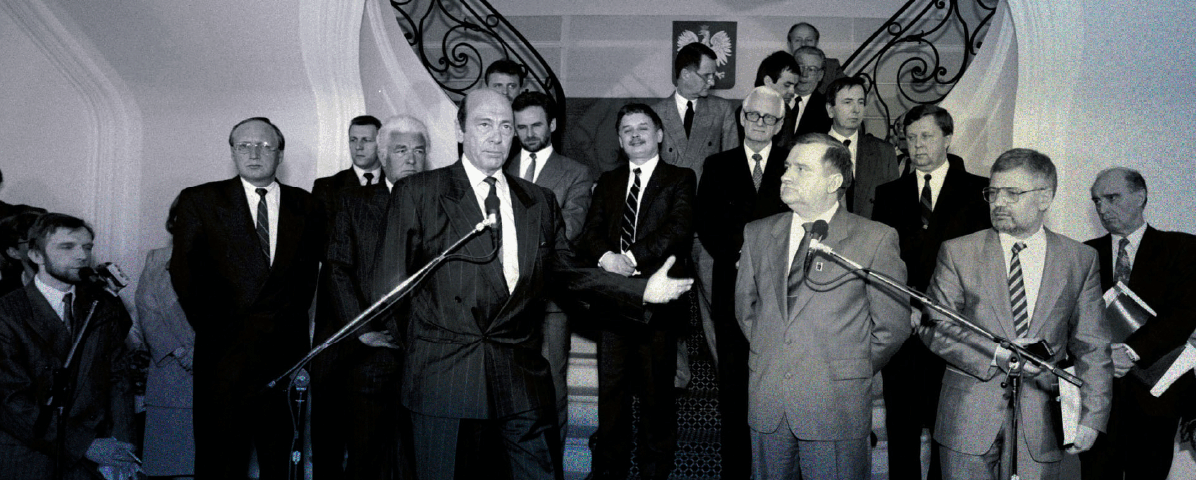
Image: Visit by NATO Secretary General Manfred Wörner (at microphone, left) and Polish President Lech Wałęsa (at microphone, right) to the Polish Embassy in Brussels, Belgium, 3 April 1991. (NATO)