 A Nation Must Think Before it Acts
In Conversation with Jakub Romaniuk | Poland’s Domestic Dynamics and Defense
A Nation Must Think Before it Acts
In Conversation with Jakub Romaniuk | Poland’s Domestic Dynamics and Defense

A nation must think before it acts.

In Conversation with Jakub Romaniuk | Poland’s Domestic Dynamics and Defense

The following conversation was recorded on September 22, 2025, and has been edited for clarity. You can listen to the conversation here.
Natalia Kopytnik: To get a sense of the current environment in Poland I am speaking with Jakub Romaniuk, FPRI Fellow and Programme Director at the Warsaw based Foundation Institute for Eastern Studies, the organizer of the annual Economic Forum, a leading platform for dialogue in Central Europe for over thirty years.
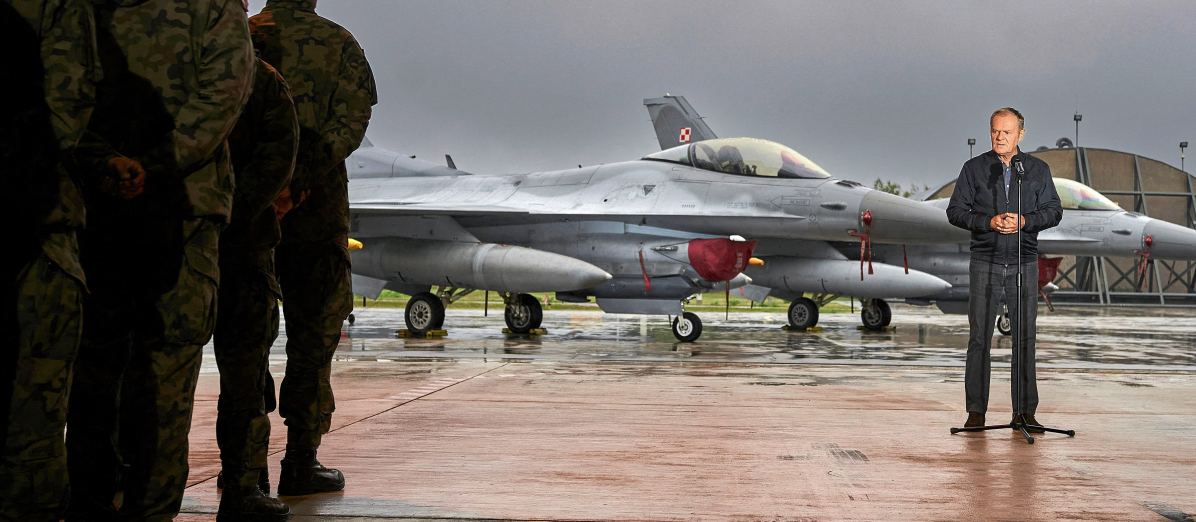
We are talking today, September 22nd. It’s been about two weeks since twenty Russian drones entered Polish airspace and NATO jets had to scramble to shoot a few of them down, which prompted Poland to request the activation of Article 4, which mandates consultations among member states if any of them perceived a threat to their territorial or integrity.
Polish Prime Minister Donald Tusk has said that this is the closest we’ve been to open conflicts since World War II. Since then, we’ve had a drone incursion into Romania. We’ve had Russian fighter jets violate Estonian air space. And we’ve seen Poland closing borders during the Zapad exercises in Belarus. Tensions are understandably high in the frontline states specifically because it does seem like there is a greater realization that the hypotheticals are becoming a reality.
And I think in Poland specifically, that’s not really a surprise. Because Poland, the Baltic states, and other countries in the region have been quite vocal about the Russian threat far before the full-scale invasion of Ukraine in 2022.
I’m curious to hear from you, what is the sentiment domestically? Do Poles seem confident in NATO’s defense response? And do you think that these events will finally prompt more European leaders to adopt a wartime mentality versus the peacetime mentality that’s been the case up till now?
Jakub Romaniuk: Thank you, Natalia. The sentiment is certainly not positive. This was a very serious violation of Poland’s security, and everyone in Poland, as you said, is well aware that this was not an accident, but a deliberate act. It was just another provocation on the part of Russia. But of course, this causes justified concerns among the citizens about our security, about the future of Poland.
More and more often, conversations are filled with increasingly vocal questions about whether Poland is still a safe place. I talked with many of my friends, and they are also starting to think about maybe finding a second house somewhere in the western part of Europe or the southern part of Europe. Italy and Spain are becoming more and more available for people so they are still thinking about maybe having a second place to live in the future especially after the last drone incursions. So, the situation is serious I think. As you said, as Prime Minister Tusk said, we are a little bit closer to the war. Of course, we are not in the state of war but like Tusk said in the Parliament, the enemy does not hide its hostile intentions. And what is important, even though we see in the last weeks that Prime Minister Tusk and President Nawrocki have different approaches to foreign policy, they both agreed that the Russian provocation was nothing more than just an attempt to test our capabilities and our response.
Fortunately, the response that our authorities [gave]—well, they responded quickly in an appropriate manner. Also what’s really important is that our Allies in NATO responded very well, so as you said the jet fighters were really quickly in the air zone of Poland and they shot down these drones, so it was really important that everyone acted really quickly in the first few hours.
Of course, there was also some information about missing drones somewhere in Poland, so our authorities were searching for parts of the missing drones in different parts of Poland, but everything was quite safe. There was only one accident with the house because one part of the missile just fell on the rooftop. So fortunately, no one was dead or injured. Everyone, everything really ended in a good manner.
But as the president and prime minister said, we passed this test, NATO passed this test. We can also see this in the latest public opinion polls that were published two or three days ago. We asked the polls, “Do you believe that NATO Allies would help Poland in the case of aggression against our country?” And 57 percent responded yes. Only 26 percent responded no, and 17 percent had no opinion on this matter. It’s important that people believe that NATO is still there and is working well, which we could see during the joint incursions.
So, it is important to have these Allies with us especially since we are at the border of war in Ukraine and a close border with Belarus, where the new project of the East Shield is.
We are trying to be more and more aware of the potential aggression from Russia and from Belarus. Also, in the same public opinion polls there were other questions like, “How much trust does the Polish society have in NATO?” And we got a very positive answer because 76 percent of Poles all trust in NATO. This is almost 2 percent more than last year, but the peak was in 2022, which cannot be surprising for us—it was at the level of 82 percent, but it’s still really high [now].
It’s good that people in Poland still believe in NATO and our Allies, as they do in our Polish army. The trust in the Polish army is at a level of 94 percent and is the highest ever. So, it’s important that we see not only NATO as a guarantor of our security, but also the Polish army—which is, of course, a part of NATO—as securing our future in Poland. So this is something really, really important in these uncertain days.
NK: You mentioned the different kind of approach in rhetoric of Donald Tusk versus President Karol Nawrocki.
I think it’s important to have a little context on what’s happening domestically in Poland when talking about the country’s role in NATO, especially in the context of heightened security concerns.
You recently wrote an article for FPRI analyzing the 2025 presidential election, which resulted in the victory of Karl Nawrocki over Rafał Trzaskowski. Nawrocki ran as an independent candidate, but he was obviously backed by Law and Justice, which is, of course, the ideological opposite of Prime Minister Tusk’s coalition government.
As you pointed out in your article, Nawrocki has a history of controversy, controversial statements, controversial activities, and he’s kind of followed the Law and Justice tradition of weaponizing historical cultural differences between Poland and Ukraine. He’s also found a bit of a kindred spirit in President Donald Trump. He got an endorsement during the campaign from Donald Trump and met with him recently in DC. It seemed like it went well because he at least got a verbal commitment to retain US troops in Poland, if not potentially increase them.
So it feels like from a foreign policy perspective, Poland is at an interesting time because you have the coalition government—Tusk, Radosław Sikorski, the foreign minister—in one camp, resetting relations with the EU, but then you have President Nawrocki on the other end of the political spectrum, kind of maintaining this friendship or at least good relations right now with Donald Trump.
What’s your take on all of this? Is there potential for Poland or Europe to benefit in this relationship Nawrocki has with Trump, at least to reaffirm or continue to reaffirm American security guarantees on the continent?
JR: Well, I really hope, because there was an image during the campaign of some kind of friendship between Donald Trump and Karol Nawrocki.
Of course, when we look at the campaign, we can see some similarities to the American campaign. The idea of Donald Trump as a president was somehow translated into Polish ground in the posture of Karol Nawrocki. So he was made into a kind of similar candidate as Donald Trump: an independent, solid, strong candidate who will be the best option for the times of war.
This is one of the reasons why he won. People wanted to have a strong president during the times of war in Poland. But the problem is that the president does not create the foreign policy in Poland because the government does it. So the Minister of Foreign Affairs Radosław Sikorski and Deputy Prime Minister Władisław Kosiniak-Kamysz, also the Minister of Defence, and of course, Prime Minister Donald Tusk are the most important figures when it comes to the foreign policy and security.
But the problem is that the president of Poland is the Chief of Staff of the Polish Army. So, we have two very distant positions inside of Polish politics, and they have to act together to find a balance and to find one common language to speak to the other countries to help not only Poland but also, of course, Ukraine. And the problem is that Karol Nawrocki in the past wasn’t the biggest friend of Ukraine. He was using our past and problems with the Polish citizens in Ukraine and Ukrainian counties and at the Ukrainian border to gain some of the votes during the campaign from the far-right voters. This is a problem. Fortunately, since he became president, he hasn’t said a word about our past, about Ukraine, and about these relations. I hope it will be the same way in the future.
And right now, there are some major problems. Thinking about the past between Poland and Ukraine, we know that we have to help Ukraine. This is the first thing we have to do. I really hope that Karol Nawrocki and the potential good relations with Donald Trump will help us be an important part of the transatlantic relations and also European security.
On one hand, of course, he was invited to DC and they had some meetings. Right now he will be speaking at the United Nations. It’s good that he’s there. But then we saw at the last meeting in August concerning European security and the war in Ukraine that Donald Trump invited some European leaders from Germany, France, NATO, Italy and other states, but there was no place for Poland. So, the question is is there really a good relationship or some kind of friendship between Donald Trump and Karol Nawrocki or not? Was it only for the campaign? So we don’t know yet what will happen in the future, but I really hope that being on the same side of politics as Donald Trump will help Poland to be there and that the Polish voice will be heard in Washington, DC.
NK: And, to some degree, what Donald Trump says and what Donald Trump does are often two very different things because earlier in the spring, there was talk of reducing the amount of US troops in Eastern Europe by, I think, 10,000. And now he is in all offices saying we are committed, we might send more.
But talking about defense and troops’ presence, obviously in Europe, there has been a lot of discussion about increasing defense capabilities, increasing defense spending.
But there’s also been a debate internally in many European Allied states about increased defense budgets versus social spending budgets. Some countries like Spain have basically said, “We’re not going to try to meet the threshold NATO has agreed to at the Hague summit,” which is 5 percent of GDP over the next decade. Now, Poland is obviously at the top of the list of dispensing. I think the goal is 4.7 percent by the end of this year, next year.
JR: This year.
NK: So it’s the highest in NATO, higher even than the US. In your view, are there political actors, parts of society that are willing to question this increasingly ambitious defense spending vision?
Are there voices in opposition to it? Are there any voices that are arguing to attempt to repair relations with Russia? It seems like a stretch for obvious historical reasons, but the Kremlin disinformation campaigns are inevitably going to be working in overdrive to exploit what little sentiments exists to exacerbate tensions potentially between Allied states, between Poland and Ukraine, and so on.
Is there any portion of Polish society or political actors that is vulnerable or susceptible to this kind of manipulation, these kinds of narratives?
JR: Fortunately, our history taught us that we know one thing, that you can never ever trust Russia.
All our worst nightmares in our history were somehow connected to Russia. So we know that they are trying to find new hostile attacks in some kind of cyberspace disinformation. Also, apart from the recent drone incursions, there were a series of diversions: They set fire to the different warehouses and production facilities during the last six months in Poland. And we know that they were all caused by the Russian influence. They just basically found some young people here from different countries that were willing to get some money and they just put fire to warehouses.
Russia wants to grow concerns among the Polish citizens. But I think that our history taught us that we can’t be so vulnerable when it comes to Russian aggression. We don’t want to have Russia as a neighbor, but we do. So I really don’t think that there is anyone in Poland who really thinks that in the future there will somehow be a scenario where Poland and Russia or the Western world and Russia will act together.
I think also the other problem now is, speaking about President Nawrocki’s foreign policy, he wants to reinvigorate the V4 format. So, we have the Visegrad group with Poland, Czechia, Slovakia, and Hungary. The problem is that it is not V4 anymore. I would say it’s like V2 plus 2, because it’s Poland plus Czechia who want to support Ukraine, and we have Slovakia and Hungary that are slightly pro-Russian countries in Europe, they still have their gas and fuel from Russia.
I would say that in Poland, we are really well aware that we can do anything with Russia in the future when it comes to spending on defense. I think right now in Poland, no one is asking why we are doing it. Also the situation, the events like the recent drone incursions, show us that this is a necessary step in planning the budget of the country.
So, there were a lot of topics that this government, in the last campaign when they won last election, promised: like, for example, affordable housing, the new abortion law, and the other social, new solutions to propose for Polish society. But right now everyone is aware of the war that is taking place in Ukraine and of the Russian aggression. So no one is asking why they want to spend 5 percent of GDP for defense.
I think it’s good. Also, a lot of people are appreciating that we are a leader in something and a leader in defense spending. We are number one in GDP spending on defense in NATO. It’s more than twice the NATO guideline, which is 2 percent. Also, the new 5 percent by 2035 proposed at the Hague Summit was a Polish proposal. So Poland wanted everyone else to spend more. The question is if everyone needs to spend the same percent of GDP. I spoke to General Vincenzo Camporini, who is a former chief of staff of the Italian army, and he said, “Yeah, it’s a good idea, of course, but maybe we should think about what each country can propose and can give the others to enhance European security.” Because, for example, spending 5 GDP in Poland is crucial, but is it in Spain, in Portugal, in Italy? We don’t know that. So, maybe there are some other solutions they can propose so that together we can build a better security system in Europe. We have to think about it.
Also, in all these meetings with President Donald Trump and European leaders about European security, we have to think what we can do together. Because it’s really easy to say “Okay, everyone will spend 5 percent, pretty safe.” But then on what are we spending? Poland is also a leader in spending this money, so more than 50 percent of this 5 percent GDP, which is approximately $38 billion, we spend on the modernization of the Polish army. That’s what we need.
Of course, there are other armies that don’t have to buy modern equipment, munitions, etc. We have to, so that’s the question: What are the needs of each country? And then when we put everyone together in the same spending target, it’s not really the best solution.
NK: Going back just briefly to the question of history, which, of course, one cannot talk about Poland without talking about history.
If there is obviously little danger of any faction of Polish society being susceptible to Kremlin narratives about questioning defense spending, things like that, do you see that there is more potential for exploiting divisions between Poland and Ukraine and kind of facilitating, encouraging Poles, to grow weary about supporting the war effort as it enters its fourth year?
JR: Yeah, definitely. And I think that, unfortunately, we can see it. A few months ago there were other polls that showed that, unfortunately, relations between Poles and Ukrainians, who are residents right now in Poland, are not really good. So, for example, a lot of people from Ukraine are talking about some kind of aggression towards them from the Polish citizens. I think it’s also caused by the implications of the social dynamics and also the economy, even though the Ukrainians and especially the Ukrainian refugees have a great input to the Polish economy—right now it’s almost 3 percent of the GDP. It’s really a huge impact that they have on the Polish economy and it’s great that we have them with us.
Of course, there are some problems that they are not always able to find the proper job for them. They’re really well qualified, but they are taking the jobs from the lowest level. It also helps the Polish economy because we don’t have a problem with our unemployment. So, it’s great. But also, there is a lot of disinformation, as you said, and also far-right parties are using these facts—well, they’re not facts, they’re disinformation—to gain more votes in the future elections in one and a half years.
NK: Alternative facts.
JR: It’s scary, really, because the problem is that we have 1 million refugees from Ukraine in Poland. But in total, we probably have approximately two million Ukrainians in Poland. That’s a lot. And we have to coexist and we have to live together. They are our neighbors. I saw something great in the first few months, in the first year of the war in Ukraine. Everyone was helping Ukrainians. Everyone wanted them here. But right now, people are a little bit tired of war and they’re also tired of having war everywhere. They turn on the TV, and all the news on the internet everywhere is war, Ukrainians refugees, and other things related to the Russian aggression. They started to think “They are here, but they have to work, they have to be at the same level as we are,” because there were some concerns, even though they were not real, that Ukrainians had some better solutions in healthcare, some better proposals for kids to go to kindergarten, and [more favorable options] for school. But it wasn’t really real. They just received the same treatment that we have here in Poland. So, there are definitely some parts of the society that don’t want to have Ukrainians with us, and probably all the parts that are voting for the far-right parties. They are really of the same view of Karol Nawrocki, as he stated a few times about the genocide of the recruit Ukrainians at the Polish border in Volhynia. So, yeah, they’re using all these alternative facts to gain votes for the next elections.
But the problem is that there is a major concern about the future of Ukrainians in Poland. Also, when I speak with my friends from Ukraine here, they also say that sometimes there are problems. For example, now in our underground, in trains, in buses, people are not as positive towards Ukrainians as they were two years ago. We unfortunately can see some tensions. Fortunately, they are not at a high level right now.
But I think that we need some new kind of media campaign from the government, just to explain that it is good that we have Ukrainians because they help our economy and also that they are, like the British, the same nation as we are, so we can coexist together here in Poland. That would be really great. I really hope we’ll have a better solution quickly.
NK: The reason we started this podcast series last year at FPRI was kind of in the background of the 75th anniversary of NATO and of reflecting on the Alliance as a whole. So, I wanted to ask you a little bit about how you see Poland now, 26 years in the Alliance.
When I was doing a little bit of reading about this, I found this great quote by Polish President Aleksander Kwasniewski. He was speaking in Washington in 1999. It was the 50th anniversary of NATO’s founding, and it was shortly after Poland’s accession. He said, “for the Polish people, NATO’s existence has always been a sign of hope: the hope of saving freedom and democracy in a Europe divided until 1989. The hope that the Iron Curtain would not last forever. The hope that as soon as Poland was able to determine its fate, it would take part in the creation of a better future for itself and for the whole of the European continent.” And he said, “the dreams of our fathers and grandfathers have now come true now.” Arguably, 1999 was, depending on how you look at it, not that long ago. Certainly the memory of this moment is still living in several generations in Polish society.
Do you think Poles today still see the Alliance through that lens of hope? And does the relative novelty of belonging to NATO, at least compared to the American experience of being a founding member back in 1949, explain why Poland has been so ambitious in its defense vision?
And then lastly do you see that belonging to NATO and institutions like NATO has become a kind of a core element of modern Polish identity?
JR: Yeah, definitely. So I think it was a really, really important and groundbreaking event because we can see that the fall of the Berlin Wall and the dissolution of the Warsaw Pact, after the end of the Cold War, opened up the possibility for further NATO enlargement. It was something unthinkable before. If you could ask anyone in 1989 to have countries from the Warsaw Pact standing together with the Allies from NATO, it was surreal.
So, it was a groundbreaking experience, I think, and it was great. It was planned for the 50th anniversary also—really, really a fantastic idea. So in March 1999, the former members of the Warsaw Pact joined NATO: Poland, Hungary, and Czechia.
For our part of Europe, it was a fantastic experience. As you quoted Aleksander Kwaśniewski words, this is just what NATO was for Poland. It was also the final step of the democratic transition in the ‘90s, because of course, in ‘89, we just became a free sovereign country, but it took four years to become a Western country.
It was the last step to become a part of the Western civilization. We didn’t want to be a part of Eastern Europe or Russia’s area of interest anymore. So that’s why we joined NATO.
I remember it was really important. I was ten at the time, but it was a really important thing, and I remember everyone was really happy. Finally, we were becoming a part of the Western world. The same was five years later when we joined the European Union. So, last year we had two great anniversaries: 25 years in NATO and twenty years in the European Union. Right now when you ask the polls, as I showed you in the recent public opinion polls, no one can imagine Poland without NATO, without the European Union. This is just kind of a normal thing for us that Poland is part of these organizations and everyone wants Poland to be there still in the future. There is no question about this and everyone wants to be a part of this. NATO is still one of the pillars of Polish security.
Right now, we are trying to be one of the leaders of NATO, especially when we see the center of gravity going towards the eastern flank. So, Poland is becoming more and more important, not only as a member, but as one of the leaders of NATO. And I really hope we will be able to stand as one of the leaders also in the future.
I can also say that Poles really believe in Article 5. Let’s hope we won’t have to check if it will be working well. But yeah, everyone in Poland is always saying that: “We have Article 5. We are in NATO. So we are safe.”
NK: One thing that I wanted to ask all the guests of this season of the Ties That Bind is, and you touched upon it in your previous response, how they view their country’s contribution to NATO. In what area do you feel Poland is a leader in NATO?
JR: I think definitely in defense spending. We spent 4.7 percent of our GDP this year, and the ambitious plan is to spend 5 percent next year. They were spending at the level of 4.2 percent in 2024. So we can do it. We can be at the level of 5 percent next year. This is our ambitious plan. And I think it’s great, even though we can, of course, speak about if it’s important for everyone to have this 5 percent GDP of defense spending. But for us, it is really important and it’s great that we can be a leader in some ranking, especially in an important organization such as NATO. So I would say this is the first thing.
The second thing, as I mentioned before, is [that we spend] more than 50 percent on the modernization of the Polish army. This is really important. And also, we are the fastest growing army in NATO. Right now we are in first place. So of course we will not be, never probably at the first place when it comes to the military personnel numbers, but we are in first place only behind the United States and Turkey.
And what is important right now, our army is at the level of approximately 220,000 soldiers. And for comparison, before the Russian annexation of Crimea in 2014, it was approximately 100,000. It more than doubled in ten years. It’s great that we can contribute in that way for our joint security.
Also, approximately 70,000 soldiers from Poland took part in different missions of NATO. We were really active from the beginning, also before, because we also sent out our troops to former Yugoslavia. So, yeah, we are trying to be an active member in all options that we have.
Also, Poles are really good at training. We have really good specialized military personnel that are training a lot of them, not only Ukrainians right now, but also soldiers from other countries. So that’s something that we are really proud of here in Poland.
NK: I think that also shows that Poland’s leadership goes into strategic thinking, because like you mentioned, the troop levels in 2014 with the annexation of Crimea, how much it’s changed—clearly, Poland has been thinking about this threat, thinking about the future for far longer than other Europeans, Western Europeans. It wasn’t until 2022 that it was really a wake-up call that things need to change, that things might not be great.
So my final question goes back to your article about Polish domestic politics. You concluded the article by saying that basically every country has its major and minor problems internally, whether it’s Poland or the US. And you cited Bruce Springsteen quoting James Baldwin, and you said the quote from James Baldwin was, “In this world, there isn’t as much humanity as one would like, but there is enough.” You kind of said that we should think about believing in people, believing in citizens because they are the center of democracy. And I think part of that belief also comes from just understanding our fellow human beings, their context of how they see themselves in the world, their experiences, and how that informs their decision making processes.
And that is kind of on par with the theme of this season, which is to create a little bit more understanding about the context of where NATO Allies find themselves and how they think about their own security. So to that end, I want to ask you, what would you like Americans to understand both about Poland’s role in securing transatlantic security and why preserving the Alliance is so critical?
JR: I think that Americans should understand that just as it is impossible to talk with Russia about Ukraine without Ukraine, it is also impossible to talk about European security without Poland. As we mentioned before, being at the border of NATO and also of Europe, so being the last safe barrier of the Western world, protecting them from Russia is really crucial. And for Poland, it means that we are increasingly important in security worldwide.
Because, of course, like in the United States, you can think about Russia, about something that is a threat for some people in Ukraine, in Poland, in the Baltic states. “OK, but it doesn’t concern us.” But of course, thanks to globalization and all the other processes in the history of our world, we know that everything is connected. So the bigger area of interest of Russia can be a threat also for the United States and the whole Western world. So, we don’t want to lose this war in Ukraine. It’s extremely important to have Ukraine as a sovereign country, as a democratic country with a democratic government. And it’s really important that we look all together at Russia as the most important threat for all of us, not only here in Europe, in Poland, but also in the US.
I would just like Americans to understand that it’s a really, really real threat for everyone, and also that a strong and secure Poland is essential to guarantee not only Ukrainian security, but also European security. [It also comes to] American security when [we discuss] for example, the economy.
Of course, we can speak about tariffs and all these different approaches to different countries and parts of the world, but still we can see that Europe is one of the biggest partners in trade with the United States. So it’s extremely important to maintain good relations with Europe. And what is right now the most important for Europe is, of course, safety. We know that after the conference in Munich, there were some concerns about the American approach towards European security, but I can assure all the Americans that all the Europeans still believe in the strong transatlantic relationship and that our friends from the US will help us when we need you. It will be great that we just continue really good collaboration between our countries, especially here in Poland with this great tradition of bilateral relations.
And as I said before, there should be no situation when we are speaking about the security of Europe without Poland at the table. We would like to be there always when it comes to the terms of speaking about the security of Poland, of Europe, and of course, of Ukraine.
NK: Thank you so much, Jakub, for all of your insights. Definitely a lot of food for thought. Thank you for sharing with us thank you for joining me today on The Ties That Bind.
JR: Thank you so much, Natalia. It was a pleasure.
Image credit: Polish service members listen as Prime Minister Donald Tusk stands in front of F-16 fighter jets as he holds a press conference regarding the threat posed by Russian drones in Polish airspace at the 32nd Tactical Air Base in Lask, about 30 km south-west of Lodz, Poland, September 11, 2025. Agencja Wyborcza.pl via REUTERS